Pages

google analytics

Showing posts with label Faith in the Face of Empire. Show all posts

Thursday, April 3, 2014

Faith in the Face of the Empire – The Geo-Politics of the Middle East


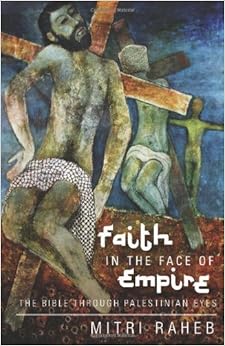
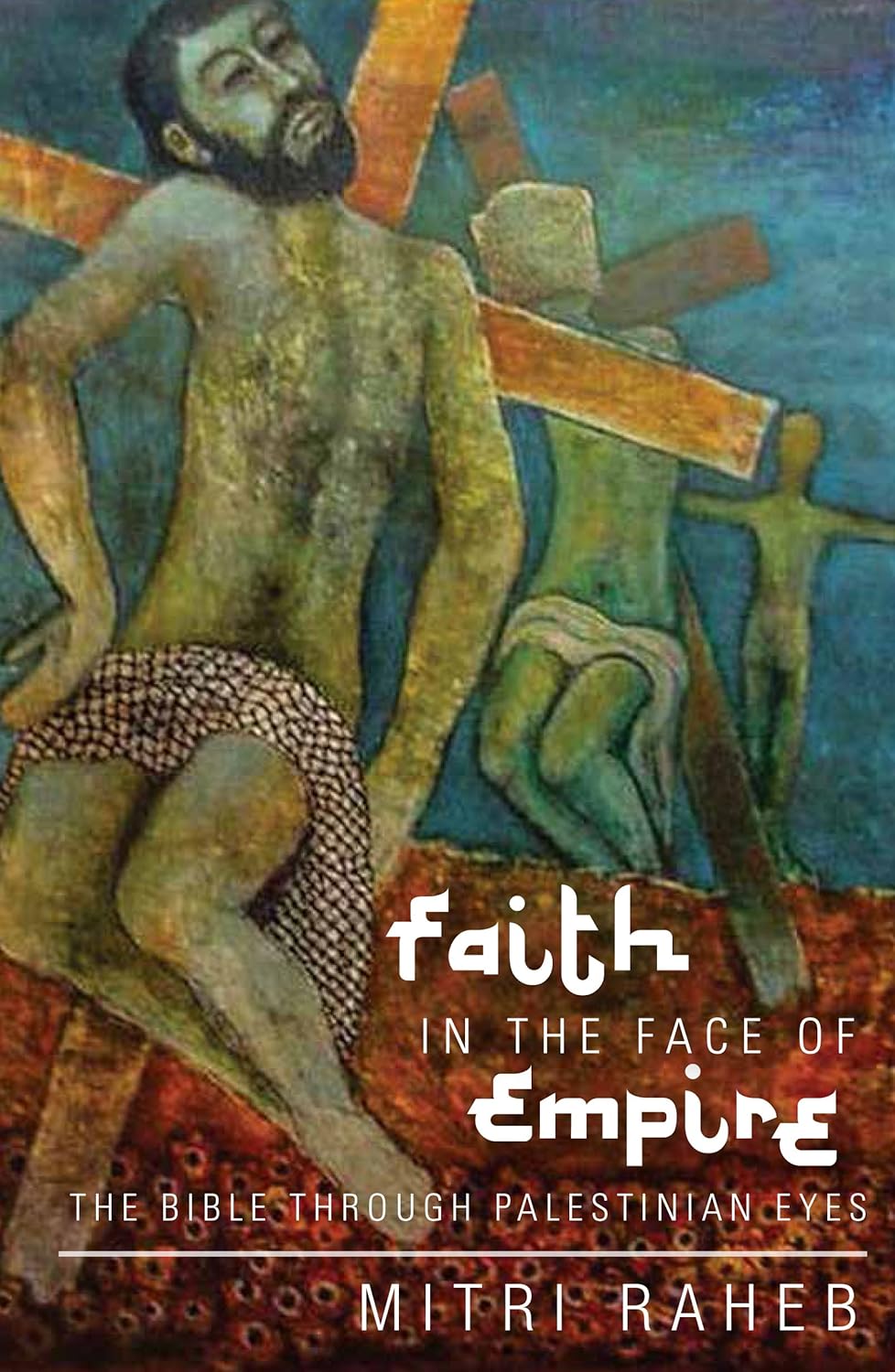
Chapter Three (“The Geo-Politics of the Middle East”) of Mitri Raheb’s book Faith in the Face of Empire: the Bible through Palestinian Eyes is brief but very necessary.   Maybe it starts to feel like a lot of preparatory work – the book’s title, after all, is about the Bible – and three chapters into it we’re still not to actually reading the bible yet. 

First – keep in mind that this is a short book, 166 pages – including the index. These chapters are brief.  But – Second – they are a necessary corrective against a long history that has ignored the concerns and viewpoint of the Palestinian people.  If Raheb spends the first few chapters reorienting (pun on purpose) us, it isn’t because he’s stalling. 

The chapter begins with a question: What do we mean when we say the ‘Middle East?’  “middle of where and east of what? (Raheb, 43) [i]  The term is a holdover from a European colonial understanding of the world – from a time when Europe was at the height of its imperial power (43).  The colonial past plus the imperial present are part of the equation that accurately describes the Middle East (44).  It is impossible to understand the situation without keeping this in mind.

In the past the region of Israel / Palestine has been controlled by 1 of 5 power poles – “albeit with different names, constellations, and degrees of power (46),” - Mesopotamia, Egypt, Persia, Turkey and Europe.  And quite often the region was under the influence of more than one of these powers as they were fighting for ultimate control.

The situation today is a little different – the power poles (as Raheb describes them) are 1) The United States, 2) Israel, and 3) Oil (that is, “Saudi Arabia and Qatar, thanks to the influence of the petro-dollar (47).”

What do we mean when we say “Middle East”?  Middle of where, east of what?  Who is in control? Who has the power?  Who is exerting the influence fiscally and militarily?  These are questions that we need to keep in front of us as we approach the bible.


[i] Raheb, Mitri, Faith in the Face of Empire: The Bible through Palestinian Eyes, Orbis Books, Maryknoll, NY, 2014.

Faith in the Face of Empire: Dispelling the Myth of Judeo-Christian Tradition


Hermeneutics is the art and science of the study of theology and the practice of interpretation. Hermeneutics is an art that requires creativity and imagination, and it is a science that requires sound methodologies.  But the art and science of hermeneutics is not neutral.  The second chapter (“A Prelude to a Palestinian Narrative”) of Mitri Raheb’s bookFaith in the Face of Empire: the Bible through Palestinian Eyes lays out a brief history of the way that Christian hermeneutics in Europe and America in the years since World War II have been used to support the occupation and oppression of Palestine.

Though it is the nation of Israel that currently occupies Palestine (the latest in a long history of occupiers), Raheb says that Israel couldn’t do this without the support (both in hardware – that is military equipment and technology and financial support, and in software – that is the culture, and narrative of theology, the hermeneutic) of the larger western world (Raheb, 24)[i]  Theologians in Europe and America have provided a “myth of Judeo-Christian tradition” that allows Israel to occupy and oppress Palestine and its people without moral or ethical consequence.

This hermeneutic operated by consistently interpreting scripture in such a way as to dismiss and diminish the Palestinian people.  “On the one hand, we are viewed as the Canaanites or the descendents of Ishmael, which means theologically we are inferiors and politically second-class citizens.  Ishmael then gets connected Arabs, and Muslims, who are viewed with an Orientalist lens, and, after 9/11 with fear and hatred as well.  On the other hand, our history, our roots, and our presence in the Holy Land are glaringly overlooked so that we become aliens and strangers, and this by divine order (38).”

However, this state of affairs is changing, says Raheb.  For the first four decades after World War II and the establishment of the state of Israel in 1948, Palestinians may have lost their voice but beginning in the 1980s with an increased interest in post-colonial studies they began to assume the responsibility for making changes, challenging the dominant culture, and questioning that omnipresent myth of Judeo-Christian tradition (27). 

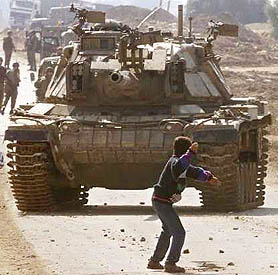
He also credits the first Intifada (“Uprising”) in `1987 for drawing the world’s attention to flaws in that narrative.  The world saw the brutal response of Israel to a (mostly) non-violent movement and the blinders began to fall away.  How can we reconcile the story of little David (Israel) fighting the giant Goliath (the Arab world) to the pictures of a young Palestinian boy with a stone in his hand facing a high-tech Israeli tank? How do we reconcile the memory of the Jewish people as the victim of persecution with the way the state of Israel victimizes the Palestinians (30)?

Raheb also notes the voices questioning this legitimizing myth from outside Palestine – Jewish theologians  like Shlomo Sand of Tel Aviv University who describes the way  “the concept of a Jewish homeland was invented by evangelical Christians together with  Jewish Zionists to facilitate the colonization of Palestine (33),” and Christian theologians like Walter Brueggemann who unveils the “national Israeli agenda behind the religious packaging (35).”

It is a brief chapter (in a small book) but it does much to disturb.  We cannot blindly and unquestioningly accept a hermeneutic that allows the dehumanization of the Palestinian people. 


[i] Raheb, Mitri, Faith in the Face of Empire: The Bible through Palestinian Eyes, Orbis Books, Maryknoll, NY, 2014.

Wednesday, April 2, 2014

Faith in the Face of Empire – The Longview of History


I’ve just begun reading the book Faith in the Face of Empire: The Bible through Palestinian Eyes by Mitri Raheb. [i]  I plan to blog my way through it. 


Raheb is a Christian, an academic, and a Palestinian, writing to present a Christian “theology from and for the Palestinian context (2).”    Maybe this breaks the stereotype we’ve been presented – that all Palestinians are Muslim. (They are not. Some are Muslim, some Christian; some are even Jewish and some are agnostic/atheist) or that all Palestinians are terrorists (this is in no way true.)

The Palestinian story according to Raheb is a long story, one of nearly continual occupation. “Such occupation is the defining feature of our history, beginning with the Assyrians (722  BC), the Babylonians (587 BC),  and the Persians (538 BC), followed by the Greeks (333 BC), the Romans  (63 BC), the Byzantines (326), the Arabs (637), the Crusaders (1099), the Ayyubids (1187), the Tartars (1244), the Mamluks (1291), the Mongols (1401), the Ottomans (1516), the British (1917), and the Israelis (1948/67), to name just the major occupiers (4).”

What strikes me immediately in this brief account of such a long history is that for the first half of it, Palestinian story overlaps the Jewish history.  Through the ebb and flow of history – the surging and receding of changing empires, the Am Haaretz – the “people of the land” have lived in that much contested area of the Middle East, surviving and outlasting empires. They have repeatedly changed their indenty and language in order to survive – now citizens of the Ottoman Empire, now British, now Israeli –  they have repeatedly changed their language – now speaking Aramaic, now Greek, now Arabic, - but they have remained.  “The Palestinian people … are a critical and dynamic continuum form Canaan to the present day.  They are the native peoples, who survived those empire and occupations, and they are also the remnant of those invading armies and settlers who decided to remain in the land to integrate rather than return to their original homelands.  The Palestinians are the accumulated outcome of this incredible dynamic history and these massive geo-political developments (13).”

But this will be contested, fiercely contested by some. Golda Meir (fourth Prime Minister of Israel) famously said, “There were no such thing as Palestinians. When was there an independent Palestinian people with a Palestinian state? It was either southern Syria before the First World War, and then it was a Palestine including Jordan. It was not as though there was a Palestinian people in Palestine considering itself as a Palestinian people and we came and threw them out and took their country away from them. They did not exist.” [ii]  

How can they have a long history to recount (and a history that overlaps the Jewish story) if they never existed?

As Raheb says, “Indeed, they [the Palestinian people] have been totally replaced by the Israelis, as though they never existed, and as if the land had been kept unpopulated or terra nullius (land belonging to no one) (19).”


[i] Raheb, Mitri Faith in the Face of Empire: The Bible through Palestinian Eyes, Orbis Books, Maryknoll, NY, 2014.
[ii] Sunday Times (15 June 1969), also in The Washington Post (16 June 1969)
Jeff Carter's books on Goodreads
Muted Hosannas Muted Hosannas
reviews: 2
ratings: 3 (avg rating 4.33)

Related Posts with Thumbnails