Pages

google analytics

Showing posts with label Epiphany. Show all posts

Sunday, January 5, 2025

Epiphany In Uncertain Times

Come now, visit and bless

this house, this home

with a gladness and glory unknown

in dark and desperate days


Show us how to rise up in splendor 

when darkness covers the earth

when thick clouds of satanic deception 

have taken control  and taken the soul 

of people I know and love


Come to make all things plain 

Come to make all things clear

here where our hearts throb and overflow 

with grotesque exaggerations 

and slow suffocation 


The global injustice

and domestic terror

the home grown police violence

of shadow puppets 

and selfish prophets

have obscured the stars of hope


Even so, the grace given to me 

is still a mystery

the light has dawned and the glory come

like justice a flower


Bless all who live here 

with the gift of your love

seeing and being seen

knowing and being known 


20+C+M+B+25


Thursday, December 15, 2016

Magi Follow the Star (Not the Shepherds)


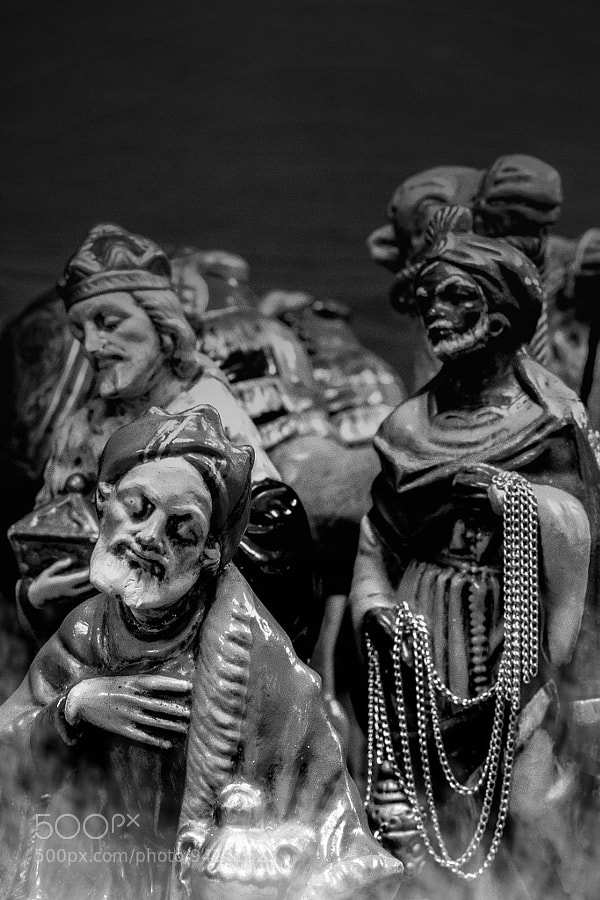
It's the magi - those Persian astrologers - that followed the star, not the shepherds.

Magi by Jeff Carter on 500px.com

Thursday, December 24, 2015

The Star Was a Sign (or I’m Going To Kick Your Aster)


The Star was an angel,
tumbling from the sky,
falling from Earth orbit
   in an uncontrolled burn
and landing in a well
in Bethlehem.

If you go there,
   they say,
you can still see him,
waving up from the water.

The Star was a gold covered icon, carried
   with all proper reverence
through the incense of
the sanctuary of the sky
by the Hallelujah chanting
host of heaven.

A comet, a meteor, a planet,
a conjunction of planets,
a meteor shower,
exploding bolides and supernovae.

The Star was an alien craft
strange and unknown;
   the Magi were abducted
by its occupants.

The Star was a sign,
a symbol, a story
of something greater than these.

Tuesday, December 22, 2015

The Magi on their Way

They won't arrive till sometime in January, but the Magi are on their way...

The Magi on the Way by Jeff Carter on 500px.com

Sunday, January 4, 2015

A Ghazal for a King


When those strange and exotically clad kings
came with naïve questions to great Herod king

asking, “Where is the newly born
bright star heralded young lad king?”

they shook and frightened the dark city
that feared and despised the old mad king,

but the soldiers did exactly as they were told -
following orders, even those of a bad king.

Now I ask you, Carter, tell me:
how does this serve Heaven’s glad king?


I'm trying out a new poetic form here (I think i'm growing tired of limericks, at least for awhile).  The Ghazal is an ancient form of poem from Persia / Iran /India.  It is marked by five to fifteen couplets, the first establishing a pattern and refrain which the following couplets echo in the second line.  The final couplet also usually includes a reference to the poet's name either in the first or third person.  The Ghazal usually deals with love and loss and melancholy and theological and metaphysical questions.  This is my first attempt at a Ghazal.   

Friday, January 2, 2015

Arise


All right. All right. Knock off the noise.
Can’t you let an old man sleep?
I’m up. Let me get the light, and I’m up.
Why the hell you come bangin’ on my door
                in the middle of the night, anyway?

Kings? Kings you say? Around here?
We don’t see royalty in these parts too often;
they breathe air more rare
than us down here in the shanties and the ruins,
and their feet tread ground
less soiled with shit and stain.

I’d just like to see them with their camels
stooping low through these close quartered alleys,
with steamer trunks filled with strange treasure.
What a thrill! What a sight!


All right, all right. I’m up;
in the middle of the night, I’m up.
Where is this light and glory?

(Isaiah 60: 1-6)

Tuesday, December 30, 2014

The Devotion of the Magi (Black and White)

Earlier I posted another version of this photo - a hyper saturated color version.  I like it in black and white too. I have already been reminded that I'm a few days early for epiphany, but I figure that if we can start Christmas in October, I can post these photos a week early.


Photograph The Devotion of the Magi by Jeff Carter on 500px

Thursday, January 16, 2014

A Servant's Hymn (A New Hymn for Epiphany 2A)


It's been a while since I last put my hand to writing a new hymn (or at least, new words for an old hymn tune).  Too long. So I'm back at it again. Here is a new hymn - A Servant's Hymn - based on two of the texts for Epiphany 2A: Isaiah 49: 1 - 4 and Psalm 40: 1 - 3.  It's sung to the hymn tune Titchfield composed by John Richardson (1853).

A Servant’s Hymn

I am Yahweh’s sharpened sword,
in the shadow of his hand;
like an arrow for my Lord,
sent to serve him in this land.
But my work is all in vain,
spent my strength with nothing gained;
yet my cause is with the Lord,
I will be at his command.

As I waited patiently
he turned to me, heard my cry,
and he came to rescue me
from the pit of mud and slime.
Then he made my feet secure,
gave me a song that will endure;
now the world my Lord will see
and on him they will rely.


In this arrangement there is a 4 bar introduction, then the melody is played through 3 times.  Feel free to use it as your own if you like it. You can download it here.


Tuesday, January 29, 2013

The Mystery of the Universe, the Mystery of Christ- Ephesians 3: 1 – 12


During Epiphany we consider the magi and the worship they brought to the newborn Jesus.  And like the Magi, I begin today with the stars.

The universe is a great big place.
It’s really huge.  And then some…

Light, we have discovered, travels at the stupefying speed of 186,282 miles per second.  Let me say that again: 186,282 miles every second.  Travelling at that speed it takes light a full eight minutes to travel from the sun to the earth.  If you’re quick with the math you could multiply that out the sun is 89.3 million miles from the earth.

Distances across the universe are so vast that they are measured in light years – the distance light travels in a year - approximately 5.9 trillion miles. 

Our own Milky Way galaxy is approximately 100,000 light years in diameter (100,000 times 6 trillion miles…) And the closest galaxy to ours is the Andromeda galaxy at 2.2 million light years away (2.2 million times 6 trillion miles…)

And that’s just a step into the incomprehensible distances of the universe.  It’s difficult to look out into the stars without feeling small, dwarfed into insignificance.

I look up at your heavens, shaped by your fingers,
at the moon and the stars you set firm,
what are human beings that you spare a thought for them
or the child of Adam that you care for him?

Psalm 8: 3 – 4

And yet…
It’s the mystery of the universe…
Why is there something instead of nothing?  And why is it such a stupefyingly enormous something?

The universe seems to be tailored to fit us; everything about the universe seems designed for life – intelligent life – to exist.   For example:  there is just the right amount of the chemical elements necessary for life and these chemicals posses the right properties for life to exist.  Physicist Richard Morris writes, “How is it that common elements such as carbon, nitrogen, and oxygen happened to have just the right kind of atomic structure that they needed to combine to make the molecules on which life depends?  It is almost as though the universe had been consciously designed…”

And again:

The strength of the four fundamental forces  - the forces that hold and bind the universe together – gravity, electromagnetism, and the strong and weak nuclear (not pronounced "nuc-u-ler") are set for the existence of life.  If the strength of any one of these forces were adjusted stronger or weaker, the universe as we know it could not exist.  The universe (if it existed at all) would be all hydrogen or all helium, or the stars would be unable to burn, or there would be no atoms at all.

And this is a very incomplete list.  There are many specific parameters in the universe set just right for us to be here marveling about the specific nature of these parameters.  The name given to this is the “Anthropic Principle.” 

The Anthropic Principle makes man the measure of the universe.  It measures everything in terms of us… and is probably very incomplete. What could we know of God’s mind in creation?   And yet… it seems that he has revealed himself to be a concerned deity – who provides for his creation, and not as a disinterested divinity who spun creation off to take care of itself.

And even more I wonder with the Psalmist…
I look up at your heavens, shaped by your fingers,
at the moon and the stars you set firm,
what are human beings that you spare a thought for them
or the child of Adam that you care for him?


It’s the mystery of the universe. Why does God take an interest in me?

All that we know or can know about God comes to us by revelation.  The Stars and the moon and the galaxies that we observe as we stare out into the sky without our increasingly powerful telescopes, all of this is Natural Revelation.  God has revealed himself to us in the marvels of his creation. He has revealed his concern for us in the many detailed specifics that exist in the universe that allow us to exist.

Yet there is more to God’s revelation than the natural. There is a supernatural revelation in the scriptures.  The books of the old and new testaments are not just another set of books… not just another bestseller.  How ever they were written, and edited and compiled, however they have come to us, we believe that the reveal something more than other books.  We believe that God has revealed himself to us through the words of scripture.

In this book we read about how humans were created to exist in community with God.  That our first parents were created innocent and pure and in that they lived in communion with God.  Man lived in and with God. 

But something happened.  Something broke that community.  Something broke the fellowship.  Something brought death.  It was sin; the willing violation of God’s standard, and it brought death and separation from God.

But this book also reveals that God wasn’t willing to allow that separation and death to keep us from him, and so he put into effect a plan that he had made even before creation.

Over thousands of years this plan unfolded, beginning slowly with one man, Abraham, who set out in faith for something he didn’t know and couldn’t understand… it grew and grew until it was a nation embracing a covenant with God.  This nation accepted the law of God’s character and promised to obey. They were to be a light to a dark world, drawing all nations close so that they might also know God.

They were marked and set apart from the other races and tribes and nations in order to reveal God’s character and God’s love.

But the plan wasn’t done.  The plan wasn’t just to create a nation.  The plan wasn’t to create a people of God that excluded anyone who couldn’t trace their heritage back to Abraham.

And so God went further and revealed himself through the incarnation.  Not a deity content to watch his creation spin out into chaos and death, he abandoned the glory of heaven to be born in that squalid cow stall.  He became one of us so that death and separation could be destroyed and the living fellowship and communion with God could be restored.  He became as we are so that we might become as he is.

And it was this that the magi saw when they knelt in that home in Bethlehem. And they were welcomed by God. 

Now, the thing is, by the time of Jesus the idea had settled among the Jews, that God’s plan included only them; that they were THE CHOSEN PEOPLE.  They were God’s specially selected people, and that as such they enjoyed special promises from God and a special relationship with God.   And it’s true; they did. 

But it wasn’t for them alone.

The magi who came to worship Christ in Bethlehem would not have been welcomed.  They were foreigners.  They were gentiles.  They were unclean. They were dogs.  They would have been sent away.  The magi who came to worship Christ in..Bethlehem.. would have been excluded from worship in the Temple in Jerusalem.

Paul wrote the letter to the Ephesians during his imprisonment in Rome on charges stemming from the allegation that he had brought gentiles into the Temple.

It was a big deal, this division between Jew and Gentile. 
But Christ undid it.  And Paul preached it.

Paul unapologetically preached it everywhere he went – that in Christ all are welcome.  This is the mystery of Christ.

…the mystery of Christ, which in other generations was not made known to the sons of men, as it has now been revealed to His holy apostles and prophets in the Spirit; to be specific, that the Gentiles are fellow heirs and fellow members of the body, and fellow partakers of the promise in Christ Jesus through the gospel, of which I was made a minister, according to the gift of God's grace which was given to me according to the working of His power.

And that’s good news for us here, for the way to God that has been opened to us through the death and resurrection of Jesus of Nazareth is not restricted to one race.  The good news for us is that we have a share in the promises made to Abraham and his descendents.  Though I hate to sing it, the children’s chorus “Father Abraham” gets it right. Father Abraham had many sons and I am one of them, so let’s just praise the Lord.

This is the mystery of Christ; that all are welcome.  His Kingdom, his Church is universal.  Membership in the Israel of God is not a matter of national identity or genetic descent.  All are welcome.

This is the mystery of Christ, unknown in ages past, that we, that everyone can have boldness and confidence to approach God through Jesus, that we are restored and reunited to the fellowship and communion that was broken, that we can be resurrected from our state of death into the eternal life of God. 

Boldness to approach the throne?  I felt small looking out into the immensity of the universe, now I am undone.  That God would plan – in the darkness and stillness before creation – to make a way for me to come to him, come to him with boldness and confidence… what could I do to deserve this?

Nothing.
Nothing at all.
I am undone.

Paul considered himself the least of the apostles, the chief of sinners… PAUL the APOSTLE… who wrote the bulk of the New Testament… and I am, well I am, as I said

undone.

And yet…

The mystery of Christ is that I am welcome.  In spite of all I was before.  In spite of my sin. My death has been swallowed up, and I am emboldened. I am given grace to be bold before God. 

This is too much for me to understand.  But understanding isn’t necessary.  This is mystery, after all. The mystery of Christ.


Sunday, January 6, 2013

Our Gift of Myrrh - A Sermon for Epiphany


Epiphany properly begins in darkness.
 Arise, shine; for your light has come; and the glory of Yahweh has risen on you.
For see, darkness covers the earth, and blackness the people,
            but Yahweh rises upon you, and his glory will appear over you.
Nations will walk to your light, and kings to your rising brightness.
 (Isaiah 60: 1-2)

And the darkness began about 600 years before the birth of Jesus

The people of Israel had sinned.  They had displeased and disappointed Yahweh God, the Lord of heaven.  They had failed to keep their covenant with him. The holy people of God – his treasured possession – had become a kingdom of violence and bloodshed, of murder and exploitation.  So in the year 586 B.C. the Babylonian Empire led by King Nebuchadnezzar became the hammer of God and was used by God to smash the nation of Israel. What wasn't destroyed was carried away into captivity and slavery. 

A generation lived and died in captivity, but a remnant remained.  A remnant was preserved to return to Israel.  They were allowed to leave the land of their captivity and to make the journey back to the land promised to their fathers.  It should have been a time of rejoicing.

But it wasn't all celebration and dancing.  Though they had returned to their homeland, they discovered that you really can’t go home again.  It was all gone.  All that they remembered was gone.  They remembered the glory and honor of King Saul, and King David, and King Solomon, but now there was no king; there was only a puppet who answered to rule of the now dominant Persian Empire.  They remembered the marvelous temple built by King Solomon.  They remembered its splendor.  But now there was no Temple.  It had been pulled down by the Babylonian invaders.  And when the people of Israel had rebuilt the temple, the oldest among them wept at the sight of it because it was so inferior to the temple of their memories.

They were poor.  They were friendless.  They were broken and in despair. Their expectations had been shattered and they had no hope for the future. This was their darkness.  This is the situation of the people to which the prophet Isaiah spoke when he said:  “Arise, shine; your light has come.”  The prophet was speaking words of hope to a destitute people whose expectations had been shattered.  He was giving them a sign that the light would not be swallowed up by eternal darkness.

In addition to having a connection with the idea of light and darkness, this passage from Isaiah is associated with Christmas and with Epiphany because of the reference to the Kings of the east who come bearing gifts:

…the wealth of the nations [will] come to you; camels in throngs will fill your streets, the young camels of Midian and Ephah; everyone in Saba will come, bringing gold and frankincenseand proclaiming Yahweh’s praises.  (6)
There they are, right, the gifts of the magi?  Gold, Frankincense and …. Oh, wait.  Isaiah doesn't mention a third gift.  Isaiah doesn't mention Myrrh.

Gold, we know.  We recognize the value of Gold.  We understand what it symbolizes: it is wealth and royalty. It was a gift for Jesus our king.  Frankincense was the incense used by the priests in the temple, and symbolized the name of God.  It was a gift for Jesus our High Priest.  But what of myrrh?  
Myrrh – that third gift mentioned by Matthew – is an aromatic gum, the sap of a tree that grows in Arabia and Eastern Africa. The trees are cut with a knife; the sap oozes out and hardens into “tears” that are collected.  The tears of myrrh were sometimes crushed into powder and worn by women as an aromatic sachet.  Or the myrrh powder could be mixed with wine – this custom is, apparently a newly re-discovered fad in some up-scale clubs.  Wine mixed with myrrh was used as a palliative or pain killer – and was offered to Jesus as he was dying on the cross.

And this leads us to the main association of myrrh – death.  Myrrh, though quite expensive (at times valued more than its weight in gold) was commonly used in the embalming of corpses and burned to mask the stench of death.  Myrrh is a symbol of death and dying.

This is hardly a sign of hope.  And what kind of birthday gift is myrrh?  It was hardly appropriate.   Would you bring a pre-paid funeral package as a gift to a new-born?   And would this register to you as a symbol of Hope and Light and Glory? 

No.  The word “myrrh” itself is derived from the Hebrew word “marror” which is “bitterness.”  The hardened pieces of sap are referred to as “tears.”  This doesn't sound like Hope and Light and Glory.

Isaiah 60 is not strictly a prediction of Jesus’ birth, though the prophecy is associated by Matthew and the coming of the kings of the east with their gifts.  It is a message of hope, of dawning light into a world of darkness.  It is a promise that the people of God would not be left destitute and alone.  It is a promise that the glory of God would again dwell within the people of Zion. 

It is the promise of peace – peace both from external aggression and from internal sin and lawlessness.  It is the promise of security.  It is the promise of blessing; the blessing that comes from dwelling in the presence of God.

It is the promise of gold and frankincense… and though it isn't mentioned in Isaiah’s prophecy, it is the promise of myrrh.  God’s plan for his people was to bless them and give them the glorious light of his presence, but that promise included something difficult – the myrrh, symbol of death and bitterness and tears.

But why?  Why is there suffering?  Why is there pain?  Why did God send the blessing of his son, the glory of his presence knowing full well that Jesus would be arrested, tortured, and assassinated?  Couldn't we just have the promise as spoken by Isaiah, of eternal shalom?

No more will the sun give you daylight, nor the moonlight shine on you,But Yahweh will be your everlasting light,your God will be your splendor.Your sun will set no more, nor will your moon wane,for Yahweh will be your everlasting lightand your days of mourning will be over. (19 – 20)

Your days of mourning will be over? Really?  Can we read the story of the Magi’s arrival and their gifts and just leave off the myrrh?  Can we leave it out?   Can we read Matthew’s account of Jesus’ birth and leave off the desperate flight of the Holy Family to Egypt, the murderous wrath of King Herod, or the slaughter of innocent children?  Can we just leave out the “bad” bits?  No, that wouldn't be true. 

Well then, maybe we should say, as some do, that our light hasn't come yet, that these promises of light and glory, and salvation, and peace are still held in some distant future.  Someday, they say, all will be well and all will be well.  Someday, Jesus will come again and then everything will be put to right. We just have to put up with the darkness until then…

But, again, I say, no.  That’s not true either.  The Light has come. The glory of Yahweh has risen upon us. (60:1) The kingdom of light, and life, and glory, and peace – God’s kingdom – is here, now, made visible in the person of Jesus, who was born in Bethlehem and to whom the magi brought gifts of gold, and frankincense, and… myrrh.

Somehow we have to reconcile that God’s peace, God’s shalom, God’s glory involves pain. We have to accept that the splendor of the heavenly Jerusalem involves pain.  The plan for our salvation came at great pain to God himself.  The suffering and torture and despair that Jesus felt, was felt by God.  God suffered.  God suffered for us.  God suffered with us.  The myrrh that Jesus received from the magi was for our death; for our embalming.  Our pain, our death, our despair, is taken up while his glory, his grace, his love, his peace is brought down to us through his death and resurrection.
 The prophet Isaiah, speaking to the disheartened Jews who had returned from exile in Babylon, described the glory and splendor of Jerusalem.  He said to them:

Arise, shine out, for your light has come,
and the glory of Yahweh has risen on you.Look!  Though night still covers the earth and darkness the peoples,on you Yahweh is risingand over you his glory can be seen.
Though night still covers the earth, even though darkness still lays thick over the people who don’t know God, on you Yahweh is rising. His glory is shining on you and in you.

In the New Testament, John also received a vision of the glory and splendor of Jerusalem, the heavenly Jerusalem.  He described what he saw when he wrote:

I saw the holy city, the new Jerusalem, coming down out of heaven from God, prepared as a bride dressed for her husband.  Then I heard a loud call from the throne, “Look, here God lives among human beings.  He will make his home among them; they will be his people. And he will be their God, God-with-them.  He will wipe away all tears from their eyes; there will be no more death, and no more mourning or sadness or pain.  The world of the past has gone.
Then the One sitting on the throne spoke, “Look, I am making the whole of creation new.  Write this, “What I am saying is trustworthy and will come true.”’ Then he said to me, “It has already happened…”
  (Revelation 21: 2 – 6)

It has already happened?  What?  The Heavenly Jerusalem is here?  Within us?  Now?  What about the fact that we still hurt? What about the fact that we still cry?  Why are there still tears?  Doesn’t it say that God will wipe away all our tears?

Myrrh… tears….

I love that it says that God will wipe away all our tears.  It’s a special promise, not one to be discounted or overlooked.  But it’s not a promise for some far off distant future.  It’s a promise that is for us now.  The promise that he will wipe our tears away isn't a one time deal; once done and then no more.

When I hurt, when I am crushed, when I cry, God is there. Or, rather, God is here – with me – holding me, crying with me, and wiping away my tears. He is receiving them as a gift, just as he received the gold and the frankincense.  He is receiving my tears – my myrrh as a gift, and is giving me his grace, and love, and peace, and glory.

We exchange gifts at Christmas, and during Epiphany we remember the gifts that the magi gave to the infant Jesus: Gold – a symbol of his royalty, Frankincense – a symbol of his Divinity, and Myrrh – a symbol of his death, and our death. 

We've exchanged gifts with each other for Christmas.  Now, during Epiphany, let’s exchange gifts with Jesus.  Give him your myrrh.  Give him your hurt and your despair; your sadness and pain.  Give him your death – the result of sin.  And receive from him the splendor of Jerusalem – the Light of his presence, the glory of his kingdom, the peace of his love. 

Arise, shine, for the light has come..... 

A Blessing for Epiphany


On this day
as we celebrate the dawn,
as we remember the gifts,
as we worship the bright morning star,
may the True Light that gives life to the world
shine on us, and in us, and through us
to dispel the darkness
and to bring us joy. 

Thursday, January 3, 2013

How Shall I Rise in Brightness - A New Hymn for Epiphany

Yesterday I posted the short poem How Shall I Rise? - a poem trying to reconcile the "Arise, shine!" kind of joy found in Isaiah's prophecy (60:1-9) with the cruelty and horror of the slaughter of the innocents (Matthew 2:1-12).  These two passages are read together at Epiphany and seem, to me, to be a difficult and awkward (and maybe even inappropriate) juxtaposition.

Yet even after I finished writing the words kept knocking around inside my head - I could almost hear them being sung, but it took me a while to figure out the melody.

Well now I have, and after a bit of rewriting, the free verse poem I wrote yesterday, has now become a metered hymn:

How shall I rise in brightness
while mother Rachel weeps?
How shall I accept the gifts
of magi from the east?
O Lord of light and glory,
bright shining star of dawn,
bring light to those in darkness;
bring light to all our hearts.

This mystery of glory,
that joy and pain come mixed,
is like frankincense perfume
with bittersweet fragrance.
O Lord of light and glory,
bright shining star of dawn,
the myrrh that anoints in death
gives way to heaven’s gold.


It should be sung to the hymn Passion Chorale (O Sacred Head Now Wounded).

Wednesday, January 2, 2013

How Shall I Rise?


How shall I rise
to shine forth in brightness
while mother Rachel weeps?

And how shall I
accept the magi’s gifts
when her treasures are no more?

Let all mortal flesh, with her, keep silent,
let the darkness deep surround;
until the Lord of light and glory,
the bright shining star of dawn,
shall cover her with radiance
and lend to her his joy.

Friday, October 26, 2012

The Ideal King and the Transformative Power of the Gospel

I wrote this sermon four years ago.  I still stand by it.

***


The Ideal King and the Transformative Power of the Gospel
(Psalm 72)

 
My choice of text and topic this week was serendipitously appropriate; providentially guided, even.  I was, in my own little way and short-sightedness, working through the relatively simple idea of taking the weeks in January to explore the chapters of the Bible associated with Epiphany – mostly as a way to reconnect with the meaning and importance of the Christmas celebration and the Christmas event without the extraneous distractions of holiday shopping, illuminated reindeer, and the rest of the assorted tinsel and trimmings.

I chose Psalm 72 for today because I’d decided to expand the celebration of Epiphany through the whole of January.  So I consulted a lectionary for the “traditional” verses for Epiphany sermons and, instead of using them all in one sermon I spread them out through the month.   I used the first – Matthew 2 – in the first week, set the second – Isaiah 60 – for the second week and the third – Psalm 72- for the third week and etc…  But the moving of the Spirit guides us even when we’re not aware and surprises us with her provision.
What I discovered as I read Psalm 72 and prepared my notes is that while the Psalm (like all parts of the bible) had an original historical context and intent, it also has a special and continued relevance for us today; especially in light of tomorrow’s celebration of the life and martyrdom of Martin Luther King Jr. and Tuesday’s inauguration of our new president.

The depth of my admiration for Martin Luther King Jr. and the historic magnitude of Tuesday’s inauguration weighed on me as I deliberated on how to prepare this sermon.  I felt the weight of gravitas hanging over me- I felt the need to fit my words to the solemn magnitude of current events, because, as so many have already said, these are important and consequential times.  I wanted the few things I have to say this morning to fit the scale of importance, to sound in the right key.  I want my few fragile thoughts to transcend my own transience and to give expression to both the anxiety for the future that permeates our country, and the tremendous hope for the future that I feel.

And so this morning I turn our attention toward Psalm 72 – a psalm that was either written by or for King Solomon – the Hebrew preposition is a bit ambiguous and has caused a fair bit of debate… but either way – written by King Solomon or written for King Solomon, Psalm 72 is a prayer that the newly crowned king (whoever he was) would be a king after God’s own heart, an ideal king.  Psalm 72 is a prayer that the new king would rule in the justice and righteousness of God for the benefit of God’s people.

Psalm 72 is a prayer that the rule of the newly crowned king would bring peace and prosperity to the land and security to the borders.  Psalm 72 is a prayer that the justice and righteousness of God would be exemplified by the new king.  And maybe you begin to see why it is appropriate for this morning as we anticipate the inauguration of President Barack Obama. 

God, endow the King with your own fair judgment,
the son of the king with your own saving justice,
that he may rule your people with justice
and your poor with fair judgment.

Mountains and hills, bring peace to the people!
With justice he will judge the poor of the people;
he will save the children of the needy
and crush their oppressors.
What makes a good King?  What exemplifies an honorable leader?  What qualities make a good president?  Will historians and theologians and blue-collar workers look back at the two terms of President George W. Bush with laude and admiration?  Will in future tests and trials President Barack Obama prove his rhetoric?  What makes a good president?  Does a reduction of taxes make a good president?  Does a decrease in the national debt (or an increase in the surplus) make a good president?  How about a decrease in the unemployment rate?  Does winning a war make a good president?  Does avoiding a war make a good president?  What makes a good president? How will we judge the success or failure of our presidents?  What criteria should we use?
We who trust and believe the words of the Bible, the chapters and verses of the Old and New Testaments, find in them the law of Love that defines our lives and our actions.  In the word of God we find the standards that govern our thoughts and behaviors.  And in Psalm 72 we find a timeless standard for our leaders.  Though it was written thousands of years ago to describe the governance of a monarch, it is still applicable and relevant to our representative democratic republic. 

He rescues anyone needy who calls to him,
and the poor who has no one to help.
He has pity on the weak and the needy,
and saves the needy from death.

From oppression and violence he redeems their lives,
their blood is precious in his sight.

The good king – the ideal king will be one who protects and defends the poor.  The good president – the ideal president will be one who provides for the needy and rescues the oppressed.  This is the standard by which we should evaluate our president.  This is the standard to which we should hold our president.

Our country is nervous right now.  Anxiety hangs like a specter; the pallor of despair.  Thousands have lost their jobs.  Savings are wiped out.  Families have lost their homes. The economy has taken a severe blow.  And people are nervous, and justifiably so.  The collapse of our banks and financial institutions, the bail out of major industries, the rising national debt, the threat of a looming economic depression.  People are anxious, nervous, angry even, and with cause. 
The decisions made in the weeks and months and years ahead are going to have an enormous effect on us all – but, as always, it will be the poorest who feel the effects; the unemployed, the homeless, the disabled, the immigrant. But the King – or President – as God’s agent for our good, is charged with protecting and defending and providing for the poor. 
It’s the unavoidable conclusion of even a cursory reading of Psalm 72.  Over and over in subtle and in explicit phrases the prayer is that the King will provide righteous justice with an emphasis on the poor and oppressed.  And it’s not Psalm 72 alone that instructs the leaders of government to care for the poor – it is the constantly repeated refrain of the totality of the bible.  It is the second most prominent theme of the bible (after idolatry).

Proverbs 14:31 – To oppress the weak insults the Creator
                                    kindness to the needy honors the Creator.

Proverbs 19: 17 – Whoever is kind to the poor is lending to Yahweh
                                    who will repay him the kindness done.

Also in the book of Proverbs, King Lemuel is instructed to: Make your views heard, pronounce an upright verdict; defend the cause of the poor and wretched. Proverbs 31:9
Yet it is sometimes objected that the bible says nothing about the government’s responsibility to the poor; that the scriptures instruct individuals to take care of the poor, and that the government should stay out of the charity business.  Many of the commentaries that I consulted in preparation for this sermon didn’t even mention the King’s responsibility for the poor in Psalm 72, or if they did it was as an afterthought.
And it is true that we are each one of us responsible for the welfare and well-being of our neighbors.  I am my brothers’ keeper and I am my sisters’ keeper.  But the prayer of the Psalmist will not let us escape the conclusion that the King – or the President – is charged with the responsibility to protect and defend and to provide for the poorest of the people because they are God’s people. 

Too often our government has been the protector of the rich and powerful instead of being protectors and servants of the poor and needy.  Too often laws have been passed that favor the wealthy and leave those who are already struggling to struggle on in desperation.  The incredible gap that separates the wealthiest 2% from the poor majority is staggering.  And it is reprehensible.  And the good president, the ideal president will not allow the poor to suffer.

Psalm 72 lays this concern of the ideal king out in positive statements: “he will defend the poor,” and “he will save the children of the needy.”  Yet sometimes we need to hear it expressed in the negative as well.  The prophet Isaiah spoke to the leaders and officials of the government of his day and said:
Woe to those who enact unjust decrees,
who compose oppressive legislation
to deny justice to the weak
and to cheat the humblest of my people of fair judgment,
to make widows their prey
and to rob the orphan.

Isaiah 10: 1 -2
The king is appointed by God to execute justice and righteousness (1 Kings 10:19).  The President, as leader of our country, is God’s agent for our good (Romans 13:4). And as such is charged with the responsibility to govern with justice and righteousness, and to defend and care for the poorest of God’s people.

And I think that our new President understands this.  He has spoken often about his faith and how his faith in God has influenced his career in politics.  Barack Obama has frequently spoken about how the message of the bible – the good news of the Kingdom of God.... – has informed his politics.  In an address at  Ebenezer Baptist Church in Atlanta Georgia, one year ago (January 20, 2008) he said:

I am talking about an empathy deficit. I’m talking about an inability to recognize ourselves in one another; to understand that we are our brothers’ keeper. We are our sisters’ keeper; that in the words of Dr. King we are all tied together in a single garment of destiny.....
We have an empathy deficit when we’re still sending our children down corridors of shame - schools in the forgotten corridors of America where the color of your skin still affects the content of your education.

We have a deficit when CEO’s are making more in 10 minutes than some workers make in 10 months; when families lose their homes so that lenders make a profit; when mothers can’t afford a doctor when their children get sick.

And we have a deficit when it takes a breach in our levees to reveal a breach in our compassion, when it takes a storm to reveal the hungry that God calls us to feed, the sick that he calls us to care for, the least of these the commands us to treat as our own.....
So we have a deficit to close.  We have walls – barriers to justice and equality – that must come down.
I believe that Barack Obama understands the charge that will be laid upon him as president.  I believe that he understands the responsibility that he has to be the servant of the poor and needy and not the servant of the wealthy and powerful.  I believe that he will work to be God’s agent for the good of our country.

But, let me be clear. 
If I have hope, it is not because of the speeches and promises of our politicians; we know what those are worth...  If I believe that the future can be good, it is not because of campaign slogans and pep rallies.  Nor is my hope in America herself. And here I would challenge our incoming president.  During the campaign, Barack Obama, while appearing on The Late Show with David Letterman, said, “This country is still the last best hope on earth. (April 9, 2007)  ”
The United States of America is not a special holy messianic force in the world.    There is nothing especially meritorious about The United States.  It is, like all other countries of the world, human.  The United States has done some exceptional things, some beautiful things, some bold and righteous things.  But at the same time The United States of America has done some terrible, blasphemous, hideously evil things.  The United States of America is not immune to criticism.
The hope that I have – and I do have hope for the future – is not in President Obama and his administration.  My hope is not in America itself. My hope is in something bigger than a president who will serve this country for four or eight years. My hope is bigger than this country, this relatively young country…  The hope that I have is in something larger.  I have hope because I know that the word of God is a powerful force for change, and for goodness and righteousness.

Dr. Martin Luther King Jr., whose life and martyrdom we honor tomorrow, put his hope – not in government officials or the laws that they would pass – though he struggled tirelessly to influence the leaders of government and to challenge the injustice of the laws that enforced segregation and racism.  King’s hope was not that the government would make people good, but that good people could change the government, and that the government could embody the justice of God.
Martin Luther repudiated the idea that public virtue was impossible.  He demonstrated with his life and with his death that public virtue was – and is – a possibility because of the good news of the gospel.   In his sermon “The Answer to a Perplexing Problem” King said, “Both man and God, made one in a marvelous unity of purpose through an overflowing love as the free gift of himself on the part of God and by perfect obedience and receptivity on the part of man, can transform the old into the new and drive out the deadly cancer of sin.”
I believe with the psalmist who composed Psalm 72, and with Martin Luther King Jr., and with Barack Obama that the good news of the gospel can be exemplified in the leadership of the king or the president. I believe that the good news of the gospel – if applied – can transform our individual lives and that it can transform our country.

It will not do to object that the bible says that “the poor will always be with you,” it will not do to sit idly by waiting for Christ to part the clouds and to push a heavenly reset button to make everything right.  It is our responsibility as Christians to put our faith into action and to embody that faith in our action. 

That’s the example that God has given us; He embodied himself so that he could transform us.  God, in the person of Jesus Christ became as we are, so that we might become as he is. We are transformed by the gospel and we continue that transformation by being a living witness to the Kingdom of God in this world, a light in the darkness.

Martin Luther King Jr. was radically transformed by the power of that gospel – and his life became the gospel.  We remember and honor and celebrate the power of that transformation.  The world is a better place because of the transformation that the gospel worked in his life.

There are too many – desperately too many – Christians who believe that the world is a sinking ship. There are too many Christians who believe that the world is dying; Christians who believe that there is nothing that can be done or should be done to redeem this world.

I thank God that Martin Luther King Jr. was not one of those Christians. I thank God that he recognized that the power that had transformed his life, could – and would – transform the world around him as well.  I thank God that King put the gospel into action.
Imagine for one moment, if you will, that Martin Luther King Jr. had believed that there was no point in trying to change the world, that there was no sense in trying to help the poor because “they’re always going to be with us” anyway.  Imagine the world where King didn’t believe in the transformative power of the gospel.

But he did.  And I thank God that he did.  I thank God that King put the gospel into action.

That’s what the good king does.  That’s what the ideal king of Psalm 72 does.  He governs the country by putting into action the justice and righteousness of God.  He governs by protecting and defending the poor, by providing for the orphans and the widows and the immigrants.  He governs by making peace.  He governs in truth and justice and righteousness.

This is not an easy call. This is not a responsibility entrusted to us all. This is a responsibility given to the one appointed by God for this time to lead our country.  President Barack Obama will face enormous difficulties and tremendous pressure.  He will be faced with obstacles and fierce enemies.  But he has said that he intends to govern by the light of the gospel that has been revealed to him.

It will be upon us as the people of God to pray – with the psalmist of Psalm 72 – for our leader.  It will be upon us to hold him, and all our government officials to the standard that is described there.  It will be upon us to hold Obama and his cabinet and his administration and congress and the courts and our state and local government officials to the standards of God’s justice, to hold them to the standards of God’s righteousness, and to hold them to God’s special concern for the poorest, and the needy among us.
What will the next years bring?  Peace and Prosperity?  Fear and Anxiety?  I cannot say.  But I have hope that we can embody the kingdom of God, and that if we will do that, the world will be a better place for it. 

Friday, January 6, 2012

The Star of Glory


It may seem strange to discuss the birth of Jesus and the journey of the wise men in January, after we have already celebrated Christmas. Some of you may have already taken down the tree, and packed away the decorations. You may have already packed away the manger scenes. But in many churches January 6th is celebrated as the Epiphany – the “manifestation” or the “showing forth” of Jesus in fulfillment of the prophecies of his birth. The birth of Christ is celebrated at this time along with the adoration of the magi and thus the manifestation of God’s Glory to the Gentiles.

After Jesus was born in Bethlehem in Judea, during the time of King Herod, Magi from the east came to Jerusalem and asked, "Where is the one who has been born king of the Jews? We saw his star in the east and have come to worship him."

When King Herod heard this he was disturbed, and all Jerusalem with him. When he had called together all the people's chief priests and teachers of the law, he asked them where the Christ was to be born. ”In Bethlehem in Judea," they replied, "for this is what the prophet has written:

" 'But you, Bethlehem, in the land of Judah,
are by no means least among the rulers of Judah;
for out of you will come a ruler
who will be the shepherd of my people Israel.'"

Then Herod called the Magi secretly and found out from them the exact time the star had appeared. He sent them to Bethlehem and said, "Go and make a careful search for the child. As soon as you find him, report to me, so that I too may go and worship him."
Matthew 2:1-12

After they had heard the king, they went on their way, and the star they had seen in the east went ahead of them until it stopped over the place where the child was. When they saw the star, they were overjoyed. On coming to the house, they saw the child with his mother Mary, and they bowed down and worshiped him. Then they opened their treasures and presented him with gifts of gold and of incense and of myrrh. And having been warned in a dream not to go back to Herod, they returned to their country by another route.

These gentile magi – wise men - were probably Persian astrologers, priests of Zoroastrianism looking for the birth of the coming redeemer of the world, the Sosiosh of their religion, whom they had identified as the King of the Jews.

These Persian astrologers had anticipated the coming of a great leader, from the land of Israel. And this was a common expectation of the time. The Jewish historian, Josephus, as well the Roman historians Suetonius and Tacitus describe the whole of the east as living in great expectation of one who would come from Judea “to attain universal empire” and to “possess the dominion”.

They came to Jerusalem and asked, “Where is he that was born King of the Jews? We have seen his star.” Theses gentile astrologers may have been aware of the prophecy of the messiah’s birth by yet another gentile, Balaam, who said:

I see him - but not in the present.
I perceive him – but not close at hand:
a star is emerging from Jacob,
a scepter is rising from Israel…
Numbers 24:17

But this also accords with the Persian idea of a fravashi – that is the stellar counterpart to a great man. When a new great leader was born on earth, a new brilliant star would appear in the heavens. The magi had observed and followed the star that betokened the birth of the great leader from Judea, the one who would attain a universal kingdom – the king of the Jews.

There has been through the centuries much speculation about the nature of this “star.” The Greek word aster is commonly translated in the New Testament as star, but is used frequently in other Greek writings to describe other shining object, which is helpful because the star that the magi followed didn’t act very much like a normal star. It moved across the sky – like you would expect, but then it disappeared from their sight, so that the magi had to stop and ask for directions in Jerusalem, and it also stopped over a particular place. Natural stars don’t behave like this.

Nearly every kind of cosmic phenomenon has been suggested to explain the nature of this star; everything from meteors, meteor showers, and comets to eclipses of the sun or moon, supernovas, and bolides (super large meteors that can generate as much light as the full moon).

Stellar conjunctions, and planetary conjunctions, have also been proposed as the explanation for the star. In the 17th century German astronomer, Johannes Kepler observed the triple conjunction of the planets: Jupiter, Saturn, and Mars. Working backwards he calculated mathematically that the same kind of triple conjunction of these planets would have occurred in the year 7 B.C. which would have been about the right time for the birth of Christ, but there is some question as to how this conjunction of planets would have guided the wise men to Bethlehem, and how it would halt over the place where the child was.

Other less scientific explanations have been proposed through the years. Some Eastern Orthodox traditions describe the star as a specially created planet (like the specially ordained fish that swallowed Jonah) that was put into place by God bearing a picture (an icon) of Mary and Jesus, or of Jesus holding a cross.

Gregory of Tours in the 6th century AD said that the star was an angel that tumbled out of heaven and landed in a well in Bethlehem. He further said that the angel was still there and could be observed by passers-by.

More recently, author Barry H. Downing in the book entitled The Bible and Flying Saucers explained the star as a “space vehicle answering the description of modern UFOs” with a “star-like beacon” to lead the wise men, sent by beings from another world to “deliberately draw attention to the birth of Christ” But as much as I’ve always liked the X-Files, I don’t find this to be a very plausible or compelling explanation.

Instead I’d like us to search the scriptures to see if we can’t find a more biblical explanation. And to start, I’d like for us to look back to the book of Exodus.

“By day the LORD went ahead of them in a pillar of cloud to guide them on their way and by night in a pillar of fire to give them light, so that they could travel by day or night. Neither the pillar of cloud by day nor the pillar of fire by night left its place in front of the people.” (Exodus 13:21-22)

This pillar of cloud by day, and pillar of fire by night guided the Israelites as they left the slavery of Egypt. They followed it out of Egypt and to Mt. Sinai where it settled over the mountain. It was the Glory of God and to the people it looked like a devouring fire on the mountain-top. (Ex. 24:17) Later, after they had constructed the tabernacle, the Glory of God, this fiery presence of God, filled the tent. (40:34 – 35)

The Glory cloud / fire, the Glory of God, is also called the Shekinah. This is the transliteration of a Hebrew word not found in the Bible but used in many Jewish writings to speak of God’s presence. The term means, “that which dwells.” It is often used in combination with Glory to speak of the presence of God’s Shekinah Glory.

It was this same cloud by day, fire by night that the Israelites followed to the land of Canaan. Whenever the Glory cloud rose from the tabernacle, the Israelites broke camp and followed. When the Glory cloud halted, there the Israelites pitched camp. (Numbers 9: 17 – 23)

When Solomon built his temple in Jerusalem we are told that, “fire came down from heaven and consumed the burnt offering and the sacrifices; and the Glory of YHWH filled the temple The priests could not enter because the Glory of YHWH filled the temple. When all the Israelites saw the fire come down and the Glory of YHWH resting on the Temple, they bowed down on the pavement with their faces to the earth, worshipping and praising YWHW with ‘For he is good, for his faithful love lasts forever!’”
(2 Chron. 7:1 – 3)

The Shekinah Glory – the fiery cloud – was the visible symbol of God’s presence among the people. It was this fiery presence that Moses observed in the burning bush. When the Israelites fled from Egypt they followed this pillar of fire during the night. When they camped in the wilderness, the fire hovered over the tabernacle at the center of the camp. The people camped around the tabernacle and dwelt in the light of God’s presence. When the Glory cloud moved, the people followed the brilliance of his presence. When they finally settled in the Promised Land God’s Glory resided with them at the temple.

The fiery cloud guided them towards safety out of Egypt and through the wilderness into the Promised Land. The Shekinah cloud also protected the Israelites from their enemies. When the armies of the Pharaoh pursued them to the Sea of Reeds, the Glory cloud moved from their front and took position behind them. It came between the army of the Egyptians and the Israelites (Ex. 14: 19 – 24)

But…

But because of their sin and disobedience and their rejection of the covenant God had made with them, that cloud of fire, the Glory of God was removed from amongst them.

The prophet Ezekiel observed as the Glory of YHWH came out over the temple threshold and rose from the center of the city and halted over the mountain to the east of the city. (Ezekiel 11:22-23) The Glory of God was abandoning the city. The city of Jerusalem had been polluted by the crimes and sins of the people and so God was removing His presence from among them. It came out of the temple, over the city, to the Mount of Olives, and hovered there, as if loath to completely abandon the city.

A Midrash ascribed to the 3rd century AD. Rabbi Johanan expresses this as follows: “For three and a half years the Presence [Shekinah] tarried on the Mount of Olives, proclaiming thrice daily, ‘Return wayward sons’ (Jer. 3:22). When it saw they would not repent, it flew away, saying ‘I will go back to my [heavenly] place till they realize their guilt; in their distress they will seek me and beg for my favor’” (Hos. 5:15)

And that was it. The Glory of God was removed and the city along with the temple was destroyed, and the people were sent into exile. That was the last time in the pages of the Old Testament that the Glory of God – that Shekinah cloud of fire was observed. God removed His presence from amongst the people.

Now God did promise that the Glory would return. When the exiles returned from Babylon and rebuilt the temple in Jerusalem Zerubbabel was promised that the temple would one day the Temple would be filled with Glory, “A little while now, and I shall shake the heavens and the earth, the sea and the dry land. I shall shake all the nations, and the treasures of the nations shall flow in, and I shall fill this Temple with Glory.” (Haggai 2:6 – 7)

Meanwhile, the Shekinah presence of God was removed from the people. But not everything was lost. All was not in despair for Ezekiel had received a vision of the return of the Glory of God. “… and I saw the Glory of the God of Israel coming from the east. His voice was like the roar of rushing waters, and the land was radiant with his Glory.” Ezekiel 43:2.

I propose that the star that lead the magi was not a UFO, or a comet or even a spectacular planetary conjunction, but that it was the Glory of God- the Shekinah presence that lead the magi.

Ezekiel said, “…and I saw the Glory of the God of Israel coming from the east. His voice was like the roar of rushing waters, and the land was radiant with his Glory.”
 Ezekiel 43:2.

During the reign of King Herod, some wise men came to Jerusalem from the east…

Isaiah prophesied

“Arise, shine out, for your light has come

and the Glory of YHWH has risen on you.
Look! though night still covers the earth
and darkness the peoples,
on you YHWH is rising
and over you his Glory can be seen.

The nations will come to your light
and kings to your dawning brightness."
(Isa. 60: 1 – 3)

Where is the one born king of the Jews? We saw his star at its rising.

This star and its fiery light guided the magi from their home in the East to Israel to find the newborn King who would attain a universal kingdom. They followed the star in the same way the Israelites followed the pillar of fire by night.

The star that the magi followed led them to another star – the bright morning star Jesus Christ - 2 Peter 1:19 Rev. 22:16.

And just as the Israelites were protected from their enemies by the presence of God, the wise men too were protected from the evil of King Herod, being warned in a dream not to return the same way they had come.

This unearthly light – the Shekinah presence – had retuned from its heavenly place as the star to guide the magi to the infant Jesus Christ whose name was Immanuel “God with us”(Isa. 7:14)– the incarnation of God’s Glory. It was this epiphany, or manifestation of God’s Glory to mankind that we celebrate today.

God sent his Glory again, his Shekinah Glory in the person of Jesus to dwell among us. Just as the Glory cloud inhabited the camp with the Israelites in the wilderness and the city of Jerusalem at the temple – Jesus inhabited the camp with us. He “tabernacled” here among us and we saw his Glory, the Glory that he has from the Father as the only son of the Father, full of grace and truth (John 1:14).

Jesus, our Emmanuel brings us into the presence of God, into the Glory of the Father. “Look, here God lives among human beings. He will make his home among them; they will be his people, and he will be their God, God-with-them.” Rev. 21:3

O star of wonder star of night,
star with royal beauty bright,
westward leading, still proceeding,
guide us to thy perfect light.

--John H. Hopkins jr.

The star – the Glory of God – led the wise men to Jesus, the incarnate Glory of God; the bright morning star. Jesus as the star, as the Glory of God guides us to the presence of the Father. We must do as the magi did, we must follow the star.

As with gladness men of old
did the guiding star behold,
as with joy they hailed its light
leading onward, beaming bright;
so most gracious Lord may we
ever more be lead to thee.

--William Chatterton Dix

Wednesday, December 28, 2011

Jesus and the Holy Innocents


Today is marked in the Church calendar as the day to remember the “Holy Innocents.”  Matthew’s gospel tells us that King Herod was so disturbed and frightened by word of the birth of “the king of the Jews” – a potential rival for the throne that he occupied – that he ordered his soldiers to kill all the boys 2 years old and younger in Bethlehem and the surrounding area. 

St. Augustine called these slaughtered children “the first buds of the church killed by the first frost of persecution,” and said that they died not only for Christ, but in his stead.”

This is a story that haunts me.  Every time I read it, am struck by its cruelty and horror.  Though it is recorded in just a few brief words in Matthew’s infancy narrative, its impact is staggering. 

One tradition, from Greece, asserts that 14,000 boys were murdered in this campaign against the newborn king of the Jews. Other traditions say 64,000 children were slaughtered, and some Medieval writers claimed as many as 144,000 died. This is, of course, extravagant and unreasonably outrageous. Bethlehem was only a small hamlet and was of little importance. Few people would have lived there at that time, perhaps only 200 or so. Modern estimates of the number of innocents killed by Herod range from 6 to 20 boys. But that does not in any way diminish the cruelty of King Herod the Great, the evil genius of the Judean nation. Even one state sponsored murder is one too many.


The Slaughter of the Innocents


When the soldiers came with sharpened swords 
obeying orders from a paranoid and murderous king 
the holy family fled across the sands to a pagan land. 
Mothers screamed into the silent starry night 
as their tiny infants bled out and died. 
Rachel weeping for her children would not be comforted. 


When heavy booted solders come again with rifles and grenades 
obeying orders as patriotic soldiers always do,
             when refugees flee across barb-wired borders
            when innocents are crushed beneath the rubble
            when mothers scream into satellite skies how will they be comforted?


O Lord, have pity on those today who live in rough and ragged places as you did; have mercy on those who, because of persecution and violence have sought refuge and shelter in a foreign land. We know that you care for them because you yourself were once one of them.  Help us to care too. Show us how we may help them. Amen.


I recorded this for KJLY radio in Blue Earth, Minnesota.  It should be broadcast this morning at about 8:40 AM. I thought I'd post it here for those who are not within the listening area of that station.
Jeff Carter's books on Goodreads
Muted Hosannas Muted Hosannas
reviews: 2
ratings: 3 (avg rating 4.33)

Related Posts with Thumbnails