Pages

google analytics

Showing posts with label Israel. Show all posts

Sunday, September 6, 2015

Hillary at Uncle Nancy's

Presidential candidate Hillary Clinton stopped into Uncle Nancy's Coffeehouse and Eatery in Newton, Iowa this afternoon. She spoke briefly, making her goals known: protecting the Affordable Care Act, continuing to work with other leaders around the planet to reduce the effects of global warming, increasing the quality and accessibility of education, protecting voting rights, a reform of the immigration process (for both legal and illegal entrants), etc...

She also took time to answer several questions. The microphone didn't get to me, but if it had I was prepared to ask what she would do to reduce America's support to Israel as long as Israel continues to occupy and harass the people of Palestine.

One the way out, she did pause, briefly, for a few photographs, but her staff was hurrying her toward the door.


Thursday, May 14, 2015

Recognition of Palestine Is not Antisemitism


It was only yesterday (May 13, 2015) the Vatican announced an official recognition of “the state of Palestine,”and already there are some calling this an act of Antisemitism.

Former Republican Congressman Allen West said:

“This is horrific. At a time when Islamic terrorists are slaughtering Christians — Catholics — all over the Middle East, for the Pontiff to recognize a terrorist organization — which is really, either Hamas or Fatah, they’re both terrorists organizations, it’s just the degree of the actions that they’re taking. This is unconscionable that he is doing that. And it just goes to show the level of propaganda success that the Palestinians have, and the level of disdain and antisemitism that there is out there; it is even coming from the Vatican.”


But recognition of the State of Palestine is not Antisemitism. It’s not. This is not an opinion. This is not a value judgement. It's just a simple matter of using words properly.

The Arab people of Palestine are themselves Semites.

The words Semite and Semitic derive from the Biblical name Shem – one of the sons of Noah (Genesis 10:21) and describe any of various ancient and modern Semitic-speaking peoples, mostly originating in the Near East, including: Akkadians (Assyrians and Babylonians), Ammonites, Amorites, Arameans, Chaldeans, Canaanites (including Hebrews/Israelites/Jews/Samaritans and Phoenicians/Carthaginians), Eblaites, Dilmunites, Edomites, Amalekites, Turukku, Ethiopian Semites, Hyksos, Arabs, Nabateans, Maltese, Mandaeans, Mhallami, Moabites, Shebans, Meluhhans, Maganites, Ubarites, Sabians and Ugarites.

Notice that: Arabs are Semites. Recognition of the State of Palestine is not Antisemitism.

West (and others like him) may want to say that recognition of the state of Palestine hurts Israel, or hurts the Jewish people (both claims that can be, and should be challenged) but it is not–by definition–Antisemitism.

And, if I may go further, it’s not a bad thing for Christians, either, especially the 50,000 Christians in the Palestinian territories, 44,000 of whom are Catholic.  (Those numbers are from 2009)


Thursday, April 16, 2015

Record! and Psalm 137


I have decided that, as I share a lot of my own poetry here on my blog, I will also begin sharing some of the poems that I like to read and that influence me as I write.

The poem “Record!” (sometimes translated as “Write Down!” –in Arabic “Sajil!”) by the Palestinian poet  Mahmoud Darwish (1941 – 2008) is powerful and evocative.

Record!
I am an Arab
And my identity card is number fifty thousand
I have eight children
And the ninth is coming after a summer
Will you be angry?

Record!
I am an Arab
Employed with fellow workers at a quarry
I have eight children
I get them bread
Garments and books
from the rocks
I do not supplicate charity at your doors
Nor do I belittle myself at the footsteps of your chamber
So will you be angry?

Record!
I am an Arab
I have a name without a title
Patient in a country
Where people are enraged
My roots
Were entrenched before the birth of time
And before the opening of the eras
Before the pines, and the olive trees
And before the grass grew

My father descends from the family of the plow
Not from a privileged class
And my grandfather was a farmer
Neither well-bred, nor well-born!
Teaches me the pride of the sun
Before teaching me how to read
And my house is like a watchman’s hut
Made of branches and cane
Are you satisfied with my status?
I have a name without a title!

Record!
I am an Arab
You have stolen the orchards of my ancestors
And the land which I cultivated
Along with my children
And you left nothing for us
Except for these rocks
So will the State take them
As it has been said?!

Therefore!
Record on the top of the first page:
I do not hate people
Nor do I encroach
But if I become hungry
The usurper’s flesh will be my food
Beware…
Beware…
Of my hunger
And my anger!

I cannot read this poem without thinking of a similar poem enshrined in the Hebrew / Christian Scriptures:

By the rivers of Babylon—
    there we sat down and there we wept
    when we remembered Zion.
On the willows there
    we hung up our harps.
For there our captors
    asked us for songs,
and our tormentors asked for mirth, saying,
    “Sing us one of the songs of Zion!”
How could we sing the Lord’s song
    in a foreign land?
If I forget you, O Jerusalem,
    let my right hand wither!
Let my tongue cling to the roof of my mouth,
    if I do not remember you,
if I do not set Jerusalem
    above my highest joy.
Remember, O Lord, against the Edomites
    the day of Jerusalem’s fall,
how they said, “Tear it down! Tear it down!
    Down to its foundations!”
O daughter Babylon, you devastator!
    Happy shall they be who pay you back
    what you have done to us!
Happy shall they be who take your little ones
    and dash them against the rock!

Anyone (Christian or Jewish) who defends psalm 137 as an honest and appropriate description of the legitimate grief and anger felt by the Jewish exile living in Babylon, but rejects and denies those emotions the Palestinian people today are either ignorantly inconsistent or willfully hypocritical. 


Sunday, November 2, 2014

Israel Shouldn't Need Our Money


I don’t know much the United States gives to Israel in the way of foreign aid, loans and other gifts, but U.S. military aid to Israel exceeds 100 Billion dollars.  There are some who would say that this is not enough – especially among those whose eschatology veers towards the dispensationalist. 

The Christian Zionist believes that a true Christian nation will give unquestioning support and loyalty toward the nation of Israel, and to even talk of reducing financial and military aid is akin to “cursing” Israel and will bring down the wrath of God.

But…

if we’re to take the Bible at it most literal, face value, it says what it means and means what it says (as most Christian Zionists, and dispensationalists would say that we must) then Israel should not need our gifts and loans.

When the Lord your God has blessed you [Israel], as he promised you, you will lend to many nations, but you will not borrow… Deuteronomy 15: 6


Wednesday, October 8, 2014

A Non-Responsive Response from the President


Several weeks ago, during the height of the violence in the most recent outbreak of violence between Israel and Palestine, I wrote to President Barack Obama. I wrote to encourage him to not allow Israel to have access to the massive stockpile of weapons and armaments that the United States keeps in Israel. 

I received the following response today.  It thanks me for writing, without actually addressing the specifics of my letter. 


Dear Jeff:


Thank you for writing.  There are no easy solutions to the challenges facing the Israelis and the
Palestinians, but I want you to know that when you send me an email, I am listening.

We cannot give up on the search for an end to this conflict.  Too much is at stake, and it is the right thing to do.  Our Nation’s commitment to a just and sustainable resolution is unwavering, and we will continue to offer constructive approaches and encourage the Israelis and the Palestinians to work together to resolve this conflict.  To move forward, both parties must face hard choices and make difficult decisions.  Only they can accomplish the compromises necessary for two independent states to live side‑by‑side in peace and security.

Again, I appreciate your thoughts.  Please know my Administration will keep looking for steps both the Israelis and the Palestinians can take to build the trust and the confidence upon which lasting peace will depend.

Sincerely,

Barack Obama

Wednesday, September 24, 2014

To Participate in the Kingdom Is To Participate in the Struggle

I am currently enrolled in my local community college (Des Moines Area Community College) and taking a composition class.  Our assignment this week was to write in response to a remembered event that moved us emotionally or greatly affected our lives. 

I have taken part of a post I wrote earlier for this blog - reworked and expanded it for the assignment.


Earlier this year I went on a tour of Israel and Palestine with a group of pastors.  We were tourists and pilgrims visiting the Holy Land.  We did the things that tourists and pilgrims do.  We saw the historical sites, we went to museums, listened to lectures, bought souvenirs, and took pictures of everything. 

During the trip I frequently wore a keffiyeh – the Arab head-covering scarf.  My brother had bought it for me when he was in Israel earlier.  They’re available for purchase from merchants in many cities in Israel and Palestine.  But I wore mine, not just as a stupid American tourist, doing the things that tourists do, but because I understand the symbolic connection the keffiyeh has with the Palestinian people and their desire for a free and independent state.  I wore my scarf in support of the Palestinian people and to identify with them.

During most of the trip it caused me very little trouble.  In the northern parts of Israel, around the Sea of Galilee, it didn’t even occasion a second glance. When we went into the city of Bethlehem, which is part of the Palestinian territory, I was hailed by a couple of street venders, “Hey Mr. Arafat!”

It was at Masada, near the Dead Sea, that I had my first discomforting encounter on account of my scarf.  Our group had gone up to that mountain fortress that was at one time a stronghold of King Herod, and later was the last stand of the Zealots during the Jewish revolt against the Romans in AD 72.  Masada today is almost a religious site for the Jewish people and a symbol of Israel’s national identity, a symbol of their national determination to live free or die. While we were there we saw a family celebrating their son’s Bar Mitzvah in the remains of the synagogue used by the Zealots before their mass suicide.

As our group was preparing to leave the remains of that mountain fortress I stepped aside to take a few last pictures.  I approached the vantage point that I wanted to photograph and realized that my path would take me right in front of two women who were taking pictures in the same area. Not wanting to photo-bomb their pictures, I waited as one of the women gave instructions (in Hebrew) to her friend on how to use the camera.  When they were finished I said, “Shalom” and made to pass on by.  The woman with the camera then rattled off a string of Hebrew to me in return.  I apologized (in English) and said that I’d just about exhausted my knowledge of Hebrew. 

“That’s okay,” she said, “I’m Canadian.”

Then she picked at my shirt and vest and my keffiyeh and said, “Why do you wear this Arab scarf?”  Not wanting to engage in a confrontational debate right there and then, and also because our group was starting to leave, I made polite excuses and continued on my way. Most of our group rode the cable car down from the top, but some of us walked the long and rugged “snake path” down the steep cliff side. 

When we arrived, hot and sweaty, at the bottom of the mountain we ate lunch at the visitors’ center and, after the obligatory few minutes at the gift shop, went outside to wait for our bus.  That’s where I saw her again – or rather – she saw me.

“There’s my Arab American friend!” she called out.  She waved me over to speak to her. “Do you know what this means?” she asked, picking at my scarf again. “Do you know what this is?”

“Yes.  I do understand the implications of the keffiyeh,” I explained.  “I know something of the history of the conflict between Israelis and the Palestinians.” We engaged in a short conversation there in front of the visitors’ center about the long history of conflict between these two groups. 

When she learned that I’m a Christian pastor she said to me, “As follower of Jesus, you must support the sons of Abraham.” 

“But aren’t the Palestinians, aren’t the Arabs, sons of Abraham too, through Ishmael?” I asked her. 

My new Canadian Jewish friend waved her hand and dismissed my question, “Pfffft.” 

Our bus arrived shortly after that.  I shook hands with my Canadian Jewish friend and we both said, “Shalom.”  The confrontation was over.  It was brief and it was mild, but it wouldn’t be my final confrontation. 

When our time in Israel and Palestine was over, we returned to Ben Gurion airport to catch our flight home.  As I made my way through the checkpoints in the airport I was stopped by a security agent because of the keffiyeh I was wearing.  The guard pulled me out of the line of travelers to ask a few questions.

“What is your purpose in Israel?” the security agent asked me. I don’t recall what he looked like; all I could see was the firearm on his hip.

“I’ve been here as a tourist.”

“Who do you know in Israel? Do you have friends here?” 

“No.  I don’t.  I’ve just been here a few days as a tourist.”

He interrogated me with firm voice and stern eyes. “You don’t have any contacts in Israel or in the Palestinian territories? Who do you know in Israel?”

“No one.  As I said, I’ve been here ten days with a tour group. Now I’m heading home.”

The guard examined my passport and my boarding pass, poked through my camera bag, and looked me over before speaking into his shoulder mounted radio.  He spoke Hebrew rapidly – but I recognized my name being said.  He stared at me as we waited for a response.  It was one of those moments that seems to last much longer than the actual elapsed time.  I could see my wife standing on the other side of the checkpoint ready to cry.  

When an answer finally came back to the security agent from some unseen officer, he returned my passport and boarding pass.  “You should proceed immediately to your plane, Mr. Carter,” he said to me as he handed me the documents.

The Catholic theologian Gustavo Gutiérrez has written, “To place oneself in the perspective of the kingdom [of God] means to participate in the struggle for the liberation of those who are oppressed by others (Gutiérrez, 287).”  But in my normal everyday life I am not oppressed or persecuted.  I live a fairly privileged life; as a white American male, I occupy a position of relative comfort and ease.  How can I identify with those who are persecuted and oppressed? 

I’m not stopped in the streets by police armed with assault rifles.  I’m not, in my ordinary life, questioned by armed guards at military checkpoints when I travel.   I don’t live behind concrete and barbed wire barricades.  I had a few brief moments of fear and anxiety in Israel because of the keffiyeh.  What is it like to live every day with that constant anxiety?  I had a difficult few moments at one checkpoint.  What is it like to have to endure a checkpoint interrogation in order to leave or return home every day?

Christian theologians talk about the kenosis of Christ – that is his “self-emptying,” the giving up of his place in heaven in order to take on a human incarnation and to live among us.  He did not count equality with God a thing to be grasped, but emptied himself, by taking the form of a servant, being born in the likeness of men. And being found in human form, he humbled himself by becoming obedient to the point of death, even death on a cross (English Standard Version, Philippians 2: 6 – 8).” He became as we are so that he could identify with us in our struggles.

It’s not enough for me, as a minister of the gospel of Jesus Christ, to speak the good news from the pulpit on Sundays.  It is a hollow gospel that is proclaimed merely from a place of safety and comfort. If the gospel is about life and freedom for all of God’s people, I cannot sit idly silent while others struggle to live and be free. It may have been a small action, but I wore the keffiyeh as a way to identify with and to, for a few moments, participate in that struggle. 


English Standard Version. Wheaton, Ill: Crossway Bibles, 2007. Print.
Gutiérrez, Gustavo, “Theology of Liberation.” Gustavo Gutiérrez: Essential Writings.  Ed. James B. Nickoloff. Maryknoll NY: Orbis Books, 1996. Print.


Thursday, August 21, 2014

Israelis in the Living Bible


I have a copy of The Living Bible – the 1971 paraphrase of the bible written by Kenneth Taylor.  I don’t read from it often, but I keep it around – mostly because it was a gift when I was a teenager, and it was the first bible that I read all the way through completely, from cover to cover.  Sentimental or something….

But I was reading through it this morning and I noticed something that I thought was a little odd.

Exodus 1: 9 in the Living Bible (LB) reads: “He told his people, “The Israelis are becoming dangerous to us because there are so many of them…”

Israeli is a modern term used to refer to the people of the modern nation state of Israel.  Israelite is the term used to describe the people of Israel in biblical matters.  The Living Bible used the term Israeli several times – Exodus 1:12, 2:23, 9: 7, 19: 1, Numbers 1: 2 … (I didn’t check any further, I’m sure it’s used more …)

The LB also used other various and roughly synonymous terms like “descendants of Israel,” “people of Israel,” “Hebrews,” “my people,” “them /they,” “Sons of Jacob,” “Tribes of Israel,” and “Israelites”  without any discernible rhyme or reason.  

But “Israeli” in a biblical text is problematic because it continues the misunderstanding that the people of the modern nation state of Israel are equivalent to the Israelites of the Bible.  

The New Living Bible, by the way, (which began as a project to revise and update the Living Bible but became a fully-fledged translation in its own right…) doesn’t use the term “Israeli.” 

Thursday, July 31, 2014

A Letter to President Obama Concerning the American Stockpile of Weapons in Israel


President Barack Obama, 

I read today that the United States of American maintains a stockpile of munitions and armaments in the nation of Israel – the War Reserve Stockpile Ammunition-Israel (WRSA-I).   

And while Israel has not yet requested permission to access this stockpile in the course of their recent hostile actions against Hamas in Gaza, they have in the past – in 2006, for example, in their conflict with Hezbollah – there may come a time when the leaders of Israel do ask for permission to use these weapons.

I am asking you, Mr. President, to refuse. You should not allow the United States of America to become more complicit than we already are in the aggressions perpetrated by the nation of Israel.  Human rights organizations have been critical of Israeli attacks in Gaza for their disproportional violence, and for the number of civilians being killed.  

The United States is already embroiled in this conflict.  Please do not further exacerbate our role by supplying even more weapons for Israel to use against the Palestinians.

Please, Mr. President, do not make the United States a party to more deaths.

Jeff Carter
Newton, Iowa

There Is No Flag Large Enough


Friday, July 18, 2014

David Barton Is a Doofus about Israel


I know.  David Barton’s a doofus.  It’s hardly worth mentioning him – except that he gets so much attention from many of the Christians I know, and that he expresses many of the opinions that I hear coming out of their mouths or sharing on the Facebook.   He’s a doofus who says dumb things.  But let me interact with him for a moment.


“The way that you treat the Jews shows the degree of civilization that you have.  Any time you go after the Jews, God comes after you. And by the way, the deal that we’re fighting now with Israel – they need to give up land or this, we’re told in Acts, God says I am the one that establishes the boundaries of nations. God told us in the Bible exactly what the boundaries of Israel are to be.  And whenever a politician gets involved and says well you need to give up this land or that land you better get God’s permission first ‘cause he’s one who drew the lines.  He’s the one that made the covenant for those boundaries, you start messin’ with that, you’re messin’ directly with God.  This is not like other nations.  This is a covenant nation.

“…and so you look at what’s going with Israel. If you side Israel, God can bless that.   If you don’t side Israel, God’s going to have trouble with that.  And how does he express that?  Well, one of the things he often did in the bible was weather phenomenon.  Other things that he did was that productivity would go down. Or agricultural crisis. Or drought. Or…  And suddenly you’re not as prosperous as you were…there are things that have happened….”


“Any time you go after Israel…”  I hear this one a lot from some of my friends.  They assume that any criticism of Israel is an attack on Israel.  By this standard, all of the prophets (save Jonah, who was an Anti-Prophet) must have hated Israel.   The promise (which was given to Abraham, and not the modern nation of Israel by the way) to bless those who bless and to curse those who curse – cannot be understood as a get out of jail free card.  Israel is not exempt from criticism.  Israel is not allowed to act with impunity.

“We’re told in Acts, God says I am the one that establishes the boundaries…” Okay, David, but that statement (found in Acts 17: 26) includes both boundaries in geographical space – and – time. So if you want to appeal to that verse, then you might have to allow that the removal of the Jews from Israel was part of that Divine establishment.

“Whenever a politician gets involved…” Pretty sure that this one cuts against your argument as well since there were numerous politicians involved in the creation of the modern state of Israel and its borders.

“This is not like other nations. This is a covenant nation.”  And this is the granddaddy of errors here.  The mistaken idea that the modern nation-state of Israel has any equivalence to the biblical nation of Israel.  It doesn’t.  It’s not. 

One can love Israel, and the Jewish people and still call them to act with justice.  One can love the people of Palestine without hating the people of Israel.  Criticism of Israel’s cruelties and criminal acts is not an automatic endorsement and justification of the cruelty and criminal acts of groups like Hamas. 

and, one last time… David Barton is a doofus.

Thursday, July 17, 2014

The Soldiers of Christ / Allah / Israel


But the Soldiers of [Christ / Allah / Israel] may safely fight their battles …, fearing neither sin if they smite the enemy, nor danger at their own death; since to inflict death or to die for [Chris / Allah / Israel] it is no sin, but rather, an abundant claim to glory. In the first case one gains for [Christ / Allah / Israel], and in the second one gains [Christ / Allah / Israel] himself. …

The soldier of [Christ / Allah /Israel], I say, may strike with confidence and die yet more confidently, for he serves [Christ / Allah / Israel] when he strikes, and serves himself when he falls. Neither does he bear the sword in vain, for he is God's minister, for the punishment of evildoers and for the praise of the good. If he kills an evildoer it is not homicide, but, if I may so put it, malicide. He is evidently the avenger of [Christ / Allah / Israel] towards evildoers and he is rightly considered a defender of [Christians / Muslims / Israel]. Should he be killed himself, we know that he has not perished, but has come safely into port. When he inflicts death it is to [Christ's / Allah’s / Israel’s] profit, and when he suffers death, it is for his own gain. The [Christian / Muslim / Israeli] glories in the death of the pagan, because [Christ / Allah / Israel] is glorified; while the death of the [Christian / Muslim / Israeli] gives occasion for the King to show his liberality in the rewarding of his soldier. In the one case the just shall rejoice when he sees justice done, and in the other man shall say, truly there is a reward for the just; truly it is God who judges the earth.

If you find any one of these more acceptable – or more loathsome than the other two variations, you are a hypocrite.


The words come from Bernard of Clairveaux’s work Liber ad Milites Templi: De Laude Novae Militae (Book to the Knights of the Temple: In Praise of the New Knighthood) written sometime between 1120 and 1136 CE in defense of the newly formed Poor Fellow-Soldiers of Christ and of the Temple of Solomon (the Knights Templar). I added the variations for comparison You can read most of the original (in English translation) here.

Friday, July 11, 2014

Civilian Deaths during Military Conflict


Much has been said in the past couple of days about the morality and ethics (or lack of) of firing missiles into residential areas, and civilian deaths and casualties caused by military conflict.  And much more needs to be said.  Both Israel and Hamas should be condemned by for firing missiles into residential areas (though to this point, only Israel’s missiles have caused any civilian deaths.)

 But

The United States of America also has a rather tainted history in this area.  During the Second World War, US forces purposefully bombed civilian targets – with conventional explosives and firebombing in Germany as well as the two atomic blasts directed at the largely civilian populations of Hiroshima and Nagasaki in Japan.

Morality is thrown out the window during military conflict.  Ethics are ignored. All that matters is killing the enemy. 


Tuesday, May 27, 2014

An Interview with Mitri Raheb

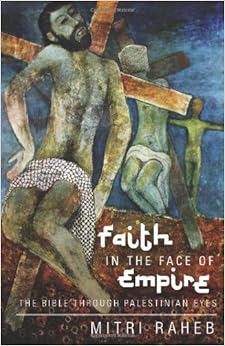
I recently read - and shared some of my thoughts about and reactions to - Mitri Raheb's book Faith in the Face of Empire: The Bible through Palestinian Eyes.

"...tear down this wall."

Here is a wonderful PBS interview with Raheb himself.

Monday, May 26, 2014

Biblical Limericks: Blessing the Sons of Abraham


When consid’ring the Arab and Jew
it is very important that you
recall without distress
that the Lord God did bless
Abram’s sons – Isaac and Ishmael too.

Genesis 17: 20, 25: 11

Friday, April 18, 2014

From the Sepulchre


 photo ChurchoftheHolySepulchre-Golgotha_zpsec44e09b.jpg


More of my photos from the Church of Holy Sepulchre can be seen here, and here, and here, and here.
 photo HangingCandle2_zps32ff97e5.jpg

Tuesday, April 15, 2014

Faith in the Face of Empire – Where Are You, God?


I have been reading and blogging my way through Mitri Raheb’s book Faith in the Face of Empire: The Bible through Palestinian Eyes[i].   In the previous chapter Raheb asked four questions that help shape his hermeneutic – one of which was “Where are you, God?”

It is a question found repeated in various ways throughout the scriptures – in both the Hebrew Bible / Old Testament and the Christian New Testament as well.  From the cries of the descendents of Abraham as they suffered under the slavery of Pharaoh in Egypt to Jesus’ cry of despair on the cross, “my God, my God, why have you abandoned me?”  The question is a central question to faith in Palestine.

This is not to say that the questioner believes God to be non-existent or absent.  The question, instead invites the hidden God to intervene.

Raheb contrasts the God of Palestine to the gods of Empire. The gods of empire are showy, loud, and visible in the shrines built by conquering armies in every new territory.   The expanding reach of empire is a sign of their claim to omnipresence.  Their victorious armies are a symbol of their omnipotence.  But the God of Palestine is different.  He was not found in huge expansive empires, but in a narrow tract of land with few natural resources.  He was not loud and showy demanding shrines and temples in far flung corners – in fact he was somewhat resistant to having a temple built for him at all.  The strength of the God of Palestine was not seen in conquering armies. 

In fact, time and again, the people of this God were defeated and captured, and taken away into slavery and exile, where their captors asked the question again:

As with a deadly wound in my body,
    my adversaries taunt me,
while they say to me continually,
    “Where is your God?”
Psalm 42: 10 (NRSV)

What is uniquely revealed of the God of Palestine is that he is always there – even in defeat and despair and exile.  He has not fled.  He has not abandoned his people.  He maintains solidarity with them.  Raheb finds this most fully demonstrated in the crucifixion of Jesus – the God/Man  - the high priest who is not unable to sympathize with our weaknesses and struggles for he has endured them with us (Hebrews 4: 15) (Raheb, 87).

Those who have this God with them are able to rebuild and restart again and again.  Defeat at the hands of Empire is not an ultimate defeat. 

For Raheb, there is no critique of Empire without God.  No other state, power, organization, or people group can help. Politicians bicker and argue, but only God comes to the help of his people.  “Seeing God on the other side of the empire queries and challenges the morality of the empire, which is a key link in weakening it (Raheb, 85).”

Previous Chapters:
Chapter 1 – Longview of History 
Chapter 4 – Omphaloskepsis  
Chapter 6 – Four Questions


[i] Raheb, Mitri, Faith in the Face of Empire: The Bible through Palestinian Eyes, Orbis Books, Maryknoll, NY, 2014.

The Valley of the Cheese Makers


 photo JerusalemintheRain_zpsc2f4f787.jpg

While we were in Jerusalem last month our tour guide made several references to "the valley of the Cheesemakers" (that is, the Tyropoeon Valley.)  I tried very hard not to giggle.  And was unsuccessful.

Every time she said it, I wanted to turn around and say "oh, shut up big nose...."


Thursday, April 10, 2014

Faith in the Face of Empire: Four Questions


Soon, in just a few days, people around the world will be celebrating the Passover – most of them Jewish, but among them will be not a small number of Christians as well. During the Seder (“order”) four questions will be asked and answered.  They are asked and answered every year; they are part of the story, part of the telling.  They are part of the way that the story is communicated from generation to generation.  They are questions that lead to freedom.

In chapter six (“The People of Palestine”) of his book Faith in the Face of Empire: The Bible through Palestinian Eyes[i], Mitri Raheb asks four existential questions of his own, questions that he hopes will help lead to freedom for the Palestinian people.

1- Where Are You, God?  This is an old, old question; “a three-thousand-year-old lament that the inhabitants of Palestine have passed from one generation to the next (Raheb, 68).”  And it is a question asked repeatedly throughout the pages of scripture.  It’s not that they doubt his existence, or his love, but…

 How long, O Lord? Will you forget me forever?
    How long will you hide your face from me?
How long must I bear pain[a] in my soul,
    and have sorrow in my heart all day long?
How long shall my enemy be exalted over me?
(Psalm 13:  1 – 2 – NRSV)

Raheb makes a rather striking declaration – “throughout the Bible, with the exception of the Exodus, the God in whom the people of Palestine put their faith appears to be silent (Raheb, 69).”

My friend Tim and I have been talking about this very thing today.  He has a sense of Geborgenheit in God.  Warmth.  Security. Closeness.  But this is not everyone’s experience with God.  And does not appear to be the experience of the Palestinian people.  God may have heard, and may have been moved by the cries of his people as they suffered in slavery under the Egyptians, but the cries of the Palestinians under the successive waves of crushing empires has not moved him to effect their release.

2 – Who Is My Neighbor? Another familiar question.  The Bible can be read as a collection of narratives about the land, the peoples, and identities.  The whole of the Hebrew Bible / Old Testament is a struggle toward a national identity.  The New Testament flips this head over heels and “instead of identifying with one people over and against the others, which is the traditional way of forming one’s identity, it calls people to reflect on the entire process of identification as misleading (Raheb, 72).”

But in Palestine, this is not just a question of learning to accept outsiders, foreigners and one’s enemies as neighbors; it is also a question of how to relate with one’s own people.  Empires have a long history of playing various occupied groups against each other.  It’s an effective way to suppress resistance. “The siege that Israel imposes on Gaza aims at developing two diverse and unrelated identities, one in the West Bank, the other in the Gaza Strip.   The stronger these identities develop in isolation from one another, the less likely it is for their people to unite (Raheb, 73).”

3 – What is the Way to Liberation? What is the best – most effective, moral way to achieve a free and independent state? There is no real consensus on this issue.  And there has never been.  Throughout Palestine’s long history of occupation there has never been a universally accepted answer to this question.  And here Raheb identifies five patterns drawn from the New Testament that are still being used in Palestine today.

A – Fighting Back – like the zealots.  Every now and again the occupation has become too oppressive, too brutal, too insulting and some (never all) of the people have taken up arms against their oppressors.  These Intifadas (“uprisings”) are usually brief – three to five years – “That seems to be the length of time or capacity of the people of Palestine for enduring direct military confrontation. The longer an Intifada continues, the more it becomes a liability for the population (Raheb, 75).”

B – Observing the Law – like the Pharisees.  In this mindset the best way to achieve liberation is to commit oneself to fully obeying God’s law.  The occupation is not the result of God turning away from us, but of us turning away from God.  And the best way to ensure our release is to ensure that everyone obeys the laws of God (as we understand them).  The Pharisees of the time of Jesus were not rigid, power hunger, religious hypocrites; they were sincere followers of God who believed that the best (and only) way to live was in complete adherence to God’s law.  This understanding is comforting in several ways – it is observable and quantifiable. You can see the results of people following the laws.  And it preserves the goodness of God. God’s (apparent) silence is not evidence of God’s lack of concern or powerlessness – it is the result of our rebellion.

This pattern is found today in the political manifesto of Hamas [Islamic Resistance Movement] (Raheb, 77).”   “The group who is promoting the law today as the solution to the Palestinian problem is Hamas.  The Arabic word for law is sharia.   For Hamas, as part of the Muslim Brotherhood movement, sharia is the way to true liberation.  The fact that Hamas has been engaged in fighting Israel since 1988 should not make us think that this group belongs to the zealots.  On the contrary, in all Muslim Brotherhood writings, the main focus is on having divine law control peoples’ daily lives.  Their main fight is not with the empire, but with their own people who have forgotten their religious identity (Raheb, 78).”

C – Accommodation - like the Sadducees, walking the tightrope between God’s will and the emperor’s (Raheb, 79).  Some try to work within the system of power. Trying to please the people and keep the rulers happy. 

D – Collaboration – like the New Testament tax (toll) collectors.  “In today’s Palestine these are the subcontractors who distribute Israeli products to the Palestinian markets, who bid on contracts in Israeli settlements, or who collaborate by providing information on people and organizations.  This group wants to exploit the empire by helping to exploit its own people.  For this group, the empire is good business.  Why fight for liberation?  Long live the empire (Raheb, 80)!”

E – Retreat [ii]- like the Qumranites.  Those that hold this attitude believes that that there is no hope.  No chance. And it doesn’t matter anyway since the world is about to collapse.  They retreat into self enclosed community to wait for the inevitable end.   Then they will reemerge to reestablish the old ways and the pure laws.  Raheb identifies the Muslim Salfists and some conservative Christian free churches as contemporary examples of this pattern; “disillusioned and disinterested in politics, they maintain a faithful watch preparing for the great battle against the evil of the present (Raheb 81).”

4 – When Will We Have a State? -   Raheb relates this question back to questions in the Hebrew Bible /Old Testament (1 Samuel 8:20) and the Christian New Testament (Acts 1:6).  But, for Raheb, the question isn’t enough.  “Liberation is not an end to itself (Raheb, 82).”  It is not enough to “be like all the other nations.” It is not enough to “restore the kingdom.”  The goal must be a free and independent state.  Liberation from the control of the empire will leave a power vacuum that will inevitably be filled. 

And even this may not be enough.  “If Israelis and Palestinians are frank with themselves, they need to admit that the state project they’ve respectively worked so hard to achieve for the last sixty or so years has failed.  Israel developed an apartheid system, and the Palestinian mini-state in Gaza or the Palestinian “holes in the cheese” of the West Bank are not the dream for which people fought.  Yet, both peoples are still unable and / or unwilling to admit that hard and painful truth and begin looking for new models of coexistence (Raheb, 84).”


Previous Chapters 
Chapter 1 – Longview of History 
Chapter 4 – Omphaloskepsis  
Chapter 5 -  Seven Marks of the Empire 


[i] Raheb, Mitri, Faith in the Face of Empire: The Bible through Palestinian Eyes, Orbis Books, Maryknoll, NY, 2014.
[ii] In the book this is “Retrieval” (page 80) – but I wonder if it’s not a mistake.  

Wednesday, April 9, 2014

Faith in the Face of Empire: Seven Marks of the Empire


In the previous chapters of Faith in the Face of Empire: The Bible through Palestinian Eyes, author Mitri Raheb has said that the normal state of affairs in Palestine is occupation.  Through its long history it has been ruled by many various empires: Egypt, Assyria, Babylon, Persia, Greece, Rome, Byzantine, Arab, Crusader, Ayyubid, Tartar, Mamluk, Mongol, Ottoman, England, Israel (Raheb, 4)…[i] And even though each successive empire is singularly different, they all develop and utilize a number of similar tactics, policies and theologies (Raheb, 55).  They’re all cut from the same imperial cloth.

In chapter 5 “The Empire” Raheb focuses on Israel as “the expression of empire in Palestine,” - not because Israel is the only empire ever, or the worst expression of imperialism ever.  It is not.  But it is the current expression of the imperial ideology in Palestine.  He acknowledges that this will be shocking to some because of the way our theologies have been shaped in order to support Empires - of which Israel is a singular example (Raheb, 55)

Raheb enumerates 7  imperial patterns that can be observed in Israel today.

1 – Control of Movement – Empires are all about control.  They rule by control.  They control by building up an army and by building watch towers, fortresses, walls and gates.  Israel control’s the movement of the Palestinian people with security checkpoints and rarely granted official permissions.  “Gaza is 360 square miles surrounded by walls and seas, making it the biggest open-air prison in the world to date (Raheb, 56).”  The Palestinian village of al-Walaja near Jerusalem is about to be completely encircled by the massive concrete wall that increasingly cuts off the Palestinian people.  When this section of the wall is completed there will be a single check point in and out. The people of the al-Walaja village will be cut off from their farms and fields and olive tree groves.  

2- Control of Resources – Water is the big one here.  And Israel controls the water.  Most of the water in the region comes from the Jordan River.  But even in places where water can be found in underground aquifers, that water is diverted to Jewish settlements and Palestinians are not permitted to dig for water (Raheb, 58).  And as this year has been an especially dry year in Israel, the situation is nearing crisis levels. 
  
While in Israel we saw a desalinization plant being built along the Mediterranean coastline. This will provide another much needed source of water to the area.  A desalinization plant has been proposed for Gaza as well, but this only heightens the concern for the Palestinian people.  What happens if they are cut off from the aquifers that supply natural fresh water, and the desalinization plant is damaged by Israeli bombings? 

3 – Settlements - Empires have always built new colonies, outposts, cities, and settlements as a way to control occupied lands.  These settlements provide an administrative base for the empire and crowd out troublesome natives.  “While native villages and cities grow and evolve naturally over time and at a ‘normal’ speed, settlements are established strategically and deliberately to control (Raheb 59).”

Despite a repeated international condemnation, including a UN General Assembly resolution and a ruling by the International Court of Justice, the population of these illegal Jewish settlements on Palestinian lands, which currently number 121, has grown by an average of 5% annually since 2001. That compares to an average growth of just 1.8% for the population of Israel proper.  These settlements and outposts are inhabited by a population of some 462,000 Israeli settlers.

4 – State Terrorism – We usually reserve this word for the “bad guys” - those fighting against the empire.  Terrorists crash planes and blow themselves up.  But Empires effectively use terror to control and suppress native peoples (Raheb, 60). 

Providentially, perhaps, I am reading this chapter on the anniversary of the Deir Yassin massacre - 

This is not to say that there are not Palestinian terrorist groups.  There certainly are.  But the state of Israel – like every other empire before it – effectively uses violence and terror against the people it controls.

5 – Exile – When Assyria conquered Israel the tribes of the north were scattered.  When Babylon conquered Judah, the people were taken into captivity.  When European settlers pressed into North America, the native populations were forced from the land and eventually into “Reservations.”  This is how empires work. This is what they do.  Israel is no different. When the state of Israel was established in 1948 some 750,000 Palestinians lost their homes, land, and possessions.  Today the number of refugee Palestinians is approximately 5 Million (Raheb, 61 – 62).

6 – The Temple – In order to demonstrate their superiority, empires have always defaced and defamed the gods of conquered nations.  Temples are burned.  Shrines are looted.  When Nebuchadnezzar captured Jerusalem his forces looted the temple and carried the sacred objects off to Babylon.  Christian armies turned Muslim mosques into Christian cathedrals by replacing the crescent moon with a cross. Muslim forces converted the Hagia Sophia in Turkey into a mosque.  Today, Israel claims complete control over the city of Jerusalem – sacred to Palestinians of the Christian, Muslim and Jewish faiths.  (Yes.  There are Palestinian Jews – 17% of those in the Palestinian West Bank. )

7 – Imperial Theology – It isn’t enough to have military, political, and economic power, though.  Empires also have to provide some sort of moral validation for their existence.  From the “Divine Right of Kings” to “Manifest Destiny” and Apartheid – theology has always been utilized by empires to justify themselves.  “From day one, theology has provided the narrative glue that keeps Israeli society together (Raheb, 66).”  [ii]

Previous Chapters:
Chapter 1 – Longview of History 
Chapter 4 – Omphaloskepsis 


[i] Raheb, Mitri, Faith in the Face of Empire: The Bible through Palestinian Eyes, Orbis Books, Maryknoll, NY, 2014.
[ii] Perhaps Raheb is cribbing a phrase from John Dominick Crossan who writes about imperial theology as the “ideological glue” that held Roman civilization together. 

Tuesday, April 8, 2014

Faith in the Face of Empire – Omphaloskepsis


“As the navel is set in the center of the human body, so is the land of Israel the navel of the world…” [i]


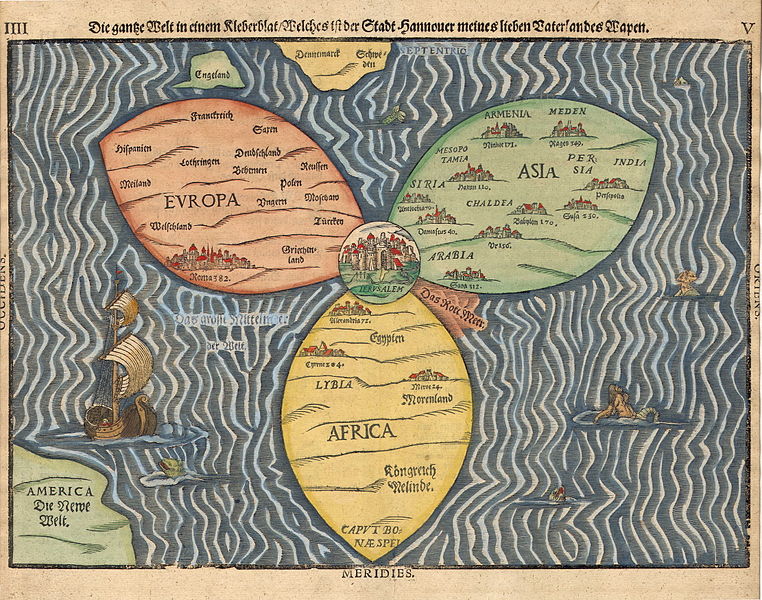
In chapter four of his book Faith in the Face of Empire: The Bible through Palestinian Eyes, Mitri Raheb examines the image of Palestine as the center - the omphalos – the navel of the world. 

Ancient mapmakers often portrayed (at the expense of accuracy) the geographic features of the world this way because it conformed to the way they thought of the world. But while Palestine might be the religious center for much of the world and while it might arguably be the geographic center – it has never been the political center.  Palestine has always been at the edge. (Raheb, 49)[ii]

Palestine has been at the periphery of empires - at the margins of power. [iii]  It has been a buffer zone between the empires and between the egos and ambitions of powerful leaders.  “Palestine was often the distance each of the empires needed from the others to feel secure or the red line that no other power should cross.  In reality, and geo-politically, Palestine is, in fact, nothing but a land on the margins.  Contrary to its religious reputation and geographical location, in reality and geo-politically the land lies on the periphery of the Fertile Crescent and is a borderland for diverse empires (Raheb, 51).”

It is a land that has been constantly fought over – but without any real concern for the land (or its people).  Successive empires have fought over it, and in it, and for it – but only as a hedge against other powers.  “Wars constitute reality in Palestine,” says Raheb. “I know this not merely from history books but from my own experience.  I am just fifty years old and have already lived through nine wars (Raheb, 51).”

This long history of occupation and wars for control has influenced the writing of our scriptures and the way that we interpret them.  “Being a largely occupied land, liberation from occupation is a central theme throughout history and plays a major role in the Bible.”  Think through the story from Abraham leaving the Fertile Crescent, through the sojourn in Egypt, the stories of conquest, the conflict with Canaanite tribes, the political machinations of the kings of Israel and Judah, the hope and warnings given by the prophets, the gospel of Jesus… The theme of liberation and freedom runs all through the scriptures. Yet, “maintaining control of the land and promoting the unity of its people remain an uphill struggle (Raheb, 53 – 54).”

Chapter 1  - The Longview of History
Chapter 2  - Dispelling the Myth of Judeo-Christian Tradition
Chapter 3  - The Geo-Politics of the Middle East


[i] Midrash on Ezekiel 38:12 – Tanhuma, Kedashim Ch. 10
[ii] Raheb, Mitri, Faith in the Face of Empire: The Bible through Palestinian Eyes, Orbis Books, Maryknoll, NY, 2014.
[iii] How appropriate then, that from this marginal land should come a Marginal Jew…
Jeff Carter's books on Goodreads
Muted Hosannas Muted Hosannas
reviews: 2
ratings: 3 (avg rating 4.33)

Related Posts with Thumbnails