I recently read - and shared some of my thoughts about and reactions to - Mitri Raheb's book Faith in the Face of Empire: The Bible through Palestinian Eyes.
"...tear down this wall."
Here is a wonderful PBS interview with Raheb himself.

Showing posts with label Mitri Raheb. Show all posts
Showing posts with label Mitri Raheb. Show all posts
Tuesday, May 27, 2014


Tuesday, April 15, 2014
Faith in the Face of Empire – Where Are You, God?
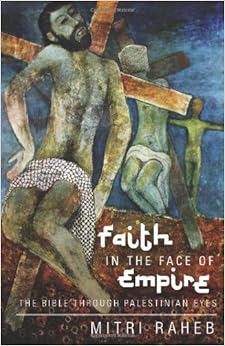
I have been reading and blogging my way through Mitri Raheb’s book Faith in the Face of Empire: The Bible through Palestinian Eyes[i]. In the previous chapter Raheb asked four questions that help shape his hermeneutic – one of which was “Where are you, God?”
It is a question found repeated in various ways throughout the scriptures – in both the Hebrew Bible / Old Testament and the Christian New Testament as well. From the cries of the descendents of Abraham as they suffered under the slavery of Pharaoh in Egypt to Jesus’ cry of despair on the cross, “my God, my God, why have you abandoned me?” The question is a central question to faith in Palestine.
This is not to say that the questioner believes God to be non-existent or absent. The question, instead invites the hidden God to intervene.
Raheb contrasts the God of Palestine to the gods of Empire. The gods of empire are showy, loud, and visible in the shrines built by conquering armies in every new territory. The expanding reach of empire is a sign of their claim to omnipresence. Their victorious armies are a symbol of their omnipotence. But the God of Palestine is different. He was not found in huge expansive empires, but in a narrow tract of land with few natural resources. He was not loud and showy demanding shrines and temples in far flung corners – in fact he was somewhat resistant to having a temple built for him at all. The strength of the God of Palestine was not seen in conquering armies.
In fact, time and again, the people of this God were defeated and captured, and taken away into slavery and exile, where their captors asked the question again:
As with a deadly wound in my body,
my adversaries taunt me,
while they say to me continually,
“Where is your God?”
Psalm 42: 10 (NRSV)
What is uniquely
revealed of the God of Palestine is that he is always there – even in defeat
and despair and exile. He has not
fled. He has not abandoned his
people. He maintains solidarity with
them. Raheb finds this most fully
demonstrated in the crucifixion of Jesus – the God/Man - the high priest who is not unable to
sympathize with our weaknesses and struggles for he has endured them with us (Hebrews
4: 15) (Raheb, 87).
Those who have this God
with them are able to rebuild and restart again and again. Defeat at the hands of Empire is not an
ultimate defeat.
For Raheb, there is no critique of Empire without God. No other state, power, organization, or people group can help. Politicians bicker and argue, but only God comes to the help of his people. “Seeing God on the other side of the empire queries and challenges the morality of the empire, which is a key link in weakening it (Raheb, 85).”
For Raheb, there is no critique of Empire without God. No other state, power, organization, or people group can help. Politicians bicker and argue, but only God comes to the help of his people. “Seeing God on the other side of the empire queries and challenges the morality of the empire, which is a key link in weakening it (Raheb, 85).”
Chapter 1 – Longview of History
Chapter 2 – Dispelling the Myth of Judeo-Christian Tradition
Chapter 3 – The Geo-Politics of the Middle East
Chapter 4 – Omphaloskepsis
Chapter 5 - Seven Marks of the Empire
Chapter 6 – Four Questions
[i] Raheb,
Mitri, Faith in the Face of Empire: The Bible through Palestinian Eyes, Orbis
Books, Maryknoll, NY, 2014.
Thursday, April 10, 2014
Faith in the Face of Empire: Four Questions
Soon, in just a few days, people around the world will be celebrating the Passover – most of them Jewish, but among them will be not a small number of Christians as well. During the Seder (“order”) four questions will be asked and answered. They are asked and answered every year; they are part of the story, part of the telling. They are part of the way that the story is communicated from generation to generation. They are questions that lead to freedom.
In chapter six (“The People of Palestine”) of his book Faith in the Face of Empire: The Bible through Palestinian Eyes[i], Mitri Raheb asks four existential questions of his own, questions that he hopes will help lead to freedom for the Palestinian people.
1- Where Are You, God? This is an old, old question; “a three-thousand-year-old lament that the inhabitants of Palestine have passed from one generation to the next (Raheb, 68).” And it is a question asked repeatedly throughout the pages of scripture. It’s not that they doubt his existence, or his love, but…
How long, O Lord? Will you forget me forever?
How long will you hide your face from me?
How long must I bear
pain[a] in my soul,
and have sorrow in my heart all day long?
How long shall my enemy
be exalted over me?
(Psalm 13: 1 – 2 – NRSV)
Raheb makes a rather striking declaration – “throughout the Bible, with the exception of the Exodus, the God in whom the people of Palestine put their faith appears to be silent (Raheb, 69).”
My friend Tim and I have been talking about this very thing today. He has a sense of Geborgenheit in God. Warmth. Security. Closeness. But this is not everyone’s experience with God. And does not appear to be the experience of the Palestinian people. God may have heard, and may have been moved by the cries of his people as they suffered in slavery under the Egyptians, but the cries of the Palestinians under the successive waves of crushing empires has not moved him to effect their release.
(Psalm 13: 1 – 2 – NRSV)
Raheb makes a rather striking declaration – “throughout the Bible, with the exception of the Exodus, the God in whom the people of Palestine put their faith appears to be silent (Raheb, 69).”
My friend Tim and I have been talking about this very thing today. He has a sense of Geborgenheit in God. Warmth. Security. Closeness. But this is not everyone’s experience with God. And does not appear to be the experience of the Palestinian people. God may have heard, and may have been moved by the cries of his people as they suffered in slavery under the Egyptians, but the cries of the Palestinians under the successive waves of crushing empires has not moved him to effect their release.
2 – Who Is My Neighbor? Another familiar
question. The Bible can be read as a
collection of narratives about the land, the peoples, and identities. The whole of the Hebrew Bible / Old Testament
is a struggle toward a national identity.
The New Testament flips this head over heels and “instead of identifying
with one people over and against the others, which is the traditional way of
forming one’s identity, it calls people to reflect on the entire process of
identification as misleading (Raheb, 72).”
But in Palestine, this is not just a question of learning to accept outsiders, foreigners and one’s enemies as neighbors; it is also a question of how to relate with one’s own people. Empires have a long history of playing various occupied groups against each other. It’s an effective way to suppress resistance. “The siege that Israel imposes on Gaza aims at developing two diverse and unrelated identities, one in the West Bank, the other in the Gaza Strip. The stronger these identities develop in isolation from one another, the less likely it is for their people to unite (Raheb, 73).”
3 – What is the Way to Liberation? What is the best – most effective, moral way to achieve a free and independent state? There is no real consensus on this issue. And there has never been. Throughout Palestine’s long history of occupation there has never been a universally accepted answer to this question. And here Raheb identifies five patterns drawn from the New Testament that are still being used in Palestine today.
A – Fighting Back – like the zealots. Every now and again the occupation has become too oppressive, too brutal, too insulting and some (never all) of the people have taken up arms against their oppressors. These Intifadas (“uprisings”) are usually brief – three to five years – “That seems to be the length of time or capacity of the people of Palestine for enduring direct military confrontation. The longer an Intifada continues, the more it becomes a liability for the population (Raheb, 75).”
B – Observing the Law – like the Pharisees. In this mindset the best way to achieve liberation is to commit oneself to fully obeying God’s law. The occupation is not the result of God turning away from us, but of us turning away from God. And the best way to ensure our release is to ensure that everyone obeys the laws of God (as we understand them). The Pharisees of the time of Jesus were not rigid, power hunger, religious hypocrites; they were sincere followers of God who believed that the best (and only) way to live was in complete adherence to God’s law. This understanding is comforting in several ways – it is observable and quantifiable. You can see the results of people following the laws. And it preserves the goodness of God. God’s (apparent) silence is not evidence of God’s lack of concern or powerlessness – it is the result of our rebellion.
This pattern is found today in the political manifesto of Hamas [Islamic Resistance Movement] (Raheb, 77).” “The group who is promoting the law today as the solution to the Palestinian problem is Hamas. The Arabic word for law is sharia. For Hamas, as part of the Muslim Brotherhood movement, sharia is the way to true liberation. The fact that Hamas has been engaged in fighting Israel since 1988 should not make us think that this group belongs to the zealots. On the contrary, in all Muslim Brotherhood writings, the main focus is on having divine law control peoples’ daily lives. Their main fight is not with the empire, but with their own people who have forgotten their religious identity (Raheb, 78).”
C – Accommodation - like the Sadducees, walking the tightrope between God’s will and the emperor’s (Raheb, 79). Some try to work within the system of power. Trying to please the people and keep the rulers happy.
D – Collaboration – like the New Testament tax (toll) collectors. “In today’s Palestine these are the subcontractors who distribute Israeli products to the Palestinian markets, who bid on contracts in Israeli settlements, or who collaborate by providing information on people and organizations. This group wants to exploit the empire by helping to exploit its own people. For this group, the empire is good business. Why fight for liberation? Long live the empire (Raheb, 80)!”
E – Retreat [ii]- like the Qumranites. Those that hold this attitude believes that that there is no hope. No chance. And it doesn’t matter anyway since the world is about to collapse. They retreat into self enclosed community to wait for the inevitable end. Then they will reemerge to reestablish the old ways and the pure laws. Raheb identifies the Muslim Salfists and some conservative Christian free churches as contemporary examples of this pattern; “disillusioned and disinterested in politics, they maintain a faithful watch preparing for the great battle against the evil of the present (Raheb 81).”
 4 – When Will We Have a State? - Raheb relates this question back to questions
in the Hebrew Bible /Old Testament (1 Samuel 8:20) and the Christian New
Testament (Acts 1:6). But, for Raheb, the
question isn’t enough. “Liberation is
not an end to itself (Raheb, 82).” It is
not enough to “be like all the other nations.” It is not enough to “restore the
kingdom.” The goal must be a free and
independent state. Liberation from the control
of the empire will leave a power vacuum that will inevitably be filled.
4 – When Will We Have a State? - Raheb relates this question back to questions
in the Hebrew Bible /Old Testament (1 Samuel 8:20) and the Christian New
Testament (Acts 1:6). But, for Raheb, the
question isn’t enough. “Liberation is
not an end to itself (Raheb, 82).” It is
not enough to “be like all the other nations.” It is not enough to “restore the
kingdom.” The goal must be a free and
independent state. Liberation from the control
of the empire will leave a power vacuum that will inevitably be filled. And even this may not be enough. “If Israelis and Palestinians are frank with themselves, they need to admit that the state project they’ve respectively worked so hard to achieve for the last sixty or so years has failed. Israel developed an apartheid system, and the Palestinian mini-state in Gaza or the Palestinian “holes in the cheese” of the West Bank are not the dream for which people fought. Yet, both peoples are still unable and / or unwilling to admit that hard and painful truth and begin looking for new models of coexistence (Raheb, 84).”
Previous Chapters
Chapter 1 – Longview of History
Chapter 2 – Dispelling the Myth of Judeo-Christian Tradition
Chapter 3 – The Geo-Politics of the Middle East
Chapter 4 – Omphaloskepsis
Chapter 5 - Seven Marks of the Empire
Wednesday, April 9, 2014
Faith in the Face of Empire: Seven Marks of the Empire

In the previous chapters of Faith in the Face of Empire: The Bible through Palestinian Eyes, author Mitri Raheb has said that the normal state of affairs in Palestine is occupation. Through its long history it has been ruled by many various empires: Egypt, Assyria, Babylon, Persia, Greece, Rome, Byzantine, Arab, Crusader, Ayyubid, Tartar, Mamluk, Mongol, Ottoman, England, Israel (Raheb, 4)…[i] And even though each successive empire is singularly different, they all develop and utilize a number of similar tactics, policies and theologies (Raheb, 55). They’re all cut from the same imperial cloth.
In chapter 5 “The Empire” Raheb focuses on Israel as “the expression of empire in Palestine,” - not because Israel is the only empire ever, or the worst expression of imperialism ever. It is not. But it is the current expression of the imperial ideology in Palestine. He acknowledges that this will be shocking to some because of the way our theologies have been shaped in order to support Empires - of which Israel is a singular example (Raheb, 55)
Raheb enumerates 7 imperial patterns that can be observed in Israel today.
1 – Control of Movement – Empires are all about control. They rule by control. They control by building up an army and by building watch towers, fortresses, walls and gates. Israel control’s the movement of the Palestinian people with security checkpoints and rarely granted official permissions. “Gaza is 360 square miles surrounded by walls and seas, making it the biggest open-air prison in the world to date (Raheb, 56).” The Palestinian village of al-Walaja near Jerusalem is about to be completely encircled by the massive concrete wall that increasingly cuts off the Palestinian people. When this section of the wall is completed there will be a single check point in and out. The people of the al-Walaja village will be cut off from their farms and fields and olive tree groves.
2- Control of Resources – Water is the big one here. And Israel controls the water. Most of the water in the region comes from
the Jordan River. But even in places
where water can be found in underground aquifers, that water is diverted to
Jewish settlements and Palestinians are not permitted to dig for water (Raheb,
58). And as this year has been an especially dry year in Israel, the situation is nearing crisis levels.
While in Israel we saw a desalinization
plant being built along the Mediterranean coastline. This will provide
another much needed source of water to the area. A desalinization plant has been proposed for
Gaza as well, but this only heightens the concern for the Palestinian people. What happens if they are cut off from the aquifers that supply natural fresh water, and the desalinization plant is damaged by Israeli bombings?
3 – Settlements - Empires have always built new colonies, outposts,
cities, and settlements as a way to control occupied lands. These settlements provide an administrative base
for the empire and crowd out troublesome natives. “While native villages and cities grow and
evolve naturally over time and at a ‘normal’ speed, settlements are established
strategically and deliberately to control (Raheb 59).”
Despite a repeated international condemnation, including a UN General Assembly resolution and a ruling by the International Court of Justice, the population of these illegal Jewish settlements on Palestinian lands, which currently number 121, has grown by an average of 5% annually since 2001. That compares to an average growth of just 1.8% for the population of Israel proper. These settlements and outposts are inhabited by a population of some 462,000 Israeli settlers.
4 – State Terrorism – We usually reserve this word for the “bad
guys” - those fighting against the empire.
Terrorists crash planes and blow themselves up. But Empires effectively use terror to control
and suppress native peoples (Raheb, 60).
Providentially, perhaps, I am reading this chapter on the anniversary of the Deir Yassin massacre -
Providentially, perhaps, I am reading this chapter on the anniversary of the Deir Yassin massacre -
This is not to say that there are not Palestinian terrorist groups. There certainly are. But the state of Israel – like every other empire before it – effectively uses violence and terror against the people it controls.
5 – Exile – When Assyria conquered Israel the tribes of the north
were scattered. When Babylon conquered
Judah, the people were taken into captivity.
When European settlers pressed into North America, the native
populations were forced from the land and eventually into “Reservations.” This is how empires work. This is what they
do. Israel is no different. When the
state of Israel was established in 1948 some 750,000 Palestinians lost their homes,
land, and possessions. Today the number
of refugee Palestinians is approximately 5 Million (Raheb, 61 – 62).
6 – The Temple – In order to demonstrate their superiority, empires
have always defaced and defamed the gods of conquered nations. Temples are burned. Shrines are looted. When Nebuchadnezzar captured Jerusalem his
forces looted the temple and carried the sacred objects off to Babylon. Christian armies turned Muslim mosques into
Christian cathedrals by replacing the crescent moon with a cross. Muslim forces
converted the Hagia Sophia in Turkey into a mosque. Today, Israel claims complete control over
the city of Jerusalem – sacred to Palestinians of the Christian, Muslim and
Jewish faiths. (Yes. There are Palestinian Jews – 17% of those in the Palestinian West Bank. )
7 – Imperial Theology – It isn’t enough to have military,
political, and economic power, though.
Empires also have to provide some sort of moral validation for their existence. From the “Divine Right of Kings” to “Manifest
Destiny” and Apartheid – theology has always been utilized by empires to justify
themselves. “From day one, theology has
provided the narrative glue that keeps Israeli society together (Raheb, 66).” [ii]
Previous Chapters:
Chapter 1 – Longview of History
Chapter 1 – Longview of History
Chapter 2 – Dispelling the Myth of Judeo-Christian Tradition
Chapter 3 – The Geo-Politics of the Middle East
Chapter 4 – Omphaloskepsis
[i] Raheb,
Mitri, Faith in the Face of Empire: The Bible through Palestinian Eyes,
Orbis Books, Maryknoll, NY, 2014.
[ii]
Perhaps Raheb is cribbing a phrase from John Dominick Crossan who writes about
imperial theology as the “ideological glue” that held Roman civilization
together.
Tuesday, April 8, 2014
Faith in the Face of Empire – Omphaloskepsis
“As the navel is set in the center of the human body, so is the land of Israel the navel of the world…” [i]
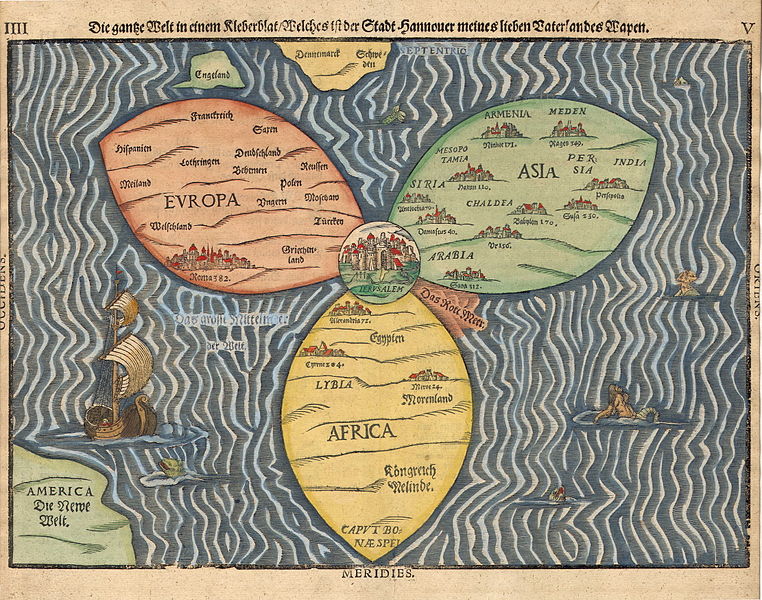
In chapter four of his book Faith in the Face of Empire: The Bible through Palestinian Eyes, Mitri Raheb examines the image of Palestine as the center - the omphalos – the navel of the world.
Ancient mapmakers often portrayed (at the
expense of accuracy) the geographic features of the world this way because it
conformed to the way they thought of the world. But while Palestine might be
the religious center for much of the world and while it might arguably be the
geographic center – it has never been the political center. Palestine has always been at the edge.
(Raheb, 49)[ii]
It is a land that has
been constantly fought over – but without any real concern for the land (or its
people). Successive empires have fought
over it, and in it, and for it – but only as a hedge against other powers. “Wars constitute reality in Palestine,” says
Raheb. “I know this not merely from history books but from my own
experience. I am just fifty years old
and have already lived through nine wars (Raheb, 51).”
This long history of
occupation and wars for control has influenced the writing of our scriptures
and the way that we interpret them. “Being
a largely occupied land, liberation from occupation is a central theme
throughout history and plays a major role in the Bible.” Think through the story from Abraham leaving the
Fertile Crescent, through the sojourn in Egypt, the stories of conquest, the
conflict with Canaanite tribes, the political machinations of the kings of
Israel and Judah, the hope and warnings given by the prophets, the gospel of
Jesus… The theme of liberation and freedom runs all through the scriptures.
Yet, “maintaining control of the land and promoting the unity of its people
remain an uphill struggle (Raheb, 53 – 54).”
Chapter 3 - The Geo-Politics of the Middle East
[i] Midrash
on Ezekiel 38:12 – Tanhuma, Kedashim Ch. 10
[ii] Raheb,
Mitri, Faith in the Face of Empire: The Bible through Palestinian Eyes,
Orbis Books, Maryknoll, NY, 2014.
[iii]
How appropriate then, that from this marginal land should come a Marginal Jew…
Thursday, April 3, 2014
Faith in the Face of the Empire – The Geo-Politics of the Middle East
 Chapter Three (“The
Geo-Politics of the Middle East”) of Mitri Raheb’s book Faith in the Face of Empire: the Bible through Palestinian Eyes is
brief but very necessary. Maybe it
starts to feel like a lot of preparatory work – the book’s title, after all, is
about the Bible – and three chapters into it we’re still not to actually
reading the bible yet.
Chapter Three (“The
Geo-Politics of the Middle East”) of Mitri Raheb’s book Faith in the Face of Empire: the Bible through Palestinian Eyes is
brief but very necessary. Maybe it
starts to feel like a lot of preparatory work – the book’s title, after all, is
about the Bible – and three chapters into it we’re still not to actually
reading the bible yet. First – keep in mind that this is a short book, 166 pages – including the index. These chapters are brief. But – Second – they are a necessary corrective against a long history that has ignored the concerns and viewpoint of the Palestinian people. If Raheb spends the first few chapters reorienting (pun on purpose) us, it isn’t because he’s stalling.
The chapter begins with a question: What do we mean when we say the ‘Middle East?’ “middle of where and east of what? (Raheb, 43) [i] The term is a holdover from a European colonial understanding of the world – from a time when Europe was at the height of its imperial power (43). The colonial past plus the imperial present are part of the equation that accurately describes the Middle East (44). It is impossible to understand the situation without keeping this in mind.
In the past the region of Israel / Palestine has been controlled by 1 of 5 power poles – “albeit with different names, constellations, and degrees of power (46),” - Mesopotamia, Egypt, Persia, Turkey and Europe. And quite often the region was under the influence of more than one of these powers as they were fighting for ultimate control.
The situation today is a little different – the power poles (as Raheb describes them) are 1) The United States, 2) Israel, and 3) Oil (that is, “Saudi Arabia and Qatar, thanks to the influence of the petro-dollar (47).”
What do we mean when we say “Middle East”? Middle of where, east of what? Who is in control? Who has the power? Who is exerting the influence fiscally and militarily? These are questions that we need to keep in front of us as we approach the bible.
[i] Raheb,
Mitri, Faith in the Face of Empire: The Bible through Palestinian Eyes,
Orbis Books, Maryknoll, NY, 2014.
Faith in the Face of Empire: Dispelling the Myth of Judeo-Christian Tradition
Hermeneutics is the art and science of the study of theology and the practice of interpretation. Hermeneutics is an art that requires creativity and imagination, and it is a science that requires sound methodologies. But the art and science of hermeneutics is not neutral. The second chapter (“A Prelude to a Palestinian Narrative”) of Mitri Raheb’s bookFaith in the Face of Empire: the Bible through Palestinian Eyes lays out a brief history of the way that Christian hermeneutics in Europe and America in the years since World War II have been used to support the occupation and oppression of Palestine.
This hermeneutic
operated by consistently interpreting scripture in such a way as to dismiss and
diminish the Palestinian people. “On the
one hand, we are viewed as the Canaanites or the descendents of Ishmael, which
means theologically we are inferiors and politically second-class citizens. Ishmael then gets connected Arabs, and
Muslims, who are viewed with an Orientalist lens, and, after 9/11 with fear and
hatred as well. On the other hand, our history,
our roots, and our presence in the Holy Land are glaringly overlooked so that
we become aliens and strangers, and this by divine order (38).”
However, this state of affairs is changing, says Raheb. For the first four decades after World War II and the establishment of the state of Israel in 1948, Palestinians may have lost their voice but beginning in the 1980s with an increased interest in post-colonial studies they began to assume the responsibility for making changes, challenging the dominant culture, and questioning that omnipresent myth of Judeo-Christian tradition (27).
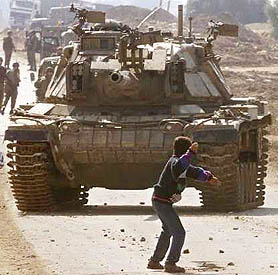
He also credits the first
Intifada (“Uprising”) in `1987 for drawing the world’s attention to flaws in
that narrative. The world saw the brutal
response of Israel to a (mostly) non-violent movement and the blinders began to
fall away. How can we reconcile the
story of little David (Israel) fighting the giant Goliath (the Arab world) to
the pictures of a young Palestinian boy with a stone in his hand facing a high-tech
Israeli tank? How do we reconcile the memory of the Jewish people as the victim
of persecution with the way the state of Israel victimizes the Palestinians
(30)?
Raheb also notes the
voices questioning this legitimizing myth from outside Palestine – Jewish theologians
like Shlomo Sand of Tel Aviv University
who describes the way “the concept of a
Jewish homeland was invented by evangelical Christians together with Jewish Zionists to facilitate the
colonization of Palestine (33),” and Christian theologians like Walter
Brueggemann who unveils the “national Israeli agenda behind the religious
packaging (35).”
It is a brief chapter (in a small book) but it does much to disturb. We cannot blindly and unquestioningly accept a hermeneutic that allows the dehumanization of the Palestinian people.
It is a brief chapter (in a small book) but it does much to disturb. We cannot blindly and unquestioningly accept a hermeneutic that allows the dehumanization of the Palestinian people.
[i]
Raheb, Mitri, Faith in the Face of Empire: The Bible through Palestinian
Eyes, Orbis Books, Maryknoll, NY, 2014.
Wednesday, April 2, 2014
Faith in the Face of Empire – The Longview of History

I’ve just begun reading the book Faith in the Face of Empire: The Bible through Palestinian Eyes by Mitri Raheb. [i] I plan to blog my way through it.
Raheb is a Christian,
an academic, and a Palestinian, writing to present a Christian “theology from and for the Palestinian context (2).” Maybe this breaks the stereotype we’ve been presented – that all Palestinians are Muslim. (They are not. Some are Muslim, some Christian; some are even Jewish and some are agnostic/atheist) or that all Palestinians are terrorists (this is in no way true.)
The Palestinian story according to Raheb is a long story, one of nearly continual occupation. “Such occupation is the defining feature of our history, beginning with the Assyrians (722 BC), the Babylonians (587 BC), and the Persians (538 BC), followed by the Greeks (333 BC), the Romans (63 BC), the Byzantines (326), the Arabs (637), the Crusaders (1099), the Ayyubids (1187), the Tartars (1244), the Mamluks (1291), the Mongols (1401), the Ottomans (1516), the British (1917), and the Israelis (1948/67), to name just the major occupiers (4).”
What strikes me immediately in this brief account of such a long history is that for the first half of it, Palestinian story overlaps the Jewish history. Through the ebb and flow of history – the surging and receding of changing empires, the Am Haaretz – the “people of the land” have lived in that much contested area of the Middle East, surviving and outlasting empires. They have repeatedly changed their indenty and language in order to survive – now citizens of the Ottoman Empire, now British, now Israeli – they have repeatedly changed their language – now speaking Aramaic, now Greek, now Arabic, - but they have remained. “The Palestinian people … are a critical and dynamic continuum form Canaan to the present day. They are the native peoples, who survived those empire and occupations, and they are also the remnant of those invading armies and settlers who decided to remain in the land to integrate rather than return to their original homelands. The Palestinians are the accumulated outcome of this incredible dynamic history and these massive geo-political developments (13).”
The Palestinian story according to Raheb is a long story, one of nearly continual occupation. “Such occupation is the defining feature of our history, beginning with the Assyrians (722 BC), the Babylonians (587 BC), and the Persians (538 BC), followed by the Greeks (333 BC), the Romans (63 BC), the Byzantines (326), the Arabs (637), the Crusaders (1099), the Ayyubids (1187), the Tartars (1244), the Mamluks (1291), the Mongols (1401), the Ottomans (1516), the British (1917), and the Israelis (1948/67), to name just the major occupiers (4).”
What strikes me immediately in this brief account of such a long history is that for the first half of it, Palestinian story overlaps the Jewish history. Through the ebb and flow of history – the surging and receding of changing empires, the Am Haaretz – the “people of the land” have lived in that much contested area of the Middle East, surviving and outlasting empires. They have repeatedly changed their indenty and language in order to survive – now citizens of the Ottoman Empire, now British, now Israeli – they have repeatedly changed their language – now speaking Aramaic, now Greek, now Arabic, - but they have remained. “The Palestinian people … are a critical and dynamic continuum form Canaan to the present day. They are the native peoples, who survived those empire and occupations, and they are also the remnant of those invading armies and settlers who decided to remain in the land to integrate rather than return to their original homelands. The Palestinians are the accumulated outcome of this incredible dynamic history and these massive geo-political developments (13).”

But this will be
contested, fiercely contested by some. Golda Meir (fourth Prime Minister of
Israel) famously said, “There were no such thing as Palestinians. When was
there an independent Palestinian people with a Palestinian state? It was either
southern Syria before the First World War, and then it was a Palestine
including Jordan. It was not as though there was a Palestinian people in
Palestine considering itself as a Palestinian people and we came and threw them
out and took their country away from them. They did not exist.” [ii]
How can they have a long history to recount (and
a history that overlaps the Jewish story) if they never existed?
As Raheb says, “Indeed,
they [the Palestinian people] have been totally replaced by the Israelis, as
though they never existed, and as if the land had been kept unpopulated or terra nullius (land belonging to no one)
(19).”
Subscribe to:
Posts (Atom)
Jeff Carter's books on Goodreads
 There Once Was a Prophet from Judah: Biblical Limericks for Fun and Prophet
 There Once Was a Prophet from Judah: Biblical Limericks for Fun and Prophet
reviews: 1
ratings: 1 (avg rating 5.00)
ratings: 1 (avg rating 5.00)
