Pages

google analytics

Showing posts with label Classics of Western Civ. Show all posts

Monday, February 16, 2015

Hideous Love of the Sword

              "Their swelling minds and spirits
made fierce in slaughter are crushed by love of country and ancestral
gods, but they are recalled by their hideous love of the sword..."
Lucan - Pharalia 1. 353 - 355

Thursday, February 5, 2015

This Divine Aeneid


I recently finished reading The Aeneid by the Roman poet, Virgil. It’s part of my personal challenge to read (or re-read) some of the classics of western civilization.

As I was reading it I was struck by an idea – a comparison that could be made to some parts of the Bible, but I hesitated to write them up, thinking that perhaps I was reaching.  That I was stretching too far.  But a blog post from that perpetual snark, Dr. Jim West, has convinced me that I was on the right track and that I shouldn’t have succumbed to my self-doubting. 

It occurred to me, as I read Virgil’s epic poem, that a comparison could be made between Aeneus and Abraham.  Both commenced upon long and dangerous journeys in order to find a promised city, Aeneus for the city that would become the great and powerful Rome, Abraham for a heavenly city.

By faith Abraham obeyed when he was called to set out for a place that he was to receive as an inheritance; and he set out, not knowing where he was going. By faith he stayed for a time in the land he had been promised, as in a foreign land, living in tents, as did Isaac and Jacob, who were heirs with him of the same promise. For he looked forward to the city that has foundations, whose architect and builder is God. (Hebrews 11: 8 – 10)

And, apparently, Martin Luther thought that comparison valid as well.  Tucked in among the very last things he wrote were these lines:
Nobody can understand Vergil in his Bucolics and Georgics unless he has first been a shepherd or a farmer for five years.  Nobody understands Cicero in his letters unless he has been engaged in public affairs of some consequence for twenty years.Let nobody suppose that he has tasted the Holy Scriptures sufficiently unless he has ruled over the churches with the prophets for a hundred years. Therefore there is something wonderful, first, about John the Baptist; second, about Christ; third, about the apostles. ‘Lay not your hand on this divine Aeneid, but bow before it, adore its every trace.’ We are beggars. That is true.


Wednesday, February 4, 2015

Virgil, Salad, Augustine, U2 and National Mottos


This year I have made it a challenge to myself to read (or re-read) some of the classics of western civilization – books like The Iliad and The Odyssey by the Greek poet Homer, and The Aeneid by the Roman, Virgil. 

I recently finished Virgil’s work, but before I move on to something else, I wanted to make note of the fact that Latin phrase E Pluribus Unum “Out of many, one” found on the Seal of the United States
may be attributed to Virgil.

It is found in his poem Moretum – which on the surface reading is about preparing type of cheese spread (sort of like pesto) eaten by the ancient Romans on breads and salads.  (Though the poem is attributed to Virgil, the actual authorship may be up for debate…)

…with his right [hand] he first
The reeking garlic with the pestle breaks,
Then everything he equally doth rub
I' th' mingled juice. His hand in circles move:
Till by degrees they one by one do lose
Their proper powers, and out of many comes
A single color, not entirely green
Because the milky fragments this forbid,
Nor showing white as from the milk because
That color's altered by so many herbs.

Another early use of the phrase, though in a slight variation – ex pluribus unum - can be found in the writings of St. Augustine.  In his Confessions he wrote:

These and similar tokens of friendship, which spring spontaneously from the hearts of those who love and are loved in return—in countenance, tongue, eyes, and a thousand ingratiating gestures--were all so much fuel to melt our souls together, and out of the many made us one. (Book 4, Chapter 8)

And though it’s not Latin, and ‘classic rock’ is hardly ‘classics of western civilization’ – I also include in this little list the song, I Still Haven’t Found What I’m Looking For, by U2 because it resonates with Virgil’s many colors mixing into one...

I believe in the kingdom come,
Then all the colors will bleed into one,
Bleed into one,
Well, yes, I'm still running.


Having finished The Aeneid, I was planning to continue with Pharsalia by Lucan, and it was going to be a collaborative reading / blog writing with a friend of mine. But something has come up, and that will be put on hold for a while.  I'll do some other reading - but will keep the plan to come back to the classics throughout this year.... 

Monday, February 2, 2015

What Madness Was This, O Citizens?


What madness was this, O citizens? What this excessive freedom with the sword?
-Lucan, Pharsalia 1. 8 - 9


Sunday, February 1, 2015

What I’m Reading: The Aeneid


The Aeneid by the Roman poet, Virgil, is another of those books – “the classics” – that for a long
time intimidated me.  Their reputation and their antiquity caused me to hesitate whenever I thought about perhaps reading them.  But no more.  This year I have been reading those classics of western civilization.  I started with Homer’s Iliad and The Odyssey, and now I have finished The Aeneid.

Of the three Virgil’s been my favorite so far.  Mostly because his language is so energetic, so vibrant.

I read The Iliad as translated by Stephen Mitchel and The Odyssey translated by Robert Fagles.  I noted then that the translation of The Odyssey by Fagles seemed less lively, less vigorous than The Iliad as translated by Mitchell, but I also think it was a matter of the story telling itself. The Iliad was very immediate, in the gory visceral present while in The Odyssey much of the action is recounted for us second hand.  We don’t get to experience the siren’s song, or the strange lethargy of the Lotus eaters.  We don’t see Scylla or Charybdis.  Homer has Odysseus tells us about them – and briefly at that.  It breaks the first rule of storytelling: show – don’t tell.

Having read Fagles’ translation of The Aeneid I’m more convinced of that opinion.  Fagles is able to make clear distinction between the poetic stylings of Homer and Virgil.  And Virgil’s poetry is not at all dull or stodgy. Though the story is told as something happening in the distant past, much of the epic poem is written in the present tense: 
“…But all of a sudden, watch,
with a ghastly swoop from the hills the Harpies swarm us -
ruffling, clattering wingbeats – ripping our food to bits,
polluting it all with their foul, corrupting claws,
their obscene shrieks, bursting from the stench.”  (3. 271 -275)
It is immediate.  Visceral.  Effective.

Virgil (at least Virgil as translated by Fagles) also alternates between long complex phrases and short bullet like sentence fragments.  Rhythmic.  Like a heartbeat, racing at times, and calm at others.

Structurally, The Aeneid is the reverse of Homer’s two volumes.  In the Iliad we read about the war for a great city – a war begun because a Trojan (Paris) stole a Greek king’s wife (Helen).  In The Odyssey we read of Ulysses long circuitous journey to get back home after the end of the Trojan War.  Virgil holds up a Roman mirror to Greek Homer’s story.  In the first part of Virgil’s work Aeneus wanders across the Mediterranean Sea (repeatedly blown off course by the vengeful goddess, Juno.)  In the second, we read of a war for a newly founded great city – a war begun because a Trojan (Aeneus) is given a wife (Lavinia) that was assumed to be promised to another. 

There are other similarities as well.  Both Ulysses and Aeneus make a dangerous journey down into the Underworld. And Aeneus, like Achilles, is given a shield made by the god Hephaestus / Vulcan.

There are differences as well; Virgil was no mere imitator of Homer.  One major difference in theme is notable.  In Homer’s work, the Greek heroes are motivated by honor – and by honor besmirched.  Agamemnon launches a thousand ships against Troy when his honor is insulted by Paris (his wife leaving him seems almost secondary…) Achilles sulks in his tent while his compatriots die on the battlefield when his honor is offended.  Ulysses deals harshly with the men who were attempting to woo his wife during his long absence because they did not treat her or his son with the appropriate respect and honor.  But in the Roman Virgil’s epic, it is not honor that motivates his hero.  It is duty. 

Aeneus is described repeatedly as a pious man – which Bernard Knox notes in his introductory comments to this particular volume refers “to devotion and duty to the Divine… but the words pius and pietas have in Latin a wider meaning.  Perhaps the best English equivalent is something like ‘dutiful,’ ‘mindful of one’s duty’ – not only to the gods but also to one’s family and to one’s country. (13)”

This is especially important during Aeneus’ affair with Queen Dido in the city of Carthage.  The two have a passionate relationship, but when he is reminded of his obligations, Aeneus chooses duty over love.


The Aeneid was composed by Virgil (but never fully finished; he died before feeling that it was polished to his satisfaction, and left instructions that it should be destroyed upon his death.  Fortunately for us, this instruction was ignored) as a bit of propaganda.  In the epic poem he describes the legendary journey of Aeneus – who escaped from Troy, wandered across the Mediterranean having strange and dangerous encounters, before settling in Italy and becoming the ancestors of all great Romans.  And Virgil links heroic Aeneus to his patron Caesar Octavius Augustus – the grandnephew and adopted son (and heir) of Julius Caesar.

Virgil seemed quite enamored of Augustus.  During Aeneus’ journey into Hades, he is given a glimpse into the future of Rome.  Virgil writes of his patron:
“Here is the man, he’s here! Time and again
you’ve heard his coming promised – Caesar Augustus!
Son of a god, he will bring back the Age of Gold
to the Latian fields where Saturn once held sway,
expand his empire pas the Garamants and the Indians
to a land beyond the stars, beyond the wheel of the year,
the course of the sun itself, where Atlas bears the skies
and turns on his shoulder the heavens studded with flaming stars.” (6. 913 – 920) 

Was this just flattery for the emperor who was keeping Virgil in work, or was it a sincere expectation of nearly Messianic greatness from Augustus

During this same parade of the future (to Aeneus) greats of Rome, Virgil writes about Julius Caesar as well:
“But you see that pair of spirits? Gleaming in equal armor,
equals now at peace, while darkness pins them down,
but if they should reach the light of life, what war
they’ll rouse between them! Battles, massacres - Caesar,
the bride’s father, marching down from his Alpine ramparts,
Fortress Monaco, Pompey her husband set to oppose him
with the armies of the East.
                                  “No, my sons, never inure
yourselves to civil war, never turn your sturdy power
against your country’s heart.  You, Caesar, you
be first in mercy – you trace your line from Olympus -
born of my blood, throw down your weapons now!” (6.951 – 961)

This refers to the bloody civil war between Julius Caesar and his son-in-law, and friend, General Pompey - which is the subject of the next book I’ll be reading – Pharsalia by Lucan (also sometimes known as Civil War).  You can expect a number of posts on that one; my friend, Joel Watts, and I are going to be collaborating on it for a while.  Joel believes that an appreciation of Lucan will give one a better understanding of the Gospel of Mark.  

It may seem intimidating.  It may appear daunting, but I would encourage you to read the Aeneid.  It is powerful work with action, and adventure, and monsters, and epic battles, and love and loss and tragedy, and hope… With all that, it’s a bit surprising that that Hollywood hasn’t tried to ruin it yet.

Saturday, January 31, 2015

I've Discovered the Location of the Garden of Eden

I have, after years and years of careful study located the actual location of the Garden of Eden as described in the Bible, along with the four rivers that flowed out of it  - and not only that, but by careful examination of ancient texts, hypothetical maps, and the fevered, hallucinogenic dreams of my friend, Dr. Tarrec, I have also located those four "Infernal Rivers" that flowed into the Underworld, that is Hades.

And based on this evidence, I have been able to conclude that the deep abyss of torment known as Tartarus, where the Titans and the wicked dead are held in prison is located in modern day West Virginia.


Well, why not?  It's at least as accurate as every other claim of discovery for Eden, or Noah's Ark or what have you...

Friday, January 30, 2015

Dido and Jezebel – Strong Women from Tyre


It’s been my personal challenge this year to read (or in some few cases to re-read) the classics of western civilization.  Thus far I have worked my way through Homer’s Iliad and Odyssey and currently I am about halfway through Virgil’s Aeneid.  It has been a pleasant challenge, and I have enjoyed finding connections to my study of the Bible.

Today my thoughts were on Dido.  As told by Virgil, Queen Dido (who is known in some sources as Elissa) fled from the Phoenician city of Tyre when her brother, Pygmalion, murdered her husband.  Pygmalion wanted his wealth, and wanted to be king of Tyre.  She fled from her murderous brother to Africa and founded the city of Carthage.  When Aeneus and his rag-tag band of refugees from fallen Troy arrive, Juno (who hates Aeneus and all Trojans) caused Queen Dido to fall madly in love with him, and to break her oath to be perpetually faithful to her dead husband.  Aeneus, while he loves Dido, cannot be bound to Carthage; his destiny lies in Italy and though he is anguished to leave, he abandons Dido.  Consumed by despair and rage and sorrow, Dido stabs herself with Aeneus’ sword and lays down upon a funeral pyre. 

Tragic stuff…

But it was the connection to Tyre that caught my attention this afternoon - being that the city of Tyre is so frequently mentioned in the scriptures of both the Hebrew bible and the Christian New Testament. 

While the historicity of these ancient tales might be rightly questioned, the Jewish historian, Flavius Josephus, in his book The Antiquities of the Jews preserves a list of the kings of Tyre.  And from that list of kings and a comparison with the Hebrew Bible and other sources we can calculate that the infamous Queen Jezebel was the great-aunt of Dido.

Say what we might about them, it seems that Tyre had a tradition of raising strong willed and powerful women.


Thursday, January 29, 2015

Reading the Flights of Birds as I’m Reading the Classics


I am enjoying my readings in the classics of western civilization, and especially in finding material that connects between the various books, and to the book that has been the focus of much of my study – the Bible.  So far this year I have read The Iliad, The Odyssey by the Greek poet Homer (maybe…), and I am currently working my way through The Aeneid by the Roman poet Virgil.  Next in the list is Civil War (also known as Pharsalia) by Lucan – though I may make a short detour to read Shakespeare’s Antony and Cleopatra as it relates somewhat to Lucan’s material, and is structured somewhat on the relationship between Aeneas and Dido in The Aeneid.

One of the things that I’ve notice in all three books so far is the use of Ornithomancy – that is, reading the flight of birds to divine the future.  Ornithomancy is the Greek word; in Latin this was known as augury.  The word was initially used specifically for the interpretation of bird flights, but over time became applied to divination in general.  Augury is the root for our English word “inaugural.”  Roman priests (called augurs) would observe the flights of birds in order to predict whether or not a new leader would have a good or a bad year

In The Iliad Polydamas encourages the Trojan warriors to not attack the Greek ships:

Seek not this day the Grecian ships to gain;
For sure, to warn us, Jove his omen sent,
And thus my mind explains its clear event:
The victor eagle, whose sinister flight
Retards our host, and fills our hearts with fright,
Dismiss’d his conquest in the middle skies,
Allow’d to seize, but not possess the prize;
Thus, though we gird with fires the Grecian fleet,
Though these proud bulwarks tumble at our feet,
Toils unforeseen, and fiercer, are decreed;
More woes shall follow, and more heroes bleed.
So bodes my soul, and bids me thus advise;
For thus a skillful seer would read the skies.
(7. 255 – 266)

But Hector, Prince of Troy wasn’t so impressed by Polydamas’ reading:

The leading sign, the irrevocable nod,
And happy thunders of the favoring god,
These shall I slight, and guide my wavering mind
by wandering birds that flit with every wind?
Ye vagrants of the sky! your wings extend,
Or where the suns arise, or where descend;
To right, to left, unheeded take your way,
While I the dictates of high heaven obey.
Without a sign his sword the brave man draws,
and asks no omen but his country’s cause.
(7. 275 – 284)

The reading of the flights of birds occurs also in The Odyssey:

Now Zeus who views the wide world, sent a sign to him,
launching a pair of eagles from a mountain crest
in gliding flight down the soft blowing wind,
wing-tip to wing-tip quivering taut, companions,
till high above the assembly of many voices
they wheeled , their dense wings beating, and in havoc
dropped on the heads of the crowd – a deathly omen -
wielding their talons, tearing cheeks and throats;
then veered away on the right hand through the city.
Astonished, gaping after the birds, the men
felt their hearts flood, foreboding things to come.
And now they heard the old lord Halitheres,
son of Mastor, keenest among the old
at reading birdflight into accurate speech;
in his anxiety for them, he rose and said:

“Hear me, Ithacans! Hear what I have to say,
and may I hope to open the suitor’s eyes
to the black wave towering over them. Odysseus
will not be absent from his family long…
I am old enough to know a sign when I see one”
(2. 153 – 171, 177)

The suitors probably should have listened to Halitheres…

Augury also appears in The Aeneid where the goddess Venus (disguised as a young Spartan girl) tells her recently shipwrecked son, Aeneus:

I have good news. Your friends are restored to you,
your fleet’s reclaimed.  The winds swerved from the North
and drove them safe to port.  True, unless my parents
taught me to read the flight of birds for nothing.
Look at those dozen swans triumphant in formation!
the eagle of Jove had just swooped down on them all
from heaven’s heights and scattere3d them into open sky,
but now you can see them flying trim in their long ranks,
landing or looking down where their friends have landed -
home, cavorting on ruffling wings and wheeling round
the sky in convoy, trumpeting in their glory.
So homeward bound, your ships and hardy shipmates
anchor in port now or approach the harbor’s mouth,
full sail ahead.  Now off you go, move on,
wherever the path leads you, steer your steps.
(2. 473 -487)

Moving closer to the scriptures of the Hebrew Bible and the Christian New Testament, we find that the Jewish historian, Flavius Josephus, makes mention of Ornithomancy in his book The Antiquities of the Jews:
Now when Agrippa had reigned three years over all Judea he came to the city Caesarea, which was formerly called Strato's Tower; and there he exhibited spectacles in honor of Caesar, for whose well-being he'd been informed that a certain festival was being celebrated. At this festival a great number were gathered together of the principal persons of dignity of his province. On the second day of the spectacles he put on a garment made wholly of silver, of a truly wonderful texture, and came into the theater early in the morning. There the silver of his garment, being illuminated by the fresh reflection of the sun's rays, shone out in a wonderful manner, and was so resplendent as to spread awe over those that looked intently upon him. Presently his flatterers cried out, one from one place, and another from another, (though not for his good) that he was a god; and they added, "Be thou merciful to us; for although we have hitherto reverenced thee only as a man, yet shall we henceforth own thee as superior to mortal nature." Upon this the king neither rebuked them nor rejected their impious flattery. But he shortly afterward looked up and saw an owl sitting on a certain rope over his head, and immediately understood that this bird was the messenger of ill tidings, just as it had once been the messenger of good tidings to him; and fell into the deepest sorrow.  (Antiquities 19.8.2 343-361)
Though several translations of the Bible use the word “augury” in passages about divination, it is usually in the more generalized sense, and not specifically about Ornithomancy.  There are a couple of references, however, that seem to be specifically about reading the flight of birds as omens of the future.

Do not curse the king, even in your thoughts,
or curse the rich, even in your bedroom;
for a bird of the air may carry your voice,
or some winged creature tell the matter.
(Ecclesiastes 10: 20)

And the Greek Septuagint translation of Leviticus 19: 26  reads,“Eat not on the mountains, nor shall ye employ auguries, nor divine by inspection of birds.”

Augury or Ornithomancy was practiced all across the ancient world – from Rome to Babylon, and it shouldn’t surprise us that it shows up, at least a little bit, in the bible.

In addition to Ornithomancy, the bible refers to the obscure practice of Lecanomancy - which is divination by reading patterns observed in oil floating on the surface of water in a bowl or dish.  Joseph seems to have used this form of divination. (Genesis 44: 4, 15)  And King Nebuchadnezzar used Belomancy - divination using arrows to predict the future. (Ezekiel 21: 21)


Of Wars Worse than Civil Wars

Of wars across Emathian plains, worse than civil wars,
and of legality conferred on crime we sing, and of a mighty people
attacking its own guts with victorious sword-hand,
of kin facing kin, and, once the pact of tyranny was broken,
of conflict waged with all the forces of the shaken world
for universal guilt, and of standards ranged in enmity against
standards, of eagles matched and javelins threatening javelins.

-Lucan, Pharsalia 1. 1 - 7

Tuesday, January 27, 2015

Messianic Themes in The Aeneid and the Ancient World


I have challenged myself this year to read (or re-read) several of the classics of western civilization.  I have already read The Iliad and The Odyssey and have written a little bit about each of them.  I am currently working my way through The Aneid by the Roman poet, Virgil. 

Virgil’s Aeneid was written during a time of political and social upheaval; everything was in flux and flummox.  The Roman republic had fallen, Rome had just come through an extended period of civil war – or rather wars.   The Aeneid was written to legitimize and validate the rule of Julius Caesar and, by extension, his adopted-son (and grand-nephew)  Augustus who, it was expected, would bring back the traditional Roman values (highlighted in Virgil’s epic poem) and restore peace and prosperity.

Virgil thought very highly of Augustus - describing him in the fourth of his Eclogues (poems written somewhere between 44 and 38 BCE) in terms that will seem familiar to Christians:
The firstborn of the New Ages is already on his way from high heaven down to earthWith him, the Iron Age shall end and Golden Man inherit all the world.Smile on the Baby’s birth, immaculate Lucina [goddess of childbirth];your own Apollo is enthroned at last.

 In 9 BCE (a few years after Virgil’s work) an inscription from the Provincial Assembly of Asia announced the rule of Augustus in even more explicitly messianic terms: 
The most divine Caesar…we should consider equal to the Beginning of all things…; for when everything was falling [into disorder] and tending toward dissolution, he restored it once more and gave to the whole world a new aura; Caesar…the common good Fortune of all… The beginning of life and vitality… All the cities unanimously adopt the birthday of the divine Caesar as their new beginning of the year… Whereas Providence, which has regulated our whole existence…has brought our life to the climax of perfection in giving to us [the emperor] Augustus, whom it [Providence] filled with strength for the welfare of men, and who being sent to us and our descendants as Savior, has put an end to war and has set all things in order, and [whereas] having become [god] manifest, Caesar has fulfilled all the hopes of earlier times…in surpassing all the benefactors who preceded him…, and whereas, finally, the birthday of the god [Augustus] has been for the whole world the beginning of good news (evangelion) concerning him [therefore let a new era begin from his birth]. (OGIS 2.#458)

 Back to Virgil - in the first book of his Aeneid he describes Jove (Zeus in Greek mythology) unrolling the scroll of fate in order to reveal to Venus (Aphrodite in Greek mythology) the fate of her son, Aeneas.  He would endure many trials and difficulties, but would eventually become the ancestor of the Roman people (and specifically of Julius and Augustus…). In his revelation to Venus, Jove says: 
On them [the Romans] I set no limits, space or time:
I have granted them power, empire without end. (1. 333 – 334)

Which brought to my mind two things from the Hebrew/Christian scriptures.  First, in the New Testament book “The Acts of the Apostles” we find the apostle Paul speaking to the philosophers of Athens at the Areopagus:
The God who made the world and everything in it, he who is Lord of heaven and earth, does not live in shrines made by human hands, nor is he served by human hands, as though he needed anything, since he himself gives to all mortals life and breath and all things. From one ancestor he made all nations to inhabit the whole earth, and he allotted the times of their existence and the boundaries of the places where they would live, so that they would search for God and perhaps grope for him and find him—though indeed he is not far from each one of us.  (NRSV Acts 17: 24 – 27)

 It also brings to mind the promises God made to David for a never ending dynasty: 
When your days are fulfilled and you lie down with your ancestors, I will raise up your offspring after you, who shall come forth from your body, and I will establish his kingdom. He shall build a house for my name, and I will establish the throne of his kingdom forever. (2 Samuel 7: 12 – 13)
 These Messianic expressions and expectations were familiar across the ancient world.  Christians reading the New Testament should not be threatened by these similarities; they are part of the context and culture of the world in which those scriptures were written.  These familiar messianic expectations and expressions even helped to shape and form those New Testament descriptions of the God/Man Jesus of Nazareth.


Saturday, January 24, 2015

Virgil Reveals My Future

  
Did you know – as I did not, until recently – that the writings of the Roman poet, Virgil, were often used in the past as a tool for prognostication, a form of bibliomancy.  People would open his books to a random page and take a passage to divine the future.
So, since today is something of an auspicious day (my 40th birthday and all…) I’m going to see what Virgil predicts for me in this coming year:

I have opened my copy of The Aeneid at random to page 265 and I find:

The roads resounded with joy, revelry, clapping hands,
with bands of matrons in every temple, altars in each
and the ground before them strewn with slaughtered steers.
8: 840 – 842

Well, that sounds pretty good…


Friday, January 23, 2015

10, 100, 1,000 Tongues


I have made it a challenge to myself this year to read (and in some few cases) re-read the classics of western civilization.  So far I’ve read The Iliad and The Odyssey and I have just begun The Aeneid, and already I have begun noticing connections between them and to other works of literature (which just means that my reading list continues to expand.)

Here’s something I thought of today.

In The Iliad when Homer (or the narrator) launches into a 250 line catalog of the many ships and heroes that set out for Troy:

“But should I seek the multitude to name,
Not if ten tongues were mine, ten mouths to speak,
Voice inexhaustible, and heart of brass,
Should I succeed, unless, Olympian maids,
The progeny of aegis-bearing Jove,
Ye should their names record, who came to Troy.” The Iliad 2: 484 - 492

In The Aneid during Aeneas’ journey through the underworld the Sibyl describes the various kinds and types of sinners:

“No, not if I had a hundred tongues and a hundred mouths
and a voice of iron too – I could never capture
all the crimes or run through all the torments,
doom by doom.” The Aeneid 6: 724 – 727

And then I thought of Charles Wesley’s hymn:

O for a thousand tongues to sing
My great Redeemer’s praise,
The glories of my God and King,
The triumphs of His grace!


If only he would have included a reference to mouths and some sort of metal (brass / iron) this would have been perfect.

Tuesday, January 20, 2015

What I’m Reading: The Odyssey


This year I’m making it a point to read through several of the classics of western civilization.  I starting with The Iliad, earlier this year, and now I've finished The Odyssey.  Next I’ll move from Homer to Virgil and read The Aeneid, and then I'll move on to Pharsalia by the Roman poet, Lucan.


Of the two works by Homer, I preferred The Iliad over The Odyssey.   This preference may, in part, be for the translations.  The translation of The Odyssey by Robert Fagles seemed less lively, less vigorous than The Iliad as translated by Stephen Mitchell, but I also think it was a matter of the story telling itself.

The Iliad was very immediate, in the gory visceral now while in The Odyssey much of the action is recounted for us at a distance, second hand.  We don’t get to experience the siren’s song, or the strange lethargy of the Lotus eaters.  We don’t see Scylla or Charybdis.  Homer has Odysseus tells us about them – and briefly at that. Homer has Odysseus give us the summary version of these exciting encounters.  All of which breaks the first rule of storytelling: show – don’t tell.

And then after his circuitous journey from Troy back to Ithaca, Odysseus has to deal with the many rude and vulgar suitors who have taken up camp in his home, trying to steal his wife.  This second half of the story neatly balances out the travelogue of the first half – but there’s a lot less happening here.  Odysseus talks and talks and talks until he finally gets around to slaughtering the suitors. 

It’s not that I didn’t enjoy reading The Odyssey; I did.  But I don’t find it quite as compelling as The Iliad.  Still, there’s a reason that it is part of our cultural heritage, why it hasn’t faded from memory.  It’s a great story.  

Saturday, January 17, 2015

Achilles, Satan, and My Year with the Classics


Apparently this is going to be the year that I read (or in a few cases, re-read) the classics of western civilization.  Earlier this year I read, for the first time, Homer’s IliadThis prompted me to then pick up Homer’s sequel to it, The Odyssey at the public library along with the Roman poet, Virgil’s sequel The Aeneid.  And now as I’m just halfway through The Odyssey I realize I’m going to have to re-read Milton too.

The realization came to me when I read Achilles’ words to Odysseus in Hades:

“By god, I’d rather slave on earth for another man -
some dirt-poor tenant farmer who scrapes to keep alive -
than rule down here over all the breathless dead.” (The Odyssey 11. 556 -558)

and I recognized Milton’s reflection of those words put into the mouth of Satan in Paradise Lost:

“…Here at least
we shall be free; the Almighty hath not built
Here for his envy, will not drive us hence:
Here we may reign secure, and in my choice
to reign is worth ambition though in Hell:
Better to reign in Hell, than serve in Heaven.” (Paradise Lost 1.258-63)

And then I compared the opening lines of The Iliad with the opening lines of Paradise Lost:

The rage of Achilles—sing it now, goddess, sing through me
the deadly rage that caused the Achaeans such grief
and hurled down to Hades the souls of so many fighters,
leaving their naked flesh to be eaten by dogs
and carrion birds, as the will of Zeus was accomplished. (The Iliad 1. 1 – 5)

"Of Man’s first disobedience, and the fruit
Of that forbidden tree whose mortal taste
Brought death into the World, and all our woe,
With loss of Eden, till one greater Man
Restore us, and regain the blissful seat
Sing, Heavenly Muse…(Paradise Lost 1. 1 – 6)


What has Athens to do with Jerusalem?  Apparently a lot more than Tertullian was willing to allow.

So here’s the plan (so far):  I’m going to finish reading The Odyssey and then begin The Aeneid.  After that I’ll launch into Pharsalia by Lucan (also known as Civil War).  My friend, Joel Watts, and I may be collaborating on some writing about that one; Joel believes that an appreciation of Lucan can give you a better understanding of the Gospel of Mark.  After that, I’ll re-read Paradise Lost 

After that? Who knows – perhaps some Sophocles, Oedipus the King, or Antigone (which I’ve seen performed on the stage, but haven’t read…) Maybe some Aristophanes – The Frogs (BrekekekĆØx-koĆ x-koĆ”x...) and Lysistrata, maybe? Dare I try Dante again?  I’ve started The Inferno three times…

Tuesday, January 13, 2015

What I’m Reading: The Iliad


I don’t know why I have waited to this point in my life to read the Greek classic The Iliad.  I think, if I’m honest, I was intimidated by it – by its reputation.  I’m a relatively bright fellow, but somewhere along the way I convinced myself that the epic poem was beyond me. Putting all that aside, I recently decided to challenge myself to finally read it.  And I have really enjoyed reading it. 

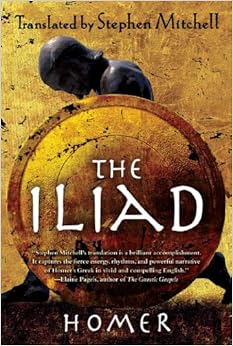
I am, of course, reading it in an English translation; I am still a bilingual illiterate (I can’t read in two languages – one of which is Homeric Greek.)  I found Stephen Mitchell’s translation at my local public library.  It is a vibrant and swift moving translation, not at all dull and stodgy like I had fearfully imagined it would be. 

The Iliad is about honor.  Its setting is the 10 year long siege of Troy, but the story itself is about honor, and the powerful motivating force of besmirched honor.  Menelaus and Agamemnon launch a thousand ships to war against Troy because of Prince Paris’ dishonorable actions.  The great warrior, Achilles, sulks in his tent while other men around him are dying in battle because of a slight to his honor by Agamemnon.  Honor – and the perception of honor – is what drives the characters in this story; they throw themselves into heroic conflict to achieve greatness and to defend their reputations and the honor of their families, and homes. 

Take that away and it all seems rather petty.  A 10 year war because Helen ran away with Paris?  Achilles refuses to join the rest of the Greeks because Agamemnon took away his prize?  The reader must be prepared to set aside modern conventions and to read the story in its own setting. 

One detail that struck me (and often) was the armor stripping.  Every time a hero (either Greek or Trojan) killed an enemy, he made a great show of stripping the armor from his defeated foe, and sometimes of desecrating the corpse (as Achilles did to Hector’s corpse by dragging it behind his chariot for several days). This act would shame his opponent and make the victory all the more glorious (or the defeat all the more shameful for the family and friends of the defeated).

Having spent much of my life reading and studying the Bible, I was curious to see how this Greek classic would compare to that great book (that great collection of books.)  The Iliad is attributed to Homer and said to have been written in the 8th century BCE – though the events that it describes occurred (whatever one thinks of its historicity) in the 12th century BCE – some four hundred years earlier.

That would compare, roughly, to a work written during the time of the Biblical kings and prophets concerning heroes during the time of the Judges (roughly).  There are a few brief flashes of similarity – I think mainly of Samson’s final prayer for his strength to be restored so that he might die an honorable death killing Philistines – but stylistically and conceptually the works are worlds apart.

The gods and goddesses of The Iliad are competitive amongst themselves and capricious in their interventions into the affairs of humans.  They are constantly flicking arrows away from their favorite soldiers, or blocking spears, or whisking wounded men away from battle.  It’s almost a wonder that the people of ancient Greece could get anything done with the constant meddling from Mount Olympus.  By way of contrast, the god of the Bible is comparatively restrained in his interruption of human affairs.  He does intervene, and miraculously, but Yahweh’s a hermetic recluse when compared to the Greek deities.

If you’re like me – somewhat intimidated by this classic of western civilization – take courage.  Be strong and noble; read the story of great men doing mighty things. Plunge yourself into a strange world where honor is praised above all else, where death is glorious on the field of battle, and the gods are fickle. 

I'm going to go on now and read The Odyssey (also by Homer) and The Aeneid (by Virgil) which are both sequels of a sort to The Iliad.  Homer's Odyssey follows Odysseus on his 10 year journey home after the end of the Trojan War, while Virgil's Aeneid tells of Aeneus' survival after the fall of Troy and his wanderings before becoming the ancestor of the Romans.


Homer. The Iliad. Trans. Stephen Mitchell. New York, NY. Free Press. 2011.


Jeff Carter's books on Goodreads
Muted Hosannas Muted Hosannas
reviews: 2
ratings: 3 (avg rating 4.33)

Related Posts with Thumbnails