Pages

google analytics

Showing posts with label John P. Meier. Show all posts

Sunday, November 8, 2015

No More Poor Sermons about the Poor Widow Woman


This passage is probably familiar to us; we’ve heard it preached in countless sermons, read it in numerous devotionals, and faith-based fundraising appeals. We’ve heard, over and over again, the repeated panegyrics for this poor widow woman who gave and gave and gave some more. The church has venerated her and her sacrificial giving and held her up as an example for us to emulate in our daily lives. Yet, for all its oft repeated familiarity, I have rarely heard the passage preached or taught correctly from its context.

Contrary to much of what we have heard over the years, the import of this passage is not in praise for her sacrificial giving (though that is a laudable virtue for the person of faith and those who deny themselves in order to give sacrificially should be commended) but in a stern condemnation of those religious leaders who value the established power system (and their place within it) over the care and protection of those they have been called to serve.

So this morning, let’s do what has been neglected; let’s begin by looking at the larger context of that poor widow’s story. Jesus is teaching within the temple courts (Mark 12: 35). We spoke a bit during last week’s sermon (Hebrews 9: 11 – 14) about the great importance the Temple in Jerusalem held for the followers of Judaism. The temple was important and because it was so important it was also very divisive.

There were some who believed that the temple was so singular and so holy because it had been built by God with his own two hands.[i] Others, like the Christian martyr, Stephen, flatly rejected this and said that God did not dwell in “a house that human hands have built… ‘What house will you build for me, says the Lord, what place for me to rest?’” (Acts 7: 47 – 50 NJB). The Essenes (who may or may not be responsible for the writings known as the Dead Sea Scrolls, found at Qumran) went so far as to pull themselves away from the rest of Judaism because they believed that the priesthood had become corrupt, and that the Temple had been defiled. They separated themselves away from Jerusalem, and set themselves to living by a high standard of ritual purity while they waited for the One who would set things right.

The temple was the center of Judaism’s ritual, even for those who separated themselves from the rest of their fellow believers. They did so because they believed the temple to be of the highest importance. Jesus arrives in the temple at the end of chapter 11 (11: 27) and he stays there through all of chapter 12, teaching and telling parables, and irritating the elites among the various religious groups. When Jesus and his disciples finally leave the temple, at the beginning of chapter 13, they comment to him, “Master, look at the size of those stones! Look at the size of those buildings!” (13: 1 NJB) at which point Jesus launches into a fierce denunciation of the temple and a prediction of its imminent destruction.

“You see these great buildings? Not a single stone will be left one on another; everything will be pulled down.” (Mark 13:2 NJB)

Now keep in mind that it was the perceived disloyalty against the Temple in Jerusalem that got the prophet Jeremiah in so much trouble. In Jeremiah 26 the prophet preached a sermon on the Temple steps, wherein he prophesied its destruction if the people would not repent. For this the priests and the prophets and all the people grabbed him and said, “You shall die!” (Jeremiah 26: 8).  They brought the prophet of God up on charges of disloyalty before the princes and said, “This man deserves the sentence of death because he has prophesied against this house and this city.” (26: 11)

Mark chapter 12 is also full of Jesus’ confrontations with the various Jewish groups; he squares off against the chief priests and scribes and elders (11: 27), the Pharisees and the Herodians (an odd partnership if there ever was one) (12: 13-17), the Sadducees (18 – 27) and the scribes (28 – 44). He speaks roughly to them, chiding them, correcting them – disrespecting them, even… at least, that’s how they certainly perceived his words.

So we find the story of our beloved widow, she of such great generosity and sacrificial giving, within a broader context of condemnation of the religious rulers and of the temple complex. We must read this story, not as a praise of this poor widow woman (though she is to be praised) but as a condemnation of those who would value the power that they wield and the respect they feel they deserve within the religious system over people under their influence.

Our reading this morning begins with Jesus’ ominous words, “Beware of the scribes…” (Mark 12: 38 NJB)

The scribes were those who knew how to read and write – something we sort of take for granted these days, but was a highly prized but not ubiquitous skill in those days.  Intellectuals from the Jerusalem aristocracy and professional scribes, as well as those Pharisees who came from the town ‘bourgeoisie’ would have been able to read, but peasants in the villages didn’t enjoy that same luxury – and women were rarely given the opportunity to learn (Meier “Roots of the Problem” 275). Originally the scribes were those royal officials tasked with recording the events and histories of the royal court but beginning with “Ezra, who established postexilic Judaism upon the Law” (Lohse 115) they eventually they became not only those who could read and write the scriptures, but were charged with preserving tradition as well as interpreting and teaching the scriptures and traditions to others. And because the torah covered every aspect of Jewish life, they decided both theological and legal questions. They had a place of respect among the Jewish community as befitted their lofty calling: they were called, “wise men, teachers of the Law, and masters,” (Lohse 116) as well as Rabbi (teacher).

The professional scribe is praised in the deuterocanonical book of Ecclesiasticus (Sirach) (39: 1- 11) written about 200 years before the time of Jesus:

“He will grow upright in purpose and learning,
he will ponder the Lord’s hidden mysteries.
He will display the instruction he has received,
taking pride in the Law of the Lord’s covenant.
Many will praise his intelligence
and it will never be forgotten.
His memory will not disappear,
generation after generation his name will live.
Nations will proclaim his wisdom,
the assembly will celebrate his praises.
If he lives long, his name will be more glorious than a thousand others,
and if he dies that will satisfy him just as well.”
(Ecclesiasticus 39: 7 – 11 NJB)

That’s pretty high praise for the office of the scribe, but instead of treating them with the dignified respect, and adulation the scribes seem to have come to expect, Jesus says to his disciples, “Beware of the scribes[ii], who like to go about in long robes, and to have salutations in the market places and the best seats in the synagogues, and the places of honor at feasts, who devour widows’ houses and for a pretense make long prayers. They will receive the greater condemnation.” (Mark 12: 28 – 40)

Jesus did not give them a deferential greeting; he did not recognize their dignity. Instead he criticized them for valuing their position of prestige in the community and the service of the temple in Jerusalem, at the expense of the poorest in the community.

The Law, which these scribes purported to value, said: “There must, then, be no poor among you” (Deuteronomy 15:4 NJB). The torah of God placed firm obligations on them to care for the poor and the helpless, the orphans and the widows.  This was the important thing – to love God and to love others – to love God by loving others.

But these religious leaders had come to value their power, their prestige, their honor, their dignity, their authority over the care of the poor. Instead of caring for the poor, they “devoured widow’s houses” and drove people, like our “poor widow” to give their last two copper pennies to the care and maintenance of the symbol of their religious authority.  She gave, out of her poverty, she gave the last little bit of what she had to maintain their glorious prestige – because they had convinced her that it was her religious obligation to do so. They ignored the law that said, “There should be no poor among you,” and used guilt and religious fear to sustain themselves and the exploitative temple complex at the expense of the poor. They devoured the poor.

While the poor widow who gave her last mite might be laudable for her sacrificial giving, those who maintained a system to exploit her mite are mightily condemned. Woe to those who value the system over the message, and their place within the power structure over justice.


Lohse, Eduard. (Translated by John E. Steely) The New Testament Environment, Nashville, TN, Abingdon Press. 1976.

Meier, John P. A Marginal Jew Vol.1: The Roots of the Problem and the Person, New York, NY, Doubleday, 1991.

Meier, John P. A Marginal Jew Vol. 3: Companions and Competitors, New York, NY, Doubleday, 2001.

New Jerusalem Bible. New York, NY. Doubleday. 1999.

"Scribes." Jewish Encyclopedia, n.d. Web. http://www.jewishencyclopedia.com/articles/13356-scribes


[i] If we may take Mekilta Shirata 10. 29 – 42 as helpful even if it was written much later. https://books.google.com/books?id=eaymyOWLPoQC&pg=PA420&lpg=PA420&dq#v=onepage&q&f=false

[ii] We should keep in mind, however, that the Scribes were not a “homogenous religious group with a united theological agenda,” and that it is unlikely, despite their characterization in the synoptic gospels, that they presented “a united front against Jesus” (Meier “Companions and Competitors” 560).

Friday, April 11, 2014

What I’m Reading: The Real Jesus

In the past couple of years I have intentionally been reading books about the “Historical Jesus,” books by scholars like Geza Vermes, John Dominic Crossan, Willie Marxsen, John P. Meier, Raymond E. Brown, and etcetera…  Some I have appreciated.  Others I have rejected.

This week I read Luke Timothy Johnson’s book The Real Jesus: The Misguided Quest for the Historical Jesus and the Truth of the Traditional Gospels[i]   The lengthy subtitle probably gives it away… Johnson isn’t especially keen on the whole “Historical Jesus” thing.  This isn’t a “Historical Jesus” book per se.  It is instead a critique of the whole quest for a Historical Jesus movement in general.

One of the blurbs (gah! how I hate that word) on the back of the paperback copy I have describes the book as “Passionately argued.”  It is that.  Very.  At times you can almost hear the hairs on the back of his neck bristling as he writes.  Not that he ever ventures into viciousness or personal attack.  But Johnson is very passionate about correcting what he understands to be the very egregious errors of the quest for the “historical Jesus,” particularly those errors perpetrated by the Jesus Seminar.

Johnson argues that the specific –facts - of history (which are only available to us with degrees of probable certainty ) cannot be separated from the narrative that gives them framework and meaning.  But that they are not necessary to see and to trust the patterns and, more importantly, the meaning of the Christian faith, and the life, death, and resurrection (being an event entirely outside the scope of the historian’s craft) of Jesus.

But in his effort to swing the pendulum away from the fanciful and far-fetched historical reconstructions of Jesus back toward reasonable scholarship, Johnson is critical of even those who would seem to agree with him- specifically John P. Meier – who affirms with Johnson that the “Historical Jesus” cannot be mistaken for the “Real Jesus” or even the “Theological Jesus” presented in the Gospels.

This bit of over-zealousness, and the fact that the book (written in 1996) already seems quite dated – are the only drawbacks to the book, in my armchair theologian’s opinion.  Otherwise, it’s a healthy corrective to some of the more outlandish claims made about Jesus and the gospels.


[i] Johnson, Luke Timothy, The Real Jesus: The Misguided Quest for the Historical Jesus and the Truth of the Traditional Gospels, HarperCollins Publishers, San Francisco CA, 1996.

Monday, March 31, 2014

Doing Theology by Story - Rethinking My Thinking

  
This post, like my last (I Was Too Critical and Not Critical Enough) are 1) prompted by my recent reading in John P. Meier’s  second volume of his A Marginal Jew series, and 2) efforts to continually rethink my thinking. 

Today I was struck by his use of the phrase “doing theology by story (Meier 922).” [i] In context he is talking about the gospel stories of Jesus walking on the water and cursing the fig tree – stories that he believes go back fairly early in Christian history, but are probably not actual-factual-historical events.  He believes them to be creations of the early Church as a way of “doing theology by story.”

And, honestly I have no real problem with this.  It is the way that I have come to understand several parts of the bible – Noah, Jonah, etc…  These stories, as we have them in our collection of scripture, are (to steal another of Meier’s frequently used phrases) not videotaped replays of historical events.  They are theology embedded in a story. 

But I must confess: I haven’t been fair in applying this.  Way back in 2010 (That’s a long time in internet years…) I wrote about a story told concerning a U.S. Infantry brigade during World War I and Psalm 91. 

As I was reading and researching Psalm 91 … I began to find a story about the 91st psalm repeated over and over on numerous websites, in the exact same words (or only slightly varied) each time.

A story from World War I tells about the 91st Infantry Brigade of the U.S. Expeditionary Army. When it was preparing to enter combat in Europe, most of the men were "green soldiers" who had never seen combat. Its commander, a devout Christian, called an assembly of his men where he gave each a little card on which was printed the 91st Psalm. They agreed to recite the Soldiers' Psalm daily.

The 91st Brigade was engaged in three of the bloodiest battles of WW I: Chateau Thierry, Belle Wood, and the Argonne. While other American units similarly engaged had up to 90% casualties, the 91st Brigade did not suffer a single combat related casualty!

Because of this story Psalm 91 is frequently described as the “soldier’s psalm” and as the “Ultimate Shield,” and you can find Psalm 91 devotional booklets to be distributed to soldiers to keep them safe.

Isn’t that story amazing?  Isn’t it just unbelievable? 

Exactly.  It is unbelievable, because there was no 91st Brigade in the U.S. Expeditionary Army.  Its commander wasn’t a devout Christian.  They didn’t recite the 91st Psalm every morning.  They didn’t fight in three of the bloodiest battles of World War One, and they didn’t avoid the massive casualties that every unit on all sides of that horrible war suffered. The story is not true.

 So on the one hand, I am willing to accept “doing theology by story” when I like the story, or when I like the theology.  But I am (unfairly?) critical of it when I don’t like the story or the theology.  

It’s these questions I’m asking myself now – how far is this “doing theology by story” allowed to go?  What guides or limitations should be in place?  Should the theology conform to, and confirm my understanding of other parts of the bible?  Should the story confirm, and conform to what I have experienced?    Should actual-factual-history be considered?  If so, then how much?  Does it matter that there was no world wide flood, that Jesus may not have walked across the surface of the Sea of Galilee, that there was no 91st Infantry Brigade reciting psalm 91….

I don’t know that I have complete and finalized answers to these questions today. I’m just rethinking my thinking…


[i] Meier, John P. A Marginal Jew Vol. IIL Mentor, Message, and Miracles Doubleday, Garden City, NY, 1994.

I Was Too Critical and Not Critical Enough – Jesus Walking on the Water


Maybe I was too critical (and not critical enough) when I asked the question back in 2012 – Why was Jesus going to walk right past the disciples “in the boat, rowing frantically against strong storm winds… in serious danger of being shipwrecked or drowning and he’s just going to walk right on by them?  I mean, what the heck, Jesus? Did he just not see them?  Or perhaps he didn’t care?”

I wonder now if I was, in one regard, not critical enough in my reading and questioning of this text (Mark 6: 30 – 56) because I was rather careless.  Mark does not say that there was a storm.  Mark tells us that Jesus’ disciples were “straining at the oars, because the wind was against them (6:48).”  There is no sense of storm.  There is no sense of danger.  When the disciples cry out in terror it’s not because of “the storm” (because there wasn’t one) but because they saw Jesus walking on the water and thought he was a ghost (6: 49).

Matthew also tells the story – but there’s no storm in his version either, only that the disciples boat was “buffeted by the waves because the wind was against it (Matthew 14: 24).”  Again there is no sense of life and death peril.   Luke doesn’t tell the story, but John does – and, like Mark and Matthew before him – there is no storm.  John says that “A strong wind was blowing and the waters grew rough (John 6:18).”

So I wasn’t critical enough in my reading. I was sloppy.  In my mind I conflated the story of Jesus walking on the water with the story of Jesus calming the storm (Mark 4: 35 – 41 / Luke 8: 22 – 25).  It was a rookie mistake that I shouldn’t have made. 

And I also ask myself if I was too critical – in the sense of unfair.  My initial impulse was to see Jesus’ actions as a bit calloused. As a bit cruel –walking right on by the disciples as they floundered in the storm… Again, sloppy reading lead to bad interpretation.

I eventually made some sense of it – found understanding in Jesus wanting to test his disciples, to see how far they’d progressed in their faith.  And, apparently, I’m not alone in finding that to be a helpful way to understand Mark 6. 48 and the story as a whole; it is listed by John P Meier in his summary of five various ways the story is explained. “Others interpret the phrase [“he was about to pass by them”] to mean that Jesus wanted to test the disciples’ faith… (Meier, 916)”[i]

Meier, however, suggests a better way to understand the story, as a Theophany – “a striking, extraordinary, and temporary appearance of a divine or heavenly figure in the earthly realm… (996)” The Jesus walking across the surface of the wind driven waves is not an indifferent Jesus, unconcerned for his floundering disciples, neither is it the pop-quiz Jesus surprising his students with a test.  Rather it is Jesus demonstrating to his disciples evidence of his divine nature.

He strides across the surface of the water like Yahweh of the Old Testament:

Job 9: 8 “He alone stretches out the heavens
    and treads on the waves of the sea.”

Psalm 77: 19 “Your path led through the sea,
    your way through the mighty waters,
    though your footprints were not seen.”

Jesus was about to “pass by them” in the same way that the glory of YHWH passed by Moses.

Exodus 33: 22 “and while my glory passes by I will put you in a cleft of the rock, and I will cover you with my hand until I have passed by”

In my previous reading of this story I was too critical and not critical enough.  One of these days I may eventually get it right.


[i] Meier, John P. A Marginal Jew Vol. IIL Mentor, Message, and Miracles Doubleday, Garden City, NY, 1994.

Thursday, March 20, 2014

Jesus the Exorcist – The Jesus I’ve Never Known


Before he was worshipped as the God/man, Lord and Savior, the Historical Jesus of Nazareth was an exorcist.  More than a moral teacher, more than an itinerant rabbi with a cluster of following disciples, more than an eschatological prophet – he was also an exorcist, casting out demons and unclean spirits by the “finger of God" (Luke 11:20). (Meier, 407)[i]

But this Jesus I have never known.

Even though he commissioned his disciples (and, one might assume, those of us who follow these many centuries later) to follow in his footsteps and “gave them power and authority to drive out all demons (Luke 9:1)” this is still a Jesus I have never known.

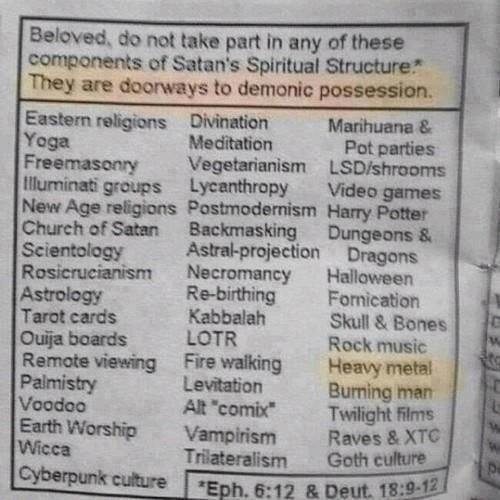
Despite all the warnings I’ve received over the years that watching horror movies, listening to rock music, dancing, playing dungeons and dragons, meditating, dressing up for Halloween, etc… would inevitably lead to demonic possession – or at the very least demonic attack  - I have never experienced anything that I could label “demonic” – meaning something of an evil supernatural spirit activity.

Actually all those warnings had the exact opposite of their intended effect: I wanted to see some supernatural phenomenon. I looked for ectoplasm, tinkered with an Ouija board, lit candles and meditated. I read Bob Larson’s books in preparation for the demonic assault.  But … nothing.

So I’ve never been able to cast out any demons.   Jesus the exorcist is the Jesus I’ve never known.

“Perhaps in no other aspect of Jesus’ ministry does his distance from modern Western culture and scientific technology loom so large and the facile program of making the historical Jesus instantly relevant to present-day men and women seem so ill-conceived (Meier 406-7).”

Still – this movie looks like a load of fun:


[i] Meier John P. A Marginal Jew (Vol.2) Mentor, Message and Miracles, Doubleday, New York NY, 1994

Tuesday, December 31, 2013

What I’ve Read this Year- 2013

These are not  listed in the order I read them, or in order of my favor, or alphabetical order either... just a list.  My reviews and comments are in the links

Fiction
Stephen R. Lawhead – The Silver Hand
Stephen R. Lawhead – The Endless Knot
Stephen R. Lawhead - Byzantium
Alan Goldsher - Paul Is Undead: The British Zombie Invasion
Seth Grahame-Smith - Unholy Night
Madeleine L'Engle - A Wrinkle in Time
Madeleine L'Engle -A Wind in the Door
Madeleine L’Engle - A Swiftly Tilting Planet
Madeleine L'Engle - Many Waters
Katy Stauber - Revolution World
Robert A. Heinlein - The Moon Is a Harsh Mistress
C.S. Lewis - Out of the Silent Planet
C.S. Lewis – Perelandra
C.S. Lewis - That Hideous Strength
Franz Kafka -The Metamorphosis, In the Penal Colony, and Other Stories
Paul L. Maier - Pontius Pilate: A Novel
Jonathan Maberry - Rot and Ruin
Walter Wangerin Jr. - The Book of the Dun Cow
Tad Williams - The Dragonbone Chair
Tad Williams - Stone of Farewell
Tad Williams - To Green Angel Tower (Parts 1 & 2)
Philip K. Dick - The Man in the High Castle
Philip K. Dick - VALIS
Phillip K. Dick - A Scanner Darkly
Philip K. Dick - Do Androids Dream of Electric Sheep?
Philip K. Dick - Flow My Tears, the Policeman Said
Philip K. Dick - A Maze of Death
Jim Butcher - Summer Knight
Brandon Sanderson - The Rithmatist
Frank Herbert – Dune
Frank Herbert - Dune Messiah
Frank Herbert - Children of Dune
Orson Scott Card - Seventh Son
Orson Scott Card - Red Prophet
Orson Scott Card - Prentice Alvin
Orson Scott Card – Heartfire
Orson Scott Card - Alvin Journeyman
Orson Scott Card - The Crystal City
Ben Bova - Jupiter
George R.R. Martin - A Game of Thrones
Cullen Bunn - Deadpool Killustrated  
Clive Barker -The Thief of Always
Richard Adams - Watership Down
Robert Penn Warren - The Cave
Glenn Beck - Agenda 21
William Shakespeare - Hamlet
Henning Mankell - Faceless Killers
Henning Mankell - The Dogs of Riga
Newt Gingrich - 1945  
Dan Brown - Inferno
William Golding - The Inheritors
William Golding - Lord of the Flies
Joseph Conrad - Heart of Darkness  
Vladimir Nabokov - Lolita
Stephen King - Carrie
Stephen King - Joyland
Stephen King - From a Buick 8
Stephen King - The Shining
Stephen King - Firestarter
Stephen King - The Dark Half
Stephen King - Dolores Claiborne
Kim Paffenroth- Dying to Live
Matt Bronleewe - Illuminated
Jeff Lindsay - Darkly Dreaming Dexter

Non-Fiction
Madeleine L'Engle - Bright Evening Star: Mystery of the Incarnation
Deborah Blum - The Poisoner's Handbook: Murder and the Birth of Forensic Medicine in Jazz Age New York
Richard A. Burridge - Faith Odyssey: A Journey through Life
Archibald MacLeish - J.B.
Marvin Meyer -Judas: The Definitive Collection of Gospels and Legends about the Infamous Apostle of Jesus  
Charles R. Pellegrino - Return to Sodom and Gomorrah: Bible Stories from Archaeologists
Laurence Gardner - Bloodline of the Holy Grail (here, here, and here)
John Larsson - 1929
Edward Jay Epstein - The Annals of Unsolved Crime
Langston Hughes - Langston Hughes
Thomas Cahill - Desire of the Everlasting Hills: The World Before and After Jesus
Bill Bryson - Made in America: An Informal History of the English Language in the United States
Marion L. Soards - Scripture and Homosexuality: Biblical Authority and the Church Today
Valerie Mindlin - The Epic of the Maccabees
E.P. Sanders - The Historical Figure of Jesus
Travis Walton - Fire in the Sky: The Walton Experience
Louis Untermeyer - The Pan Book of Limericks
Lee Gurga  - Haiku: A Poet's Guide
Susan Stryker - The Transgender Studies Reader
Joseph Reino - Stephen King the First Decade: Carrie to Pet Sematary
Kenneth E Bailey - Open Hearts in Bethlehem: A Christmas Drama
Raymond E. Brown - An Adult Christ at Christmas
Michael J. Nelson - Mike Nelson's Mind over Matters
Jason Draper – A Brief History Album Covers
Marcella Althaus-Reid - Indecent Theology


Thursday, January 17, 2013

Mistaking a Marginal Jew


I have, in the past several days, been reading John P. Meier’s book A Marginal Jew: the Roots of the Problem and the Person. This is one of the books that I bought with my Christmas gift card.  Great stuff.  This is the first of four volumes by Meier in this series.  Last year I read Volume Three: Companions and Competitors.  I realize that I'm reading them out of order.  It doesn't bother me all that much.

PhotobucketI have only recently become interested in reading about “the historical Jesus” but I have for years seen references to Meier’s work in other books that I’ve read.  And, not knowing the book, I misunderstood the title. My mistake wasn't as extreme as the illustration to the right might suggest, but was a powerful mistake none-the-less.  In those days of ignorance I thought “historical Jesus” books were all trying to disprove the fact of and faith in Jesus.  And I thought the title “A Marginal Jew” was an attempt to denigrate Jesus in some way.

Ignorance is a terrible thing.

Meier intends his description of the historical Jesus as a “marginal Jew” to be an invitation to discussion and inquiry.  It’s meant to be a bit ambiguous and a bit of a riddle.  But it is not (as I wrongly assumed) intended to marginalize Jesus.

From the historian’s vantage point, Jesus was marginal.  He lived in a remote corner of the Roman Empire, he didn’t travel outside of his homeland, he didn’t found a school, and he left behind no writings.  And, outside of the New Testament authors, he is hardly mentioned among writers of the time.  He was not a world leader.  He held no position of prestige or honor. He abandoned his career as a carpenter to become a homeless, itinerant preacher, and was condemned and executed as a common criminal.  In these ways, and many more, Jesus was only a “marginal” Jewish figure.

And yet the mystery and wonder is that this marginal figure has become the central figure of much of world history since. 

Meier’s book attempts to answer the question: What can we know about the historical Jesus?  Can we prove that he existed? Can we know something (anything) about his life and teaching?  The gospels, written in the afterglow of the resurrection, are documents of faith, not historical, objective fact.  But does that mean we must reject them completely as sources of historical information?  And though there was precious little written about him outside of the New Testament, do these extra-canonical sources help us to know him any better?

Anyone interested in better knowing the person of Jesus should read these books.


Friday, December 28, 2012

What I'm Reading - Books of 2012

This is a more or less complete list of the books I read this year.

Fiction
Fantasy
The Silver Hand – Stephen Lawhead
The Paradise War – Stephen Lawhead
Shadowheart – Tad Williams
Shadowrise – Tad Williams
Shadowplay – Tad Williams
Shadowmarch – Tad Williams
Dragons of Autumn Twilight – Margaret Weis
A Lion Among Men – Gregory Maguire

Science Fiction
Have Space Suit – Will Travel – Robert Heinlein
Nebula Awards Showcase 2010 – ed. Bill Fawcett
Mostly Harmless – Douglas Adams
Young Zaphod Plays it Safe – Douglas Adams
So Long, and Thanks for All the Fish – Douglas Adams
Life, the Universe, and Everything – Douglas Adams
The Restaurant at the End of the Universe – Douglas Adams        
The Hitchhiker’s Guide to the Galaxy – Douglas Adams
Epic – Conor Kostick
Ready Player One – Ernest Cline

Horror / Graphic Novels
Coldheart Canyon – Clive Barker
The Regulators – Stephen King
The Crossroads – Chris Grabenstein
Hold Me Closer, Necromancer – Lish McBride
Ghost Knight – Cornelia Funke
Batman: The Long Halloween – Joseph Loeb
Just After Sunset – Stephen King
The Walking Dead – Rise of the Governor – Robert Kirkman
Dying to Live – Km Paffenroth
11/22/63 – Stephen King

Classics 
A Portrait of the Artist as a Young Man – James Joyce
Murder on the Orient Express – Agatha Christie
Silence – Endō ShÅ«saku
Dead Souls – Nikolai Gogol
Crime and Punishment – Fyodor Dostoyesky
The Plague – Albert Camus
The Brothers Karamazov – Fydor Dostoyevsky

Historical / General Fiction
The Heretic’s Daughter – Kathleen Kent
Guns of the South – Harry Turtledove
The Closers – Michael Connelly
The Reluctant Fundamentalist -  Mohshin Hamid
The Casual Vacancy – J.K. Rowling

Religious Ficition
Soul Harvest – Tim LaHaye and Jerry Jenkins
Apollyon – Tim LaHaye and Jerry Jenkins
More than a Skeleton – Paul Maier
A Skeleton in God’s Closet – Paul Maier
Mary of Nazareth – Marek Halter

Non-Fiction
Science
The Hidden Reality: Parallel Universes and the Deep Laws of the Cosmos – Brian Greene
A Short History of Nearly Everything – Bill Bryson

History / Biography
The Rocket and the Reich: Peenemünde and the Coming of the Ballistic Missile Era – Michael Neufeld
Moscow 1941: A City and It’s People at War – Rodric Braithwaite
The Devil in the White City: Murder, Magic, and Madness at the Fair that Changed America – Erik Larson
Night – Elie Wiessel

Theology / Bible
Introduction to the New Testament – Raymond E. Brown
The Historical Jesus: Ancient Evidence for the Life of Christ – Gary Habermas
The Changing Faces of Jesus – GĆ©za VermĆØs
Ante-Nicean Fathers : Volume 1 ed. Alexander Roberts
Ephesians 1 – 3 – Markus Barth
And I Turned to See the Voice: The Rhetoric of Vision in the New Testament – Edith Humphrey
Beginnings: Keys that Open the Gospels – Morna Hooker
John’s Apologetic Christology: Legimation and Development in Johannine Christology – James F. McGrath

Devotional
The Imitation of Christ – Thomas Ć  Kempis

Philosophy / Psychology
Green Lantern and Philosophy: No Evil Shall Escape this Book – ed. Jane Dryden
Batman and Psychology: A Dark and Stormy Knight - Travis Langly

True Crime
Preacher’s Girl:  The Life and Crimes of Blanche Taylor Moore – Jim Schutze
Vulgar Favors: Andrew Cunannan, Gianni Versace, and the Largest Failed Manhunt in U.S. History – Maureen Orth
My Life Among the Serial Killers: Inside the Minds of the World’s Most Notorious Murderers – Helen Morrison

Friday, December 21, 2012

Hurrah for Christmas Present Books

I received a gift card for books for Christmas - best gift ever. And though they won't arrive until after Christmas day, I'm still very excited.

What did I order, I hear you asking...

A Marginal Jew: Rethinking the Historical Jesus: The Roots of the Problem and the Person, Vol.1  by John P. Meier
The Apocalyptic Jesus: A Debate by Dale C. Allison
Jesus, Criteria, and the Demise of Authority - by Chris Kieth & Anthony Le Donne
and
The Burial of Jesus: History and Faith - by James McGrath

You can accuse me of being a nerd.  I don't care.  I've got some great books to read.

Monday, October 8, 2012

Simon the Fundamentalist


Christ you know I love you
Did you see I waved
I believe in you and God
So tell me that I’m saved

Christ what more do you need to convince you?
That you've made it, and you're easily as strong
As the filth from Rome who rape our country
And who've terrorized our people for so long [i]


As much as I love this song, it’s time to let go of the romantic, revolutionary picture of Simon the Zealot.  He seems to be a misguided fabrication. 

Simon the Zealot – one of the chosen 12 followers of Jesus  (Matthew 10:4, Mark 3:18, Luke 6:15, Acts 1:13) has sometimes been described as a member of the Jewish revolutionary group the Zealots,  as one who called for violent and armed rebellion against the occupying forces of the Roman Empire.  It is in this tradition that Simon sings in Jesus Christ Superstar

There must be over fifty thousand
Screaming love and all for you.
And everyone of fifty thousand
Would do whatever you ask him to.
Keep them yelling their devotion,
But add a touch of hate at Rome!
And you will rise to a greater power!
We will win ourselves our home!
And you'll get the power and the glory!
Forever and ever and ever!
And you'll get the power and the glory!
Forever and ever and ever![ii]

But the Zealots, as an organized Jewish group like the Pharisees, Saducees, and Essenes, didn’t really exist until the First Jewish War – founded specifically during the winter of A.D. 67 – 8 in Jerusalem by Judas of Galilee.[iii]  To describe Simon, the disciple of Jesus, as a member of this group is an anachronism.   It makes for great drama and exciting movies, but it’s inaccurate.

Instead we should maybe think of him as Simon the Fundamentalist.

Zealotry, in this way, is behavior motivated by a jealous desire to protect one’s self, group, space, or time from violations.[iv]  The Zealots were Jews who were intensely fierce protectors of the torah, insistent that their fellow Jews  strictly observe the Mosaic law to distinguish and separate themselves from the idolatry and immorality of the people groups that surrounded and occupied them.

They took for their model and hero the priest and grandson of Aaron, Phinehas, who thrust his spear through an Israelite man and his wife (mid-coitus) because they were idolaters (Numbers 25: 1 – 13).  This zeal was aimed inward at their fellow Israelites, rather than outward toward the Romans.   The Zealots during the time of Jesus were more intent on making sure that the Jews rigorously and strictly observed the laws of the torah than in seeing the Romans ejected from the country.

And this fits with what we know of Galilee during the time of Jesus.  Galilee during those days was ruled by the Jewish (half Jewish) prince, Herod Antipas, and not directly by the Romans.   Herod Antipas did, of course, answer to Rome, but was clever enough to avoid offending the religious sensibilities of the people he governed. 

It also fits with what we know of another person in the New Testament – Paul, formerly Saul – who described himself as a “former zealot” (Galatians 1: 13 – 14, Philippians 3: 6).  He was zealously motivated to protect the law – even to the point of using violence to force Jews to observe the law. 

So, as exciting as it is to think of Simon the Zealot as a revolutionary figure bravely fighting against the imperial forces of Rome, we should let it go.  It’s not an accurate picture.  Instead think of him as Simon the Fundamentalist.  This is closer to the truth.


[i] Simon Zealotes / Poor Jerusalem – from the Rock Opera Jesus Christ Superstar by Andrew Lloyd Webber and Tim Rice.
[ii] Ibid.
[iii] Meier, John P. A Marginal Jew: Volume III- Companions and Competitors,
Doubleday, New York NY, 2001. Page 205

[iv] Anchor Bible Dictionary Volume VI page 1044.

Friday, September 28, 2012

I've Discovered 'A Marginal Jew'


I went to the Newton public library the other day and, in perusing the shelves, I discovered John P. Meier's book A Marginal Jew: Volume 3 Companions and Competitors.  (Our libary doesn't have volumes 1 and 2 or 4...)

I've seen these books referrenced in other books that I've read, but I haven't read them.  And I've misunderstood the title - "Marginal Jew..."  But now that I've started reading, I'm really rather impressed and am eager to track down (and or purchase) the entire series.

For a 'brief' summary and an interesting lecture by the author, you might like to watch the following video:


Jeff Carter's books on Goodreads
Muted Hosannas Muted Hosannas
reviews: 2
ratings: 3 (avg rating 4.33)

Related Posts with Thumbnails