Pages

google analytics

Showing posts with label Raymond E. Brown. Show all posts

Sunday, April 16, 2017

I May not Understand It (Matthew 27: 50 – 54)


I must say, right up front, that I do not understand the resurrection of Jesus. I believe it, I gratefully accept it, I receive it in faith – but I do not understand it. It is beyond our comprehension. It is outside of all human experience. There were no eyewitnesses to it. It cannot be replicated in a laboratory. I do not know what to make of it

But I am, fully, unabashedly, grateful for what it makes of me.

And yet, the Gospel of Matthew makes the story even more difficult to comprehend, if that were even possible. If the supernatural resurrection of Jesus weren’t enough, Matthew also describes a number of concurrent phenomena that threaten to boggle our already reeling minds. At the moment of Jesus’ death on the cross, the veil of the temple in Jerusalem was torn in two from top to bottom, the earth shook violently enough to split rocks and to burst open a number of tombs – from which the bodies of many holy men and women who had died were raised. And these resurrected saints went into the city of Jerusalem and seen by many.

We could almost explain them with a naturalistic explanation – an earthquake (to which the region of Jerusalem is prone as it is located along a fault line known as the Dead Sea Transform (also called the Syrian-African Rift)) shook the area at about the time of Jesus’ death. Damage from this earthquake caused the veil in the temple to fall, and it fell it was torn in two. The earthquake caused rocks to fall from the steep cliffs around Jerusalem and they were shattered on the ground below, and tombs – which were carved into the stony hills of the region – were cracked open and… the bodies of dead saints were …..

Yeah. That’s where a naturalistic explanation falters. There’s no natural way to explain the revivification and reanimation of numerous dead bodies. It is a fantastical event, to be sure, so far outside the realm of normal, natural, human experience as to be almost unbelievable.

Did it happen? Did it literally, historically happen just this way?

If so, there is a curious lack of historical evidence for it. There is no physical evidence of Jesus’ resurrection, either of course. But where one raised, and resurrected body could be denied, discredited, and ignored, where one resurrection could be overlooked, it seems like a mass evacuation of graves in the area around Jerusalem would have attracted some attention, that it would have been noticed (by someone other than Matthew)[i]. “…Many interpreters balk at the thought of so many risen dead being seen in Jerusalem. Such a large scale phenomenon should have left some traces in Jewish and / or secular history” (Brown “Eschatological” 64).  But there’s no trace of this mass resurrection in Jewish writings, or in secular histories. Nothing in Josephus (the Jewish historian). Nothing in Roman government reports. Nothing in the Talmud. Nothing.

And if it did occur – literally and physically just this way – we might have expected the other New Testament writers to mention it, but they don’t. Jesus’ resurrection is there, of course; it is the central theme of the New Testament, without which the whole thing would be in vain (1 Corinthians 15: 14), but there’s nothing in the writings of Paul, in the other thee gospels, in the other epistles or in the Revelation given to John on Patmos about these walking dead.[ii]

This small sliver from the gospel of Matthew is the only place where we read about the raising of the many dead holy ones at the time of Jesus’ resurrection.[iii] And though the “argument from silence” is not the strongest argument to be made, we do wonder why, if many holy ones were raised up from their tombs and were seen by many people in the city of Jerusalem, why nothing of them is said anywhere else. Maybe the bodies of many saintly women and men were restored to life and were seen walking around the streets of Jerusalem in the days after Jesus’ resurrection, but if they did, no one except for Matthew seems to have said anything about it.

But what if we were to read these phenomena not as literal, physical, historical happenings, but as poetic symbols of what’s happening in Jesus’ death and resurrection. There is symbolism here (Barclay 409) and we should take note of it.

Jesus’ death and resurrection is such a powerful event that the effects of it are felt throughout the whole of creation. There is darkness in the heavens (Matthew 27: 45) as the sun is dimmed for several hours. There is a tremendous shaking of the earth (Matthew 27: 51).  And the underworld is opened, releasing those who were dead back into the realm of the living. The heavens, the earth, and what is under the earth are all affected by Jesus’ death and resurrection.

And being found in appearance as a man, He humbled Himself and became obedient to the point of death, even the death of the cross. Therefore God also has highly exalted Him and given Him the name which is above every name, that at the name of Jesus every knee should bow, of those in heaven, and of those on earth, and of those under the earth, and that every tongue should confess that Jesus Christ is Lord, to the glory of God the Father. (Philippians 2: 8 – 11 NKJV)

These are apocalyptic, eschatological symbols here – signs of the end, symbols of powerful judgement, but also symbols of powerful grace. Darkness and earthquakes – these are your standard biblical expressions of the kind of judgments to be seen at the end. The prophets spoke this way: of the darkening of the sun and the falling of the stars and of earthquakes shaking the land… These were signs of judgment and wrath at the end. But this terrible and tragic ending (Jesus’ death), is also the beginning of something wonderful and new (Jesus’ resurrection) – which is why we also have the resurrection of these holy ones. They are the symbols of Christ’s resurrection and the resurrection life given by Christ to his followers.

It is the resurrection power of God’s action that is important here, not the identification of those raised saints who were seen in the city afterwards. (Brown “Death” 1126) It is the fact that the way is open, and that access to God has been made possible through Jesus’ death and resurrection that is important, not which of the Temple veils Matthew intended to describe[iv].

I may not understand Jesus’ resurrection – it is outside human experience, it stands without eyewitnesses, it cannot be repeated or duplicated. But I accepted it and receive it with thanks and praise to God. I definitely do not understand Matthew’s description of these fantastic phenomena, but I accept them too, as symbols of the mighty work of God. Jesus’ death and resurrection tears the fabric of the universe, even as it tears the fabric of the temple veil, shakes the foundations of the universe even as it shakes the rocks and hills of Jerusalem. And Jesus’ death and resurrection brings life to those who are dead. I may not understand, but I accept it and receive it with thanks and praise. And I say, along with the Roman centurion, who had seen the earthquake and all that was taking place, “in truth this man was – and is – son of God.”


Barclay, William.  The Gospel of Matthew Volume 2. Philadelphia, PA: The Westminster Press. 1958. Print.

Brown, Raymond E. The Death of the Messiah: Volume Two. New York, NY: Doubleday. 1994. Print.

Brown, Raymond E., “Eschatological Events Accompanying the Death of Jesus, Especially the Raising of the Holy ones from their Tombs” Faith and the Future: Studies in Christian Eschatology. NY: Paulist Press, 1994. Print.


[i] Yes. I know the author of the Gospel of Matthew (whoever he was) was not an eyewitness to any of the events in his gospel
[ii] There were not zombies, either. (Though that might make for a great story…)
[iii] And there’s debate: were these saints raised as Jesus died, or were they resurrected after? Matthew is a little ambiguous on the point.
[iv] And there is debate about which of the two or three veils Matthew intended. (Brown “Death” 1110 – 1113)

Sunday, April 10, 2016

Through the Dark, Toward the Dawn (a sermon on John 21)


“I’m going fishing,” Peter said. What else do you do when you’ve lost everything, but go home? What can you do when the way is blocked, the future dark? You go home, back to what you know, or what you knew, or what you thought you knew.  “I’m going back home, back to fishing.”

Peter hadn’t read Thomas Wolfe’s novel or he might have known, “You can’t go back home to your family, back home to your childhood…back home to a young man’s dreams of glory and of fame…back home to places in the country, back home to the old forms and systems of things which once seemed everlasting but which are changing all the time – back home to the escapes of Time and Memory.” (Wolfe)

You can’t go home again, not really. But who could blame Peter for trying? “I’m going back to fishing, back to what I know, back to where I know or where I knew or where I thought I knew who I was and what I was doing.”

And the others with him: Thomas (the Twin), Nathanael (from Cana), the Thunder Brothers-James and John (the sons of Zebedee) and two others said, “We’ll go with you. What else have we got to do? What have we left to lose?”

Jesus, their rabbi, their teacher, was gone. Jesus, their friend, was dead. Killed in a grisly execution. And the three years that they’d followed him were gone. All that time lost. Wasted. So they went, or tried to go, back home, back to Galilee, back to fishing, back to the smell of the wet wooden boat, and the wind off the water, the smell of leather aprons and the fleshy smell of fresh caught fish. They went back to hands calloused by flaxen nets (Hanson) and muscles sore from the repetitive motion of throwing out and drawing in the heavy sodden nets.

And there on the Sea of Tiberias (an overblown name if ever there was one for that lake, 13 miles long, 8 miles wide and less than 200 feet deep) Peter and his friends spend a long night fishing.  They fished at night because it was cool, and throwing and drawing the nets was hot, sweaty work. They fished at night because that’s when the fish were more active and more easily caught. (Brown 1069)

But perhaps they also went fishing at night because it was dark. Because it was easier to hide. They could hide in the dark out on the lake the same way that they had hid in that closed and locked room in Jerusalem, hiding in fear of the Jews. Hiding because maybe they knew, without having read Thomas Wolfe’s novel, they couldn’t go home again. Maybe they were familiar with the Greek philosopher Heraclitus’ cryptic utterance, “Ever-newer waters flow on those who step into the same rivers." - No man ever steps in the same river twice; no one ever fishes in the same lake twice. Everything changes.

Would there have been a chorus of “I told you so” greetings from former friends and family members they had left three years prior to follow that itinerant rabbi from Nazareth? Would there have been scorn and mockery? “Here come the ones who thought they would change the world? What happened to all your idealistic talk about peace, and love, and the Kingdom of God?” Would there have been, perhaps, a measure of fear as well?  After all, if their rabbi and master had been arrested and executed as a common criminal, what could be said of these, his followers, skulking back into town?

So Peter and the others went back to what they thought they knew, back to Galilee and back to fishing, back to calloused hands and tired backs and spent the night fishing on the lake in the dark. But, as sure as you can’t go home again, Peter and the others couldn’t go back to fishing. Not really. They fished all night and they caught nothing. Nothing. Not a thing. Each and every time they threw out the net they hauled it back into the boat empty. They blistered their hands and strained their muscles for no reward.

Perhaps it should be noted that we never actually read in any of the four canonical Gospels of the disciples catching any fish except with Jesus’ help. (Brown 1071)

I usually try to refrain from using clichés in my sermons, but sometimes they prove helpful. The proverbial statement that “it’s always darkest before the dawn”[1] isn’t exactly true scientifically; it is darkest at the midpoint between dusk and dawn, when the half of the earth experiencing night time is facing 180° from the sun. It may not be physically true, but it feels right. In a metaphoric, poetic sort of way it is true. Things just can’t seem to get any worse for Peter and the other disciples. Everything is lost and broken; the past is gone and the future is dead. But then comes the dawn. Then comes the light of the rising sun, an appropriate symbol for the risen Lord.

Dawn finds our dejected disciples about to give up. There’s nothing left for them, not even fish. It’s then that they are hailed by a strange figure on the shore, his features obscured by distance and early morning fog. “Boys, you haven’t any fish, have you?”

The disappointed disciples answer, “No.” And the stranger on the shore, a mere one hundred yards away, told them to throw their net on the right side of the boat, that there they would find a large catch of fish. This isn’t necessarily a miracle. It was common practice for fishers on the Sea of Galilee in their boats to use a spotter on the shore to help point out large schools of fish. The disciples, as exhausted as they were, threw the net out one more time, on the right side and, just as the stranger said, they found the fish. The nets were full and straining, but did not rip. They were unable to pull the net into the boat they caught so many fish.

This may not have be a miracle, in the same way that water was turned to wine, or the way the royal official’s son was healed in Capernaum, or the paralytic was healed at Bethsaida, or the crowd was fed on the Galilean hillside. It may not have been a miracle in the way that Jesus walked upon the waves of the sea of Galilee or the blind man was made to see at the Pool of Siloam, but something in this event, something in the unexpected catch of fish triggered in “the disciple that Jesus loved” a sudden recognition: “It is the Lord!”

The risen Jesus is strange and unrecognizable Lord. Even when seen he is unseen, unrecognized. Mary Magdalene in the garden early Easter morning saw him, spoke to him even but did not see him. Not until he called her by name. Then a sudden recognition came to her. And again sometime later, as the disciples prepared to come ashore with nothing in their nets and nothing in their lives, they saw and spoke to the risen Lord, but did not see him. Not until the sudden catch of fish. And even then they’re not really sure.

On the shore they share a meal with the Lord of fresh cooked fish and bread, cooked over a charcoal fire, but even they as they are sitting at his feet, sharing a communal meal with their rabbi, their Lord, they still not quite see him for who he is. This is so strange that none of them dared to ask, “Who are you?” because they knew it was the Lord. They saw, but couldn’t see. They knew but couldn’t understand. “They recognize him, but are puzzled and unsure. The Jesus they knew has undergone transformation in becoming the risen Lord” (Brown 1076).

This is how the darkness is broken and dawn blooms over the horizon, how light breaks in and spills over the lake and their lives. It is a sudden recognition, a sudden (but still incomplete) understanding. Jesus meets with his confused and disconsolate disciples with an intimate meal on the lakeshore. They’d shared a meal of bread and fish with him on alongside this lake once before (John 6: 1- 15). He’d shared with them the bread of life, the bread that came down from heaven. He’d shared with them the kingdom of God and as he shared that simple meal on the shoreline with them they slowly began to understand.

The light of dawn does not come all at once, it grows in intensity and brilliance till the morning is bright and clear. And an understanding of the Kingdom of God – with peace and joy and confidence – does not come all at once to the disciples (or to us), it grows in intensity and fullness. It comes in fits and starts, with the occasional sudden realization-an a-ha moment (It is the Lord!)-and with slow gradual understanding (They dared not ask him, “Who are you?”).

Moments of darkness and doubt and confusion, long dark nights of the soul when all seems like loss, and waste, and death will be part of our Christian life. This is unavoidable. We will have times when, despite all our effort, we come up empty and unfulfilled. We may want to give up and go home, go back to what we thought we knew, and who we thought we were. But the way (and we are followers of the Way) is forward through the dark, toward the dawn, from loss and despair to renewed joy and comfort in the risen Lord.


Brown, Raymond E. The Gospel According to John xiii-xxi: Introduction, Translation and Notes. Garden City, NY: Doubleday and Company, Inc. 1970. Print.

Hanson, K.C. “The Galilean Fishing Economy and the Jesus Tradition.” Biblical Theology Bulletin Vol. 27. 1997.

Wolfe, Thomas. You Can’t Go Home Again. New York: Harper and Row. 1940. Print.


[1] Which may go back to Thomas Fuller’s 1650 work A Pisgah Sight of Palestine

Saturday, September 12, 2015

Dealing with Disagreement within the Ranks: Attacking (and Becoming) the Enemy


The Salvation Army, like every other denomination, has a set of doctrinal statements that defines our expression of the Christian faith. However, like every other denomination, we have within us a spectrum of ways in which those statements are interpreted. We have our share of disagreements. And this causes friction.

I have, in recent weeks, been thinking a lot about how to handle these disagreements within the ranks of the church, and I’ve been writing a series of short blog posts on the topic.  And while I’ve been writing them with my experiences in my own denomination in mind, I hope that the posts will be helpful to the broader Christian community as well. 

One of my more vocal critics has commented, “Jeff – you appear to consider the biblical methods that only appeal to you, while deliberately ignoring the more forceful methods the scriptures teach.”

He then listed for my edification: Romans 16: 17 – 18, 2 John 1: 10 – 11, and Matthew 7: 15 – 19.

It has not been my intent to “cherry pick” only the verses that appeal to me, or to paint myself as some sort of saint. In fact, I’ve tried to allow that these biblical methods apply to us all, even if it could be demonstrated that I am wrong. But, in an effort to ameliorate my critic’s accusation, let me treat another biblical approach to dealing with disagreement – one that he brought up for me in 2 John 10 -11 – and more broadly in all three of the Epistles of John.

These epistles, written by the unidentified “presbyter,” were written to address the encroaching of what the author felt to be a damnable heresy into the Johannine community of Christians – 1 John being addressed to the house churches of a large, metropolitan area (perhaps Ephesus, as in tradition) to reinforce their loyalty to the doctrine that they have received, 2 John to the members of the provincial community nearby, in order to warn them of dangerous missionaries with false ideas, and 3 John written to other nearby house churches, within the city, to elicit their hospitality and support for the presbyter’s emissaries. (Brown 99)

The thing about these heretical missionaries is that they came from within the Johannine Christian community, “they have gone out from among us.” (1 John 2: 19) They were not outsiders coming in with what the presbyter saw as a dangerous message, but insiders who had gone wrong. “The adversaries were not detectably outsiders to the Johannine community, but the offspring of Johannine thought itself, justifying their positions by the Johannine Gospel and its implications” (Brown 107).

To understand the presbyter’s hostility towards this group we need to go a little further back in history. In the years prior to the Jewish revolt against the Roman Empire and the destruction of the temple in Jerusalem in A.D. 70, it would have been possible (and more accurate) to speak of Judaisms (plural) rather than Judasim (singular). There were numerous competing groups of religious Jews, each claiming to be an authentic expression of the Jewish faith. The more well-known of these were the Pharisees, the Sadducees, the Essenes, and the Zealots – but there were other various shades along the spectrum of the faith. We should also include in this listing the nascent Christian community – who did not yet consider themselves to be a separate faith, apart from Judaism. Until its destruction, the Christians still worshipped at the Temple, and they gathered with their Jewish coreligionists in the synagogues.

After the failed rebellion, most of these groups disappeared, and Judaism came to be defined largely by what was left of the Pharisee branch. And, in that precarious world struggling to preserve a Jewish identity, the theological disagreements between “the Jews” and the Christians became more apparent and more divisive. There was less tolerance for diversity under the Jewish umbrella.  Whereas before the rebellion there might have been a forbearance for other groups, afterwards there was a perceived need for unity.  And the Christians were eventually expelled from the synagogues. 

It was during this time that the “18 Blessings” of Jewish prayer were formulated by the rabbis.  The 12th of these blessings is known as the “Blessing on the Heretics” (blessing here being a euphemism for curse). Though the identity of the heretics in question is debated, it is thought by many to be reference to Christians: “For the apostates let there be no hope. And let the arrogant government be speedily uprooted in our days. Let the noẓerim (possibly Nazarenes – i.e. “Christians”) and the minim (“heretics”) be destroyed in a moment. And let them be blotted out of the Book of Life and not be inscribed together with the righteous. Blessed art thou, O Lord, who humblest the arrogant"

The Gospel of John seems to have been composed in the wake of this expulsion. You can easily see the vitriol and antagonism heaped upon “the Jews” in that gospel. They are children of their father, the Devil (John 8:44). This schism seems to have created a starkly dualistic mindset in the Johannine Christian community. Everything was understood in this binary, us-vs- them attitude. They are children of darkness, we are children of light. We have truth, they have only falsehood. We are from above, they are from below. We are children of God, they are children of the Devil. They hate us. They kill us!

The split was acrimonious and the hostility dangerously hateful. 

By the time we come to the Epistles of John, the threat is no longer an external one (Them! “the Jews!) but comes from within. Proponents of diverging interpretations of their text – the Gospel of John – began taking sides against one another. And that starkly, dualistic, us-vs. them attitude, refined during the community’s conflicts in the Jewish synagogue, turned inward. The presbyter, the author of the Epistles of John (who was, most likely, not the same as the Evangelist who wrote the Gospel) turned that invective inward.

“As understandable as this sense is, this dualistic articulation is dangerous, and in fact it encouraged Christians of later centuries to see a dualistic division of humankind into believers (Christians) and non-believers, into an ‘us’ who are saved and a ‘them’ who are not. Inevitably such a dualistic outlook will shift over into divisions within the ‘us’ and the cannons that once pointed outwards to protect the fortress of truth will be spun around to point inwards against those betraying the faith from within” (Brown 134 – 135).

Thus the presbyter can refer to those preaching a different interpretation of their shared gospel as “Antichrists” (1 John 2: 18 – 23, 4: 3, 2 John 7) as “deceivers” (2 John 7) trying to lead you astray (1 John 2: 26, 3: 7) as belonging to the devil (1 John 3: 8 – 10), as false prophets (1 John 4: 1) and etc. This is sourly ironic language in letters that repeatedly insist on the need to “love one another.”

This seems to be the method of dealing with disagreement preferred by my critic. He has on several occasions questioned my salvation, and called me a “false officer.” In one spectacularly over-the-top outburst of vitriol he wrote the following – and although he didn’t call me out by name, I’m quite sure that he had me (among others) in mind.

False teachers! Wolves and serpents among the flocks of God's people! Devils dressed in robes of priestly garb; falsifiers! Disgusting! Repulsive! Uncircumcised wretches of erupting evil! Dissenters and liars filled with hell and heresies of old! Darkness has consumed them! Satan has enchanted them with all the pleasantries of the world and like worms they burrow themselves deep into the mission field where the weak are led astray by their winds of wandering illusions of relativism and subjectivism.

You are children of the harlot riding the beast - indulging yourselves in all the fanciful pleasantries of worldliness. I am sickened to my soul by your words and driven to righteous indignation by all your divisive chatter and scheming! The Lord is coming with His sword of righteousness to lay low His enemies which dare to insult Him with their insolence, ignorance and rebellion against His Holy Word. (1)

My critic seems to have mastered the Presbyter’s invective – surpassed him, even. But this approach to dealing with disagreements is dangerous. While it may (potentially) be effective in preserving truth (or one interpretation of truth), this approach effectively turns us into the enemy that we hate. The Presbyter failed to see that by insisting that “if anyone comes to you bringing a different doctrine, you must not receive him into your house or even given him a greeting,” (2 John 10) he was acting in exactly the same manner as “the Jews” who had expelled the Christians from the synagogue.  In attacking the enemy, he became the enemy.

“Those who believe that God has given His people the biblical books as a guide should recognize that part of the guidance is to learn from the dangers attested in them as well as from their great insight” (Brown 135). This forceful method of dealing with disagreement may be effective in putting disagreements to a quick and decisive end, but at what cost?


 - I highly recommend this book:
Brown, Raymond E. The Community of the Beloved Disciple: the Life, Loves, and Hates of an Individual Church in New Testament Times. New York. Paulist Press, 1979.


(1) This is part of a much longer post that was shared on Facebook on August 18. I was later expelled from the group where it was posted, and unfortunately do not have a screen shot to display.

Friday, April 11, 2014

What I’m Reading: The Real Jesus

In the past couple of years I have intentionally been reading books about the “Historical Jesus,” books by scholars like Geza Vermes, John Dominic Crossan, Willie Marxsen, John P. Meier, Raymond E. Brown, and etcetera…  Some I have appreciated.  Others I have rejected.

This week I read Luke Timothy Johnson’s book The Real Jesus: The Misguided Quest for the Historical Jesus and the Truth of the Traditional Gospels[i]   The lengthy subtitle probably gives it away… Johnson isn’t especially keen on the whole “Historical Jesus” thing.  This isn’t a “Historical Jesus” book per se.  It is instead a critique of the whole quest for a Historical Jesus movement in general.

One of the blurbs (gah! how I hate that word) on the back of the paperback copy I have describes the book as “Passionately argued.”  It is that.  Very.  At times you can almost hear the hairs on the back of his neck bristling as he writes.  Not that he ever ventures into viciousness or personal attack.  But Johnson is very passionate about correcting what he understands to be the very egregious errors of the quest for the “historical Jesus,” particularly those errors perpetrated by the Jesus Seminar.

Johnson argues that the specific –facts - of history (which are only available to us with degrees of probable certainty ) cannot be separated from the narrative that gives them framework and meaning.  But that they are not necessary to see and to trust the patterns and, more importantly, the meaning of the Christian faith, and the life, death, and resurrection (being an event entirely outside the scope of the historian’s craft) of Jesus.

But in his effort to swing the pendulum away from the fanciful and far-fetched historical reconstructions of Jesus back toward reasonable scholarship, Johnson is critical of even those who would seem to agree with him- specifically John P. Meier – who affirms with Johnson that the “Historical Jesus” cannot be mistaken for the “Real Jesus” or even the “Theological Jesus” presented in the Gospels.

This bit of over-zealousness, and the fact that the book (written in 1996) already seems quite dated – are the only drawbacks to the book, in my armchair theologian’s opinion.  Otherwise, it’s a healthy corrective to some of the more outlandish claims made about Jesus and the gospels.


[i] Johnson, Luke Timothy, The Real Jesus: The Misguided Quest for the Historical Jesus and the Truth of the Traditional Gospels, HarperCollins Publishers, San Francisco CA, 1996.

Wednesday, April 9, 2014

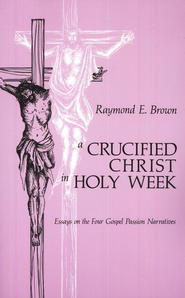
What I’m Reading – A Crucified Christ in Holy Week


Catholic writer, Raymond E. Brown was intelligent, thorough and prolific.  When he wrote The Birth of the Messiah (1977 – and enlarged edition in 1993) and The Death of the Messiah (in two volumes – over 1,600 pages! ) (1994) he found that he had more material than he could fit into either of those works.  Seriously!  They’re already pretty massive, but he had even more to share.

So he prepared a series of liturgical reflections  - essays on various parts of the life of Christ tied to the liturgical calendar year of the Church.  A Crucified Christ in Holy Week is, obviously, intended to be useful during Holy Week.

In this brief volume, Brown leads the reader through the diverging Passion accounts in each of the gospels, noting that the Synoptic accounts -read cyclically over a period of 3 years on Palm Sunday – are paired against the gospel of John’s account – read on Good Fridays. 

Brown shows how each of the gospel writers – though telling the same basic story – have crafted their story to emphasize different messages, different aspects of the death (and resurrection) of Jesus.  He (rightly) insists that they should not be artificially harmonized.  Their differences should be made clear.  To smooth over the discrepancies, to weld them all together doesn’t make a stronger, better gospel.  It weakens the different strengths of the individual gospels.

Brown also emphasizes the need for preachers and pastors to make clear that the hostility directed toward “the Jews” in the passion accounts reflect the situation contemporary to the gospel writers – but are not appropriate for Christians today.  It is not enough, says Brown, to excise the offending passages in a “Speak no evil; see no evil; hear no evil” manner.  This would only perpetuate an unthinking, uncritical reading/hearing of scriptures.  Instead we need to read them fully and unabridged, and carefully – but forcefully – preach that such hostility between Christians and Jews cannot be continued today (Brown, 15 – 16).[i]

These essays, though brief, are insightful and powerful.  You would do well to read them.
Catholic writer, Raymond E. Brown was intelligent, thorough and prolific.  


[i] Brown, Raymond E. A Crucified Christ in Holy Week: Essays on the Four Gospel Passion Narratives, The Liturgical Press, Collegeville, MN, 1986.

Monday, April 7, 2014

What I’m Reading: The Virginal Conception and Bodily Resurrection of Jesus


A friend of mine recently caught me reading the book The Virginal Conception and Bodily Resurrection of Jesus by Raymond E. Brown.[i]  Flipping through the pages he noticed that these two topics were described as “the problem of…” and he was a little disturbed.  Why are these considered problems?

The virginal conception (as opposed to the virgin ‘birth’ – which makes no logical sense) and the bodily resurrection are problems in the sense that they cannot be considered historical events and because the biblical narratives that describe them are conflicted and littered with contradictions and inconsistencies.  

But let’s not freak out too much there. 

Brown probes these two doctrines with the methodology and questions of biblical criticism and, being Catholic, weighs them against the traditions of the Church (held as equal to the witness of scripture) and still concludes that the biblical evidence favors the acceptance of these doctrines – without denying that there are significant questions and that there are unresolved problems in the stories as we have them. 

The virginal conception and bodily resurrection cannot be described as historical events because they stand outside observable history.  No one was there to see the resurrection.  No one (except Mary) could vouch for the virginal conception.  And the stories – both nativity and post resurrection appearances- that we have in the gospels are not exact and precise records of historical happenings.  They are, rather, theological stories about the person of Jesus.  The precise details of his birth and death are not available to us.  What we have in scripture are doctrinal elaborations.

Yet, even still, Brown accepts biblical testimony (balanced with Church tradition) for both – even as he acknowledges the difficulties posed by biblical criticism.

My friend asked me for my opinion – do I believe in them?  I answered him “Probably not and probably yes,” referring to each.  Probably not – for the historicity of the virgin conception (though I accept as a theological story elaborating what it means that Jesus is the “son of God.”)  Probably yes – for the historicity of the bodily resurrection – though when, and how it happened cannot be described, and though what kind of “body” it was we cannot say.

This short book (133 pages) makes a good primer for Brown’s more exhaustive treatment of each of this issues in separate books: Death of the Messiah  (1994) – in two volumes, and Birth of the Messiah  (1998). 


[i] Brown, Raymond E. The  Virginal Conception and Bodily Resurrection of Jesus, Paulist Press, New York, NY, 1973.
Jeff Carter's books on Goodreads
Muted Hosannas Muted Hosannas
reviews: 2
ratings: 3 (avg rating 4.33)

Related Posts with Thumbnails