Pages

google analytics

Showing posts with label People of Color. Show all posts

Monday, August 21, 2017

White Dives and Poor Old Lazarus


There was a rich white man named Dives who used to dress in fine linen suits and who feasted every day on tasty victuals and wines. At his gate there used to be a poor black man named Lazarus, covered with sores (he did not have health insurance, of course). He longed to fill his belly with even the scraps that fell from the rich man’s table. And dogs came to lick at Lazarus’ sores. (Did we mention that he had no health insurance?)

Now it happened that the two men died on the same day. Lazarus was carried away by the angels into the Bosom of Abraham, the rich white man was buried in the family plot and descended into the underworld.

Tormented in Hades, he looked up and saw Father Abraham a long way off with old Lazarus in his embrace. He cried out, “Father Abraham, have pity on me. Send Lazarus to dip the tip of his littlest pinky finger in water to cool my parched tongue. I am in agony here in these flames.”

And Father Abraham said, “My son, remember that during your life you had your fill of good things – you lived a life of privilege, white privilege But Lazarus lived a difficult life; now he is being comforted while you are in agony.”

So Dives said, “Father Abraham, send someone, I beg you. Send someone to speak to my five brothers. Send someone to warn them about this white privilege so they won’t end up here in torment.”

But Father Abraham said again, “They have James H. Cone, Howard Thurman, and Cornel West; let your brothers listen to them.” The rich white man said, “No, Father Abraham. But perhaps if someone came back from the dead they’d listen…”

Father Abraham said, “If they will not listen to Cone, Thurman, and West, they will not be convinced even if Martin Luther King Jr. came back from the dead.”


Thursday, March 2, 2017

Dr. Cornel West on Reconciliation at The Salvation Army

Dr. Cornel West recently spoke at a Salvation Army conference for young adults. This is a video of his address:

Tuesday, February 14, 2017

This Is (Still) the Problem We All Live With


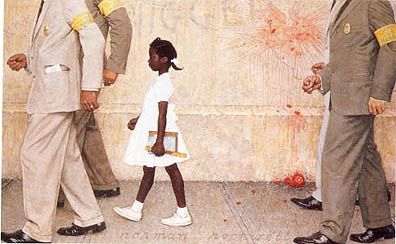
Conservative cartoonist Glenn McCoy has published an editorial cartoon depicting the recently confirmed Secretary of Education, Betsy DeVos. In this cartoon McCoy has shamelessly hijacked the layout of Norman Rockwell's 1964 painting, The Problem We All Live With but replaced six year old Ruby Bridges on her way to a recently desegregated school with Betsy DeVos.

The problem (that we still live with) is that Betsy Devos is not the disenfranchised being empowered. She is the powerful (rich and powerful) who now directs the franchise. Betsy DeVos is not the weak needing protection. McCoy has hijacked the story of people of color to portray conservatives as the oppressed and mistreated. It is foolish to suggest this when conservatives currently control the executive branch and the legislative branch, and are poised to control the judicial branch as well. This is disingenuous. This is still the problem that we all live with.


Wednesday, January 4, 2017

Comparing Martin Luther King Jr and Jeremiah Wright


Consider -

The distance of time, and his death by assassination has all but made a saint of Reverend Martin Luther King Jr. – in the same way that President Abraham Lincoln is revered now as a ‘founding father’ but was divisively hated in his own time…  But Martin Luther King Jr. was despised in his day.

Compare -
Martin Luther King Jr. has been made tame, made safe. Where he was once a burr and a bone of contention and challenge, he’s now respectable and honored. Perhaps we’ve lost something in his elevation. Read through his sermon “Standing by the Best in a Time of Evil” (August 6, 1967 – Ebenezer Baptist Church, Atlanta, Georgia).

Notice that he says, “The judgment of God is on America now.”

“Oh I weep for my nation. And I must think about the fact that I live in a country that is the greatest purveyor of violence in the world. … And I’ll tell you my friends I’m going to stand by my convictions. I’m going to stand by the principle that the Spirit is mightier than the sword. The judgement of God is on America now. “(page 6 of 9) 

In the relatively recent past, The Reverend Jeremiah Wright was vilified by white Christians in America for his “God damn, America” sermon.  But read the full text (and not just the out-of-context inflammatory sound bite…).


“Governments fail. The government in this text comprised of Caesar, Cornelius, Pontius Pilot – Pontius Pilate – the Roman government failed. The British government used to rule from east to west. The British government had a Union Jack. She colonized Kenya, Guyana, Nigeria, Jamaica, Barbados, Trinidad and Hong Kong. Her navies ruled the seven seas all the way down to the tip of Argentina in the Falklands, but the British failed. The Russian government failed. The Japanese government failed. The German government failed. And the United States of America government, when it came to treating her citizens of Indian decent fairly, she failed. She put them on reservations. When it came to treating her citizens of Japanese descent fairly, she failed. She put them in internment prison camps. When it came to treating her citizens of African descent fairly, America failed. She put them in chains. The government put them in slave quarters, put them on auction blocks, put them in cotton fields, put them in inferior schools, put them in substandard housing, put them in scientific experiments, put them in the lowest paying jobs, put them outside the equal protection of the law, kept them out of their racist bastions of higher education and locked them into position of hopelessness and helplessness. The government gives them the drugs, builds bigger prisons, passes a three-strike law, and then wants us to sing “God Bless America.” No, no, no. Not “God Bless America”; God damn America! That’s in the Bible, for killing innocent people. God Damn America for treating her citizen as less than human. God damn America as long as she keeps trying to act like she is God and she is supreme!”


Is there a significant difference between what Martin Luther King jr (now safe, and respectably in his grave) said and what Jeremiah Wright said? No. Not really. So… should Wright have been treated with more respect – with a larger measure of the respect we now give to Martin Luther King Jr.? Probably.

But, then again, perhaps we shouldn’t have allowed Martin Luther King Jr to have been tamed, to have been made safe. 

Sunday, July 10, 2016

Let the Old Gods Fall (Psalm 82 sermon)


Psalm 82 is a difficult psalm to place contextually; we don’t know when it was written. Though it is included in the “Psalms of Asaph” – which seem to mostly fit during the Babylonian exile – some have suggested that Psalm 82 is much, much older, perhaps even predating the monarchical period of Israel’s history (Dahood 269)

It begins in the heavens, in the space beyond space; it begins in in the throne room of eternity where the gods and the sons of the gods have assembled to be judged. “God takes his stand in the divine assembly, surrounded by the gods he gives judgment” Psalm 82: 1 (New Jerusalem Bible).  The word there is “Elohim” – gods – though some translations read this as human ruler sand leaders. This is an acceptable translation – there are instances where “Elohim” is used to refer to human judges (Exodus 21:6 for instance) but let’s stick with the divine assembly idea for now – these are “the gods” that are being judged.

We’ve been taught that the Israelites were monotheists, that they believed in one and only one God. But this is only partly true. By the time that we get to the New Testament they were what we would think of as monotheists, believing that there is only one God and that all other so-called gods were only evil spirits masquerading as gods. But in the Old Testament /Hebrew Bible, especially the older parts of it, there is the idea that there are, in fact, a great many gods.  The Israelites chose from among all these gods to worship only Yahweh. This is, to use one of those fancy college words, henotheism. The commandment “you shall have no other gods before me” doesn’t make much sense in terms of monotheism, you can’t have other gods before Yahweh if there are no other gods… But if we start from henotheism, there are other (lesser, inferior) gods.

And in Psalm 82 we have all those lesser, inferior, little g gods gathered together for a divine assembly. I particularly like the way Mitchell Dahood (in the Anchor Bible series) translates this first verse:

God presides in the divine council
in the midst of the gods adjudicates (Dahood, 268).

I like the formal verbs there: “presides” and “adjudicates.” This is serious and official business. This is a formal legal procedure. The gods are assembled for judgment and the charge is that they have not been defending the poor and the weak. Instead, they have been siding with the rich, and the powerful, and the wicked.

How much longer will you give unjust judgments
and uphold the prestige of the wicked?
Let the weak and the orphan have justice,
be fair to the wretched and the destitute (Psalm 82: 2 – 3 NJB).

God delivers the accusation and there is silence. Selah. (that is, assuming for the moment, Selah means something like “stop and listen,” or “pause and think on that.” We don’t know exactly what the word Selah means. But “silence” seems to make a certain sort of sense. It heightens the tension as we wait for someone to respond.)

No one speaks. No one can answer the charge.
After the awkward silence, God reiterates the charge, challenging them to do what is right:

Give justice to the weak and the fatherless;
maintain the right of the afflicted and the destitute.
Rescue the weak and the needy;
deliver them from the hand of the wicked (Psalm 82: 3 – 4 New Revised Standard Version).

These lesser, inferior, little g gods are ignorant and walking around in darkness. Because of their failures the very foundations of the earth are shaken. (Psalm 82: 5).

In verse 6 the psalmist gives his/her voice (whoever he/she might have been).:

I had thought, “You are gods
all of you sons of the Most High,
yet you shall die as men do
and fall like any prince” Psalm 82: 6 -7 (Dahood 268).

The psalmist had at one point thought these gods were something to be feared, entities to be respected because of their power and their position. But no longer. They are not gods. They are nothing. They are nothing because they are unable or unwilling to help the poor.  And so, they are ejected from divine realm, no longer immortal, they’ll die like any man and fall into the grave like any prince. But as they fall from glory, the psalmist calls for God to rise up in their place. I like the movement here; the no-gods fall as God rises to assume direct rule over all the nations. No more middle management gods.

Now we can also read this psalm as pertaining to human rulers and judges, to human leaders and kings and officials, leaders who have failed in their divinely appointed duty to protect and defend the poor and the powerless. It is a prophetic liturgy of judgment on pagan gods/human leaders who have failed to be agents of justice.

And there is no justice if there is no justice for the poor. There is no justice if there is no justice for the weak, for the orphan, for the widow, for the immigrant, the refugee, the minority. If justice is sold to special interest groups or powerful lobbyist, it is not justice. If we give up on justice. If we give up on peace, the foundations of the earth are shaken; all is darkness and ignorance and death without justice.

And we have been shaken in recent days, by news report after news report of violence death and murder in the streets. We live in darkness. We have a problem in our country: our gods have failed us. They have not been agents of justice, of righteousness, of peace. And we are shaken.

So we cry out with the psalmist and demand:

Give justice to the weak and the fatherless,
maintain the right of the afflicted and the destitute
rescue the weak and the needy
deliver them – deliver us – from the hands of the wicked.

In the words of the hymn writer, Fanny Crosby: “Rescue the perishing, care for the dying.”

Let God arise.
Let God arise within us.
Let the old gods fall, die like any mortal man or woman
and let God rise up.

They are nothing – if they will not work for the right.
They are nothing – if they will not promote justice, and justice for all – the immigrant, the minority, the woman, the black, the Latino, the Asian, the Native American, the homosexual, the transgendered.
They are nothing, nothing at all - if they will not make peace.

We may have thought of them as people of power and prestige because of their political positions, because of their wealth, because of their dynastic families, but they are nothing, no-gods if they prove incapable of or unwilling to defend the poor and rescue the perishing.

They are nothing.

Arise God, arise within us, and judge the earth, for all the nations, including this one, are your possession.


Dahood, Mitchel, Psalms II: 51 – 100 – Introduction, Translation and Notes, Doubleday & Company, Inc, Garden City, New York, 1968.  

Saturday, August 29, 2015

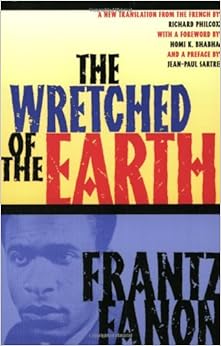
A Few Reactions to The Wretched of the Earth #FrantzFanon


Reading Frantz Fanon’s The Wretched of the Earth (1961 – translated by Richard Philcox) has been a troubling event for me. I have only recently become aware of his work, and this is the first of his writings that I’ve read. And these are some of my initial reactions to this influential writing.

I am immediately divided in my opinion. On the one hand I am impressed by his vigor and fire, his energy. His passion–and I use that word with its emphasis on pain–from the Latin “to suffer.” His analysis of the colonized peoples struggle against the power of the colonizers is infused with anguish and anger. And rightly so. Fanon wrote as an intellectual, yes, but not as an ivory tower elite. His words are not dull academic discussion of distant problems, but cutting; they bleed. They scream.

Fanon was not only (and maybe not primarily) a revolutionary, but also a psychiatrist. I am prepared to accept his analysis of the psychological motivations of colonized people (not just in the historical context of his writing – during the Algerian Revolutionary War- but today as well, in the context of people of color in the United States).

But I am, on the other hand, deeply distressed by his (apparent) emphasis on the necessity of violence. When he writes “At the individual level, violence is a cleansing force… (Fanon, 51)” the pacifist in me objects, and loudly. In fact, Fanon is frequently criticized for his prescription for redemptive violence. 

Walter Wink coined the phrase “redemptive violence,” noting that the idea goes back to the creation stories of ancient Babylon wherein the world was created in catastrophic acts of violence-and that the idea continues to influence the modern world. We fight revolutions, invade countries, and topple governments with military force because we believe that we can create something better from the ashes.

I will make a few observations about The Wretched of the Earth that may, or may not ameliorate those concerns (though I concede that I am not a Fanon scholar and do write authoritatively…)

1) Fanon used brusque declarative statements describing what was happening and what he projected would happen the future. “The underprivileged and starving peasant is the exploited who very soon discovers that only violence pays…Colonialism is not a machine capable of thinking… it is naked violence and only gives in when confronted with greater violence. (Fanon, 23)” And it is very easy to read this type of sentence as prescriptive instead of merely descriptive. To say that something “is” is not necessarily the same as saying that something “should be.” 

2) The first chapter “On Violence” really needs to be read along with the final chapter, “Colonial War and Mental Disorders” wherein Fanon describes the debilitating psychological effects of violence on both the perpetrator and the victim. If you stop reading and toss the book aside after the first chapter you’ll have missed an important part of the book. IF Fanon is prescribing violence as the means to effecting revolutionary change, he is not doing so unconditionally.

3) Some of the more powerful pro-redemptive violence statements are actually found in Jean-Paul Sartre’s preface rather than in Fanon’s work.  Sartre wrote “Violence…is man recreating himself, (Sartre, lv)” and “Will we recover? Yes. Violence, like Achilles’spear, can heal the wounds it has inflicted (lxii).” 

4) This particular edition of The Wretched of the Earth is prefaced with a forward by Homi K. Bhabha–an important figure in post-colonial studies. Bhabha says that “It is difficult to do justice to Fanon’s views on violence,” noting that, while Fanon described the doctrine of liberatory violence, Fanon the man, deep down hated it. (Bhabha, xxi)

The Wretched of the Earth is a powerful work, passionate and angry. But it is a clouded book. Perhaps a fire with more smoke than heat and light at times. That said, I am not through with Fanon. I will continue to think about this one, and seek out his other works as well.


Fanon, Frantz, Richard Philcox, and Homi K. Bhabha. The Wretched of the Earth. New York: Grove, 2004.

Thursday, August 13, 2015

Frantz Fanon, Jean-Paul Sartre, #blacklivesmatter, N.W.A - A Powerful Convergence


I’ve just begun reading The Wretched of the Earth (1961) by the philosopher, psychiatrist and revolutionary, Frantz Fanon. As I’m reading it, I’m hearing the soundtrack for Straight Outta Compton in my head and thinking of Sandra Bland, Ferguson, Missouri and the #blacklivesmatter movement. This is powerful stuff.

As I said, I’ve just started reading – in fact, I’ve only read through the new forward for this edition (2004) by Homi K. Bhabha and the preface by existentialist Jean-Paul Sartre. And it is Sartre’s words that caused me to think of the #blacklivesmatter campaign. He may have been writing to Europeans in the latter end of the 20th century who struggled to understand the violent collapse of the French Algerian colony, but he might as well have been writing to white Americans struggling to understand the riots and marches and protests in places like Ferguson, Missouri – to me.

Read this:

“Europeans, open this book, look inside. After taking a short walk in the night you will see strangers gathered around a fire, get closer and listen. They are discussing the fate reserved for your trading posts and for the mercenaries defending them. They might see you, but they will go on talking among themselves without even lowering their voices. Their indifference strikes home: their fathers, creatures living in the shadow, your creatures, were dead souls; you afforded them light, you were their sole interlocutor, you did not take the trouble to answer the zombies. The sons ignore you. The fire that warms and enlightens them is not yours. You, standing at a respectful distance, you now feel eclipsed, nocturnal, and numbed. It’s your turn now.  In the darkness that will dawn into another day, you have turned into the zombie.

“In that case, you say, let’s throw this book out of the window. Why bother to read it since it is not meant for us? For two reasons: first, because Fanon analyses you for his brothers and demolishes for them the mechanism of our alienations. Take advantage of it to discover your true self as an object. Our victims know us by their wounds and shackles: that is what makes their testimony irrefutable. They only need to know what we have done to them for us to realize what we have done to ourselves. Is this necessary? Yes, because Europe is doomed. But, you will say once again, we live in the metropolis, and we disapprove of the extremes. It’s true, you are not colonists, but you are not much better. They were your pioneers, you sent them overseas, they made you rich. You warned them: if they shed too much blood you would pretend to disown them; the same way a State – no matter which one – maintains a mob of agitators, provocateurs, and spies abroad whom it disowns once they are caught. You who are so liberal, so humane, who take the love of culture to the point of affection, you pretend to forget that you have colonies where massacres are committed in your name. Fanon reveals to his comrades – especially to those who remain a little too Westernized – the solidarity of the metropolitans with their colonial agents. Have the courage to read it, primarily because it will make you feel ashamed, and shame, as Marx said, is a revolutionary feeling. You see I, too, cannot lose my subjective illusions. I, too, say to you: “All is lost unless…” I, a European, am stealing my enemy’s book and turning it into a way of healing Europe. Make the most of it.” (xlviii – xlix)


Wednesday, August 12, 2015

Now Is the Summer of Our Disconnect


Now is the summer of our disconnect
made inglorious by another murdered son
and the clouds of teargas lowered upon our house.
Now are our brows bound with funeral wreaths,
our bruised arms up – don’t shoot -
with stern alarums and violent meetings,
our dreadful marches and protest measures.
Grim-visaged War has put on black face
and now, mounted on Pentagon armored steeds,
to fright the souls of fearful citizens
he capes nimbly in the city streets.

Friday, June 19, 2015

A Limerick for the Confederate Flag


We should be dumbfounded, it is stag-
gering that people still go out swag-
gering with the symbol
of our nation’s evil,
flying the old Confederate flag.


Tuesday, March 3, 2015

What I’m Reading – The Last of the Mohicans


The Last of the Mohicans by James Fenimore Cooper is a difficult novel to assess. It has been both hailed as a great American classic, and derided as overwrought and verbose. It is set within the confines of history–particularly in the Seven Year War (French and Indian War) and the events surrounding the Ft. William Henry Massacre, but it veers off from history into the realm of the imaginative romance (in the classical sense – a tale of love and adventure) that becomes increasingly ridiculous, before returning to something like reality in its final chapters.

Of particular interest to me as I read the novel was Cooper’s treatment of racial relations. And here, too, the novel is difficult to judge. On the one hand Cooper uses what may be described as clichĆ©s and stereotypes to define his characters. Uncas and Chingachgook are the “noble savage,” brave and stoic, wise and proud; Magua, the villain, is cruel, without loyalty and is one of those drunken Indians addicted to the white man’s “fire water.” But are these two dimensional characters intended to slur all Native Americans or is this the result of a genre where everything is heightened and exaggerated – where the heroes are pure and virtuous and the villains are barbaric and despicable? Are Uncas and Chingachgook at one end, and Magua at the other end of a spectrum of human characteristics–encompassing all rather than reducing all?

The character Natty Bumppo, known as Hawkeye, also presents an interesting dilemma. He is a white man who lives at the fringes of society, more at home with the native tribes than whites, but freely moving between both. He sometimes lauds his whiteness as a measure of his superiority, and sometimes praises his native brothers as the better men. 

It should probably be remembered, also, that The Last of the Mohicans was first published in 1826-at a time when American attitudes toward the Native Americans were generally less than favorable (to put it kindly.) Native American tribes were regarded by white leaders as mere savages, uncivilized. White leaders said that the Indians prized “theft, arson, rape and murder” and raised their children “to regard killing as the highest virtue.” Indian men, according to these powerful American leaders, were indolent and lazy, leaving all the hard work for their women. They were barbarous, and savage, and superstitious heathen” (Nichols 175 - 6). Not many years after Cooper’s book was published the Native American Removal Act of 1830 was passed by Congress, which paved the way for the forced expulsion of tens of thousands of Native Americans along the “Trail of Tears.”

But in the Cooper’s novel, Native Americans are heroic and brave, noble and praiseworthy. And in one of the frequent footnotes Cooper included, the Quaker William Penn and his descendants are praised for having done no wrong “to the original owners of the soil” (356).  It is difficult to read the story as ‘racist’ against this background. 

We might also consider the character of Cora Munro – who is of mixed race, a “mulatto.”  She is never disparaged in the book because of her mixed ancestry, though she acknowledges the second class status she and her black ancestors are given in society. 

And speaking of Cora, the issue of sexism is sometimes raised in criticism of the novel. The female characters Cora and Alice Munro (half-sisters with different mothers) are repeatedly referred to as the “gentle ones.” They are delicate and need male protection and rescue. That said, however, the novel does pass the Bechdal Test–if only just. The treatment of Cora and Alice may be considered sexist and chauvinist by today’s standards, but it represents the norm of that time–and it should be noted that Cora and Alice are just as brave and courageous as any of the male characters. 

The Last of the Mohicans is a divisive book; many love it, many loathe it. It has inspired multiple adaptions for film, television and radio. It has even been adapted for the stage as an opera.  But I’m not particularly fond of Cooper’s overwrought style.  His endless descriptions are tiring.  His dialogue is stilted.  And the prose is pretentious. 

He swung for the fences, writing as if for an epic in the style of Homer and Virgil, but Cooper let his novel drift into the realm ridiculous and could not sustain the epic majesty he wanted to achieve with his prose.  The novel begins in the grounded events of history at Ft. William Henry but towards the end it is reduced to a series of costumed hijinks:  Hawkeye disguises himself as a bear and prowls through an enemy camp; Chingachgook disguises himself as a beaver to fool their pursuers. It’s silly. I can accept Patroclus disguising himself in the armor of Achilles to lead the Greeks into battle; I can only laugh at Cooper’s characters parading around in animal costumes.

  
Cooper, James Fenimore.  The Last of the Mohicans, USA. Readers Digest, 1984.

Nichols, David A. Lincoln and the Indians: Civil War Policy and Politics, St. Paul, MN. Minnesota Historical Society Press, 2012.

Saturday, February 14, 2015

Black Theology, Black Power, and My Complicity


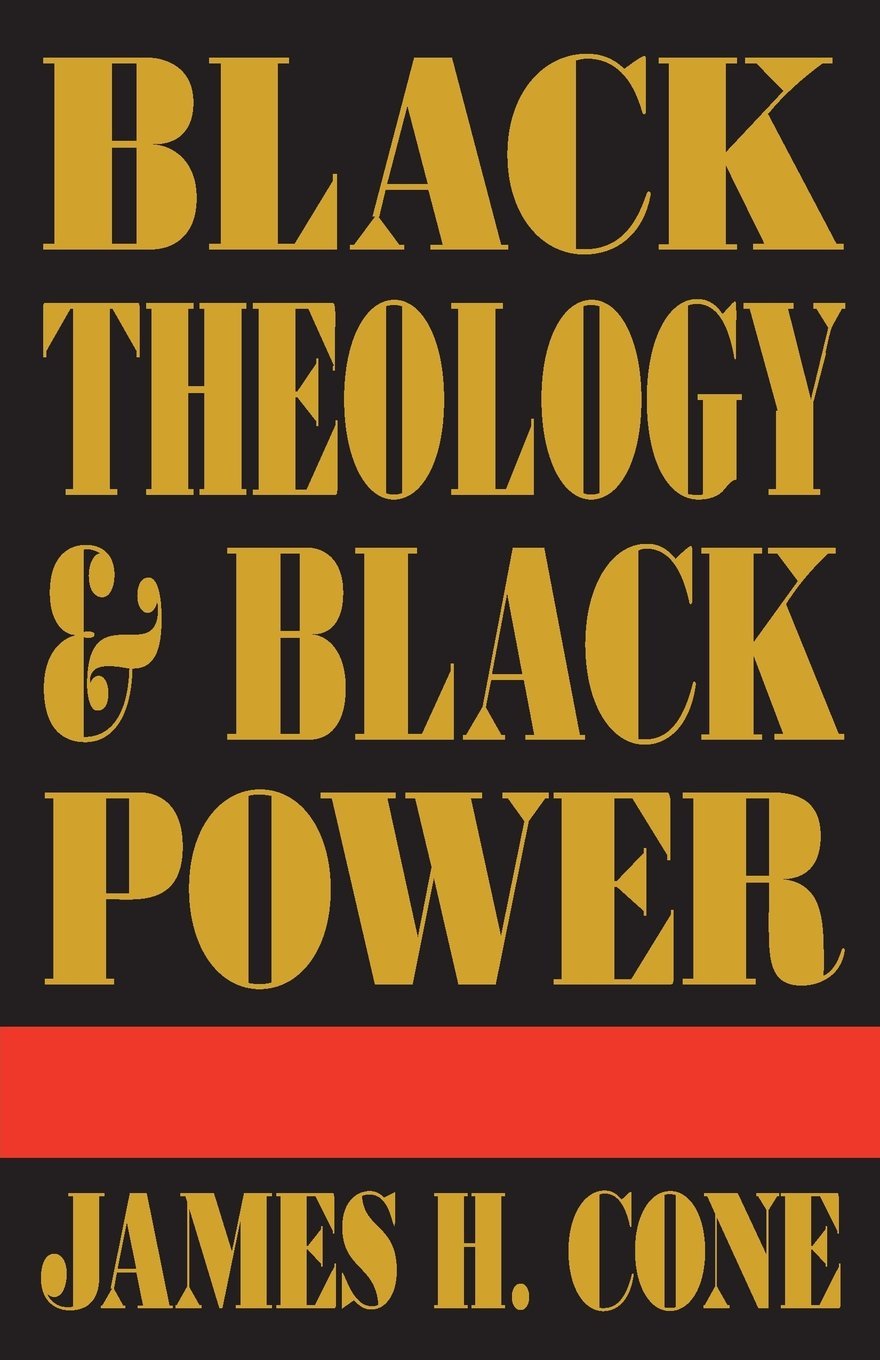
I have just begun reading James H. Cone’s book Black Theology and Black Power written in 1969, or 1989, or last week, I can’t tell.[i] When he writes about the “rebellion in the cities” (7), I know that he’s writing about the race riots in New York City, or Philadelphia, or Watts, or Detroit, Chicago during the 1960s, but I read it in terms of Fergusson, Missouri. When Cone writes that “blacks are beaten at will by policemen as a means of protecting the latter’s ego superiority as well as that of the larger white middle class” (25) I know he’s referring to what happened to Michael Brown, and Eric Garner and etc…

To read Cone in 2015 is to know that we are not yet living in a post-racial society. The evil of racism is still a part of us. We may have made some progress towards an equal and egalitarian society (though that may be debated), America is still racist.

It does no good to say that we’re not as racist as we used to be – we fought the Civil War to end slavery[ii], we’ve had Martin Luther King Jr and the Civil Rights Movement, we even have a black president. It does no good because “Racism … biologically is analogous to pregnancy, either she is or she is not, or like the Christian doctrine of sin, one is or is not in sin. There are no meaningful ‘in betweens’ to the fact itself.  And it should be said that racism is so embedded in the heart of American society that few, if any, whites can free themselves from it” (Cone, 23). 

That was a provocative – aggressively so – statement in 1969 and it so it remains in 2015. But Cone doesn’t stop there.  He pushes harder:  “all white men are responsible for white oppression” (24).  All. 

In most branches of the Christian faith there is a doctrine of human depravity – sinfulness; while it takes many forms and expressions, the general sense of the thing is that humans, as a whole, are twisted, bent toward sinful behavior. In my denomination we express it this way: “We believe that our first parents were created in a state of innocence, but by their disobedience, they lost their purity and happiness and that, in consequence of their fall, all men have become sinners, totally depraved, and as such are justly exposed to the wrath of God.”[iii] 

And we tend to believe that (or some variation thereof) until we’re pressed on those words “all” and “totally” – especially when it comes to the matter of race. Then we back pedal furiously. 

“While it true that some Americans” we say, “perhaps even some of my ancestors,” (see how honest and forthcoming we’re being?) “were slaveholders or members of the KKK, but that was the past and, besides, neither I nor anyone I know, participated in those kinds of things.  I’m only responsible for my own actions.”

But Cone counters that objection saying, “racism is possible because whites are indifferent to suffering and patient with cruelty” (24). 

And I think that for the most part white Christians in America have become less indifferent to people who are suffering – if we have made any progress since 1969 it may be here, but we are still very patient with their suffering. We are, by and large, willing to be patient in the face of the continued presence of racism. We’re willing to excuse and justify white on black violence; we throw up black on black violence as a smokescreen, a dodge so that we can continue being patient with the presence of cruelty and violence. “Look at how far we’ve come,” we might say. “Be patient. Be calm,” we might say. But while we are keeping calm and exercising this patience, institutionalized racism continues to oppress many millions in our country.  We can be patient because we’re not the ones who are hurting.

Cone quotes the German psychiatrist / philosopher, Karl Jaspers:

There exists among men, because they are men, a solidarity through which each shares responsibility for every injustice and every wrong committed in the world, and especially for crimes that are committed in his presence or of which he cannot be ignorant. If I do not do whatever I can to prevent them, I am an accomplice in them. If I have not risked my life in order to prevent the murder of other men, if I have stood silent, I feel guilty in a sense that cannot in any adequate fashion be understood juridically, or politically, or morally … That I am still alive after such things have been done weighs on me as a guilt that cannot be expiated.[iv]

I am reminded of a song by the band Dime Store Prophets  which included the lines:

I’m not myself
till you are you
if I close my eyes
I’m killing you.[v]


[i] Cone, James H.  Black Theology and Black Power New York: Seabury Press. 1969. 
The paperback version of the book that I have is the 20th anniversary edition published in 1989 with a new preface. 
[ii] That’s not really true.  Slavery ended as a consequence of the American Civil War, but the war was not fought with that goal in mind…
[iv] Karl Jaspers La CulpabilitƩ Allemande (German Guilt) 1948.
[v] The song was inspired by words from Martin Luther King Jr's speech "The American Dream" - June 6, 1961:

"All I’m saying is simply this, that all life is interrelated. And we are caught in an inescapable network of mutuality, tied in a single garment of destiny -- whatever affects one directly, affects all indirectly. For some strange reason I can never be what I ought to be until you are what you ought to be, and you can never be what you ought to be until I am what I ought to be. This is the interrelated structure of reality."


Wednesday, October 8, 2014

We Need To Talk about an Injustice

Recently in my English Composition class we watched the following TED talk by Bryan Stevenson.  Afterwards we had 40 minutes to write a response. 


Brian Stevenson says that we need to talk about an injustice, but we, as a nation, are reluctant to have this much needed conversation.  We refuse to deal with an injustice that has poisoned our collective spirt.  And, he says, we will not be well; we will not be whole until we commit to truth and reconciliation and speak to each other about how race and poverty affect our criminal justice system.

It is an injustice that such a disproportionate number of poor, African Americans are incarcerated.  The fact that among the countries of the world, the United States of America has the highest percentage of its population incarcerated and that we are the only country to hand down life sentences to convicted offenders as young as thirteen years old is an indication that something is very wrong.  When one third of black, American men are or have been in the prison system, we desperately need to have a conversation about an injustice. 

Like Stevenson I believe that we will not be judged by our technology, or by our accumulation of wealth and power.  I believe that we be judged on the basis of how we treated the poor and disenfranchised among us.

I am led to this conviction by the words of Jesus in the gospel of Matthew chapter 25.
  He told his followers a story about that final judgment at end of the world when the Son of Man has all peoples of the world gathered before him and he separates them into the “sheep and the goats,” dividing them  - the sheep on his right and the goats on his left.  The standard for this judgment is not their financial security; it is not their business acumen, or their collective wealth and power.  The standard used for this judgment is this:  Did you feed me when I was hungry?  Did you give me something to drink when I was thirsty?  Did you invite me into your home when I was a stranger?  Did you clothe me when I was naked?  Did you care for me when I was sick? Did you visit me when I was in prison? 

Both groups – the sheep and the goats – are surprised by this standard.  When did we see you hungry, thirsty, a sick, naked, stranger in prison? Jesus replies, ‘Whatever you did (or did not do) for the very least among you, you did (or did not do) for me.’


 It is an injustice that we are so reluctant to discuss how our undiscussed attitudes towards race and poverty are allowed to affect our criminal justice system. And it is upon this issue that we will be judged.  

Thursday, October 2, 2014

The Problem with Believers - Some Thoughts about a Horror Movie


It’s October again.  Wow how the year disappears.  But October means monster / horror movies. Actually, I watch scary movies all throughout the year, but in October I like to try to write a little bit about them.  I have in the past tried to watch and then write about one every day of the month, but I don’t think I’ll be able to do that much this year.  Still, I’ll get up as many as I can.

Last night I watched the 1987 film The Believers starring Martin Sheen, Helen Shaver, Robert Loggia, and Jimmy Smits.  The Believers was based on the 1982 novel The Religion by Nicholas Conde. It’s not the greatest movie ever made – it’s not even the greatest horror movie ever made – but it’s not a terrible movie, even if Rodger Ebert hated, hated, hated it (Ebert, 36 – 38).

The film concerns police psychologist, Cal Jamison (Sheen), who, after the recent death of his wife, has returned to New York City with his son.  He soon finds himself involved with the investigation of a series of ritualistic murders of children linked to an Afro-Cuban cult brujeria “witchcraft” - with strong similarities to Santeria.  The movie is more of a thriller than a horror film – but it does have a bit of a Rosemary’s Baby kind of twist toward the end.

The Believers is part of that “satanic panic” that gripped the United States in the 80s – an irrational fear that Satanic Ritual Abuse (SRA) was happening in every city and every town across America.  But in The Belivers it’s not Satanism, but Santeria (or something like Santeria) that is to be feared.

Even if I disagree with him about the quality of The Believers, one of Ebert’s complaints about the movie is valid:  “Every voodoo[i] movie that has ever been made has depicted bloodthirsty cults of savagely sadistic murderers vengefully thirsting for innocent blood (Ebert, 37)

There is some attempt in The Believers to separate the authentic practice of Santeria –which does involve animal, but not human, sacrifice – from the ritualistic murders being committed by this Santeria like cult, but the distinction isn’t drawn very well and for those already predisposed to see evil in every stranger’s face, this movie would likely confirm their suspicions. 

On the other hand – the evil in this film isn’t the savage, benighted immigrants practicing a heathen religion – it is the seemingly decent, rich, white folks who have, in an act of cultural appropriation created a horrifically literal expression of the 80s “voodoo economics,” sacrificing their children for the promise of wealth and power and fame (Muir, 559).

As I watched this film I was reminded of something that Reza Aslan said in a recent interview on CNN.  When asked if Islam promotes violence, he answered: “Islam doesn't promote violence or peace. Islam is just a religion, and like every religion in the world, it depends on what you bring to it. If you're a violent person, your Islam, your Judaism, your Christianity, your Hinduism is going to be violent. There are Buddhist -- marauding Buddhist monks in Myanmar slaughtering women and children. Does Buddhism promote violence? Of course not. People are violent or peaceful. And that depends on their politics, their social world, the way that they see their communities, the way they see themselves.”  (transcript here)


Ebert, Roger, I Hated, Hated, Hated this Movie, Kansas City, Andrews McMeel Publishing, 2000.

Muir, John Kenneth, Horror Films of the 1980s, Jefferson City, North Carolina, McFarland and Co. Publishing, Inc. 2007.


[i] Voodoo (or more accurately Vodou or Vodoun) and Santeria are similar in many respects, and are often confused, but they are different and separate religions.

Wednesday, September 10, 2014

What Color is God?


It may seem like a silly question.  It may be a silly question.  But, if God can be said to have a skin color -and I don't really believe that it can be said, but if it could the answer is fairly easy to find.


In the Revelation given to John, when he saw the the throne room of heaven, he saw the One seated upon the throne whose appearance was like Jasper and Carnelian (or Sardius, depending on your translation- Revelation 4:3)

So God is a deep red / brown color.  God's not white; that's for sure.


Carnelian 


Jasper


Saturday, September 6, 2014

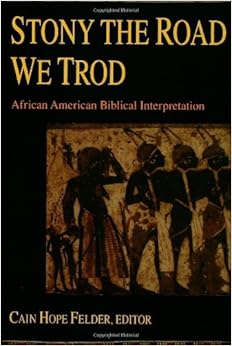
What I’m Reading: Stony the Road We Trod: African American Biblical Interpretation


When the lectionary readings recently moved into the book of Exodus, I took it as opportunity to finally read a book that has been sitting somewhat neglected on my bookshelves.  In my mind this was a way of connecting with the events in Ferguson, Missouri, and my reading of an introduction to black theology.  I wanted to read the exodus story in the light of African American experience. 

This isn’t to say that Stony the Road We Trod [i] is exclusively, or even primarily focused on the Exodus story.  This collection of essays, edited by Cain Hope Felder, Professor of New Testament Language and Literature at the School of Divinity, Howard University, is a collaborative work from eleven different scholars, exploring the history and style and range, and impact, and future of African American interpretations of scripture.  There is a lot in this little volume.

Though the collection was uniformly great, I was especially impressed by the material in the third section of the book - “Race and Ancient Black Africa in the Bible.”  Here the authors argued that, rather than being slighted or degraded in scripture, (especially in the Old Testament / Hebrew Bible), Africans and African nations are held up as exemplary figures and powers.  They are strong, and wise, and rich.

I also really liked the essay by David T. Sherman, “’An Ante-Bellum Sermon’: A Resource for an African American Hermeneutic.”  Sherman examines in detail a sermon-in-verse written by the poet Paul Laurence Dunbar.  As one who thinks of himself as a poet and a preacher (or as a preacher and a poet) I am amazed by both aspects of Dunbar’s work, and by Sherman’s exegesis of it.

The book’s title is drawn from second verse of the “African American National Anthem” song /poem “Lift Every Voice and Sing” by James Weldon Johnson:

Stony the road we trod,
Bitter the chastening rod,
Felt in the days when hope unborn had died;
Yet with a steady beat,
Have not our weary feet
Come to the place for which our fathers sighed?
We have come over a way that with tears has been watered,
We have come, treading our path through the blood of the slaughtered,
Out from the gloomy past,
Till now we stand at last
Where the white gleam of our bright star is cast.


[i]  Felder, Cain Hope ed. Stony the Road We Trod: African American Biblical Interpretation, Augsburg Fortress, Minneapolis, MN 1991.  

Friday, September 5, 2014

Biblical Limericks: The Curse of Being White


Some think white skin is good, black is worse
but for Miriam t’was the reverse;
we read in the Torah
how she mocked Zipporah
and was given whiteness as a curse.

Numbers 12: 1 - 10

Thursday, August 28, 2014

Behold, the Lamb of God – The Death of Emmett Till


Very early on the first day of the week
while it was still as dark and full of secrets
as a bad man’s soul, they came for him,
with a flashlight and a .45 in hand,
they came for Emmett Till.

They said he’d whistled at a white woman;
they said he needed to be taught
that a nigger boy
ain’t got no right to be talkin’ outa’ place.

And in a barn they beat that boy
across his back and hips and face.
Then to a shed they carried him;
they pistol whipped and thrashed
fourteen year old Emmett Till.

They broke his nose like as with a meat chopper.
They gouged his eye out from its orbit.

A bullet through his skull killed the boy at last,
but even more disgrace was done:
they tied a weight around his neck
with loops of sharp barbed-wire
and dumped his body into the water
of the Tallahatchie River.

On the third day he rose again.

His corpse was taken home and put upon display;
laid out in public for all the world to see.
And there were many who were appalled.

His appearance was so disfigured
beyond that of any other man.

Emmett Till was sacrificed
upon a Mississippi courtroom altar,
a boy, a lamb,
that we might break free
from our nation’s original sin.


July 25, 1941 - August 28, 1955

Sunday, August 24, 2014

Enslaved by Fear - A Sermon on Exodus 1: 8 - 2: 10

It is a truth, though not universally acknowledged (for to acknowledge it would be to allow a measure of doubt to creep into our practiced certainty that everything is just as it should be) that those in possession of power fear the powerless, just as the rich fear the poor and the master fears the slave.

Uneasy lies the head that wears a crown. Always. (Shakespeare)

A new king came to power in Egypt land – one that could not (or would not) remember Joseph or all that son of Israel had done for Egypt.  He was a mighty king, a powerful king.  He led the navy to repulse attacks from sea-pirates, he maintained (and expanded) the borders of Egypt.  He built cities, and palaces, and monuments – Lord, how many monuments.  In every city, on every corner, there was a statue or an inscription to mark his presence and to memorialize his achievements.  In the 30th year of his rule, he was transformed into a living god in the Egyptian “Sed Festival” and thereafter, every third year, another Sed Festival was held in his honor.  He had 45 sons and 40 daughters with his many multiplied wives. (Wente, 618 - 620)  He ruled for 67 years, bringing peace, and power, and prosperity to the nation of Egypt. 

And the inscription beneath the colossal statue erected in his honor read:
My name is Ozymandias, king of kings,
Look on my works, ye mighty and despair.
 (Percy Bysshe Shelley)

Ozymandias, (in Greek) or Ramses II “the Great” was powerful beyond most human imagination. 

But those in power never rest easy.

This new king in Egypt – who could not (or would not) remember what the son of Israel had done for Egypt - looked upon the Israelites with fear.

“Look… the Israelites have become too many and too mighty for us.”

The mighty Pharaoh Ramses II, the great and powerful Ozymandias feared the Hebrew people who, though they had continued to multiply during the years between Joseph and Ramses II, were still a minority people in the land of Egypt.  They held no political power (not since the days of long forgotten Joseph) they held no numerical advantage.  They were a minority in Egypt.

But the minority is always feared by the powerful, just as the rich fear the poor, and the master fears the slave. The oppressor fears those that he/she oppresses.

This is not an ancient pattern, now eliminated in our modern society.  We have not yet outgrown these things.  In our own nation’s history we have seen this fear.

The Native American tribes were regarded by White leaders in the 1860s as savages. They were uncivilized. White leaders said that the Indians prized “theft, arson, rape and murder” and raised their children “to regard killing as the highest virtue.”  Indian men, according to these powerful American leaders, were indolent and lazy, leaving all the hard work for their women.   They were barbarous, and savage, and superstitious heathen.  (Nichols, 175 - 6)

In 1736, Colonel William Byrd – a wealthy Virginian slave owner (considered to be the founder of Richmond, Virginia) wrote, “We have already at least 10,000 men of these descendants of Ham fit to bear arms, and their numbers increase every day as well by birth as importation.  And in case there should arise a man of desperate courage among us, exasperated by a desperate fortune, he might with more advantage than Cataline kindle a servile war.  Such a man might be dreadfully mischievous before any opposition could be formed against him and tinge our rivers, as wide as they are, with blood.” (Zinn, 35) also here
The Africans being brought to this country as slaves were feared by their masters. If they could not be kept under control, they would, as Colonel Byrd feared, rise up in revolt, and kill their masters, rape the white women, burn the plantations, and bring economic ruin upon the white ruling class. 

Even after slavery was abolished on these shores, the “darkies” were feared by those in power.  Blacks were described alternately as "lazy, thriftless, intemperate, insolent, dishonest, and without the most rudimentary elements of morality" or as violent beasts, “a hyena in a cage,” “wild beast” ready to rape and murder.  (Zinn, 208)

They were feared and had to be kept in check.  The Indians were slaughtered, and those that survived were herded onto crowded reservations (and often moved again, further afield, when those lands were coveted by whites.)  Blacks were harassed and lynched. Segregated into separate and entirely unequal stations within society. 

Fear turns the “other” into something other than human.  They become sub-human animals, brutes.  Fear makes them seem inferior, greedy, conniving, ugly, lazy, diseased, filthy…

 Said the new king, “Look… the Israelites have become too many and to mighty for us.  Let us deal shrewdly with them or they will take our jobs and take our women.  They’ll flood our hospitals with their diseases and our schools with their dirty children.  They’re violent.  They’re drug users and they bring illegal drugs across our borders.  They don’t worship the way we do.  They don’t even speak our language properly. Come, let us deal shrewdly with them, or they will increase and, in the event of war, join our enemies and fight against us and take over the land.”
Uneasy lies the head that wears a crown.

Ramses II, the great and powerful Ozmandias with legions of armed men and servants at his command, with wealth and power incalculable was afraid of the Israelites. He perceived them to be a threat – for those in power always perceive the poor and the oppressed as a threat – and he began a systematic program to reduce the Hebrew danger. 

He put them to work, made their lives bitter with rigor and toil.  He oppressed them with forced labor; he compelled them to build store-cities for him – which further increased his wealth and power, while at the same time reducing the Hebrew strength and power.  The Egyptians used them ruthlessly.  They exploited their labor, and stole the sweat from their brows. But the Pharaoh’s plan was flawed.  The more he oppressed them, the more they multiplied and spread.  The more he tightened his grip, the more they slipped through his fingers. 
So the Egyptians came to fear the Israelites. The Egyptians came to dread the Israelites.

Next Pharaoh ordered that the midwives of Egypt murder the Hebrew boys at birth.  But the midwives feared God and refused to be a part of this vile plan. So Pharaoh expanded the scope of his plan; he ordered all of the people of Egypt to throw Israelite boy children into the Nile.  Not just the midwives. Not just the soldiers. Every good and law abiding citizen of Egypt was instructed to hurl Israelite baby boys into the waters of the Nile.

Because they were afraid. 

The great and the powerful are never so strong that they do not fear those whom they oppress.  The rich and wealthy are never able to purchase an escape from their fear of the poor.  The master can never sleep easily with slaves at hand. 

We tell the story of the Exodus as the escape of the Israelites from the slavery of Egypt.  But we must see that the Egyptians were enslaved too, held in chains of their own forging.  Chains of fear and dread and loathing. The powerful fear the powerless. The rich fear the poor. The oppressor fears the oppressed. The master fears the slave.  Pharaoh feared the Israelites. Herod feared the newborn Jesus.

The Israelites were enslaved to the people of Egypt – a physical slavery of rigorous labor and bitter tears. But the Egyptians were enslaved as well – enslaved to fear and loathing.  And every powerful and prosperous people since has faced the same slavery. 

While we view people as something other – something less than human.  When we see them as thugs and criminals, when we think of them as lazy and freeloaders we are binding our own chains even tighter.  We enact harsher punishments for criminal acts – but we fail to reform the legal system that incarcerates a disproportionate number of minorities.  We equip our police with more powerful weapons and armor – but that only serves to tighten the chains of fear.

Fear can only be undone by love.  Courageous, radical love.

A courageous radical love that says – if you are hungry I will feed you, if you are naked I will clothe you without regard for anything except the fact that you are a child of God, created in his image.  What we need is a courageous radical love that says – if you are low I will lift you up, if you are weak I will support you.

Love does not oppress.
Love does not crush.
Love does no harm
Love does not fear
because perfect love drives out all fear.


(A disclaimer:  there is no universal agreement about which of the Pharaohs was in power during the oppression and during the exodus – if it was an actual historical event…  Ramesses II is the favored choice of many, but not all, historians.)

Nichols, David A. Lincoln and the Indians: Civil War Policy and Politics, Minnesota Historical Society Press, St. Paul MN, 2012.
Shakespeare, William, Henry the IV Part II
Shelly, Percy Bysshe Ozymandias
Wente, Edward F. “Ramesses II” in The Anchor Bible Dictionary Vol. V, Doubleday, New York, NY, 1992.
Zinn, Howard, A People’s History of the United States: 1492 – Present, Haper Collins New York, NY, 2003.

Monday, August 18, 2014

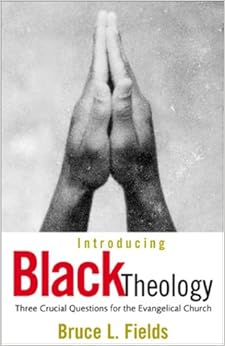
What I’m Reading: Introducing Black Theology

This little book (134 pages including preface, notes, and indexes) by Bruce L. Fields (assistant professor of biblical and systematic theology at Trinity Evangelical Divinity School) is intended as a primer to the topic of Black Theology.  And, for what it is,Introducing Black Theology: Three Crucial Questions for the Evangelical Church [i] is a fine little book.

Fields addresses three questions: 1) What is Black Theology?  2) What can Black Theology Teach the Evangelical Church? And 3) What Is the Future of Black Theology?

He answers these questions, though not in any great detail.  This is just a primer, not a fully articulated and exhaustive study.  This is my biggest complaint about the book.  It was just too short. Fields often notes that ‘this topic could be elaborated much more, but that would require more space than this book allows.”  Sigh… “Always leave them wanting more,” might have been good advice from P.T. Barnum (that is, if the quote came from him originally) but it’s bothersome in a book I’m studying.  As a primer, however, Fields’ book will serve to expose interested readers to a number of other authors for further and continued study…

…especially James Cone.  Fields quotes so often from the various works of James Cone, that I wondered if I should have just started with his books instead. 

A couple of other smallish complaints:  the book seemed especially focused on Black Theology in an African American – (as in the USA) situation.  This isn’t necessarily a problem, but I wonder (because I have no experience) how Black Theology might be different in Europe, or South America or Africa or Australia…

Also the language was rather dry.  I don’t mind reading academic works, I don’t have a problem with technical language.  But Fields’ prose was somewhat lifeless.  Again... this isn’t a big issue but I could see it inhibiting others from reading. 


[i] Fields, Bruce L. Introducing Black Theology: Three Crucial Questions for the Evangelical Church, Baker Academic, Grand Rapids, MI, 2001.
Jeff Carter's books on Goodreads
Muted Hosannas Muted Hosannas
reviews: 2
ratings: 3 (avg rating 4.33)

Related Posts with Thumbnails