Outside the
building’s stone black walls, the crowd had assembled. Not yet a
mob. Not yet. A mob has a purpose. These were only waiting for
instructions to strike. The austere apartments towered above them. I
could push through the crowd. Retreat to soulless safety. Turn back.
Turn back. Turn back again.
“Listen up, you
liberal twat. No American Christian has ever embraced socialism as a
guiding principle. It has no place in this country. No value.”
“But it was a
socialist who wrote the Pledge of Allegiance,” I remind them. I was
having my lunch, eating an apple on bus bench. “A Baptist minister,
Francis…”
“I don’t know
where you studied history, sir, but I suggest you take another course
from a different source. You couldn’t be further from the truth.
The agitations of
the crowd surged and rolled. They surrounded me on the bench. Knocked
the half-eaten apple from my hand.
“The United
States of America is the protector and defender of freedom and
democracy.”
“But the US of A
has a history of toppling democratically elected governments around
the world.”
“Liar!
“Costa Rica,
Syria, Guatemala Iran. Chile… I could go on.”
“No! You’re not
going to convince us to jeopardize our freedom and security with your
leftist lies.”
We don’t see. So
we don’t know. Won’t see. It’s not ignorance but a willful,
belligerent unknowing. Open eyes and shuttered minds. The lights
shining in darkened corners have been snuffed. My people are
destroyed for a lack of knowledge.
Then I beheld all
the fruitless work of man. Armed conflict between thirty nations.
Millions threatened. Mounting pressure from international leaders.
And Pope John XXI dies when the ceiling of his study collapses. He’d
been Pope for eight months. Affliction comes to make us sad or make
us wise.
Freedom is a heavy
load, a choice through scorching days and restless cold nights. South
American strip mines and deserts are rocked by earthquakes, meanwhile
Pope Adrian IV chokes to death on a fly in his wine. This is the
curse that feeds on life.
History is recorded
by impatient observers. Pomp and circumstance in the land of hope and
glory. Fading ancient fame. Pope Celestine V, overwhelmed by the
pressure and demands of the papacy, renounces the throne and returns
to the hermitage. He is later imprisoned by his successor and all men
shall fear.
How wretched I am, too long living
among a people for war.
Lies pass into
history. Critical food shortages on three continents in a season of
bitterness. Supply lines strained by militants. Pope Sylvester II
makes a compact with the devil for redoubtable scientific and
mathematical knowledge. History passes into lies.
Therefore, behold,
Pope Boniface VIII is belligerent. He kicks political envoys in the
head. He throws ashes in the eyes of kneeling bishops. He is captured
during the violence of the Outrage of Anagni and imprisoned for three
days. He is beaten. He is starved. He dies, chewing off his own hand.
A marvelous work among the people, and a wonder to the world.
Work while it is
day; the night comes when no one will work. Regional salt wars are
fought by child-soldiers and immigrants. Pope Joan’s horse is
startled during a procession and she goes into spontaneous labor. The
child is born. Her secret is revealed but she dies. And there is none
that can deliver me.
Lord, save me from
lying lips war-arrows over
red-hot coals.
Yea, before the
day, Pope Formosus is exhumed by his successor nine months after his
death and put on trial for perjury, for having taken the papacy
illegally. His corpse is dragged to the courtroom and found guilty
before being reinterred. His papacy is annulled. May the truth
protect me always.
Great force pirates
raided coast towns, year after year, decade after decade. Terror in
France, Italy, Portugal and Spain. As far as Britain, Ireland in the
1800s. Now Algeria, Libya, Tunisia and Iceland. All across the North
African Atlantic.
But currents were
shifting to some unpromoted American paradise.
Consider the
victims killed and surrendered. A brutal menace and sporadic crime.
Ragged political division from Mediterranean misfits. Powers traded.
Scourged on choppy waters. Trading in Holy Human Bondage. Paying
tribute, but never debts. Fugitive and furtive. Chastised but
unpunished.
Recent attention
has been drawn to two new forces: Straight death and Twisted videos.
The soul of American Evangelicals wrestled into submission. Forced
downside into conditional rejection. Their soul sold for a pittance.
Traded for unexceptional power. Drinking from putrid puddles.
American commerce.
The plan failed.
Hypocrisy crept back in. Barbarity increased.
Refuse
conditionalism. Forever forced. Burning. Forever burning. Incense and
refuse.
What more do you
want me to tell you? Rarely has one voice spoken thus. Welcome to the
last word. Language is too poor for power – Killing joy and
exaltations. Who would receive it?
There’s fog in the morning and I can’t find my way
I hear obscured voices leading me astray
I know there’s danger, I can feel it
I hope there’s beauty but I can’t see it
There’s a mournful church bell toll
as our leaders pledge to troll the opposition
I don’t believe America was ever good.
Line her up with all the slaughtering empires of the past
She stands as tall as any
whether governed by an evil one
or voted by a calloused many it is the same And I don’t believe America was ever good.
Walking circles back where we began
There to start the damnable trek again
As day gives way to early night
Our mayhem knives and chaos guns
Can never make us right
Like Babylon, like Herod
We’ll make America great again but greatness is not good I don’t believe America was ever good.
If you've paid any attention to this blog over the years, you may have already guessed that I'm a bit of a dork. It's true. I know it. My girlfriend seems to appreciate it.
I have a D&D character which is a bard. He's not really the stereotypical D&D bard, seducing the all women - though he does have some bawdy songs in his repertoire. He's more a sort of adventuring Woody Guthrie, a folk singer and folk hero. And, in advance of an upcoming gaming session, I have composed a couple of songs for my character to sing.
There was a mighty dragon whose name was Roland Raygun but down he fell straight into hell for consorting with the pagans.
Now I do not wish him tortured though he torched my father's orchard. But how the hell is his name so well remembered and blessed by fortune?
The ogre with an iron hatchet her name was Margot Thatchet. She was a beast to say the least and stirred up quite a racket.
The kobold king for oil did loot, and raid, and spoil. He was blessed by priests for war in the east and greatly increased our toil.
His son followed up years later assuming the role of invader. Oh what a bore, again to war. He made our trouble much greater.
We was sittin’ in a booth at Denny’s on account of David
George getting us kicked out of Lindsey’s Tavern. Lindsey didn’t think that
David George was funny anymore; he’d covered the toilets (in both the men’s and
the ladies’ restrooms) with clear plastic-wrap and waited for the splashing and
the screaming.
“It was a joke!” David George pleaded.
“How old are you? 13?” Lindsey asked before he kicked us out. We used to go to
Lindsey’s after our shift at Alvin’s Speedy Lube and Parts, but we didn’t work
there anymore either.
“You know what we should do?” David George asked me.
“What?” I asked around a mouthful of hash-browns and scrambled eggs.
“Somethin’ big. Somethin’….” He trailed off, his eyes far away, looking at
something a hundred miles away at the back of his imagination. I knew that
look. He got that look whenever he had an idea. And he always had an idea.
“I dunno’, David George. Maybe we should go back to the Lube and Parts. Maybe
we could get our jobs back.”
But David George had an idea. A big one. “We should find Geronimo’s head,” he
declared abruptly. Loudly. I spit coffee across the table. Other folks in the
restaurant turned to stare at us.
“No, David George. You remember what happened when we tried to dig up the body
of President Lincoln…” That was an adventure I wished David George hadn’t
gotten us into. “No. We can’t be doin’ these kind of things. Grave-robbing’s
nasty work. Let’s go back to the Lube and Parts. Or to Lindsey’s. Maybe he’ll
let us in if you…”
“No. This is different,” he said. “I recognize that our attempt to disinter the body of the 16th president of the United States was misguided, but this
isn’t grave robbing. It’s… it’s… it’s historical preservation is what it is. It’s
cultural restoration. It’s important. And besides, Geronimo’s skull has already
been dug up and stolen. We’d just be finding it and returning it. And if it
should bring us some cash in the process, well, that’s good too.”
David George told me how he heard the story when he was a boy at summer camp in
Enid, Oklahoma, how the famed Indian warrior had died at Fort Sill in Oklahoma
and was buried there in an unmarked grave. Then during World War I, as the rest
of the world was being buried in blood and bullets and mud and muck, six
members of the Yale secret society – the Skull and Bones were at Fort Sill as
U.S. Army volunteers. These Bonesmen - including Prescott Bush, future father
of President George H. W. Bush, and grandfather of President George W. Bush –
dug up the corpse of the famous Apache and stole the skull, along with some of
his other bones.
“The Skull and bones took it, right! The freakin’ Skull and Bones, dude. Prescott
and his pals found the unmarked grave and dug it up in the middle of the night.”
“Then what?”
“Well, presumably Prescott Bush held the relics for the group and passed them,
along with their totemic power, to his son and grandson.”
“You’re serious?” I asked as I stabbed what remained of my eggs. I’d lost my appetite.
“How else would you explain the election of W. in 2,000?”
I put down my fork and picked up the ceramic coffee mug that held the cold
remains of my coffee; it’d had been a long time since our waitress had come by.
“This sounds dangerous, David George. Won’t you wake up a poltergeist or some
other trope?”
“No. no.” he laughed. “In fact this is the reverse of the movie. The Skull and
Bones left the cemetery and took the headstone… Well… the head, anyway.
I put the coffee cup down; it was empty anyway. “I still say it’s a bad idea,
David George. I mean it’s not like you
could fence the skull. What are we going to do with it afterwards? We’d be stuck with it. It’d be like stealing
the Mona Lisa.”
“That’s not a bad idea, Holt. But it’s already been done.”
I yawned. Like Geronimo, I yawned. The famed Apache hero could, it was said,
anticipate future events. He went to the 1904 World’s Fair in St. Louis, sold
picture postcards and rode the Ferris wheel and repented that he’d ever
surrendered. He should have fought until he was the last man alive. I yawned,
but I couldn’t feel my teeth. Whether the future would be better or worse, I
don’t know. David George is not able tell me. And I wouldn’t trust him if he
did.
This morning, around 9:00 my supervisor at work came round to tell us that there would be a mandatory plant-wide meeting in the break room. "This can't be good," said one of my workmates. There's usually a meeting like that every 90 days without an injury - that comes with a special meal as a reward and incentive- but we're currently only at 84 days without injury.
The news was indeed, not so good. Our plant manager announced to us that overnight there had been a fatality in one of the other company plants in Oklahoma. He didn't have any real details to share with us - other than the fact that the plant where the death occurred is laid out differently than ours and that thier issues would not be our issues specifically. But he did use the opportunity to remind us to follow the safety procedures, and the OSHA regulations, and to wear our protective items properly.
We've come a long way from the beginning of the industrial revolution when workplace accidents were common and laborers were cheap; we've come a long way from incidents like the Triangle Shirtwaist Factory fire of 1911 (resulting in the deaths of 146 garment workers).
Maybe the plant where I work only emphasizes the need for safety so as to avoid lawsuits and expensive settlements; maybe thier motive is purely fiscal. But I don't think that's the case. There seems to be a genuine interest in making sure that we are safe.
So don't take shortcuts. Don't grumble about the encumbrance imposed by OSHA and the Department of Labor. Look twice before crossing the street, and always wear your helmet and seat-belt. Make sure everyone goes home alive at the end of the day.
Brunner and Barth’s friendship was
defunct,
all past camaraderie now junked,
and the source of their hate
was scholarly debate
pertaining to the Anknüpfungspunkt.
I have been reluctant to label the current GOP dominated government of the
United States as fascist – mostly because the term is notoriously difficult to define. The word itself is derived from the Italian word fascio
meaning “a bundle of rods” suggesting something not easily broken, strength
through unity. But it’s not so easy to pin down fascism as a political
ideology; it’s more a loose aggregate of overlapping traits including an animosity towards socialism, a preference for action over policy, a call for renewed traditional values, etc...
However…even if we are reluctant to identify President Trump’s administration and
the GOP congress as fascist, we can say that they share some traits in common
with fascists groups.
The Italian politician and historian, Angelo Tasca (writing under the pseudonym A.
Rossi) wrote: “The fascist economy is a closed and planned economy with war as
its objective…preparation for war may relatively reduce unemployment and
improve the lot of some classes of workers, but under a system of autarchy it
is only achieved by sacrificing the standard of living of the working class as
a whole.” (67)
Even as the United states launches a wave of Tomahawk missiles into Syria, Raytheon’s stock is rising in value. Raytheon – the U.S. Defense contractor that makes the Tomahawk missile, as well as a number of other missiles and missile defense systems, is profiting from our steps toward another war in the Middle East.
And at the same time the GOP government is cutting
education, healthcare, minimum wage protections, etc… it is making plans to increase
military spending by $54 Billion.
Maybe Trump and the GOP aren’t fascists, but they share some troubling traits
with the fascists.
“I now come to the crux, to what I might call the plan of
control for Italian economic policy in the coming fascist era. This plan is
determined by one single consideration: that our nation will be called to war.
When? How? Nobody can say, but the wheel of fate is turning fast” (Benito Mussolini quoted by Tasca 66 -67).
Tasca, Angelo (as A. Rossi) “The Rise of Italian Fascism” Fascism:
An Anthology. Ed. Nathanael Greene. Arlington Heights, IL: Harland Davidson
Inc. 1968. Print.
The Carter family (at least my small branch of it) is on vacation this week in Washington D.C. This morning we visited the Air and Space Museum. After lunch we went to the National Museum of the American Indian. (I was very impressed by the exhibit of photographs by Horace Poolaw:For a Love of His People.
In the late afternoon we stopped by the Lincoln Memorial.
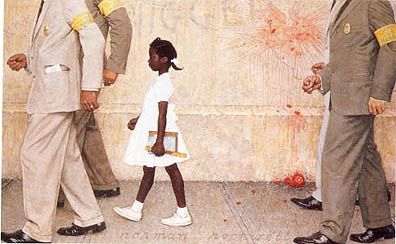
Conservative cartoonist Glenn McCoy has published an editorial cartoon depicting the recently confirmed Secretary of Education, Betsy DeVos. In this cartoon McCoy has shamelessly hijacked the layout of Norman Rockwell's 1964 painting, The Problem We All Live With but replaced six year old Ruby Bridges on her way to a recently desegregated school with Betsy DeVos.
The problem (that we still live with) is that Betsy Devos is not the disenfranchised being empowered. She is the powerful (rich and powerful) who now directs the franchise. Betsy DeVos is not the weak needing protection. McCoy has hijacked the story of people of color to portray conservatives as the oppressed and mistreated. It is foolish to suggest this when conservatives currently control the executive branch and the legislative branch, and are poised to control the judicial branch as well. This is disingenuous. This is still the problem that we all live with.
“I have not come to abolish the Law and the Prophets,” Jesus
told his disciples. “I have come not to abolish, but to complete them.”
(Matthew 5: 17) If Jesus was a radical, revolutionary prophet, he was not so in
this regard; he followed the tenets of the Jewish faith and accepted the
authority of the torah. (Evans 223)
How blessed are those
whose way is blameless,
who walk in the Law of Yahweh!
Blessed are those who observe his instructions,
who seek him with all their hearts,
and, doing no evil,
who walk in his ways.
You lay down your precepts
to be carefully kept.
May my ways be steady
in doing your will.
Then I shall not be shamed,
if my gaze is fixed on your commandments.
I thank you with a sincere heart
for teaching me your upright judgments.
I shall do your will;
do not ever abandon me wholly.
(Psalm 119: 1 – 8 New Jerusalem Bible)
But Jesus, in his “Sermon on the Mount” gives a series of antitheses, not
this-but that statements. In this he does not contradict the law or abrogate
it; he goes beyond and further than the law. The law spoke to a man’s outward
actions, to a woman’s behavior. Jesus’ words speak to his inward thoughts, to
the attitude of her heart.
The physical act of murder in the old law is punishable by death, but Jesus
extends this judgment to inward anger – the murderous, malicious anger burning inside
a person. Jesus told his disciples that calling someone a “fool” or “raca” =
liable to judgment
But Jesus himself called people fools. Later, in this same gospel – the gospel
of Matthew, Jesus calls the scribes and Pharisees fools. “You blind fools!”
(Matthew 23: 17) So either Jesus was inconsistent, didn’t heed his own
instruction, or Matthew wasn’t accurate in recording either one or the other of
these passages. Or it could be that we need to seek a different explanation for
this text.
There are two terms to understand in this verse. The first is the word “raca” and is not easily explained. It
seems to be an Aramaic word – a contemptuous form of address, “good for
nothing” or “wretch” (Exegesis 295). This is more than a “fool;” this is the
description of a heretic. (Schaff 61) The second is usually understood as the
Greek word Morē meaning “fool.” But
some scholars have suggested that it may be the homophonic Hebrew word Môrê which means “rebel” – that is, a
rebel against God or Apostate. (Albright 61, Stott 84)
We can read these two phrases as roughly parallel – the first contempt for his
mind – his “empty head”, the second contempt for his scoundrel’s black heart.
(Stott 84) Jesus’ instruction is then: Whoever despises a brother or sister in
the faith as a heretic, or as a rebel against God will be liable to the Gehenna
of Fire.
Religious debate is often divisive; along with politics it
is a topic to be avoid in polite company. It tends to leave people polarized,
raging in a state of fury. Sectarian violence is plague on the faith – on all
faiths: Catholic Christians murdered Orthodox Christians during the Crusades,
Protestants and Catholics killed each other during the Reformation, Catholics
and Protestants killed each other in Ireland from the 16th century
up through 20th century.
Early in the history of Christianity, when Christians were still by and large Jewish
and members of the Jewish communities, there was division between the
traditional Jews and the Christian “followers of the way.” This internecine
conflict led to a split in the two groups; the Christians were expelled from
their synagogues and cut off from their community.
The rabbis eventually developed 18 Benedictions to be read as part of the
liturgy. The twelfth of these blessings was the “blessing” on the heretics:
“For the apostates let there be no hope, and may the arrogant kingdom be
uprooted speedily in our days and may the Nazarenes (notzrim) and the heretics (mînîm)
perish as in a moment and be blotted out of the Book of Life, and not be
inscribed with the righteous. Blessed art thou, O Lord, who humblest the
arrogant.” (Encyclopedia Judaica)
But this cursing wasn’t one sided; there is a virulent
strain of anti-Semitism that has run through the Christian church since the
beginning.
It’s hard to come back from that. It’s hard to come back from that anger, from
that hatred. It becomes an impenetrable wall between us.
I have been called a fool. I have been called an idiot. A
blasphemer, a false prophet, a son of the whore heretic. And this by my fellow
Christians, my fellow Salvationists. I have been, I am hated by some. Recently a friend of mine told me of a Salvation Army
officer that she knows who has expressed a hatred of me, despite the fact that
I don’t think we’ve ever actually met. This officer ‘hates’ me because I
support LGBTQI people, and believe they should be welcomed and included into
our churches. Hate is the word the officer used. And it’s sometimes difficult
to believe that I am a part of this community – because of the animosity that
is expressed.
This kind of hate is murderous. It kills. It destroys the
bonds of fellowship, destroys the bands of brotherhood /sisterhood.
The one who keeps and follows the law of God, the torah, the divine rule of faith and
practice was considered to be blessed. And to this we say amen, so say we all. We
might all agree that we worship only one God, and that Jesus has saved us from
our sins and that the scriptures of the old and new testaments are to be the foundations
of our faith and practice, but problems and conflicts arise when we get right
down to how that scripture should be interpreted and put into practice in our
ordinary, everyday life. We cannot allow those differences in interpretation
cause us to break the Christian fellowship of faith.
All who hate a brother or sister are murderers, and you know that murderers do
not have eternal life abiding in them. (1
John 3:15)
This is not to say that doctrine is unimportant, or of no concern. This is not
to say that we should have a freewheeling, anything-goes approach to doctrine. We are called to study and to rightly divide
the word of truth (2 Timothy 2:15). But we cannot let our disagreements – even in
the matters of religious doctrine – become so inflammatory that we begin to
hate and to despise our brothers and sisters.
If we call them “Racca,” empty
headed, good for nothing worthless, reprobates, if we call them “fools,”
black-hearted rebels and wretched apostates, then we have put ourselves in the
place of God and judged them – and in doing so we make ourselves liable to the
judgment of Gehenna Fire.
Albright, W.F. and C.S. Mann, Matthew: Introduction,
Translation, and Notes. Garden City, NY: Doubleday and Company, Inc. 1979.
Print.
Buttrick, George A. “Matthew: Exposition.” The
Interpreter’s Bible Volume VII. Nashville, TN: Abingdon Press. 1951.
Print.
Encyclopedia Judaica. 2008 The Gale Group.
Evans, Graig A. Fabricating Jesus: How Modern Scholars
Distort the Gospels. Downers Grove, IL: InterVarsity Press. 2006. Print.
Schaff, Phillip. Ed. A
Popular Commentary on the New Testament by English and American Scholars.
Edinburgh, Scotland. T & T Clark. 1879. Print.
Stott, John. Christian Counter Culture: The Message of
the Sermon on the Mount. Downers Grove, IL: InterVarsity Press. 1978.
Print.
Forgive Our Sins as We Forgive - Rosamond E. Herklots, 1905-87,
"Forgive our sins as we forgive,"
You taught us, Lord, to pray,
But you alone can grant us grace
To live the words we say.
How can your pardon reach and bless
The unforgiving heart
That broods on wrongs and will not let
Old bitterness depart?
In blazing light your cross reveals
The truth we dimly knew:
What trivial debts are owed to us;
How great our debt to you!
Lord, cleanse the depths within our souls
And bid resentment cease;
Then, bound to all in bonds of love
Our lives will spread your peace.
Have you seen the new GOP proclamation concerning President Elect Trump?
Since providence, which has ordered all things of our life
and is very much interested in our life, has ordered things in sending Trump,
whom she filled with virtue for the benefit of men, sending him as a Savior
both for us and for those after us, him who would end war and order all things,
and since The Donald by his appearance surpassed the hopes of all those who
received the good tidings, not only those who were benefactors before him, but
even the hope among those who will be left afterward, and the birthday of the
god was for the world the beginning of the good tidings through him…
(based on the Prirene Calendar Inscription ca. 9BC)
First, I’d like to say: “Happy New Year!” You smile because you think I’m
early, but I’m not. I’m right on time. We all live under several different
calendars – those of us with school age children have the school calendar that
begins in August and ends in May, In the Salvation Army our fiscal calendar
begins in October and ends in September (I don’t understand it. I just use
it.) And in the Christian church we have
the liturgical calendar, the church year that begins today – the first Sunday
of Advent. So again, I say: “Happy New Year!” And may it be a happy one, filled
with goodness and light.
In the summer of 1914 the world seemed fairly bright. Things were going well. There
was hope and a sense that the world was moving forward into a brighter,
healthier, wealthier future. This isn’t to suggest that there weren’t significant
social issues that needed to be addressed, but there was a sense that the world
was getting better.
International trade was growing with
traditional goods as well as new technologies: Electrical goods, chemical dyes,
internal combustion vehicles, gold, diamonds, African rubber, South American
cattle, Australian sheep, Canadian wheat, etc… goods were bought and sold
around the globe. (Keegan 10 – 11)
Of that time, the English journalist Norman Angell wrote in his book, The Great Illusion (1910) that the
disruption of international trade and credit that would inevitably be caused by
the outbreak of war would either inhibit nations from going to war, or would
force them to bring conflict to a swift resolution. (Keegan 10) Because war
would be futile, and it was a matter of “enlightened self-interest,” to avoid
going to war. (Angell 488)
This Belle Époque was further
enhanced by the development of international laws. “It had been recognized then…
that the peace of Europe was a matter for the concern of all European
countries. There were certain categories of actions that were widely recognized
as threatening the peace and security of all states, and as such actions were
not supposed to be taken without prior consultation with the other governments”
(Lafore 31).
There was also the growing recognition that continued the militarization of nation
states would not protect the peace, but would lead to war. Tsar Nicholas II
called for an international conference in 1899 to strengthen limitations on
armaments and to found an international court dedicated to settling disputes
between stations. Tsar Nicholas warned that the accelerating arms race – to produce
ever larger armies, heavier artillery, and bigger warships – was transforming
the armed peace into a crushing burden that weighs on all nations. (Keegan 17) “It appears evident, then, that if
this state of things were prolonged, it would inevitably lead to the very
cataclysm which it is desired to avert, and the horrors of which make every
thinking man shudder in advance.” (Nicholas II)
And if the bonds of international trade and commerce guided by enlightened
self-interest, along with the recognition of the need for international law and
the need to check the increasing militarization of nations weren’t enough to
keep the peace, there were also the bonds of familial relationships. The leaders of many of the nations that came
to be involved in “the great war” were related either by blood or marriage or
both. The Kaiser in Germany was cousin to the Tsar in Russia. “It was broadly
true that all European royalty were cousins; even the Hapsburgs of Austria, the
most imperious of sovereigns, occasionally mingled their blood with outsiders;
and since every state in Europe, except France and Switzerland, was a monarchy,
that made for a very dense network of inter-state connections indeed” (Keegan
16).
But in the summer of 1914, when everything seemed good and bright, primed for the
increasingly peaceful relations between nations, the assassination of Archduke
Franz Ferdinand in Sarajevo sent the world into an extended paroxysm of
violent, bloody death, the likes of which the world had never seen, and from
which – one hundred years later – we still have not fully recovered. The “war to end all wars” as it came to be known, did nothing of the sort.
World War One came to an end, only to flare up again a few years later in World
War Two, which ended but not really. The cold war, Korea, Vietnam, Algeria,
Yugoslavia, Iraq, Iran, Afghanistan… the War to End All Wars continues to be
fought.
But it will happen. It will happen. It must happen. We must put an end to our incessant
warring. The prophet Isaiah had this hope, this faith, this vision – that there
would come a time when humanity would put away their weapons of war and learn
the ways of peace.
“How desperately our world needs such a faith! Without its inspiration and its
power to sustain our search for a way of peace, we are condemned to the
dreadful prospect of wars succeeding wars until the human race destroys itself.
We have in each generation the strange, tragic spectacle of men endowed with
genius, yet wholly unable to learn the art of living together in peace. Even
with bitter experience of the horrors of war, every proposal for peace is
basically related to the use of force” (Kilpatrick 180 – 181).
The prophet dreams, and I dream and hope and am anxious for that time when I
can “lay down my sword and shield down by the riverside, and study war no more.”
“Let’s go up to the mountain of Yahweh,” I rejoiced when they said that,
because there we shall learn peace. There we shall learn the peace of God.
There we can be united and whole with our weapons put away, our weapons melted
down and the instruments of death turned into the tools of production. There our
swords will melted down and made into plows and our spears will be hammered
into sickles.
Blessed are the peacemakers. Blessed are the peacemakers – they have learned the
ways of God and walk in his paths. Peace based on “enlightened self-interest”
will not hold. Peace through continually increasing militarization – that is, peace
through superior fire power, - is a lie. There is only the peace of God found
in love, and grace, and forgiveness.
If we are sharpening our swords, instead of melting them down, then we have not
learned the law of God; we have not gone up to the mountain of the house of
Yahweh.
Come, please. O Come, let us go up to the house of God, up to the city of
peace.
Every once in a while I try a little hymnody – writing new
hymns, or at least new words for older melodies.
This week I have been listening to various recordings of
Irving Berlin’s arrangement of words from the socialist poet, Emma Lazarus: Give Me Your Tired, Your Poor. The lyrics of Berlin’s song (composed for the
all-but-forgotten musical Miss Liberty (1949))
were drawn from Lazarus’ sonnet The New Colossus, which was written as part of the fundraising campaign for the
construction of the pedestal upon which the Statue of Liberty stands. Lazarus’
poem was engraved on a bronze plaque and is displayed in the pedestal’s lower
level.
I have written a new first verse, drawn from Jesus’ words in
Luke 4: 18, to add to Berlin and Lazarus’ work. I think the two pair together
very well.
But I hesitate somewhat with this. I am often vocal about the need to
disassociate the idea of American exceptionalism from the gospel. America is
not the Promised Land. The American Dream is not an expression of the gospel
message.
Despite this, I think Lazarus’ poem is bigger and better
than the American dream. I think that it is an expression of the values and concerns
of the Kingdom of God.
The Spirit of the Lord
has given me a mission and a call:
to preach the gospel message to the poor,
to free the pris’ner and give sight to the blind,
to proclaim the year of the jubilee.
Give me your tired, your poor,
your huddled masses yearning to breathe free,
the wretched refuse of your teeming shore.
Send these, the homeless, tempest tossed to me.
I lift my lamp beside the golden door.
I also like that this is a reminder that Socialism is as
American as apple pie (whatever that means). Both the Pledge of Allegiance (in
its original form) and the Statue of Liberty poem were written by American socialists.
Socialism is not necessarily either godless or un-American.
What follows is not a proper review of Count Leo Tolstoy’s final novel Resurrection; it is instead a few of my
thoughts about and responses to the book. It’s been a few years since I read Anna Karenina, and ages and ages since I
read War and Peace. I feel like I
should revisit those now (but there’s so much still left in my to-be-read pile…)
The story feels somewhat autobiographical – if not in details, in its theme.
The journey of Prince Dmitri Ivanovitch Neklúdof from noble born, silver-spoon,
aristocratic, playboy to a fervent idealistic religious revolutionist who
dreams of changing the world is Tolstoy’s story.
Neklúdof wants to atone for his frivolous life, to correct the mistakes he’s
made, to heal the wounds he’s caused. And this, not for himself, but because it
is the right thing to do. But there is no such thing as a selfless good deed and his attempts to do right are viewed with suspicion and outright rejected.
When he tries to give his land estates to the peasants who live upon them, they
believe that it’s just another trick from a member of the wealthy elite to squeeze
another ruble from the poor. His sincere offer to marry the woman he left destitute
is refused; she can’t believe him.
Resurrection is a literary attempt to
find a way to put into practice the radical claims of the gospel.
“I don’t know whether
they deserve it or not, but I do know how they suffer,” said Neklúdof. “You are
a Christian and believe in the Gospel, and yet you have no mercy.”
“That has nothing to do
with the case. The Gospel is one thing and what we despise is another. It would
be worse if I pretended to love Nihilists, especially short-haired one, when to
tell the truth I really hate them” (Tolstoï
Resurrection Vol. 2, 40).
Much of the novel is a defense of Georgist ideas –
a subset of socialist thought, an economic theory that says that the economic
value of the land should be owned and shared by the community that lives on the
land. Again, this is part of Tolstoy’s literary attempt to put into practice
the radical claims of the gospel of Jesus Christ.
But radical is not easy. And Tolstoy knew this. He was not a wild-eyed
unrealistic idealist. Resurrection is
filled with the details of observed real life. In fact these detailed stories
begin to pile up towards the end of the novel that it begins to feel like a
fevered dream. Reality is incredibly unreal. How can this be real? But it is.
And Neklúdof (the novel’s stand in for Tolstoy himself) is shocked to realize
his place in it.
There are few easy answers. Many of the questions Tolstoy raised about the
criminal justice system and the state of prisons in Czarist Russia at the end
of the 19th century remain unanswered – and could be asked with tragically
continued relevance about the criminal justice system and state of prisons in
America in the 21st century.
The version of Resurrection that I’ve
read was published in 1911, translated by Aline P. Delano. This may not be a complete
version of Tolstoy’s work. The full novel was heavily censored by Russian
authorities, and an unexpurgated text wasn’t published until 1936.
Tolstoï, Lyof N. Resurrection Trans. Aline P. Delano. New York, NY: Thomas Y.
Crowell & Company. 1911. Print.