Pages

google analytics

Showing posts with label Magi. Show all posts

Thursday, January 1, 2026

Myrrh for the Dead

     This is how Jesus the Christ came to be born; it rambles a bit and anachronisms abound, nevertheless it remains something like the true story. At least I believe it to be so. It is the story as I heard it told. It begins – not, as others have told it, in the northern hillside village of Nazareth, but in small, little Bethlehem, a city of fog and shadow, a city in the shadow of death. A tenebrous city with rubbled streets below your feet and the sound of military helicopters over your head. The doctors were dead, the hospital bombed out. The schools were closed – burned down. It begins with hunger and deprivation. It begins with Joseph living and working in Bethlehem.

    Every morning Joe put on his work clothes – heavy denim pants, steel toed boots, and a plain t-shirt. Over these he put on his protective equipment – durable work gloves, a hard hat, and a bright orange and reflective orange and silver safety vest. He worked as part of crew clearing the streets of bombed out buildings. He filled wheelbarrows with chunks of broken concrete and twisted bands of rebar and hauled them to a municipal dump truck which would haul it all out of the city to a dump site at the outskirts of town. The work continued despite the occasional burst of nearby gunfire. The bombed out buildings were slowly cleared even as violent revolutionary groups clashed with government forces, bringing down another building in explosions of dust and smoke and fire.

    Grinning death head gunships flew through the air with their spectral shadows trailing below. Blackwater gunmen, backed by free-market robber barons and commercial advertising agents in the United States, prowled the smoldering rubble in search of misguided martyrs whose pursuit of apocalyptic ecstasy by way of explosive detonation, had chained the weight of nightmare around the neck of the whole world. It was new technology for the same old conflicts. People die the way they always have – screaming in pools of blood and gore, suffocating under the ruble – dehydrated or starved to death. It’s a new war; it’s the same war. Death is death.

    He wore a mask and a scarf tied around his face to keep the dust and ash from his nose and mouth but smoke burned his eyes as he worked to clear the streets. Blinded and lost in the chaos created by the grasping militants with their demands for vengeance and honor; the shadow of death stretched long across the land. There were days when he worked from daybreak to midnight, excavating the ruins and the rubble by bright klieg lights powered by portable generators.

    Joe moved heaps of concrete and brick, sorting through the detritus of a dying city. Amongst the debris he found the cast off trash of a displaced society – plastic coke bottles, chips of china, a shattered Nokia cell phone, sandwich wrappers, and the like. Also among the debris and rubble were the more gruesome remains of cast off members of society, human remains – sometimes just teeth or perhaps the bones of a severed hand. Sometimes he found crushed corpses that were taken to the medical facility to be identified. If they could be identified. Some of those bodies were so mangled they hardly looked human any more.

    As gruesome and noisome as it was, Joseph appreciated the work. So many were unemployed and desperate. He knew he was fortunate. But he was concerned with his excavating role. The daily destruction was dangerous and people were dying all around. Bethlehem, like all cities, had been built on heaps of ruins. Digging down through the rubble he and his coworkers discovered Arab ruins heaped atop the ruins of Christian Crusaders, Turks, Mongols, Greeks, Egyptians, further and further back the deeper they delved. Winding alleys horizontally through the city, and vertically down through history, down to the Bronze Age foundations of abandoned and forgotten structures.

    He’d grown up with the stories his grandfather Bartolo told him of ancient cities swallowed overnight by the sands of the desert. Those fabulous tales fascinated and amused him as a boy but they seemed less fantastic these days. He’d seen enough instant destruction to know the truth. He’d seen military helicopters dropping sulfuric acid on populated areas. He’d taken shelter as missiles exploded overhead. He’d carried his gas mask with him everywhere in case of attack. And he’d heard the shouts and screams of fathers and mothers, children crying, cursing Herod’s administration. Cursing King Herod. Cursing the far away Romans, and the Americans too – selling their weapons and munitions to anyone with cash enough to buy. Cursing the suicidal, mad-bomber Zealots. Cursing and abusing God, even, in their anger and their despair.

    But even in that land of death and struggle, life went on as it always had. Their children continued to go to school – though the school house had been abandoned after a tank had driven through the wall and exploded. They met in the basement of the Orthodox church. People continued to eat and drink, enjoying meager festival feasts and humble birthday parties, eating and drinking together when and where they could. Weddings were celebrated and divorces were mourned. Life went on. Though surrounded on all sides by the looming shadow of death, life went on. And Joe was engaged to marry a girl from the neighborhood. Mary.

    But rumors began to circulate that Mary was already pregnant. People talk; stories spread but Joe refused to believe the gossip. He trusted his fiancée. He believed her to be as honest and true as himself. But as the rumors persisted his confidence wavered and he confronted her directly. “Is it true, Mary? Are you pregnant?” And with a simple, silent nod she confirmed the worst of his fears. Chilled the warmth of his heart. Still, whatever disgrace he felt, he was a young man of mature character and didn’t want her to be subjected to any further shame or public humiliation. Life was hard enough here. He intended to break off the engagement quietly. Secretly without the whole neighborhood being up in her business. Or his.

    Joe was awakened in the night by the sound of gunfire and explosions – not far off in the distance, but somewhere nearby. There were coordinated rebel attacks on the munitions factory and the state owned pig farm. Because he couldn’t get back to sleep, he got up from his bed and opened the window above his bed to look into the street.

    But he closed it almost immediately. He could hear the shouts of rebel commanders and the screams of wounded soldiers. The acrid smoke choked him before he could get it closed and he coughed for several minutes. He stood at the window observing the thick clouds of billowing smoke illuminated by illuminati search lights sweeping back and forth across the sky in long, lugubrious arcs.

    One of the search lights swept across the face of Joe’s apartment complex and the light through the window blinded him. He flinched and stumbled backwards, throwing his arms in front of his face to block out the blinding light. When he blinked back from the darkness he saw a stranger in his room standing among the illuminated floating dust particles. He was tall and thin, nearly gaunt, but his face still held an ethereal fascination as if he were glowing with an inward radiation.

    “This is a dream,” Joe said. “This is a dream. A strange and terrible dream.”

    “Think of it as a dream if you like,” the stranger said, “but you must remember all of what I am about to tell you when you awaken in the morning.”

    “I will remember,” Joe said. “I will remember what you tell me.”

    “It is very important,” the stranger said.

    “I understand,” Joe affirmed. “I will remember. Every word.”

    “Good. Now Joseph, you must not be afraid to take Mary as your wife. It is true that she is pregnant, but it is no ordinary conception. This is a virginal conception through the Holy Spirit of God. Definite or indefinite, it is the same spirit. And the spirit is sent and life is created.”

    “But that’s…”

    “This is what the ancient prophet promised: Behold the virgin shall conceive and bear a son…”

    “But that’s not…”

    “Do not interrupt me, Joseph. This is a theological truth – by the gift and grace of God she shall conceive and bear a son called Emmanuel.”

    “God with us,” Joe sighed.

    “God with us,” the messenger affirmed. “But you will call him Yeshu, for he will be the one to save his people from the sickness of their sins”

    There was another shout from the streets below as the rebels pressed their advantage and surged into the streets pushing the faceless forces of the Herodian riot strike teams back. Another furious round of gunfire erupted and the Illuminati searchlights were extinguished and the night was dark once more. He knew there would be more work tomorrow clearing the streets around the munitions plant and hauling away the unclean carcasses of dead hogs from the state pig farm. Joe awoke on the floor, naked and shivering in the cold. The heat was off again. The power was out. He rose up from the floor and looked out the window. It was nearly dawn but no birds were singing.

    And when the time was fulfilled, the boy was born in the normal way of things. Even in the midst of death there was life. The Lord, most mighty, holy and most merciful, delivered him to them through the bitter pains of death into newborn life. Life went on.

    Some time after this, King Herod was on the balcony of his bed chambers in the palace within the City of Lights and Murder, snorting Adderall and shouting about the vermin that were infecting and polluting the blood of the country when the strangers from the east arrived. “The blood is the life!” he shouted through his electronically amplified bull horn. “But they are destroying the purity of our lives by diluting the purity of our blood. Rapists and murderers. Drug fiends and half breed witches.”

    The people in the street knew that he wasn’t really a Jew himself; they knew him for the Edomite outsider that he was. Half-Jew at best. He was a shifty man, a querulous alienator of fathers and sons. He never began a single confession, only multiplied confrontations, projecting himself and his woes upon the world around him. “This is our profession of faith: the libtards are out to destroy our history and culture. Illegal immigrant are crossing the borders to get public welfare and the Parthians and the Nabataens are threatening to invade again.” His ancestors may have converted to Judaism, but the people had no illusions of his own personal piety. And they accepted him as their king in name only, only because they were forced to do so by their far-distant, Roman overlords. Few spoke out against him. To do so was death.

    He was still on the balcony raving into his bullhorn when the astrologers arrived.

    Herod the multivalent opportunist put on a mask to receive them. He was obsequious with Caesar and preening with dignitaries of the surrounding nations. He was reverent and pious when dealing with the temple priests and threatening with the members of his family. With the foreign magi – from some shithole country to the east – he was smarmy and smooth talking.

    “We are humble astrologers, my lord,” they said as they introduced themselves to the King. “Practitioners of Chaldean wisdom, scholars and researchers from the Oriental Institute for Full Brain Potential and the appointed envoys of our respective nations. We have traveled, at great risk and great expense, across the sands, following for these many months, a newly observed star. Consulting the ancient texts and lore, we have determined that this novel star is the star of a newly born king of the Jews, and we have come to give him due homage and awe. We know that this is strange and difficult to believe, but we are amiable and honest and trust that you can tell us where he has been born.”

    “I agree that what you’ve told me is strange,” King Herod said to the members of the OIFBP, gripping the arms of his throne until his knuckles turned white. “But the question I have is this: Is it strange enough to be true?” he grinned and waved nonchalantly. The wise men began to speak all at once filling the chamber with their overlapping foreign languages. “No. No. No,” he interrupted them. “Let me consult with my own advisors and religious experts. They will know what to tell me. And then I will know what to tell you.”

    There was argument among the scribes. You know the expression: Two Jews – Three Opinions. They read from their scrolls and consulted the elders – each of which provided a variety of voice and explanations. Multiple version of every position and more answers than participants. But after the arguments flared and died and flared and died again, they returned to the king with an answer.

    “The durations of life are dependent upon the constellations, my Lord, and anyone who knows how to calculate the astronomical movement of constellations and does not do so, does not take notice of the work of God...”

    “Get to the point!” he shouted at them through his bullhorn.

    “But tell them this,” stammered the representative of the scribal union, “from the words of the prophet: ‘And you, Beit-Lechem in the land of Y’hudah are by no means the least among the rulers of Y’hudah for from you will come a Ruler who will shepherd my people, Israel.’ That is the answer you required.

    But King Herod had other plans. “Only I can fix the problems that plague our country. Not some newborn nobody from some little town in nowhere,” he mused. So he told the emissaries from the OIFBP, “Go and find this child in Bethlehem,” he told the astrologers, “but come back after and tell me where, so that I can give him my respects and gifts as well.”

    All of Jerusalem trembled as the Magi departed. They knew enough of Herod’s raging.

    The traveling members of the OIFBP parked their dusty VW van on the street outside the two story brick house where Joseph’s family lived in Bethlehem. Joseph lived there with his brother Sava, his cousin Tavish, Tavish’s wife and their three children, as well as his grandmother Shera. There had been others in the house with them before, all of them crowded into the small building. His grandfather Bartolo had died a little more than a year before of pneumonia and his father and mother, Jacob and Lissa had been killed in an explosion three months ago. They were gone, but the house felt even more crowded now, with the memories of their laughter and songs still lingering heavily in every room.

    The visiting magi knocked on the door of house. Sava opened the door cautiously and, after a brief and somewhat confused explanation of their presence, ushered them in. He scanned up and down the darkened street for police patrols and overhead for Herod’s surveillance drones.

    “This is the child of whom we have read,” said the astrologers when they saw the infant lying in a makeshift crib – Joseph’s tool chest, emptied of hammers and sockets and filled with blankets and a somewhat ragged stuffed rabbit. “This is the one.”

    “I have brought him gold,” The first of the visitors said, handing Joseph two small coins. “It is not much, I am sorry. We are humble scholars, not aristocracy. Not kings. But may this be the first tokens of his increasing kingdom.”

    “I have brought him frankincense from Ubar” said the second, “the ‘Atlantis of the sands,’ the City of towers, lofty porcelain and gold towers – one of those legendary lost cities of the Arabian deserts. This bottle of perfume has been preserved since before that fabled city’s disappearance.” He placed the vial into Mary’s hands.

    Then the third and eldest of the visitors stepped forward, slowly. He haltingly lowered himself to his knees and laid his fragile body prone on the floor and placed a small wooden box before the boy. “And I have brought myrrh. Myrrh for the dead.”

    Joseph, Mary, and the extended family gathered around gasped but said nothing.

    Joseph’s family insisted that their guests stay the night and to share a meal. Shera cooked up some rice and a bit of goat. Tavish’s wife brought out the last of the baklava she’d made a week ago. A desperate and rare dessert made with honey she’d taken from a bee hive she found in the remains of the burned out school building. The travelers themselves shared what they had, some dried figs and almonds. After securing the blackout curtains over the windows, they lit a kerosene lantern and sang the Hallel as a blessing for the food, the family, and their joyful fellowship.

    The next day, early, well before dawn, the astrologers loaded back into their van. “We must go now,” they insisted. Shera began to insist that they stay as their guests for another day, but Joseph interrupted. “No,” he said. “They have to go. And Mary and I must go too. We must flee.”

    “You have had the dream too?” one of the astounded magi said to him. Joseph looked at the faces of his family, lingering long with Mary’s eyes, and then said to the astrologer. “Yes. Warned in a dream.”

    Later, after the scholars were gone, Tavish brought out a locked metal box and showed it to Joseph. He took a key from his pocket and unlocked it. Inside was a .38 snub-nosed revolver. He handed the gun to Joseph. “Take it, Joe. You’re going to need it,” Tavish said. Joseph considered the weapon Tavish had extended to him. He took it, rolled the empty chamber, and snapped the revolver closed. Then looked from the gun to his wife. She said nothing, only looked away. Joseph turned back to his cousin and returned the gun. “What if I’m caught with it?” he asked. “Besides, I wouldn’t know what to do with it anyway.”

    “It’s easy,” his cousin said shoving the gun back to him again. “Just point and shoot. Bang. The bad guy falls down dead. Simple.”

    “It’s never simple. Nothing ever is.” Joe said. “No. I don’t want the gun.” He turned then to his wife.

    “Mary, we’ve gotta’ go. Tonight. We can’t take my motorcycle, not with the baby. But I can sell it for cash. I won’t get much for it. Not nearly what I paid for it. Tavish offered me eight hundred. It’s a loss, but it’s enough to get us a couple of bus tickets for Egypt. We can be there by tomorrow morning. Our ancestors wouldn’t hesitate to pick up and go. They were nomads. Bedouins, wandering with their flocks and herds, landless and homeless. We can be like them. We’ll make a home on the road. Wherever we are, you, me, and the boy, that’s home.”

    “Oh, Joseph, Joseph,” Mary whispered. “There should have been a life for us here. You should have been the one to build us a house, a home. Now there is nothing, and we’re about to leave it all.”

    “We’ll be like our fathers in the desert, Mare, living in tents and not houses. Taking shelter where we can, always on the move. This is how they lived. This is how we can live again. But you are my champion, Mary. My leader. I can’t do it, I can’t go without you and the boy. And we have to go. Tonight. Now.” She nodded and gathered up the child.

    Joseph threw on his leather, motorcycle jacket. A patch on the shoulder of the jacket displayed a screaming skull and the words, “Terror of Demons.” He kept their passports and travel permits in a purse inside his jacket, ready to display them for the demanding Roman authorities. Mary wrapped the baby in a wool blanket and put on her own coat.

    “I’m not okay with this,” Tavish said again. “I don’t like you going. And I don’t like you going unarmed.”

    “We’ve been over this,” Joseph said. “Acquire the spirit of peace and thousands around you will be saved.”

    “But I’m definitely not at peace about this.”

    “That’s fine,” Joseph said. “We’re going.”

    “That’s fine! That’s fine!” Tavish huffed. “Fine. Save your wife and your boy. You’re saving the world.” Joseph grinned. “Go on. Get out of here,” Tavish said as he walked them to the door.

    Behind them as they fled was smoke on the city like a funeral shroud, the moon indistinguishable through the smoke. Heat waves rippled the cool night air. The smell of burning rubble, and plastic followed them – along with the stench of burning flesh. Innocent bodies dissolving like fat in the sun. Clouds of dust rising and the roar of converging military vehicles. They could hear the screams as they stepped up into the bus.

    “We are abandoned. We are destroyed,” Joseph thought. But he pushed away those thoughts and prayed. A helicopter roared overhead.


Sunday, December 28, 2025

How Shall I Rise in Brightness? A Christmas Sermon

     At long last and with great joy, we say, Merry Christmas! Joy to the world, the Lord is come and we celebrate and rejoice. After the long and cold weeks of waiting through the season of Advent, where we focused on the small but potent image of the seeds of promise – the seeds of Hope, and Peace, and Joy and Love – we’ve come to the season of Christmas.

He is born the holy child
Play the oboe and the bagpipes merrily!
He is born the holy child
Sing we all of the Savior mild.
    (French 18th century)

    With lights and songs, with gifts and feasting, with laughter and family, we’ve come together, in our own homes and in our own ways, to celebrate the joy and wonder of this day, to celebrate the gift of God, redemption and salvation from heaven. The word became flesh and lived among us. And we have seen his glory – the light that shines into every darkness. Praise God and celebrate, amen!

    I want to say more about the festivities and the celebration. I want us to linger in the light and laughter, and love of this day but we cannot. I’m sorry. Our scripture reading for this morning sends us wham and whiplash into terror and screaming and slaughter. We are dragged from delight into danger. We are dragged from the light back into the darkness.

    After the departure of the magi, who’d come to give homage to infant prophesied to be the King of the Jews, King Herod realized that he had been fooled. The wise men did not return to him to tell him what they had found and where. And he furious, full of wrath. He sent his soldiers to kill all the youngling boys in Bethlehem.

    In some Byzantine liturgies, we are told that Herod’s soldiers slaughtered some 14,000 of Israel’s sons. In a Syrian text the number is 64,000. In some medieval texts the number is expanded to 144,000 to match those martyrs of Israel described in the book of Revelation, sealed and preserved by God. But these are unnecessary embellishments. Bethlehem in the first century was little more than a hamlet, a few miles south of Jerusalem. The number of slaughtered innocents could scarcely have been more than 20 at most. (Raymond Brown, The Birth of the Messiah, 204) But even twenty is an incalculable tragedy. One slaughtered innocent is too many to endure.

    Saint Augustine called these murdered children “the Church’s first blossoms, matured by the frost of persecution during the cold winter of unbelief.”

    We have no historical evidence of this cruelty. Josephus, the Jewish historian of those times, doesn’t mention it. There is no other contemporary account of the slaughter outside of the book of Matthew. But it certainly fits within what we know from other historical records of King Herod’s character. He was a murderous and vengeful king, who was fearful and paranoid and willing to have even members of his own family killed in order to keep his grasp on the throne of Israel. He ordered the deaths of chief priests and scribes and members of the Sanhedrin, as well as his own brother, his own sister and her husband, three of his sons, and his beloved wife Mariam. And years later, when he was ill and knew that he was about to die he ordered that several prominent Jewish leaders be rounded up and executed at the moment of his death, so that the people of Jerusalem would have reason to mourn his passing.

    It’s a story that leaves us uncomfortable – and it should. There’s no historical record of the slaughter of the boys in and around Bethlehem. And we certainly don’t sing about it. Not often anyway. We have hundreds – even thousands of Christmas carols, songs, and hymns but how many of them are about this part of the Christmas story? The Coventry Carol is somewhat familiar

    Herod the King, in his raging,
    Charged he hath this day,
    his men of might
    in his own sight
    all young children to slay.

    Then woe is me, poor child for thee
    and ever mourn and say
    for thy parting
    neither say nor sing
    by, by, lully, lullay.
        (English 16th century)

    But that might be the only one that most people know. After a bit of digging around I found a Catalan carol entitled El Rei Herodes.

    One day Joseph resting, the Child by his side
    heard shouting and tumult that evil betide;
    The wicked King Herod has made a decree
    for soldiers to kill ev’ry infant they see.
        (Catalan Traditional)

    There are a few others, but not many – and none that are a part of our usual Christmas festivities. We are reluctant to sing of this cruelty. We rarely bring it to mind. We sing of the angels, and the shepherds, and the star, and the magi. We sing of Joseph and Mary. We sing of wassail and figgy pudding. We sing of holly and ivy. We sing about partridges and pear trees and the whole assorted list. But the slaughter of innocent children by a mad bastard of a king – no. We rarely sing of that.

    The Slaughter of the Innocents

    When the solders came with sharpened swords
    obeying orders from a paranoid and murderous king
    the holy family fled across the sands to a pagan land.
    Mothers screamed into the silent starry night
    as their tiny infants bled out and died.
    Rachel weeping for her children would not be comforted.

    When heavy booted soldiers come again with rifles and grenades
    obeying orders as patriotic soldiers always do,
    when refugees flee across barb-wire borders
    when innocents are crushed beneath the rubble
    when mothers scream into satellite skies
    how will they be comforted?

    Matthew connects the story of Herod’s slaughter with a text from the prophet Jeremiah

    “A voice was heard in Rama,
    weeping and much grieving.
    Rachel weeping for her children,
    and she did not want to be comforted
    because they were no more.”

    How dare we sing of Santa in the face of that grief? How dare we sing of flying reindeer, and magic snowmen and all the other innocuous traditions of the holiday when Mother Rachel is crying out for her dead children?

    And she is still crying even today. Still refusing to be comforted for her dead children. Her weeping has not been stilled; her grief has not be silenced. She is weeping in the face of war in the Ukraine. She is screaming against the genocide in Gaza. She is keening in Cambodia and Thailand after another explosion. She is shrieking after every mass shooting in the United States. In the gospel story, Mary and Joseph take the infant Jesus and flee into the safety of Egypt. The immigrant family, refugees from horror and death. But immigrants and refugees still face that horror here and now.

    How shall I rise in brightness while Mother Rachel weeps?

    There is no magic escape here. There is no hallmark happy ending. The children are slaughtered. Mary, Joseph and Jesus flee into the night, barely escaping the violence themselves. They traverse across desert terrain to the relative safety of a foreign land until they hear that Herod the King has finally died himself.

    But take comfort there. Tyrants die. Their power is not forever. Their empires crumble. Their thrones are pulled down in disgrace.

    And we sing the songs of despair. Lament is not faithlessness. Lament is resistance to tyranny. We refuse to normalize the slaughter. We refuse to accept the violence. We refuse to turn a blind eye and deaf ear to Mother Rachel still weeping today in every land, across every border.

    This mystery of glory
    that joy and pain come mixed
    is like frankincense perfume,
    a bittersweet fragrance.
    O Lord of light and glory
    bright shining star of dawn
    the myrrh that anoints in death
    gives way to heaven’s gold.

    Jesus, the word of God become flesh and living among us, inhabits the lowly plains of this dark world with us. God with us. God with the mothers of Ukraine. God with the mothers in Gaza and Thailand and Cambodia and in a hundred other places. God inhabits our tragedy with us. God is here, the light that shines into every darkness.

    We will sing another couple of hymns this morning. We will pray our prayers and go back to our lives. Back to our homes. And we will go back to the joy and celebration of Christmas. And we should. This is indeed a time to celebrate and merry – even if that delight is mixed with pain and grief. Sing the songs of joy. Sing the songs of woe. God hears them all.

    How Shall I Rise in Brightness

    How shall I rise in brightness
    while mother Rachel weeps?
    And how accept the gifts
    of magi from the east?
    O Lord of light and glory,
    bright shining star of dawn,
    bring light to those in darkness,
    bring light to all our hearts.

    This mystery of glory
    that joy and pain come mixed
    is like frankincense perfume,
    a bittersweet fragrance.
    O Lord of light and glory
    bright shining star of dawn
    the myrrh that anoints in death
    gives way to heaven’s gold.

Sunday, January 5, 2025

Epiphany In Uncertain Times

Come now, visit and bless

this house, this home

with a gladness and glory unknown

in dark and desperate days


Show us how to rise up in splendor 

when darkness covers the earth

when thick clouds of satanic deception 

have taken control  and taken the soul 

of people I know and love


Come to make all things plain 

Come to make all things clear

here where our hearts throb and overflow 

with grotesque exaggerations 

and slow suffocation 


The global injustice

and domestic terror

the home grown police violence

of shadow puppets 

and selfish prophets

have obscured the stars of hope


Even so, the grace given to me 

is still a mystery

the light has dawned and the glory come

like justice a flower


Bless all who live here 

with the gift of your love

seeing and being seen

knowing and being known 


20+C+M+B+25


Sunday, December 22, 2024

One Moment of Rage


It was one moment of rage like a fire in a life spent burning. It was a moment of blazing heat when the learned Orientals came into his royal chamber. One moment of panic. But the grey faced librarians had found the information that had sent the magi on their way to the slumbering Bethlehem suburb. One more moment of uncontrollable passion. Now he was wide awake in his darkened hideaway. Safe in his private recluse.

“Find the woman,” he told them. “Find the child.” And he’d sent them on their way. One moment of rage, the next was extinguished and quiet. Silent. Jaws clenched, shoulders tense. Fists balled into tightly curled fists. Nervous and fearful. Angry. But now he was relaxed. He could breathe.

The moment was broken by a knock on the door as he sat in his rocking chair drinking gin and mulled wine by the fireplace. Self-satisfied as any king should be. A king of courage by Roman appointment. Captured culture and captured loyalty were his by right, by rule. A knock on the door and all the hurt and horror rushed back. Memories of all the murdered. He looked stunned and confused towards Bethlehem and saw the flames in the distance. He smiled when he smelled the smoke. Visible vapors and heavy smoke and the smell of burning wood and tar and plastic. He could feel the heat from his balcony. And the screams. He could hear the screams. His men of might would handle the rest.

Another knock at the door and his face puckered. Soured with fear. He preferred his own company. Others were unfailingly irksome. Out there in the rural canyons and crowded urban streets were people who deserved nothing better than the lash and the wire. They deserved what they would get. Mortify the flesh of everyone, he thought. Everyone.

The knock came again, more insistent now. One of the fools hammering on the boards. Incompetent irritation. A voice came through the panels. “Sir, they have not returned. They have gone another way.” Herod pulled his privacy curtain closed and pulled at his beard. One moment of renewed rage like fire anew.

Wednesday, December 18, 2024

The Fires of Winter (a new Christmas Carol)

 I wrote this short little carol today as I delivered mail. I heard the melody in the wind-chimes hanging at one of the first houses on my route and the song developed throughout the course of the day. 


The fires of winter keep the cold away.
Long is the night, short is the day. 
We will bless the Lord because he came to save 
and because the fires of winter keep the cold away. 

The fires of winter keep the wolves at bay.
All through the night we can hear them say, 
"You should bless the Lord because he came to save
and because the fires of winter keep the wolves at bay."

The star of Christmas came to guide the way.
Shining at night for magi on the way. 
We will bless the Lord because he came to save 
and because the star of Christmas came to guide the way. 

Tuesday, December 27, 2016

The Magi and the Dinosaur (Matthew 2 Re-imagined)


Melchior wanted to leave the beast at home, but Gaspar insisted. "What little boy doesn't love dinosaurs?" he said...


(You may also be amused by Luke 2 re-imagined)

Thursday, December 15, 2016

Magi Follow the Star (Not the Shepherds)


It's the magi - those Persian astrologers - that followed the star, not the shepherds.

Magi by Jeff Carter on 500px.com

Wednesday, December 14, 2016

Shepherds Can’t Follow the Star


I know that I can be critical (maybe overly so) of the songs and carols played during the extended Advent / Christmas season. I usually refuse to sing “Away in the manger” because of line “no crying he makes” is absolutely ridiculous. I realize  that my (overly) critical spirit is probably due, in part, to my general dislike of the Christmas season - still, there are aspects of the holiday I do like, and there are songs and carols I like despite their accuracy problems.

Take for instance the Christmas Spiritual, Rise Up, Shepherd and Follow. It’s difficult to find any information about the history of this particular song. One book I have says that “practically nothing is known of the source of this spiritual” (Evans 327).  Another points back, without further detail to the 1909 book, Religious Folk Songs of the Negro as Sung on the Plantations. Online sources say that it likely originated with the slaves on plantations on the islands off the coast of Georgia and North Carolina.

There's a star in the East on Christmas morn,
Rise up, shepherd, and follow
It'll lead to the place where the Savior's born,
Rise up, shepherd, and follow

Leave your sheep and leave your lambs
Rise up, shepherd, and follow
Leave your ewes and leave your rams
Rise up, shepherd, and follow.
Follow, follow
Rise up, shepherd, and follow
Follow the star of Bethlehem
Rise up, shepherd, and follow

If you take good heed of the angel's words
Rise up, shepherd, and follow
You'll forget your flocks, you'll forget your herds
Rise up, shepherd, and follow

Encouraging the shepherd to “rise up and follow” the star conflates the two separate, and very distinct infancy narratives in Luke and Matthew. In Luke the shepherds are visited by an angel and given instructions to go to nearby Bethlehem. In Matthew, it is the Magi who follow the star (and later instructions from an angel seen in a dream). In neither one do shepherds follow “the star of Bethlehem.”

Still, angels are frequently equated with stars in the scriptures of the Hebrew and Christian bibles (see Job 38:7 and Revelation 12:4 for example.) So… we could say that the shepherds followed a star to Bethlehem. But that would be just convenient retconning to make the song fit the stories.

Despite all that, I still like the song.


Evans, George K. The International Book of Christmas Carols. Brattleboro, Vermont: The Stephen Greene Press. 1963. Print.

Fenner, Thomas P. Religious Folk Songs of the Negro as Sung on the Plantations. Hampton, Virginia: Hampton Normal and Agricultural Institute. 1909. Print. 

Wednesday, December 7, 2016

Monday, December 5, 2016

The Stars of Bethlehem


It was me and Sam that night, just hanging out, listening to some tunes, drinkin' some wine I swiped from the house, and lighting off the fireworks Sam’s older brother, Benjamin, picked up at that fireworks shop just across the border in Perea. You can get everything there: Star of Davids, Roman Candles, Fire and Brimstones, Gomorrah Rockets, everything. Anyway, we were just lighting off some of the Gomorrah Rockets, watching them explode in the sky in a shower of golden sparks and laughing at the night.

Old Man Mordechai came out and yelled at us. “Heathen children!” he shouted as he shook his tiny fists. Sam just tossed a couple of Babylon Smoke Bombs at him – and you know those things smoke forever. Mordechai slammed his door shut, but kept shouting at us. Sam and I just laughed.

“Totally righteous!” Sam shouted as another round of Gomorrah rockets lit up the night sky.

That’s when the old dudes showed up. Two of them were dressed in long belted tunics and wore strange pointed caps. The third had yellow skin and folded eyes and a long, long white mustache. He didn’t say much but when he did it was all garbled – thick with a weird accent that I couldn’t recognize. The other two, the dudes wearing the pointy caps, did most of the conversing.

“Greetings, young ones” said the taller of the men in those caps. “I am Qosem Qesamim and my confederate is Menahes.” The two of them bowed low, their funny hats almost touched the ground. “We are magi, that is, astrologers from the court of King Prarates the Fourth, scholars and learned men trained in esoteric arts and occultic practices. And this,” he gestured to the wizened old man with the strange eyes, “is the renowned Doctor Zhou, one of our fellow scholars from further east, from the land of the rising sun, a servant of the Emperor Cheng.”

“We saw your colored lights and were drawn to them. They are fascinating, almost hypnotizing. We thought they were what we have been seeking, but now we see that our colleague, Doctor Zhou, was correct. They are what he calls ‘yanhou’ and not the star that we seek.” 

The old guy with the weird eyes laughed, his mustache bobbing back and forth. “Fire woks,” he said with his weird accent.

“We’ve come so very far,” said Qosem. “We are being guided by a light, by a star – just as Aeneas was guided to that place where the city of Rome should be founded. We’ve traveled over fields, through fountains, across moors and mountains…following a great and wonderful star, not to find a city. No. Nothing so ordinary as that. The star that we follow is the natal star of a newborn king.”

“A king?” Sam and I said together.

“Do you mean King Herod?” I asked.

“No, dear boy. Though we did stop at his palace to inquire about the birthplace of this king. We would have followed the star, but … it disappeared.” The old guy blushed. He was embarrassed to have lost his star. “Herod’s scribes said that we should travel to a place called Bethlehem. But we are lost without the star.”

“Bethlehem? That’s not far from here. Just a few miles,” I said. “We can take you there.”

Sam elbowed me in the ribs. “Dude! Are you nuts? We can’t go wandering off with these freaks!” I pushed him away with my elbow.

“We can take you to Bethlehem,” I repeated, “for a price. It’s no problem.” Then I turned to Sam, and said, “It’s no problem. I told my mom that I’d be at your place. And you told your mom that you’re at mine. So we can lead these guys down to Bethlehem and come back in the morning with a few coins in our purse.”

Turns out those funny hats are Phrygean Caps - a sort of uniform of their order. They told us all about them as we traveled south along the road to Bethlehem. Menahes and Qosem Qesamim were from Persia. Doctor Zhou was from much further away, but they all met up on the road, following a strange light in the sky.

“It’s a star,” said Menahes. “We saw its rising!”

“It is a strange star…” Qosem Qesamim interrupted. His tone suggested that this was a frequent argument between the two of them.

“Yes. A very strange star,” agreed Menahes, not seeing the trap to which he was being led. “This star differs from the other stars in the heavens, differs in nature, in orbit, in light, in position. It is not what you would call a fixed star, but a movable star, able to rise, and to descend, and to turn in any direction.”

“Indeed, such a variable star,” Qosem said drolly, “one wonders how you can name it a star at all…”

“No. No star,” Zhou interjected. “What star moves across sky? No star. It is hui hsing. It is kommet.” He balled up his fist and swung it through the air, making a whooshing noise to illustrate the comet’s flight through the heavens. “It guide. We follow.”

“I think they’re both wrong,” Qosem told me, whispering behind his hand. “It’s a conjunction of the planets Jupiter, Saturn and Venus – all regal signs, I assure you. This is a very rare occurrence,” he said. “Very rare.”

Just then the three of them gasped and pointed. There, on the other side of the next hill, a strange brilliant light began to glow.  “Brothers, look how the sky is burning,” Qosem said to the others.

“The Star! The Star! Shining in the night!” shouted Menahes.  

Something in their excitement, in their joyful, eagerness to find the source of this light – and the newly born king to which they believed it was guiding them – caught fire within in Sam and me. Before we knew it, we were running ahead of the three magi, racing up the hill on our young, strong legs and leaving the old men to choke on our dust. We laughed as we ran towards the crest of the hill but stopped suddenly at the top. It was no star that we saw.

“What is it?” huffed the breathless Qosem as the three scholars joined us, panting for air at the top of the hill. Then they saw it for themselves.

The glowing light was not coming from the sky above us, but from down in the next valley. The strange light was radiating from a glowing baby. Yeah. A glowing, baby boy, wrapped up in diaper cloths – and he was walking back and forth along the road on his fat baby legs, and he was carrying a golden cross above his head.

Sam called out, “Hey! Hey you!” and started running down the hill towards that bizarre baby. I was freaked out and tried to grab Sam, to stop him. But he pulled away from me, and ran down the hill, ignoring my shouts, and the calls of the old dudes. Before Sam reached the bottom of the hill, though, the cross carrying child was gone. Lights out, gone.

Doctor Zhou was the first to speak, but I couldn’t understand a word of what he whispered. Qosem must have understood him though. “Indeed. This is most strange.” 

As the lingering glow of the cross porting boy slowly faded, we made our way down the hill, catching up with Sam, who still stood staring off after the boy, looking for him, though he was really and truly gone. The dark had returned, with only the pin prick light of the normal night sky stars.

“This is very strange,” Qosem repeated.

“We go. We go on,” Doctor Zhou pointed toward Bethlehem, which wasn’t far off now.
Bethlehem is a little burg, a nowhere sheep town that would have been forgotten if it hadn’t been the birthplace of King David. “What are you expecting to find there? What is this star, or planetary convergence, or comet hsing thing supposed to show you?” I asked as we walked.

“Our hero,” Menahes explained, “a prophet of yours, in fact, Balaam, long ago spoke a prophecy…”

“He’s no prophet of ours,” Sam interrupted. “He was a wicked man with a wicked eye.”

“Truly?” quizzed Menahes. “We understood that your people revered him as one of the seven gentile prophets. We will have to reconsider his role. But his prophecy stands. ‘Word of Balaam, word of the man whose eye is true…'” Sam growled a little at this, but Menahes continued. “'What I see is not yet, what I behold will not be soon: A star rises from Jacob…’  And it is a star, just as the prophecy said.”

And then it was a three way argument again: Star! Comet! Planetary Alignment!

Bethlehem may be hicksburg, but they do have a decent well just outside of town, deep with clear cold water. I led our bickering party to the well for a drink. Walking six miles is thirsty work; walking while debating must make one parched. But Qosem, Menahes and Doctor Zhou didn’t break from their argument even for a drink.

I shrugged my shoulders and leaned over the stone lip of the well to draw up the bucket. That’s when I was blinded by the light. A brilliant, white light reflecting on the surface of the water in the well. It must have been the light the magi were seeking. I screamed in pain and fell backward. “The star! The star!” I shouted as I pointed blindly into the sky. “It’s up there.”

“Where?” asked Menahes. “We do not see it. Where?”

“I saw it. I saw it reflected in the well.”

“Dude, there’s nothing up there,” Sam said to me.

“It’s true.” Qosem confirmed. “There is no light in the sky now except those that are usual. Our mysterious light is gone.”

“Look in the well!” I screamed.

The others crowded around the well, peering into its waters.  And then they saw it too – the star, or whatever it was, the light glimmering, glistening on the surface of the water- a reflection. But in the sky above the well, there was nothing. Nothing but the ordinary stars you see every night.

“I have maintained that the light we saw is a star, a strange variable star,” said Menahes. “But this is beyond my comprehension. A star that appears only as a watery reflection?”

We stood there, staring silently at the star in the well, at the empty sky, and back at the light in the well.

“Could the star have fallen?” Sam piped up.

“Could the star have fallen into the well?” Menahes repeated the question with wonder. Thinking. Puzzling.

“Not star.” Doctor Zhou said sullenly.

We were still staring at the star that was and wasn’t there in the well, when two strangers ran past us carrying some exotic form of torch. The redheaded woman called after her partner, who ran faster ahead of her swinging his flameless torch into the sky. “Mulder… Mulder, stop. You’re chasing aliens that aren’t there.”

He stopped and turned to her, his face twisted with passion and desire and desperation. “I saw them, Scully,” he said to her. “You saw them. Multicolored lights dancing above the mountain that can’t be explained away as atmospheric phenomenon or geological anomaly. There’s no scientific, credible explanation at all except …”

“Except what, Mulder? UFOs? Extraterrestrial visitors from billions of miles away with nothing better to do than to buzz the sky over some obscure Judean village?  What are we doing out here, Mulder?”

The man named Mulder slowly relaxed. He was disappointed, but seemed resigned to it, familiar with the weight of it on his shoulders. “When you say it like that… Maybe you’re right, Scully. Let’s go home. The two of them extinguished their curious lamps and walked away.

“This night is most strange,” Qosem said. “Most strange with so many unexplained lights.”

Just then the light reappeared over the city of Bethlehem, and the light of its beams isolated an individual house. It was indistinguishable from the other homes and houses around it, built in the same manner, of the same material, neither larger nor smaller than the others around it. An ordinary house in every way – except for the light that the star (or whatever it was) cast upon it.

“There! There!” Shouted Doctor Zhou. And suddenly he and Menahes were running towards the house. Leaving Sam and I, and their friend Qosem Qesamim standing with us. 

“Thank you, boys, for leading us here. But now it seems our ‘star’ has returned, and is directing us to the end of our journey.”  He fumbled in a purse tied around his waist and brought out a handful of coins for each of us. “Here. Take this with our thanks.” And then he turned and ran after his colleagues.

Sam and I pocketed the coins he gave us and turned back toward Jerusalem with enough money to buy a basket full of Gomorrah rockets next time Benjamin went across the border to Perea.


Friday, December 2, 2016

Magi from the East


It's much too early to celebrate thier arrival to visit the newly born King of the Jews; we won't do that until Friday, January 6, 2017. But, perhaps, we can suggest that the magi have started on their long trek over field and fountain, moor and mountain...


Magi from the East by Jeff Carter on 500px.com

Saturday, August 27, 2016

Venus and Jupiter


My teenage son and I have been enjoying the new game No Man's Sky in which players are free to explore an open universe of over 18 quintillion planets (1.8 X 10¹⁹). It’s pretty amazing. But tonight we left the fictional planets of a digital universe to observe real planets in the physical universe which we inhabit. We went out to observe the conjunction of the planets Venus and Jupiter. 

This stellar event will not occur again until 2065.

There are some who believe that the conjunction of Venus and Jupiter may have been the “star” that the three wise men of Matthew’s gospel observed. 


Monday, December 28, 2015

That’s Not How the Christmas Story Goes…


“We must hurry,” said Melchior. “I wouldn’t have thought it possible but the weather is getting worse.” The magi could hear distant, metallic thuds of strange thunder, and the wind that swept around them blew gales of cold, dry snow. “It can’t be much further. We must make no more delay!”

And with that the three men urged their camels forward through the blowing snow. Bethlehem lay just beyond one final hill. They’d travelled the hard roads from the far corner of the eastern table-lands of Di’ningoom. And now, after so many long days and worrisome nights, they’d almost reached their destination. They’d come so close, but…

“What is that?” shouted Gaspar! “I hear something in the wind.”

“More thunder?” asked Belshazzar. “This storm is strange beyond all accounting; never have I seen atmospheric conditions such as these.”

But it was not thunder. “No!” Gaspar exclaimed. “Dogs! The king has loosed his hounds upon us. We’re doomed. If the storm does not kill us, Herod’s dogs will. We are doomed, ill fated. This is a disaster.”

“Nonsense!” bellowed Melchior. “The star has not failed us, and even now its light pierces the raging storm. Look.” He pointed and, indeed, a shaft a glorious light illuminated the sleeping village of Bethlehem. “Fly faster now, my brothers. Ride! Ride on to find the king!” He thumped his camel in the side with his heels. The camel grunted and took off at a long-legged trot. The other magi pulled their scarves tighter around their faces to protect themselves from the wind and followed after him.

They arrived in Bethlehem, breathless and joyous but not yet fully relieved. They’d found the place where the newborn king of the Jews lay sleeping in a manger, but the danger had not yet passed. The barking dogs were closer, and the astrologers could hear the screams of little girls.

“It’s too late!” moaned Gaspar. “The king has found us, has found the child. We’re doomed. Doomed!”

Just then an angel swooped down from the sky and landed in front of them. He shook the snow from his wings, tossed back his curly, golden hair and said, “Fear not; a way has been prepared for you. Your flight to Egypt is now boarding. Please have your boarding passes ready.” 

A smiling stewardess guided Melchior, Belshazzar, Gaspar, and Mary and Joseph and Baby Jesus (still sleeping unaware in the manger), along with two shepherds and a handful of sheep into a jumbo jetliner. Clearance for departure came to the pilot from the control tower, and they were off, escaping just ahead of the dogs sent by the murderous king. They were safe – all of them except for one sheep who fell out the window as the plane ascended into the night sky.

They fled from the dangerous king, but the winter storm had continued its pursuit. The wind blew stronger now. The snow obscured the skies.  “I can’t see anything through this storm,” gasped the pilot.

“We’re doomed!” wailed Gaspar from his seat in coach as he fumbled to fasten his seat belt and pulled down the overhead oxygen mask.

“Fear not” said the angel. “I will guide you through the storm.”

But angel flew too fast, and the pilot could not follow. The plane was buffeted by turbulence. Engine number one caught on fire and the plane began to spiral down towards the sands of Egypt.

“This is a disaster! We’re doomed!” screamed Gaspar. “Doooooooooooooooooooomed!”

***

“Cut it out, Jeff,” came a voice from the kitchen. “That’s not how the Christmas story goes.”

“It is when you’re playing on the floor with your nephew and his toys,” I said and picked up another figurine. “But not to worry; three Jedi knights were there in the desert with their lightsabers…”

Thursday, December 24, 2015

The Star Was a Sign (or I’m Going To Kick Your Aster)


The Star was an angel,
tumbling from the sky,
falling from Earth orbit
   in an uncontrolled burn
and landing in a well
in Bethlehem.

If you go there,
   they say,
you can still see him,
waving up from the water.

The Star was a gold covered icon, carried
   with all proper reverence
through the incense of
the sanctuary of the sky
by the Hallelujah chanting
host of heaven.

A comet, a meteor, a planet,
a conjunction of planets,
a meteor shower,
exploding bolides and supernovae.

The Star was an alien craft
strange and unknown;
   the Magi were abducted
by its occupants.

The Star was a sign,
a symbol, a story
of something greater than these.

Tuesday, December 22, 2015

The Magi on their Way

They won't arrive till sometime in January, but the Magi are on their way...

The Magi on the Way by Jeff Carter on 500px.com

Wednesday, December 16, 2015

And You, O Bethlehem - A Prophecy without Context


I should begin by saying that I like the book attributed to the 8th century BC prophet, Micah; some of the passages that I find most inspiring come from his writings. His vision of a time when people will “hammer their swords into plowshares” and give up warring (4: 3), along with his description of what it means to truly follow God: “to do justice, and to love kindness” (6:8) – these words continue to motivate me.
But the more I explore the words of the prophet Micah, the more difficulty I have. It is easy to appreciate these words in an abstract sense, removed from their context, but a text stripped of its context is all but meaningless. Without context a passage is malleable, and can be beaten into the shape of any argument, without regard for the original intent.

And for the prophet Micah, context is difficult to demonstrate. The opinion of biblical scholars on what parts of the book are from the mouth of the prophet, and which parts may be from later editors and redactors is divided. Most scholars agree that chapters 1 – 3 are from the prophet, but very little of chapters 4 -7 are attributed to him. (Simundson 535) The difficulty, then, is to locate a historical period in which to find context for the chapters in question. And there, too, opinion is divided; suggestions range from the time of Hezekiah (and the prophet Micah) to the Maccabean period.

And if the difficulties of locating a historical context weren’t difficult enough alone, the Hebrew text of Micah is a mess. “Although many of the passages present no textual difficulties or only trifling problems, others are badly, perhaps hopelessly, corrupt” (Hillers 809).

Reading Micah is much more difficult than is usually appreciated, especially during this Advent / Christmas season. 

One of the lectionary readings for this Sunday is that famous passage from Micah 5: 2 (or 5:1 depending on which translation you use, another source of difficulty in this book).

“And you, O Bethlehem of Ephrath,
least among the clans of Judah,
from you one shall come forth
to rule Israel for Me -
one whose origin is from old,
from ancient times.”
(Micah 5:1 JPS)

This verse has become a treasured verse for Christians at Christmastime because of its quotation by chief priests and scribes in response to the magi’s question in Matthew’s gospel (Matthew 2: 2 – 6). But Matthew’s citation of this verse does just what we don’t want to do: it strips the words from their context. And, even though it is a treasured verse, part of a beloved story, we should ask-does Matthew’s use of the verse from Micah fit the context of the original passage? If we are willing to read carefully and critically we’ll probably conclude that, no, Matthew has not followed the context of Micah’s words (whether these are from Micah himself or from a later redactor or editor).

“No other chapter in scripture has been more abused by its friends than this. It is one of the scriptural sources of the Messianic hope that was to loom so large in post exilic Judaism. The tradition that Jesus came in fulfillment of this and other prophecies was so early and so deep a part of Christian tradition that it wrote itself into the Gospels…It is hard to believe that anyone who had actually read this chapter carefully could think it had any reference at all to the coming of Jesus Christ. There is little or nothing in common between its central theme and anything he did or said. Actually the gospel records claim only that Bethlehem was the ordained birthplace of the one who was to be ruler in Israel. Once they have ‘established’ that by referencing vs. 2, they walk straight away from everything else in the chapter” (Bosley 930-1).

To put the passage back into context somewhat, we should go back and read through chapter 4. This long expected ruler would come during a time of great calamity and distress, during desecration and destruction, during a great siege by the Assyrians. And during this time the ruler of Israel would be struck on the cheek with a rod. (Micah 4:14)

In response to this the ruler, coming from the humble village of Bethlehem, would rise to power, bringing peace and security. He along with “seven shepherds” and “eight princes” (5: 4) will take the war to the Assyrians. They will invade Assyria and “shepherd Assyria with the sword, the country of Nimrod with the naked blade” (5: 5 NJB).

But does this sound like Jesus? Did Jesus, who was struck and beaten, disgraced by his enemies, take up swords and naked blades to make them pay for their insults and their abuse? Did he make peace by making war?

The more I read of Micah, the more I’m convinced that Matthew used the verse as a proof-text without regard for the context. And I don’t quite know what to do with this. “To lift this prophecy out of history…is to defy the historical element in the prophets. Yet, to obscure the Messianic thrust … is tantamount to defying the divine plan for Israel and the world” (Bullock 120-1).


Bosley, Harold A. “The Book of Micah: Exposition.” The Interpreters Bible: Volume 6. Nashville, TN: Abindon Press. 1956.

Bullock, C. Hassell. An Introduction to the Old Testament Prophetic Books.  Chicago, IL: Moody Press. 1986.

Hillers, Delbert R. “Micah, Book of.” The Anchor Bible Dictionary: Volume IV. New York, NY: Doubleday. 1992.


Simundson, Daniel J. “The Book of Micah.” The New Interpreter’s Bible: Volume VII. Nashville, TN: Abingdon Press. 1996.

Thursday, December 10, 2015

There Were No Innkeepers in the Story (A Christmas Counting Song)


The other day I had a bit of an ear-worm: the song "Five Green and Speckled Frogs," for whatever reason, lodged itself in my brain and would not go away. Over and over and over again it played in my mind. So, in an attempt to drive it away, I wrote my own little children's counting song to be sung at Christmas.

You are welcome to it.


This song is included on the O, Christmas Trees: Volume T(h)ree collection. It's an eclectic collection of traditional, offbeat, maudlin, humorous, and original Christmas music, and well worth the free download. (And I don't say that just because my song is in it.)


Sunday, January 4, 2015

A Ghazal for a King


When those strange and exotically clad kings
came with naïve questions to great Herod king

asking, “Where is the newly born
bright star heralded young lad king?”

they shook and frightened the dark city
that feared and despised the old mad king,

but the soldiers did exactly as they were told -
following orders, even those of a bad king.

Now I ask you, Carter, tell me:
how does this serve Heaven’s glad king?


I'm trying out a new poetic form here (I think i'm growing tired of limericks, at least for awhile).  The Ghazal is an ancient form of poem from Persia / Iran /India.  It is marked by five to fifteen couplets, the first establishing a pattern and refrain which the following couplets echo in the second line.  The final couplet also usually includes a reference to the poet's name either in the first or third person.  The Ghazal usually deals with love and loss and melancholy and theological and metaphysical questions.  This is my first attempt at a Ghazal.   

Tuesday, December 30, 2014

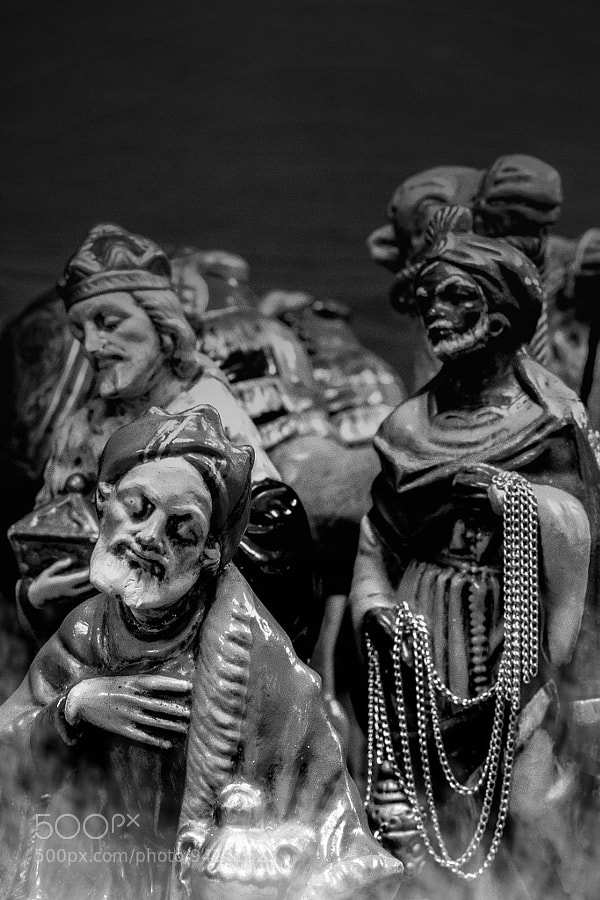
The Devotion of the Magi (Black and White)

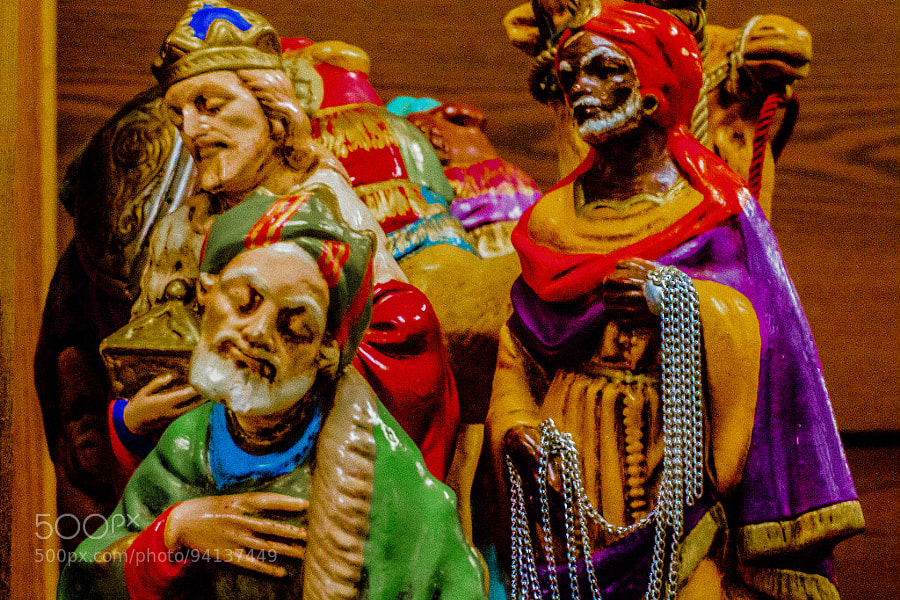
Earlier I posted another version of this photo - a hyper saturated color version.  I like it in black and white too. I have already been reminded that I'm a few days early for epiphany, but I figure that if we can start Christmas in October, I can post these photos a week early.


Photograph The Devotion of the Magi by Jeff Carter on 500px

The Devotion of the Magi


Photograph The Devotion of the Magi by Jeff Carter on 500px

Jeff Carter's books on Goodreads
Muted Hosannas Muted Hosannas
reviews: 2
ratings: 3 (avg rating 4.33)

Related Posts with Thumbnails