Pages

google analytics

Showing posts with label zombies. Show all posts

Thursday, May 19, 2016

What I’m Reading: Pontypool Changes Everything


“A face is a marvelous thing for those who possess it. It is really the only thing that distinguishes us. Not quite enough to recommend us, just a trickster feature of our anatomy that makes everyone appear famous. But still, the face is beautiful. A sensitive sign of obscure integration. And every once in a while that integration is challenged” (Burgess 184).

Zombies are the thing these days–though maybe the craze is starting to wane. Even so, we’re fascinated by the bleak, apocalyptic horror of the zombie story. They’re not like other monsters, not like other supernatural creatures of the night; they’re worse, more frightening because they are us. “[W]hat is especially terrifying with zombies is that their monstrous state is their human state, it never transforms or goes away” (Paffenroth 9).

Most Zombie books, graphic novels, movies, video games focus on the horror that arises from the disintegration of human society – the collapse of modern culture and the breakdown of human relationships. But Pontypool (both the novel (1995) and the movie (2009) are different; indeed, as the full title of the novel declares, Pontypool Changes Everything. Pontypool features that same psychological terror–the horror of watching human characters, not only being eaten by the undead, but also the horror of humans slaughtering creatures that still so closely resemble us humans, that is humanity consuming itself. (Paffenroth 9) But even more the disintegration of human civilization, Pontypool is about the disintegration of human language.

The novel is not a ‘regular’ novel. It’s a bit like the Dadaist poetry of Tristan Tzara and the cut-up writings of William Burroughs. It’s a pile up of nonsense, non-sequiturs like a multiple vehicle collision on the highway that eventually creates something that resembles reality, albeit a terrible, burnt out, wrecked and ruined reality. The movie, the screenplay of which was also written by Tony Burgess, is more straightforward, more linear than the novel, but is still fairly unlike most other zombie films.

“I’m not the person who wrote this book,” says Burgess in the afterward to a 2009 edition of the novel; “I remember him. He had just graduated with a degree in semiotics, which is to say he was insufferably preoccupied with literary malformations… He wanted to magnify the least recognizable parts of his thoughts and feelings” (Burgess 253).

In Pontypool, the zombies are not brought to unlife by mysterious radiation from a space probe returning from Venus (as in George Romero’s Night of the Living Dead) or some sort of divine wrath, not by a disease or virus (as in Romero’s Dawn of the Dead) or some sort of biological weapon (as in Resident Evil or 28 Days Later). But neither is it left forever unexplained (as in The Walking Dead graphic novels and television series). In Pontypool the zombie virus is spread through language; the ‘virus’ infects words; its victims lose the ability to understand or communicate and are driven to states of rage and brutal animalistic violence, including the inevitable cannibalism.

“That night I had terrible dreams I was killing people. When I awoke it took some serious self-examination to convince myself that I was not repressing real acts of murder. So completely vivid was my sense of guilt that I felt nothing short of running through a full account of my life could provide me with the peace of mind I needed to fall back asleep. In spite of the three hours I spent combing over the details, I have, to this day, a persistent certainty that hidden inside me is the revolting knowledge of days when I wasn’t quite myself. I now suspect that my inexplicable bouts of exhaustion are due to the massive effort of keeping those days behind me” (Burgess 10).

Acclaimed horror writer, Stephen King says that we should “[b]egin by assuming that the tale of horror, no matter how primitive, is allegorical by its very nature; that it is symbolic” (King 31). The monster, the horror at the symbolic, dark heart of Pontypool is the fear that the world that we inhabit is inevitably and utterly incomprehensible, that we cannot make sense of the universe. In the end everything is madness and frenzy, and rage, and despair.

“You can’t pretend that you don’t feel very sorry for this man and his self-portrait. He has completely lost the ability to take care of himself. He will die soon, and the fact that that is merely all he ever wanted doesn’t make you feel any less protective of him now. You remember looking in the mirror and feeling awe: the self-portrait is complete.You think that you have found the face that can finally say goodbye” (Burgess 109).

“There is no life without prayer. Without prayer there is only madness and horror.” -Vasilii Rozanov


Burgess, Tony. Pontypool Changes Everything. Toronto, Canada: ECW Press. 1998. 2009. Print.

King, Stephen. Danse Macabre. New York, NY: Berkley Books. 1981. Print.

Paffenroth, Kim. The Gospel of the Living Dead: George Romero’s Visions of Hell on Earth. Waco, TX: Baylor University Press. 2006. Print.

Friday, July 31, 2015

This Accursed Melody - Soundtrack

A couple of years ago I, along with my brother and a large number of my friends and coworkers, put together a short zombie movie.  We had a lot of fun with it.  I've shared the movie here on the blog before but, for whatever reason, I never shared the music separately from the film.

So - here is the music - three songs.  And all this, of course, gives me opportunity to repost the film.


This Accursed Melody from Brad Carter on Vimeo.

Click here if you'd like to check out the script / storyboards/ and production notes.


Saturday, November 1, 2014

One More Death Face and Smoke and Sunlight

Yesterday afternoon I shared a couple of photos that my son and I created.  Here is one more from that set.  We put up a couple of lamps, hung some old curtains, painted his face, put on a hooded robe, and turned on the fog machine.   I've also included here a photo of the smoke curling up through the sunlight that streamed in through the garage door.

Death Face by Jeff Carter on 500px.com

Smoke and Sunlight by Jeff Carter on 500px.com


Friday, October 31, 2014

Night of the Living Politicians

Watching the classic horror movie Night of the Living Dead in this season of increasingly antagonistic political ads, I am drawn to the thought that many of the politicians vying for our votes are very much like Ben and Mr. Cooper.

They both have a plan to keep the people in house safe from the shambling monstrosities outside, plans that are not necessarily mutually exclusive.  But they're so busy fighting each other that, instead of keeping anyone safe, they actually ensure that the house is overrun by the flesh eating living dead.

Officials from both major parties are at fault.  By creating an atmosphere of suspicion, fear, and distrust, by refusing to see anything outside of their narrow field of vision, by allowing ego and one-ups-manship to be the guiding rule they are ensuring our destruction.

Thursday, October 16, 2014

Biblical Limericks: The Baptized Dead


I may not understand what Paul said,
much of it goes right over my head,
but I would like to see
when I watch my TV
a show ‘bout zombies – The Baptized Dead.

1 Corinthians 15: 29

Monday, October 7, 2013

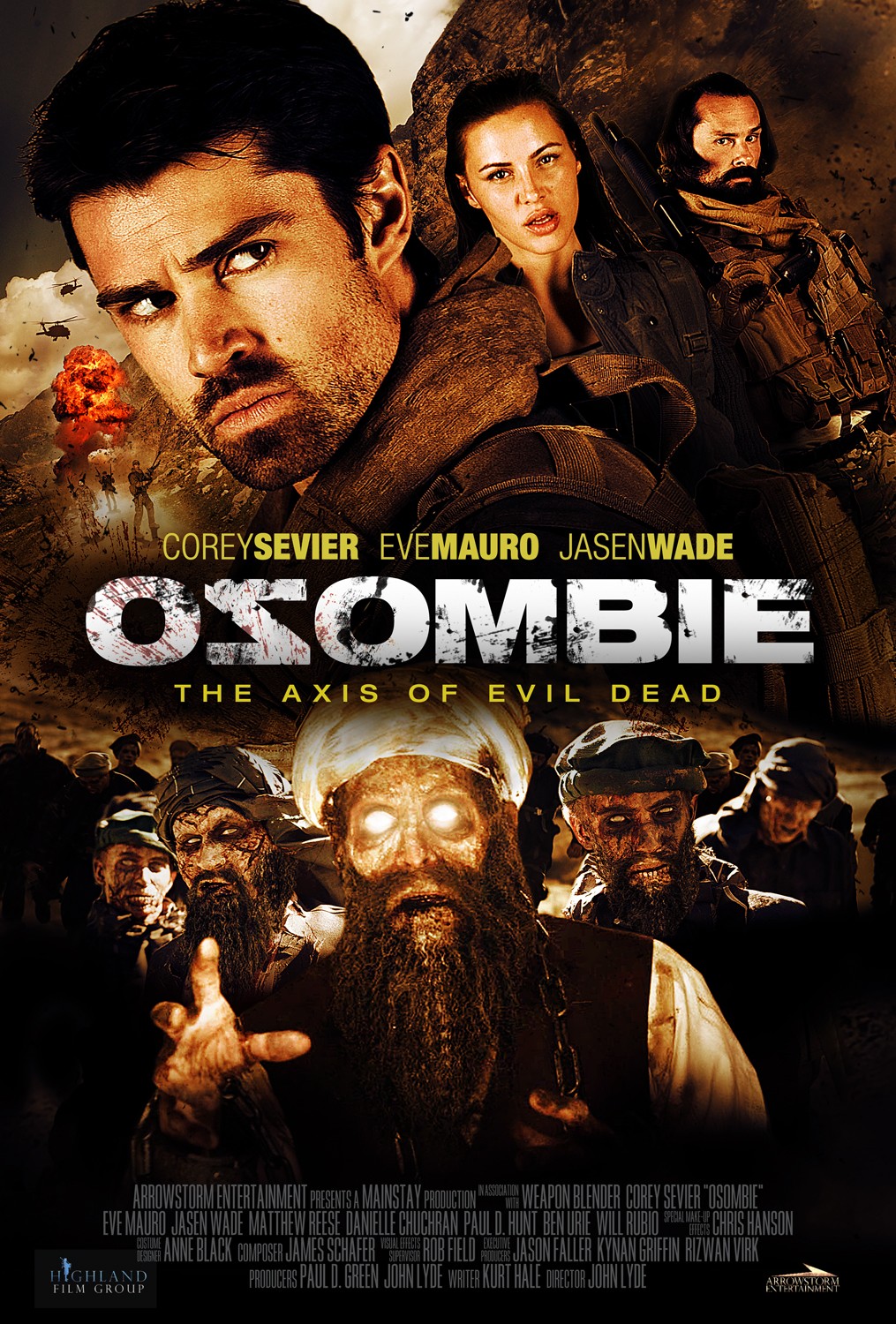
Osombie: Only a Gimmick


It’s time again for monster movies in October. To be honest, I watch monster and horror movies all year, but in October I try to write a little bit about them.

First – I watched Osombie (2012) with absolutely no expectation that it would be any good.  It’s a B-grade movie and not much more.  The special effects rely entirely too much on CGI.  The script is full of clichés.  The narrative arc is pretty much a flat line.  The actors are competent (but not much more than that.)  But I hoped that it might be something more.

The story, such as it is, follows a team of U.S. Special Forces team –and a yoga instructor - as they tramp across Afghanistan looking for the yoga instructor’s missing, tinfoil-hat wearing brother and the elusive, zombified remains of the undead Osama bin Laden.  This is a story ripe for over-the-top violence, gory mayhem and thick political satire.  It’s an insane set up, and that insanity should have been exploited to the fullest.  

But the movie that director John Lyde released takes itself too seriously.  It plays out as a rather bland straight forward action / zombie movie that seems more interested in showing us how super cool American soldiers are as they shoot the undead, make snappy (sometimes) one-liners, wield samurai swords and repeatedly take off their shirts.

I wish that this movie had done more with its initial concept, but it remains only a gimmick – a device to attract attention and nothing more.  

Other Monster Movies in October this year:

Thursday, October 3, 2013

The Re-Animator: Ruining our Deepest Hopes


It’s time again for monster movies in October. To be honest, I watch monster and horror movies all year, but in October I try to write a little bit about them.

I should probably be embarrassed to admit this.  I am a huge fan of H. P. Lovecraft’s writing, and I watch a lot of horror movies – but I’ve only just now watched The Re-Animator (1985).  It’s considered a classic in the genre but, for whatever reason I had, to this point, missed it.

The movie, directed by Stuart Gordon, is loosely based on H.P. Lovecraft’s "Herbert West-Reanimator,” (serialized between 1921-22) updated to a more contemporary setting – but also has much in common with Mary Shelley’s Frankenstein.  Lovecraft’s Reanimator was one of the first to deal with zombies – as the result of science rather than voodoo.

It’s a common story – mad scientist, crazed genius, playing god, trying to break the barrier of death.  We’ve seen it many times.  But rarely is it done with the scene chewing, paranoid frenzy that Jeffrey Combs brings to the role of Herbert West, or with the over-the-top splatter and gore effects.  It is a fun movie – if your idea of fun is talking decapitated heads, violent raging zombies, and laser brain surgery. 

Seriously though, the horrific element in all the stories of this type – Frankenstein, Zombies, Lovecraft, Mad Scientists, etc… is that, while there may be life after death, it may not be all that we’ve hoped for.  These stories take our longing for hope resurrection and eternal life and pervert it, ruin it. 

Did we in our own strength confide, our striving would be losing… (Martin Luther)

We want to do good.  We want do right.  But we often find that the great and noble things we attempt turn around to bite us, have unexpected, unintended, even terrifying consequences.  Horror movies, when done right, allow us to contemplate this. 


Saturday, January 5, 2013

What I’m Reading: Paul is Undead


My wife gave me the book Paul is Dead: The British Zombie Invasion by Alan Goldsher as a Christmas gift.  She knows I like to read. She knows that I like Zombies and she knows that I like the Beatles.  It should have been the perfect gift, right?  It certainly seemed that way to me.  I mean, what could be better than an oral history of the zombified Beatles? 

But then I actually began to read to book

My initial enthusiasm quickly wore off because the book was tedious to read; all of the characters speak in the same voice.  They all sound the same – Paul, George, Ringo, John, George Martin, Brian Epstein…. Everyone in the book speaks in the same way, with the same idioms, with the same vocabulary, with the same cadences.  Everyone, that is, except Mick Jagger – who sounds like a character from a bad swords and sorcery movie.  The oral history format of this novel needed a diverse range of characters that Goldsher was unable to deliver.

Paul is Undead also fails as a book about the Beatles as Zombies (except Ringo, a seventh level ninja)  in that they’re not zombies.  Not in either the Haitian Voodoo or the George Romero sense.  They ‘re brain eating, undead creatures of some variety.  But not Zombies.

And they’re not convincingly the Beatles either…

Sadly this book is a low level knock off of Seth Grahame-Smith’s Pride and Prejudice and Zombies (inserting zombies and ninjas into a favorite and familiar classic) and Max Brooks’ World War Z: An Oral History of the Zombie War (the oral history format). 

There’s plenty of madcap violence and destruction, there are cameo appearances by Rock-n-Roll greats like Roy Orbison, Elvis Presley, and Bob Dylan – all of which are intended to be humorous.  But they’re mostly not.  I chuckled a few times as I read, but not often.

It was a great gift from my wife, but disappointing.

Friday, December 7, 2012

He's a Dead Ringer


Dead Ringer


If you'd like to support the Salvation Army you can donate via this handy-dandy online kettle.

The link takes to to a kettle I've set up for the Newton, Iowa corps, but you can use the "find a kettle" feature to find the Salvation Army unit nearest to you.


Thank you.


Sunday, October 7, 2012

Fido – The Heartwarming Story of a Boy and His Zombie


My wife knows that I like horror movies and she, for the most part, continues to tolerate me.  She won't watch them with me, but she allows that I watch them.  She rolls her eyes at me.  And I think she laments the fact that our children are developing a taste for the weird and strange and scary. 

Nevertheless, I convinced her to watch the movie Fido (2006) with me the other night. It’s a zombie movie but I was able to persuade her to watch it with me because it’s also a comedy. And, believe it or not (she denies it now…) but she laughed several times during the film.  I think she liked it more than she’s willing to admit.

Fido is set in an alternate 1950’s – after a radioactive "space dust" led the the reanimation of the dead and  the nearly catastrophic “zombie wars.”  Conditions in the town of Willard (a nod to George Romero's film) and across the country are relatively safe and, thanks to the Zomcon Corporation and the invention of zombie control collars. In fact, it is so safe inside Zomcon protected communities that many families keep collared zombies as house-servants and pets.

The movie is infused with brilliant, crisp colors and sharp patterns, providing a strange contrast to the rotting corpses that inhabit the town.  The dialogue is well written and filled with witty 1950's cliches turned upside down and inside out, and the actors all perform admirably.  It is, simply, a great zombie movie.

And it is, indeed, a zombie movie –  it does have the requisite gore and blood (it wouldn't be much of zombie movie without it…) but, like the best zombie movies, it is less about the staggering, reanimated corpses and more about the living.  Fido is social commentary and satire.  It is a dark, biting humor.  While it never sinks to the point of being mere diatribe, the movie explores American culture and values and laughs at them.  It laughs at American fears that lead to racism, totalitarianism, and consumerism.  It laughs at the fear of death behind what passes as religion.  At a funeral, the priest intones “From dust have you come and to dust shall you return, but from dust shall you not be resurrected.”

If we can't laugh at our fears, they're sure to consume us.


Monday, October 1, 2012

Exit Humanity - Devouring Ourselves


It's October - time for monster movies.  Of course, I watch horror movies all year, but especially so in October.  And now that I'm blogging, I try to write a few things about the monster movies that I watch in October.

Tonight I watched the movie Exit Humanity (2011) directed by John Geddes - a zombie movie set six years after the end of the American Civil War.  Part Western, part Horror, this genre mashing film explores the horror of war and probes the self-inflicted wounds of mankind's cruelty.  But it's more than just a horror movie; the characters look for ways to live with and to live beyond  the horrors they've experienced and the horrors that they've committed.

The movie was filmed north of Toronto - imbuing the scenes with a stark, almost colorless - lifeless - pallor.  The story is structured around the chapters of the hero's illustrated journal. (And this is my only complaint about the movie.  The gritty historical realism achieved in the costumes and scenery is broken by a few animated sequences-used mostly to cover flashback material -that look too much like modern comics and graphic novels to fit within the rest of the film.) There are long scenes without any dialogue - carried very well by the actor's strength. (But there are also a number of scenes that rely too much on a voice-over narrator. Oh well...) The costumes look (mostly) authentic, and the gore and monster effects are convincing - something remarkable considering the movie's relatively low budget.


The American Civil War is often described as a war that pitted brother against brother.  Exit Humanity pushes the consequences of that war between brothers beyond the war's end in 1865. When hatred, and murder, and revenge are allowed to pour out, unchecked-like an infection- across the land, families are torn apart (quite literally).  And, as is always true in war, the innocent suffer.  Children die.  When we lose whatever is good in our humanity we become like the shambling horrors of this film, devouring and consuming each other.


Wednesday, August 15, 2012

Gnawing on the Flesh -Some thoughts and questions about John 6: 51- 59


The past several weeks’ lectionary readings have focused on Jesus’ feeding of the 5,000, the walking on the water, and the subsequent “Bread of Life” discourse in Capernaum.   This week’s reading is from John 6: 51 – 59, a passage that many have noted makes a sharp break from the preceding verses (6: 35 – 50.)  The Bread of Life discourse in vss. 35 – 50 seems to be a full and complete sermon, with a beginning a middle and an end.  But vss. 51 – 59 pick up again, circling back round to the same material – though with a different emphasis.

In vss. 35 – 50 the “Bread of Life” teaching is –to use one of those fancy college words – Sapiential – that is - having to do with wisdom, especially God’s wisdom.  To eat the bread of life is to believe in the one that God has sent and to be taught by God.  This section may also be Sacramental – having to do with the Eucharist / Communion sacrament, but that seems to be a secondary or minor emphasis.
In vss. 51 – 59 the “Bread of Life” teaching lays stress on the eating (or more literally the “gnawing”) of Jesus’ flesh and the drinking of his blood.  There is no mention of “belief” in this section – only on the receiving and consumption of Christ’s flesh and blood – and the eternal life that those elements impart.

Many scholars have suggested that what we have here are two different “Bread of Life” discourses that have been edited together.

Rudolf Bultmann believed vss. 51-59 (and all sacramental references in John) to be the corrective work of a later editor who tried to bring John’s gospel back into line with traditional ideas and to make the discourse more acceptable to the church. Raymond E. Brown takes a ‘middle of the road’ approach, accepts vss. 51 – 59 as authentically John, but transplanted from the narrative of the last supper and the institution of the Eucharist sacrament.

This is an interesting suggestion. 

John, unlike the synoptic gospels, does not include in his Last Supper narrative anything about Jesus instituting the Eucharist sacrament. Though his account of the Last supper is substantially longer than the synoptic (5 chapters!) he says nothing about the communion sacrament.  The body and blood are absent in John’s last supper.

“His purpose in all of this seems to have been to spell out the eucharistic undertones already implicit in the chapter.  He has given 51 – 58 the same beginning and the same ending as 35 – 50; the same type of interruption where the Jews protest; the same promise of eternal life.  But where the original discourse stressed the necessity of belief in Jesus, the new discourse stresses the necessity of eating and drinking the eucharistic flesh and blood.”[1]

It wouldn’t be the only incident of narrative transplant in John’s gospel – the ‘cleansing of the temple’ incident, which occurs toward the end of the synoptics is placed at the beginning of Jesus’ ministry in John.  And both of these stories are connected to the Passover celebration.  Is that merely a coincidence?

But – so what?  As the pastor for a small, Midwestern congregation of people who will be, at best, largely uninterested in hypothetical constructions of how the gospel came to be … or, at worst, hostile to the idea that John didn’t record authentic historical events in exactly the way they occurred – how do I interpret and teach and preach from this passage? 

Does the shift from an emphasis on wisdom and belief to sacramental consumption matter to them? And to further complicate the issue – how do I handle these issues from within a non-sacramental denomination?  (The Salvation Army, along with the Religious Society of Friends – the Quakers- does not practice formal sacraments, believing that all of life should be considered sacramental and holy.)

I’m also rather fascinated by that word “Gnaw”.

John doesn’t use the regular word for “to eat” here.  Instead of the expected esthiein “to eat,” John uses trogein, a word that was used to describe “crunching” and “munching” -the way animals eat.  [2]  It certainly gives emphasis to the sacramental theme – the eating of the bread of life – but it seems that John is deliberately making the message offensive.

The idea of crunching and gnawing upon the flesh and drinking the blood of Christ must have been repugnant and deeply offensive to the Jews who heard this message (whether in the synagogue with Jesus or in the artfully crafted narrative of John).  And perhaps it should be more offensive to us as well. It certainly sounds more like an episode of The Walking Dead than a dignified church service.

Eat Flesh - To eat someone’s flesh was an indication of violent and hostile intent:  “… the wicked came against me, to eat up my flesh…” (Psalm 27:2)  “…let what is dying die, and what is perishing perish.  Let those that are left eat each other’s flesh.” (Zechariah 11:9)  This is brutal slaughter and apocalyptic carnage. In speaking to the vultures and carrion eating animals, the prophet Ezekiel encouraged them to “gather together…that you may eat flesh and drink blood” (Ezekiel 39:17)

And Jesus didn’t do anything to discourage this ghastly (mis)understanding.  It’s as if he were making it difficult on purpose – trying to offend them.  If this was his intent, he certainly succeeded. In next week’s reading we find that even many of his followers were disgusted by this teaching and abandoned  him (John 6: 60 – 66).

So do I preach it this way?  I’m still the new guy here – barely a month in.  If I launch into a “Zombie Christ” kind of sermon complete with slurping and gnawing sound effects am I going to offend members of the congregation? 

And if I do, should that matter? 

Apparently it does.  Just yesterday I received a message from our Divisional Headquarters saying, “To date, Sunday School and Sunday Worship in your appointment have decreased in average attendance over last year. Consider what measures are being taken to promote growth and evaluate for effectiveness…. Continue to guard these souls with tender care and the truth of God's Word.”

Is this cannibalistic Christ part of the “tender care” of God’s Word? 

These are some of the questions that I’ve been trying to answer, and that I will continue to gnaw on through the rest of this week.

And, of course, if I mention Zombies then I have to include a link to my zombie movie!


[1] Brown, Raymond E. The Gospel According to John: Introduction, Translation and Notes, ed. William F. Albright, David N. Freedman, Doubleday & Company, Inc., Garden City, New York, 1966 page 287-289
[2] Moloney, Francis J. Sacra Pagina: The Gospel of John, page. 381

Wednesday, January 11, 2012

What I'm Reading: Valley of the Dead


"Through me the way into the suffering city,
   Through me the way to the eternal pain,
   Through me the way that runs among the lost.

Justice urged on my high artificer;
   My maker was divine authority,
   The highest wisdom, and the primal love.

Before me nothing but eternal things were made,
   And I endure eternally.
   Abandon every hope, ye who enter here."[i]

The poet, Dante read these words above the gate to hell - wherein he would observe the most ghastly scenes of sin and vice and human depravity.   But how did he come to such a place? What did he see in his life to inspire such horrific descriptions? 

Kim Paffenroth, a professor of Religious Studies and author of several horror novels, has in his novel –Valley of the Dead: The Truth behind Dante’s Inferno - supposed it to be “a massive, horrifying outbreak of cannibalism… Dante had witnessed what I previously thought was a deadly plague only in our modern world – zombies, ghouls, the undead, the living dead.” (pg.10 -11) [ii]

This outbreak of flesh eating monsters flung the traveling poet headlong into a valley filled with the most sordid and vile examples of human depravity imaginable.  But as in the best zombie stories, the evil isn’t so much in the reanimated corpses but in the living.  The dead are, of course, dangerous.  They are the threat that sends Dante and his companions fleeing, but it is the sin and wickedness of those still alive that raise Dante’s revulsion. 

The monsters, the shuffling and moaning corpses are, for all the danger they pose, to be pitied.  They have become creatures without will, without choice, driven by base and uncontrollable desire. 

At one point in the novel Dante and his three companions are asked by a lecherous man why they think the creatures have come.  “Tell me, in your tidy universe of a just, loving God, who made these abominations, these creatures of evil, malice, and destruction?”

One answers, “God made them so that we may overcome them and grow stronger.”  Another says, “They make no difference to us, since this life is unimportant… We care only for the soul and eternal life.”  Dante answers the man’s question saying, “They are just people left to their own sinful ways…They are what we have made of ourselves.”  And the other in his group, the only woman among them, answers, “They are here for us to pity.” (pg. 122 – 123)

Pity.  And Mercy.  Even in this hell on earth there is mercy for these creatures.  It is the living who seem to be beyond pity (though hopefully not beyond mercy.)  The dead may be forgiven their destructiveness for they do not choose it, can not resist it, and do not enjoy it.  The living encountered in this valley of the dead, are truly wicked.  They are greedy and gluttonous.  They are lustful. They are full of malice and anger and blasphemy. They are the truly monstrous.

And like C.S. Lewis’s gates of hell –locked from the inside- the people of this valley refuse to leave. They are so consumed by their selfishness that they will not leave their sin to flee neither the plague of walking dead nor the invading army that is destroying and slaughtering everything and everyone in its path. 

It’s been several years since I struggled through Dante’s Inferno. And, truth be told, I didn’t actually finish it.  I’ve wanted to read it through, but haven’t yet.  But this lack of familiarity with the Inferno wasn’t a handicap to reading Valley of the Dead.   There were several references that I recognized (the wolf upon the road, the river crossing, the fortune teller with an undead creature whose head had been turned backwards on its body, the frozen lake at the center…) and I can only assume that there were just as many that went over my head. But the novel is written clearly enough that even those without any knowledge of Dante’s writing could understand and appreciate the story.

The Zombie genre has a bad reputation (even worse that that of science-fiction or fantasy), some of which may be deserved. Many zombie movies seem to be merely an excuse to fling copious amounts of blood and gore upon the screen. Zombie novels seem to be the new fad in horror writing – a quick way for publishers to make a buck (in the same way that pulp crime novels, science-fiction novels, and romance novels have been for years). But good writing transcends the stereotypes and clichés of the genre to honestly describe the human condition.  Though there is plenty of gore and violence in Valley of the Dead (what would a zombie novel be without them?), the thoughtful reader will recognize that there is something more within these pages.

So bitter is it, death is little more;
   But of the good to treat, which there I found,
   Speak will I of the other things I saw there.[iii]


***

And writing about the living dead gives me opportunity to link back to my zombie film : This Accursed Melody.


[i]    Dante – Inferno - Canto III. 1 - 9
[ii]   Paffenroth, Kim, Valley of the Dead: The Truth Behind Dante’s Inferno, Permutated Press, 2010
[iii]  Dante – Inferno  - Canto I. 7 - 9

Thursday, December 29, 2011

This Accursed Melody - the Movie

It's Christmas.  I'm on vacation with my family so, of course, we are watching zombie movies.  (Isn't that what every family does during holiday get-togethers?)  We've even managed to coerce my mom into watching several episodes of The Walking Dead with us.  She's admitted that the show is deeply compelling and well acted, but she wishes that "they'd not show so much gory stuff."  I think she's missed the point...

But we're not just zombie movie watchers.  We're also zombie movie makers.

Last summer, during my annual stint at music camp, I made a zombie movie with  my brother and the staff and campers. We managed to film and edit the entire movie in just under a week.  And everyone had a lot of fun.  Some of the leaders were a bit nervous when they heard rumors of a zombie movie; they were apprehensive about it being a horror movie, but when the movie was screened on the final day of camp, every one was pleased. (At least, no one came to yell at me afterwards.)

My brother and I entered the film into a couple of film contests and festivals, but it was rejected (awww...). That was kinda' sad, but instead of being depressed about our rejection we are - finally - making it available for you to watch and enjoy - perhaps you'd like to watch and enjoy it during your next family holiday vacation.


We made extensive use of The Freesound Project - both in the music and sound effects - for this film:

Monday, October 17, 2011

Undead or Alive


Undead or Alive (2007) is a genre blending RomZomCom along the lines of Shaun of the Dead – a romantic zombie comedy for those who liked Brokeback Mountain.  I didn’t expect very much from this movie when I started it (I mean, come on…Chris Kattan is in it!), but I was pleasantly surprised and I laughed out loud several times. 

All the western clichés are present – from the frontier women in long cotton skirts baking pies in wood burning stoves, to the corrupt and mustachioed sheriff, the saloon girls, horses, and six-guns. These common western tropes are combined with recognizable zombie movie chestnuts like the shambling rotting corpse eating the brains of his wife and daughter.   It’s not, by any means, a great movie, but it does deliver all that it promises:  Cowboys and Zombies and not a few laughs. 


But, I should say, my enjoyment of this lighthearted movie was very qualified.

Zombie movies can generally be divided into two kinds based on their explanation for the origin of the zombies.  One says that the dead are reanimated by some sort of bacteria or virus, that is to say, a scientific and natural explanation (however un-scientific it might be).  The other kind of zombie movie suggests that Zombies are the result of a supernatural curse.  Undead or Alive is one of the latter.

The movie’s prologue tells us that the legendary warrior and medicine-man Geronimo, “renowned for bravery in the face of overwhelming odds…was credited with supernatural powers.”  After many years of guerrilla war against the U.S. Army, Geronimo was finally cornered and his final act was to make “the secret medicine known as the White Man’s Curse.” This curse is what causes the white-men to become zombies.

And this is where part of me started to object.

If the curse of the film were cast by any unidentified Apache warrior / medicine man, I could have watched the movie without struggling to maintain my suspension of disbelief.  But crediting it to the famous and historically important Geronimo causes several problems.

Geronimo was indeed renowned for his raids against Mexican provinces and later against US territories.  After a lengthy pursuit, he finally surrendered to US forces in 1886. He was taken as a prisoner of war and lived for many years and became something of a celebrity.  He also became a Christian and urged his people

“..to study that religion, because it seems to me the best religion in enabling one to live right.” [i]

He didn’t die until 1909 - from complications from pneumonia.  So the history and characterization of Geronimo is far from accurate.  And he’s hardly a character in the movie anyway.  We see him only briefly during the prologue and in a few very short flashes as the curse is passed from victim to victim, so I’m not sure why the filmmakers thought it necessary to attach Geronimo’s name.

But then again, having all but cleansed the old west of authentic “Indian” characters in real-life, why should we expect our films to portray them accurately.  Why bother when we can pit cowboys verses zombies or cowboys verses aliens?

"I was living peacefully with my family, having plenty to eat, sleeping well, taking care of my people, and perfectly contented. I don’t know where those bad stories first came from. There we were doing well and my people well. I was behaving well. I hadn’t killed a horse or man, American or Indian. I don’t know what was the matter with the people in charge of us. They knew this to be so, and yet they said I was a bad man and worst man there; but what had I done? I was living peacefully there with my family under the shade of the trees, doing just what General Crook had told me I must do and trying to follow his advice. I want to know now who it was ordered me to be arrested. I was praying to the light and to the darkness, to God and to the sun, to let me live quietly there with my family. I don’t know what the reason was that people speak badly of me. Very often there are stories put in the newspapers that I am to be hanged. I don’t want that anymore. When a man tries to do right, such stories ought not be put in the newspapers. There are very few of my men left now. They have done some bad things but I want them all rubbed out now and let us never speak of them again. There are very few of us left." - Goyathlay (Geronimo)[ii]


[i] Geronimo, His Own Story. New York, New York: Ballantine Books.   page 181
[ii]  quoted in Bury My Heart at Wounded Knee by Dee Brown , page 392

Tuesday, October 11, 2011

What Could Be Worse than Nazi Zombies?


I’ve made another change in my Monster Movies in October schedule. I swapped out The Bloodstained Shadow for the 2009 Norwegian film Dead Snow (Død Snø) about Nazi Zombies.  Dead Snow is a movie that I wanted to like.  Seriously.  Nazi Zombies!

It seemed like a great concept.  And I really wanted to like this movie, but the movie knows that it is cliché and is never able to rise above the level of cliché.

How many movies start with a group of friends on a trip to a cabin?

There are a few clever moments in Dead Snow but never gets around to adding anything new to the zombie genre.  It just quotes all the old zombie favorites but with amplified blood and gore.  But the great zombie movies aren’t really about the zombies.  The great zombie movies are about the human characters.  Dead Snow is just about the zombies… the zombies and lots of gore.

And it could have been so much more.  Given that Zombies (usually) are mindless flesh eating creatures a film about Nazi zombies could have explored the nature of evil and the choices that humans make.  It could have been about guilt and shame.  It could have been, but it wasn't. And I was disappointed.  I wanted something more than a lot of blood.


Of course Nazi Zombies aren't really new. There was the 1977 movie Shock Waves that featured Nazi zombies and Peter Cushing.


Friday, September 30, 2011

It's Time for Monster Movies


It’s October.  It’s time for monster movies.  It’s time for screams in the dark.  So I’m going to watch a horror movie every night this month.  (I’m actually rather excited, so I’ve started early…)

Here’s my plan:

Sept. 30 – Trollhunter (2010)
Oct. 1 – Mark of the Devil (1970)
2 – Wolfen (1981)
3 – Glass Dolls (1971)
4 – Moon of the Wolf (1972)  Dagon (2001)
5 – Sheitan (2006)
6 – Shiver (2008)
7 – Goth (2008)
8 – Don’t Torture a Duckling (1972)
9 – The Black Belly of the Tarantula (1971)
10 – The Bloodstained Shadow (1978)  Dead Snow (2009)
11 – Daughters of Darkness (1971)  Arang (2006)
12 – Inferno (1980)  Barking Dogs Never Bite (2000)
13 – The Cat O’Nine Tails (1971) Paranormal Activity (2006)
14 – The Perfume of the Lady in Black (1974) Creepshow (1982)
15 – Xombie: Dead on Arrival (2003)
16 – Empire of the Ants (1972) Undead or Alive (2007)
17 – The Food of the Gods (1976) Cronos (1993)
18 – Return of the Ape Man (1944)
19 – The Legend of Hell House (1973)
20 – Jesus Christ Vampire Hunter (2001)
21 – Black Swarm (2007)
22 – Mutants (2009)
23 – Ripper: Letter from Hell (2001)
24 – Let the Right One In (2008)
25 – Thirst (2009)
26 – Vampire Circus (1972)
27 – Dunwich Horror (1970)
28 – Countess Dracula (1971)
29 – Shadow Puppets (2007)
30 – Night Junkies (2007)
31 – Vampyre (1932)

I’ve tried to pick a wide selection of movies – vampires, zombies, werewolves, killers, ghosts, and trolls (TROLLS!) – from different eras and from all around the world.  I’ve not seen any of these.   I’ll be writing up my thoughts and reviews of them for this blog. 

If you’ve seen any of them feel free to share your comments.

I might change this list as I go along. 

Friday, July 8, 2011

This Accursed Melody - the Trailer


This Accursed Melody Trailer from Brad Carter on Vimeo.


Here is the trailer for our film This Accursed Melody.   We - my brother and I - made it at music and now we're just about ready to release it to the world.  We've been looking at various distributors and online download providers, trying to find the best and most affordable way for us to get this out to everyone.   And we think we've found a good way to do it. 

Until then, enjoy the trailer, and tell your friends - please!

We're also considering submitting the film to a couple of film festivals.  Obviously we'd like to enter it at Cannes or Sundance.

But perhaps a more realistically:
Corpsedance International Horror Film Festival (October 21 - 23 in Chapel Hill, North Carolina)
and

Kids First! Film Festival (even if their website is much too sunshiney...)

Proceeds from the sale of This Accursed Melody  will support The Salvation Army of Fairmont, MN and our World Services, so please - PLEASE - tell your friends, and when the DVDs are ready buy a copy, or buy several copies. 

Jeff Carter's books on Goodreads
Muted Hosannas Muted Hosannas
reviews: 2
ratings: 3 (avg rating 4.33)

Related Posts with Thumbnails