
Showing posts with label painting. Show all posts
Showing posts with label painting. Show all posts
Tuesday, March 28, 2017
Strange Dreams

It's a detail of the painting, Jacob and Rachel at the Well by an unknown 16th century Italian artist.


Tuesday, February 14, 2017
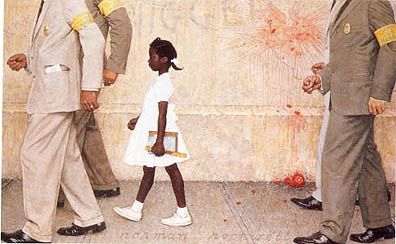
This Is (Still) the Problem We All Live With
Conservative cartoonist Glenn McCoy has published an editorial cartoon depicting the recently confirmed Secretary of Education, Betsy DeVos. In this cartoon McCoy has shamelessly hijacked the layout of Norman Rockwell's 1964 painting, The Problem We All Live With but replaced six year old Ruby Bridges on her way to a recently desegregated school with Betsy DeVos.
The problem (that we still live with) is that Betsy Devos is not the disenfranchised being empowered. She is the powerful (rich and powerful) who now directs the franchise. Betsy DeVos is not the weak needing protection. McCoy has hijacked the story of people of color to portray conservatives as the oppressed and mistreated. It is foolish to suggest this when conservatives currently control the executive branch and the legislative branch, and are poised to control the judicial branch as well. This is disingenuous. This is still the problem that we all live with.
Sunday, November 8, 2015
Paul Klee: Forward and Backward to the Center
This is a short essay that I wrote for my ART 101 (Art History ) class at the Des Moines Area Community College
That the Swiss painter Paul Klee (1879 – 1940) isn’t more widely known and immediately recognized is somewhat shocking considering his vast output of creative work: by the time of his death he had created over 10,000 works in various mediums including: oil paint, water-color, pen and ink drawings, lithographic prints, chalk, and etc. (Baker 169) That Klee remains somewhat obscure is also puzzling when one considers his many and varied links to other popular artists within a variety of modern artistic movements of the early 20th century and his anticipation of styles taken up by artists in the late 20th and early 21st centuries. His work should be known, and loved, and treasured, not only because of his mastery of a diverse range of styles and techniques, but also because of his restless investigation into the human condition and his preservation of a childlike spirit in spite of human depravity and social crises.

 Omphalo-Centric Lecture (Paste color on silk and burlap)-created
in 1939-the year before his death–is a visual description of this artistic
quest; looking inward, looking deeper, looking into the mystery at the center
of the universe, what lies before and what lies beyond. It is, quite literally,
navel-gazing.
Omphalo-Centric Lecture (Paste color on silk and burlap)-created
in 1939-the year before his death–is a visual description of this artistic
quest; looking inward, looking deeper, looking into the mystery at the center
of the universe, what lies before and what lies beyond. It is, quite literally,
navel-gazing.
 The Mask of Fear (oil on burlap, 1932) is a painting that describes the mental anguish
of the artist and of the world. The oval shaped, somewhat African styled mask
has large, round eyes with widely dilated pupils-as if starring, transfixed in horror,
at something unseen-over a quirky, thin handlebar mustache. Painted on the eve
of Adolf Hitler’s rise to power, it’s not difficult to guess what horror that
might be. The satirical death mask is supported on two sets of human
legs-suggesting that this fear of death is corporate, rather than individual. “The
Mask of Fear, then, is a mask of
anguish covering the face of Europe, whose myth was again collapsing” (Ponente
97).
The Mask of Fear (oil on burlap, 1932) is a painting that describes the mental anguish
of the artist and of the world. The oval shaped, somewhat African styled mask
has large, round eyes with widely dilated pupils-as if starring, transfixed in horror,
at something unseen-over a quirky, thin handlebar mustache. Painted on the eve
of Adolf Hitler’s rise to power, it’s not difficult to guess what horror that
might be. The satirical death mask is supported on two sets of human
legs-suggesting that this fear of death is corporate, rather than individual. “The
Mask of Fear, then, is a mask of
anguish covering the face of Europe, whose myth was again collapsing” (Ponente
97).
 And his work continued to demonstrate a
combination of mature reflections on pain and sadness, as well as the mystery
of wonder and joy in the world. Klee returned again and again to the Opmphalo
as a sort of reoccurring image of life and wonder in his work. In 1932, he painted The Fruit (oil on jute), another example of his
quest to find the mystic center. In that work, a spiraling cord–an umbilical
cord–leads us forward and backward, curving through space and time, to find the
intense white light at the center of a dark piece of fruit– the seed, the
embryo from which all will grow.
And his work continued to demonstrate a
combination of mature reflections on pain and sadness, as well as the mystery
of wonder and joy in the world. Klee returned again and again to the Opmphalo
as a sort of reoccurring image of life and wonder in his work. In 1932, he painted The Fruit (oil on jute), another example of his
quest to find the mystic center. In that work, a spiraling cord–an umbilical
cord–leads us forward and backward, curving through space and time, to find the
intense white light at the center of a dark piece of fruit– the seed, the
embryo from which all will grow.
 In 1936, he painted the cheerful landscape Southern
Gardens (Oil on paper). Klee
painted few works that year because of the debilitating pain of his illness, yet
despite his sickness, this work is filled with a joyous light and warmth. It
depicts a serene Mediterranean landscape–a garden. And, again, in the center of
this garden is the Omphalo. The Garden becomes then, not just any garden, but
the mythic and mystic Garden of Eden where men and women walked with God in the
cool of the day (Genesis 3:8)-close to the heart of creation.
In 1936, he painted the cheerful landscape Southern
Gardens (Oil on paper). Klee
painted few works that year because of the debilitating pain of his illness, yet
despite his sickness, this work is filled with a joyous light and warmth. It
depicts a serene Mediterranean landscape–a garden. And, again, in the center of
this garden is the Omphalo. The Garden becomes then, not just any garden, but
the mythic and mystic Garden of Eden where men and women walked with God in the
cool of the day (Genesis 3:8)-close to the heart of creation.
It is this combination of pessimism and satire
with charming innocence and whimsy, of the realities of pain with the joy of
existence that draws me into the artwork of Paul Klee and makes me wish that
more people were familiar with his work.
“I don’t want to render man as he is” said Klee in one of his lectures, “but
as he might be” (January 26, 1924, quoted in Poente 14). Through the artistic work of Paul Klee it is
possible to discover the fullness of the human experience and to search for the
greater mysteries-to become more than we are.
***
That the Swiss painter Paul Klee (1879 – 1940) isn’t more widely known and immediately recognized is somewhat shocking considering his vast output of creative work: by the time of his death he had created over 10,000 works in various mediums including: oil paint, water-color, pen and ink drawings, lithographic prints, chalk, and etc. (Baker 169) That Klee remains somewhat obscure is also puzzling when one considers his many and varied links to other popular artists within a variety of modern artistic movements of the early 20th century and his anticipation of styles taken up by artists in the late 20th and early 21st centuries. His work should be known, and loved, and treasured, not only because of his mastery of a diverse range of styles and techniques, but also because of his restless investigation into the human condition and his preservation of a childlike spirit in spite of human depravity and social crises.
Paul Klee was influenced by the artists before him
and by those working around him, yet he never became inextricably linked to any
particular style or artistic movement. He developed his own artistic language,
borrowing and reinterpreting the styles and methods of many others, but always
using them to his own design. The influence of artistic movements such as cubism,
fauvism, expressionism, futurism, dada, and surrealism is easily seen in Klee’s
vast output of work. He is frequently compared with Picasso, Chagall, and
Mondrian, among others, but the comparison is always slight because Klee never
duplicated anyone else’s stylings. Even the painting of Wassily Kandinsky, with
whom he taught at the Bauhaus art school in Germany, and with whom he founded Der Blaue Reiter (The Blue Rider) group
of artists, was similar but only in some small way; the differences were
notable. (Ponente 16)

And if the influences on Klee’s work were many and
varied, so too are the artists that his work has influenced in the years since his
death and whose styles he anticipated. One can project the shimmering
rectangles of color painted by Mark Rothko from Klee’s The Closet (1940, Colored paste on cardboard), and the thick-lined
graffiti style figures of Keith Haring from Klee’s Project (1938, Colored paste on burlap). It can be said that, while there was little
in Klee that resembled the “action paintings” of artists like Jackson Pollock,
Klee’s theories and explorations set the stage for abstract expressionism.
(Ponente 109 -110)


Klee’s work is often described as having a “charming
innocence and freshness of outlook,” (Waldberg 52), as a “personal, fairy-tale
world of fantasy and invention” (Baker 168). But to say that his art is “childlike” is to
ignore the deep maturity of his work, even in his early years. It is true that
there is much whimsy and wonder in the work of Paul Klee, but there is also
meditation on the fullness of the human condition, and that includes
experiences of pain, and depression, and misery. In addition to his childlike
playfulness his work demonstrates a “tendency to pessimism and satire”
(Grohmann 11). His work is at times playful and sardonic, romantic and bizarre.
In an essay written in 1920 (while he was serving
in the German army during World War I), Klee wrote, “Art does not reproduce the
visible, but makes visible” (quoted in Ponente 56). His painting was more than
just a replication of shapes and forms and colors from nature on canvas; it was
an attempt to see into the deeper realities of the universe.

The mysterious figure in Klee’s painting stares
out at us, as if inviting us to join the artist in this quest to find the
center of all things. She (the figure is vaguely feminine in its curves) cups
in her hand a glowing navel, radiating with a sort of divine light – a light
from which all knowledge spreads.
For Klee, who suffered in the last years of his
life from scleroderma (an autoimmune tissue disorder that causes a thickening
and hardening of the skin and of blood vessels and internal organs) the Omphalo
(Greek for “navel”) was a symbol of life and death. He dealt continually with
images of life as well as images of fear and death in his last years-not just
his own personal fears and his own imminent death, but those of the world
around him as well.

In 1933 Klee and his wife fled from Germany, back
to his native Switzerland, to escape persecution from the Nazi party. Klee,
along with many other modern artists in Germany, was labeled a “degenerate”
artists by the Nazis, and accused of being a “Jew” and a “foreigner.” (Grohmann
31) But, he said, “It seems to me unworthy to answer back to such crude taunts.
Even if it were true that I am a Jew or that I come from Galicia, this would
not change by one iota the value of my personality or my achievement” (Letter
dated April 6th, 1933-quoted in Grohman 31).
Despite the horrors of war, the death of close
friends, and the pain of his illness, Klee did not consider death to be the
end. The epithet on his tombstone (which he composed himself) reads:
I cannot be grasped in the here and now
For I live just as well with the dead
as with the unborn
Somewhat closer to the heart of creation than usual
But far from close enough
For I live just as well with the dead
as with the unborn
Somewhat closer to the heart of creation than usual
But far from close enough


Baker, Samm Sinclair, and Natalie Baker. Introduction to Art: A Guide to the Understanding
and
Enjoyment of Great Masterpieces. New York: Harry N. Abrams, Incorporated.
1971.
Grohmann, Will. Paul Klee: Masters of Art. Trans. Norbert Guterman. New York:
Harry N. Abrams, Incorporated. 1985.
Ponente, Nello. Klee: Biographical and Critical Study. Trans. James Emmons. Skira. 1960.
Waldberg, Patrick. Surrealism. Trans. Stuart Gilbert. Skira. 1962.
Friday, September 11, 2015

Thursday, September 10, 2015
The Amazing Juggler Performs, but Does He Enjoy It?
I am currently enrolled as a student at the Des Moines Area Community College (DMACC). This semester I am taking an art appreciation class. The following was written as an assignment for that class. We were required to visit the Des Moines Art Center (either in person, or by way of the internet), to view the works on display and to write about one of them.
***
I don’t know if “The Amazing Juggler” (oil on canvas, 64
3/4” x 39 5/8”) by the Japanese born, American artist Yasuo Kuniyoshi, was
specifically intended by the artist to be understood as a self-portrait, but
the painting can certainly be read as such. Painted in 1952, a year before his
death, it is a haunting and melancholic dream of his life and career as an
artist in America.
Featuring a cast of circus performers-two acrobats and the
eponymous juggler-in an uncertain and ambiguously defined space, “The Amazing
Juggler” continues Kuniyoshi’s lifelong use of circus and carnival themes. One
of the acrobats tumbles through the background, moving horizontally through the
upper third. Is this clown tumbling into or out of the frame? In the lower
right, another female performer rests in the curved trunk of an elephant. But
it is the juggler who holds central position in the painting. He is deftly
juggling four balls while riding a bicycle. Above them all are the poles and
cables of the circus tent–or are they the steel frames of modern city
skyscrapers? Everything is motion; the acrobat is cavorting, the elephant rider
is rocked, the juggler cycles towards the viewer. Even the foreground and
background are in motion, merging in uncertain space. The red performance floor
pushes backward, vertically, into what is either the sky or the circus tent.
Most of the work is defined by the shapes of the
performers–but the space they perform in is defined and broken by lines. The
horizon is uneven. What may be read as the floor also becomes the vertical line
of the circus tent post. The sky above is divided the painting’s strongest
lines–dark and rigid–but even so, they give no clear definition of the space.

Kuniyoshi has painted this picture with rough strokes and
dry scumbled paint. In many places, pencil lines show through the paint. The
effect is to create soft focus haze that emphasizes the dream-like qualities of
the painting. Even the garish colors–bright red, pink, magenta, turquoise, and
orange–are softened. What could easily become a nightmare is subtly subdued.
The Juggler occupies the same space as the vertical dividing
line with a performer on either side. But Kuniyoshi has kept this from becoming
a static arrangement by arranging the two other performers on a diagonal line.
The Juggler himself seems instable, almost ready to fall off the bicycle, but
is held balanced against that strong vertical line. The balance is precarious,
however; the chaotic motion of the performers comes dangerously close to a
crash. Perhaps that is the thrill of their performance.

In contrast to the other two performers in this painting,
the Juggler is wearing a mask. And his mask, in contrast to the rest of the
painting, filled with bright, brash color, is sober in black and white and with
its long nose resembles the medico della peste (“plague doctor”) masks of
Venetian carnivals, a memento mori symbol of death. The mask displays a rictus
that may be a smile–but only ambiguously so. Is it pleasure? Is it pain? Is
it something of both?
Born in Japan in 1889, Yasuo Kuniyoshi came to America,
alone, in 1906. He lived in the United States of America the rest of his life,
but was prohibited by law from ever becoming an American citizen. Even after
living in this country for decades, and having become a respected member of the
artistic community, when Japan attacked Pearl Harbor, Kuniyoshi’s status went
from “resident alien” to “enemy alien” (Wang 3).
Kuniyoshi, like many other immigrants at the time, was
placed under house arrest and interrogated by

If understood as a self-portrait, “The Amazing Juggler”
shows us a Yasuo Kuniyoshi, who is a precariously balanced performer,
skillfully performing his tricks-but aware that stability is precarious. His
place in society is held only through dexterous manipulation, keeping all the
props aloft and in motion, a balancing act that threatens to veer off course
and come crashing down. He hides behind a mask that seems to say “I am smiling,
see how much fun we’re having,” but that smile is dubious and there a
foreboding of death. It is the American dream-almost a nightmare. The Amazing
Juggler performs, but does he enjoy it?

Wang, Shi Pu. Becoming American? The Art and Identity Crisis
of Yasuo Kuniyoshi. University of Hawai’i Press. 2011.
Friday, September 4, 2015

Friday, March 13, 2015
Albert Schweitzer Fight Club
 I was deeply disturbed and the visions that passed
through my head alarmed me. Albert
Schweitzer started a secret fight club in the basement of my church. So I approached one of those who were
standing by and asked him about all this.
And in reply he said to me, “Rule number one: You don’t talk about
Albert Schweitzer fight club.”
I was deeply disturbed and the visions that passed
through my head alarmed me. Albert
Schweitzer started a secret fight club in the basement of my church. So I approached one of those who were
standing by and asked him about all this.
And in reply he said to me, “Rule number one: You don’t talk about
Albert Schweitzer fight club.”This was the horn I had watched making war on the holy ones in the basement, and proving the stronger.
“Let me give you a definition of fight club,” he
said to me. “It is good to maintain and
further life. It is bad to damage and
destroy life. And this ethic, profound, and universal has the significance of a
religion. It is a religion.”
I was greatly disturbed in my mind, for the highest knowledge is to know that we are surrounded by mystery. I grew pale; but I couldn’t keep these things to myself.
Wednesday, March 11, 2015

Friday, March 6, 2015

Saturday, February 7, 2015
The Eyes of the Madonna and Child
I photographed a reproduction of Carlo Crivelli's painting Madonna and Child using a DIY macro attachment and a multi-faceted filter.
My wife just says it's creepy...

My wife just says it's creepy...
Tuesday, October 14, 2014
Icon 2

Confession time. I flipped the image. I forgot in my carving to reverse the picture so that it would come out the "right way" in the print. No real worries, though. I like it. I like the idea of a left handed Jesus.
Here I've played around the image a little bit, added some text torn from a couple of old books.
Monday, October 13, 2014
Icon
 I spent a couple of hours the other day carving the image into a woodblock (and gave myself a nasty little blister in the process). Then I printed the image (several copies of it) onto these great pieces of old, heavy, water-stained pieces of paper that I found in the back of a storage closet.
 Tuesday, August 26, 2014

Monday, February 10, 2014
White on White
I was thinking of the Suprematism paintings of Kazimir Malevich - paintings based on geometric shapes and a limited color palette - particularly his painting White on White (from which I have stolen the title.)
White on White by Jeff Carter

White on White by Jeff Carter
Monday, October 28, 2013
A Day with the Arts and with Friends
Over this past weekend my family went down to St. Louis, MO to visit some of our very favorite people. On Saturday we all went to the SLAM - the St. Louis Art Museum - and spent the morning looking at various works of art. I was very pleased to see so many of my personal favorites by Max Ernst, and Joseph Cornell and Max Beckmann. the SLAM has quite a few by Beckmann - including this painting of Jesus and the woman caught in the act of adultery, and this one of Adam and Eve and the Tree by Marc Chagall

After we left the museum (reluctantly on my part. I would have been quite willing to ignore lunch and spend several more hours there...) we went for a late lunch / early dinner at Ranoush - a middle-eastern restaurant.
Following that, as we walked back to our van we passed by a "poet for hire" He had his typewriter with him there on the sidewalk - and with $3.00, the phrase "mediterranean lunch" and fifteen minutes he composed the following poem for us.

Our plan for the rest of the evening originally included a trip to a pumpkin patch /corn maze, but the day was already growing long and the littlest one among us was getting tired, so we we went home and played card games and wii mini golf.
Few days are this terrific. Few friends are this wonderful.
I took several photos of my friends' daughter, as my own daughter glares and pouts when I try to take her picture. This is Caroline at the museum. And so is this.
After we left the museum (reluctantly on my part. I would have been quite willing to ignore lunch and spend several more hours there...) we went for a late lunch / early dinner at Ranoush - a middle-eastern restaurant.
Following that, as we walked back to our van we passed by a "poet for hire" He had his typewriter with him there on the sidewalk - and with $3.00, the phrase "mediterranean lunch" and fifteen minutes he composed the following poem for us.
Our plan for the rest of the evening originally included a trip to a pumpkin patch /corn maze, but the day was already growing long and the littlest one among us was getting tired, so we we went home and played card games and wii mini golf.
Few days are this terrific. Few friends are this wonderful.
Tuesday, September 17, 2013
Is He a Blessing or a Curse?

·
Microstatic Fluctuations
·
the Missing Variable
·
Voltage Spikes
·
Inverted Spectrograms
·
Fluid Dynamics
Wednesday, September 4, 2013
A Rare Portrait of Dr. Tarrec

He believes that cameras, whether capturing his image on film or as digital bits of information, steal from him some vital electromagnetic energy, energy that he believes to be essential to his research into the more arcane and esoteric sciences.
He allowed me to paint this quick sketch of his likeness - and informed me that the last time he sat for a portrait was 1908 in Austria . If I understood him correctly, and sometimes his accent is difficult to get through, I believe he said that the painter was Gustav Klimt. That portrait, he said, was later destroyed by bombs during WWII.
The rooster, included at his insistence, is a symbol of the passing of time, and an alarum of death.
Tuesday, August 6, 2013
Moses

So the woman took the boy and nursed him till he was grown; then she handed him over to Pharaoh's daughter who adopted him as her own son, and gave him the name of Moses, the Rescuer; I had to rescue him, she said, from the river.
This small painting is acrylic and ink on paper.
7 X 10"
Wednesday, July 17, 2013
The Market in Review

12:07 a.m. - A report of someone who pounded on a back window of a residence...
10:51 a.m. An ongoing problem with a barking dog was reported...
12:39 p.m. A report of an unlicensed driver was received...It was later confirmed the driver was valid.
2:58 p.m. A report of juveniles stealing pumpkins ...the juveniles were located and a verbal warning was issued.
5:18 p.m. A complaint of older kids who stole toys from younger children was received...
Monday, June 24, 2013
Raheim's Bird

This is Raheim's Bird.
Subscribe to:
Posts (Atom)
Jeff Carter's books on Goodreads
 There Once Was a Prophet from Judah: Biblical Limericks for Fun and Prophet


 There Once Was a Prophet from Judah: Biblical Limericks for Fun and Prophet
reviews: 1
ratings: 1 (avg rating 5.00)
ratings: 1 (avg rating 5.00)
