I’ve read Stephen King’s apocalyptic magnum opus, The Stand, repeatedly. More than half a dozen times. It’s a powerful piece of work. Maybe he does, as he admits, have a case of “diarrhea of the word processor,” maybe 1141 pages (in the uncut 1990 paperback edition) is going on a little long. Maybe. But the book affects me; I am hung upon this “long tale of dark Christianity”.
I've also been reading John Howard Yoder’s book The Politics of Jesus and it strikes me that there is some significant overlap. Absurd, I know, but it’s there.
As the book nears its climax, Stu, Larry, Glen, and Ralph (along with the dog, Kojak) set off on foot from Boulder, Colorado - sent out like the disciples of Jesus (“go in the clothes that you stand in. Carry nothing.”) - towards the Dark Man and his legions in Las Vegas, and the threat of death by crucifixion. Before leaving, Larry Underwood asks, “Do we have a choice?”
Their spiritual guide, Mother Abigail, says, “A choice? There’s always a choice. That’s God’s way, always will be. Your will is still free. Do as you will. There’s no set of leg-irons on you. But...this is what God wants of you.” (King 905)
It’s a foolish quest. But they go, and willingly, towards an uncertain end.
Yoder writes in The Politics of Jesus: “The key to the obedience of God’s people is not their effectiveness, but their patience. The triumph of the right is assured not by the might that comes to the aid of the right, which is of course the justification of the use of violence and other kinds of power in every human conflict. The triumph of the right, although it is assured, is sure because of the power of the resurrection and not because of any calculation of causes and effects, nor because of the inherently greater strength of the good guys. The relationship between the obedience of God’s people and the triumph of God’s cause is not a relationship of cause and effect but one of cross and resurrection.” (Yoder 232)
A great combination of thoughts in this time of plague and quarantine and Easter.
You, sir, are a scoundrel and a cheat. And what is more, you are a coward. Afraid to trust the merits of your own work, you attempted to trade on a similarity of names. And I while I don’t know if the cover design was yours or the Magic Pen Designs named on the copyright page, I’m sure it was no accident that your cover apes the style of books written by the more famous Stephen King. Stephen R. King (yes, you duped me. I didn’t notice that initial until I’d returned home from the library) you are no Stephen King.
I am walking in a city at night, maybe it’s Indianapolis,
maybe it’s Peoria or Des Moines. The orange glow of sodium street lights give
everything a strange, sickly pallor. But it’s is a sickly pallor that we’re all
accustomed to, so no one pays it any mind anymore. The people around me walk in
and out of bars and restaurants, they get in and out of Uber vehicles, they
text, they talk, they laugh, they move on. The jaundiced tinge to the world
doesn’t disturb them.
I am carrying an oversized drawing pad and a pouch of
pencils. Its large white sheets of heavy paper now appear a dull orange under
the street lights.Without regard for
the other pedestrians around me, I sit down on the sidewalk, cross-legged, with
the sketch pad in my lap. I flip open the cover and find a fresh page to begin
drawing.
I am interested in the buildings, the skyline, and various architectural
details. The people around me disappear as my hand moves across the page. I see
only the graphite lines I am creating nothing else until
A slurred, mush-mouthed voice says, “Heaaay there, buddy. Do
you need shome money?”
I look up from the drawing pad. An inebriated man is
standing there in front of me, fumbling with a bottle of beer in one hand and his
open wallet in the other. His female companion stands next to him with her
hands jammed resolutely into the pockets of her coat. “Don’t give him cash,
Larry,” she warns him. “He’ll probably just use it to buy books…”
The book you all have been waiting for - There Once Was a Prophet from Judah: Biblical Limericks for Fun and Prophet - has arrived, at least at my house. And you can see just how excited my wife is about it.
Order your copy (or your seven or eight copies) now:
You can order it from the Wipf and Stock Customer Service line at 541-344-1528.
Recently, I’ve been reading Bob Woodward’s 1987 book, Veil: The Secret Wars of the CIA 1981 - 1987 in which Woodward describes the way that the Central Intelligence Agency expanded its covert and extra-legal activities during the presidency of Ronald Reagan, exerting influence, and power, and supplying weapons and money around the world in the aid of of American interests, and American profits.
Then this morning, I was struck (again) by Paul’s exhortation to the Philippians and I began to wonder what it might look like if an ostensibly, nominally Christian nation used Philippians 2: 3 - 4 as the guiding principle for its foreign policy. Do nothing from selfish ambition or conceit, but in humility regard others as better than yourselves. Let each of you look not to your own interests, but to the interests of others. (NRSV) Or in the the KJV - Let nothing be done through strife or vainglory… Would we wage secret wars and fund and arm militant right-wing dictators to benefit the Coca-Cola Company or The Aluminum Company of America (Alcoa). Would we depose government officials, topple democratically elected leaders, crash world economies, and stir up war and revolution around the world if we thought of the interests of others as important as our own, if we thought of the people of Chile, Lebanon, Argentina, Cuba, Iran, Korea, etc… as more important than ourselves?
If we want to “make America great again” we should look to the needs of others and not to our own profits.
the good news today has me transfixed:
There’s a publisher who
is ready and set to publish my biblical limericks. The acceptance email came this afternoon from Wipf and Stock. I’ll share more details as I have them.And, of course, you can still get a copy of my first book, Muted Hosannas.
Welcome, welcome welcome to the Biblioblog Carnival for May 2017, a round up of, if not the best of biblical studies on the world wide web of information, then at least the stuff I thought was interesting. Here at the carnival there are rides and games of chance, performers and daredevils (and regular devils, too). The bearded woman's here (she's Calvanist, obviously). There are thrills and spills and delights around every new corner. Take your time. Stroll down the midway and enjoy the sights.
The story of Moses doesn’t just show up in the Bible. In the
ancient world, nearly every culture had their own version of what happened. The
Egyptians, the Greeks, and the Romans all had their own way of explaining why
thousands of people left Egypt to live in Jerusalem. The Moses you know, who
performed miracles and freed the Jewish slaves from Egypt, is just one version
of the story. There are others – and they paint a completely different picture
from the one you’ve heard
Our discussion is all about the mystery of Israel’s origins.
And it is a mystery. The exodus and conquest of Canaan (Exodus through Joshua)
are central to Israel’s identity, and are certainly informed by old traditions
and authentic historical memory—but they not historical accounts in the modern
sense. How and when, historically speaking, Israel stepped out onto the world
stage is a huge mystery, though we have some clues to piece together a
compelling picture.
…the first story in 1 Kings has many incredible elements. This did not incline
me to reject the existence of Solomon as a historical person (as it did some),
but it suggested that much of what we find in the Bible about Solomon is not
history.
Saying this in non-musical language is nearly impossible. My
overall thesis is that the use of the accents defines poetic structure (and
prose also) beyond the scope of the line and beyond the scope of the verse. As
I have noted elsewhere, this thesis contradicts claims made over the past 1000
years in the literature on the accents, notably from Wickes in his treatises
from the 19th century. Two excellent examples are Psalm 96, where the accents
define the scope of the stanzas so clearly, and from the prose books, the
lament of David over the death of Saul and Jonathan. I can only illustrate
these with the music, which to a musician is so much clearer than any list of
accents would tell us.
Thus, Jewish priestly
education inherited from the Babylonian lexical lists some numerical schemes
based on the sexagesimal counting system (i.e., a numerical system with sixty
as its base), and the Levitical author presented it as part of priestly
knowledge. Once Levi learns how to prepare the holocaust offering and
accompanying meal offering together with the fraction notations (14–61), then
in his wisdom poem (82–98) he instructs his children/students not to neglect
the study of scribal craft (88, 90, 98). The priestly education system is
characterized as belonging to the scribal type of knowledge, which indicates a
strong Babylonian background and a clear link with the pseudepigraphic book of 1
Enoch
In this volume of collected articles—most of them published
previously in a variety of scholarly venues, though updated here—Loren
Stuckenbruck of the Ludwig-Maximilians-Universität, Munich, takes the reader on
a detailed exploration of the birth and early history of this legend as
attested in ancient Judaism and earliest Christianity. There are few, if any,
as capable of guiding this tour, and though these individual studies were not
originally intended to be read as part of a comprehensive account, readers of this
book will come away with a rich understanding of the myth of the fallen,
rebellious angels and their offspring as understood in ancient Judaism and
Christianity.
NT Jesus Never Saidby Scott Fritzsche at Unsettled Christianity:
An argument from silence is a rhetorical device designed to
be a convincing argument in a simple and straight forward way. It often, on the
surface, is. There are numerous inherent flaws in an argument form silence
however. This becomes important in theology as arguments from silence are, and
have been, used to try and form persuasive arguments as well as having become
part of the basis for theological stances.
I love this line on Galatians: “The best way to comprehend
Galatians is to read it out aloud, shouting in an angry voice at the
appropriate points” (475).
The chapter begins with a very
brief run through the rhetorical structure of Philippians with a view to
possible sacrificial metaphors. Patterson's claim is that these sacrificial
metaphors are more than "rhetorical flourishes" but are "a tool
of active thought" (113). She wishes to show that "the shelamim sacrifices
(sacrifices of thanksgiving) constitute a pattern of offering that Paul applies
metaphorically and imaginatively as a guide for the actions of the
Philippians" (86).
In some discussions of a Christian view of creation much has
been made of the phrase “it was good” in Genesis 1 repeated in verses
3,9,12,18,21. In verse 31 we have the summary: God saw all that he had
made, and it was very good. One can, of course, take the position that the
image of the sea as chaos and the denizens of the deep as creatures of terror
are a result of the fall. Prior to Genesis 3 they were “good” in an
idyllic sense. If there had been no fall, they’d be good and tame yet. But
we still have a problem in scripture – at least if we take a literal
approach as preferred and assume a motif of creation, fall, redemption, and
restoration. Revelation does not really depict a restoration of an idyllic
primeval garden or the reestablished perfect creation of Genesis 1.
Kevin McKissick, M.Div student at Grand Rapids Theological
Seminary, reviews The Apostle Paul and the Christian Life, edited by Scot
McKnight and Joseph B. Modica.
Wait. What? … We don’t need to blacken Simon’s character,
but it’s totally cool to call the woman a whore even if there’s no evidence of
it in the text? We can construct an entire narrative around her life as a
prostitute, and her expensive oil that could only have been purchased through
her elicit [sic] activity, but let’s make sure we don’t disparage the man in
the room — the one who is totally missing the message of Jesus, who is over
there looking down on this woman in his heart, playing at the pretense of
hospitality with no real love behind it, withholding the lavishness of his love
and worship while this woman lets it all out?
Here’s the big picture: Those educated today in typical
schools learn to think in what is called the historical-critical method. That
is, students in theology and Bible are taught to think like a historian, to
think critically over against the received traditions, and to base their
theology on the evidence (the Bible). The goal, then, is to determine the
intent of the author. They are taught not so much to say What does God say in
Matthew 5:17-20 but instead, What does the author of Matthew intend to communicate
with this text in his historical (Jewish) context?
That form of interpretation is not 1st Century and derives
from developments following the Renaissance and the Enlightenment and,
ironically enough, the interplay of tradition and history in the orthodox-fundamentalist
vs. the who-cares-about-the-orthodox and modernist stream of thinking.
Jesus, the apostles and the early church did not read the
Bible in the historical-critical method.
The Date of Thomas – by Jonathan Bernier at Critical Realism
and the New Testament:
Now, let me be clear: I'm not arguing that Thomas' Gospel
should be dated c. 60. The above is a hypothesis, one which at this point I
neither affirm nor reject. I have not yet thought through the issue
sufficiently to reach a final judgment. But one who would undertake to argue
that many of the texts of the New Testament canon are notably earlier than
typically supposed cannot in principle exclude the possibility that the same is
the case for some of the New Testament apocrypha. It is thus incumbent upon me
to explore such possibilities, considering and vetting hypotheses for such
earlier dates. Any other procedure would run the risk of special pleading.
What the Gemara does not point out, but struck
me as remarkable, is that the Torah portion that lays out the rule for levirate
marriage comes in Deuteronomy, while the story of Zelophehad’s daughters is in
Numbers, which of course precedes Deuteronomy in the Five Books of Moses. In
other words, the rabbis envision Moses possessing a complete Torah while the
events the Torah recounts are still taking place. While he is wandering the
wilderness, in Numbers, he can consult the law code he will not actually
deliver to the Israelites until years later, in Deuteronomy.
The Apocalypse of Elijah is not strictly speaking an
apocalypse. It is strongly influenced by the book of Revelation, especially
11:1-12 (the appearance of two witnesses in Jerusalem). There are dozens of
possible ways to interpret the two witnesses, from literal people (Elijah and
Moses, Elijah and Enoch) to figurative (the Old and New Testament, two
volcanoes, etc.) The book does not contain any of the sorts of things we expect
in a true apocalypse: heavenly journeys, thinly veiled reviews of history,
revelation of mysterious secret knowledge, or angelic guides. Coptic
translations of a Greek original of the Apocalypse date to the fourth century.
The book is clearly dependent on Revelation and appears to quote 1 John 2:18. A
date of the mid-second century seems probable (OTP 1:730). If the book was a
Christian re-working of a Jewish original, then some material may be still
older (There is a Hebrew Apocalypse of Elijah which may stand in the background
of the book, but no one has systematically studied the possibility of a Hebrew
to Greek to Coptic translation). The book may reflect an Egyptian Christianity,
but this is far from clear.
Reports came last week that President Donald Trump would
avoid visiting the ancient site of Masada in the Judaean desert during his trip
to the Middle East because his helicopter was not allowed to land on the sacred
ground there. Here is why the site is important and why President Trump should
have walked or taken the cable car to the top--just like everyone else.
Numismatic Report – by David Hendin – at The Ancient Near
East Today:
Readers of Israeli newspapers and archaeology blogs for the
last few years have seen a notable uptick in the number of coin finds reported
by “good Samaritans” (both Israelis and tourists) and turned into the Israel
Antiquities Authority (IAA), as well as some newsworthy numismatic finds at
licensed excavations. This led The Ancient Near East Today to ask me to
look into the finds and their importance, as well as other numismatic
discoveries in or related to Israel. I recently returned from Israel, where I
talked with numismatic scholars, officials of the Israel Antiquities Authority,
licensed antiquity dealers, and collectors. Here is my report.
In light of the recent day-session on “Coins and the Bible”
here, I want to note two recent books.
Coins were a regular medium for kings and administrators to promote
themselves and their regimes. Coins were
also sometimes minted to celebrate military victories. Coinage is one important part of the
“material culture” of the ancient world.
The metals used, the use of images and writing, the places where coins
were minted, all these things and more contribute to historical understanding
of the period in which they were minted.
Thousands of artifacts are being stolen every year and
making their way into Jewish hands, yet the Israeli division responsible for
theft prevention has just one inspector to cover 2,600 sites
Behaviour is deeply embedded within individual cultural
psyches, reinforced by the social groups. As children we are taught to say
please and thank you, or to refer to our elders with special terminology to
infer respect. In British society, certain behaviour is encouraged and
considered polite - eating with a knife and fork, keeping your elbows off the
table - standard parental ways to help children understand what is expected of
them socially.
We Evangelicals have a 500-year history of dividing over all
sorts of issues ranging from modes of baptism to the color of the carpets in
our sanctuary – even (maybe even especially!) with our fellow Protestants.
While there is a pastoral responsibility to inquire with love about a leaver’s
spiritual health, what happens if you discover that the one moving to another
faith tradition is doing so because their faith is growing, and that growth has
shifted their faith out of your particular stream?
… his progressive views have garnered no shortage of
controversy. Conservative pastor Tim Keller has gone so far as to say that he’s
not sure whether George MacDonald was even a Christian. However, despite all
the accusations brought against him, I’ve never heard anyone call George
MacDonald an open theist. Of course that would technically be anachronistic, as
the term open theism didn’t come into use until the late twentieth century, but
my point is that I’ve not heard his beliefs compared to what open theists
believe about God and the settledness of the future.
It is rare that archival research makes the national
news. Jeffrey Alan Miller’s
identification of a draft of a portion of the King James Bible hit the
headlines in October 2015: not only was it the earliest known draft, but was
uniquely a draft written by the hand of one of the translators, who was known
by name. The notebook in which Miller
found this work – Sidney Sussex College, MS Ward B – had belonged to Samuel
Ward (1572-1643), Master of the College from 1610 until his death. Eighteen months after the discovery, the
notebook has been digitised in full and published on the Cambridge Digital
Library, in the latest instance of an ongoing collaboration between the
University Library and the Cambridge Colleges to make archival and manuscript
material available online.
Augustine’s reading is what many Christians believe Paul
actually said, and which is why Augustine’s notion of “original sin” is
defended with such uncompromising vehemence as the “biblical” teaching. But
neither Romans nor Genesis or the Old Testament supports the idea.
Matthew Bates’ book Salvation by Allegiance Alone: Rethinking Faith, Works, and
the Gospel of Jesus the King is just one straw in a strong wind blowing out of
biblical studies, driving us away from theological towards narrative
constructions of Christian identity and purpose. In my view, this is an
exhilarating and necessary development, but Matthew’s book, for all its merits,
has highlighted a fundamental shortcoming. Because evangelicals naturally want
to retain the direct practical application of the “gospel”, evangelical
narrative theologies exhibit a consistent tendency to leapfrog history.
Jesus said, "I am the #Covfefe of life. All who cov and fefe in me shall have eternal life."
— Unvirtuous Abbey (@UnvirtuousAbbey) May 31, 2017
How odd then, that the man who believed in spiritual
perfection of the saints as one full of grace would remove this article? Odd or
completely in line with Wesley’s thinking? I think Wesley got tired of the
elevation of bishops clearly undeserving of blessing the sacrament. It was a
new world, with no episcopal jurisdictions, yet, Wesley was laying the ground
for a kingdom of priests, without sin.
"It has never been good for anyone—including (and
particularly) Martin Luther—to look too frequently or lengthily or seriously or
systematically at demons (who for Luther were usually compressed into the
single figure of the Devil.) It does not make the slightest impression on the
demons if we do so, and there is the imminent danger that in so doing we
ourselves might become just a little or more than a little demonic."
My basic thesis is that inerrancy may only be used as a
secondary criterion for the original reading. It cannot be used to overturn
strong external support or to support conjecture.
Recently, Andrew Wilson shared an impressive critique of
open theism called: “Responding To Open Theism In Fourteen Words.” Andrew’s
article didn’t persuade me, but it did challenge me (seriously!). Below I will
respond to each of the words Andrew presents. But first I will add one word of
my own (if Andrew gets 14 words, I should get at least 1, right?). The word I
want to add to the discussion is “Holy.”
Taking inspiration from grim Hollywood reboots like Man of
Steel and Batman v Superman: Dawn of Justice, B&H Kids announced Tuesday
that it would be relaunching the Bibleman series of superhero stories in a dark
and gritty resurrection of the purple-and-gold caped crusader.
Jim Bakker says Colbert Is Provoking Anti Trump Violence -
KimKierkegaard:
Enjoy how you look now because you're not getting any younger. The most painful state of living is remembering the future.
— KimKierkegaardashian (@KimKierkegaard) May 13, 2017
At the end of the day, no one had come up with a Grand Unified Theory about how
Joseph Smith translated, but we had raised some important issues that show the
inadequacies of the old model (Smith translating from one language to another
without any of his own input, or what Skousen called the “tight control”
model).
The Book of Mormon is a wholly American Scripture. It is the
sacred text for the 15 million-strong Church of Jesus Christ of Latter-day
Saints. It’s the calling card for thousands of missionaries, and part of the
inspiration for a Tony award-winning Broadway musical. But rarely has the book,
on its own merits, been considered a genuine work of art. That’s changing, as
American literary scholars embrace it as worthy of attention. In 2012, during
the waning days of Mitt Romney’s presidential campaign and the nation’s
so-called “Mormon moment,” literature professors were on the cusp of their own
“Book of Mormon moment.” For the first time, studies of the Book of Mormon’s
literary qualities were appearing in major journals of American literary
studies. Literature courses that prominently featured the Book of Mormon
started to appear with more frequency in secular university course catalogues.
Now the text, first published in 1830 and once derided as “a fiction of
hob-goblins and bugbears,” is being parsed by non-Mormon students across the
country, with literature scholars breaking more than a century of professional
silence on the book.
St.
Athanasius:
“The world is against you, Athanasius!”
”Then I am against the world." + St Athanasius (commemorated May 2) pic.twitter.com/uxSKTOUP3J
Stephan Huller spent hours compiling all the bad things that
scholars have observed about Epiphanius's reliability as a historical witness.
"But when you give a feast, invite the poor, the crippled, the lame, the blind, but don't make it too good cause, you know..." Luke 14:13 https://t.co/hj334dvuNX
Today is the feast of Gregory of Nazianzus. Of Christ's full humanity, he said "that which He has not assumed He has not healed." pic.twitter.com/4hoRHzCPIE
Oh, and by-the-by, Jim West is hosting his own so-called "Avignonian Carnival." You can visit there if you like, but don't feel like you have to, or anything. I mean, if you do you're likely to see him wearing plaids - two different plaids. How uncouth.
FUTURE CARNIVALS
If you would like to host the Biblioblog Carnival in the near future (and I recommend that you do) contact Phil Long:
Our local public library is having a photo contest for National Pets Month (who knew that was a thing?) - patrons are asked to share photos of thier pets 'reading.' So here is Rufus reading a biography of the painter Henri Matisse.
I had it with me the other day as I sat in the doctor’s
office for an appointment, reading as I waited for my turn to see the
physician. He knocked on the door, and then entered the room and, seeing the
book, he asked, “What’s on the reading list today?” I always have a book with me as I wait, and
he usually asks.
“It’s a junk novel,” I told him.
“Junk?”
“I read junk novels now and again to remind myself what bad writing looks like.” He chuckled and then proceeded with the
doctor stuff.
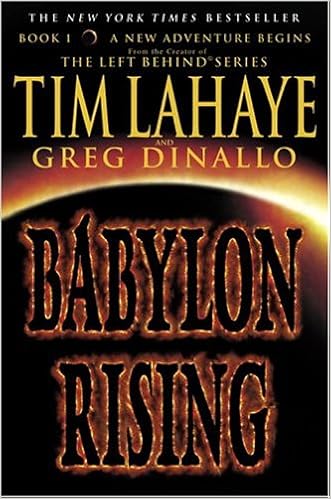
The junk novel in question was Babylon Rising the first book of Tim
LaHaye’s “Babylon Rising” series (written with Greg Dinallo), a sort of prequel
series to his expansive series of Left Behind novels – also junk novels.
The “Babylon Rising” series never garnered the reputation or fan base of the
Left Behind novels. I couldn’t say why.
They’re written in the same style, with same flat characterization, the same
incredible plot lines filled with the same stupefying and ridiculous plot
failures. It’s fast paced and filled with cliff hangers, but not at all believable.
The series follows one Dr. Michael Murphy – who is one part Indiana
Jones and one part evangelical minister; he is a “Biblical Archaeologist” who
chases around the world looking for archaeological artifacts and lecturing a
class of college students to prove the truth of the Bible. “It’s not just
digging up artifacts and finding out where they came from. That’s what regular
archaeologists do. It’s about proving the truth of the Bible” (LaHaye 161).
But what happens in this series of junk novels is not
archaeology, is not academics, and is barely Christian. To summarize:
An allegedly ancient scroll, without provenance is given to Dr. Murphy by an
anonymous and suspicious ‘benefactor.’ Murphy assumes, without testing, - based
only on the word of this ‘benefactor’ that the scroll was written during the
time of King Nebuchadnezzar – the Chaldean king of the Neo-Babylonian Empire.
The scroll describes a bronze serpent, and we’re off and running. “We’re definitely dealing with the Biblical
Brazen Serpent” (98).
Apparently the bronze serpent fashioned by Moses, and broken by King Hezekiah,
was preserved and eventually stolen away to Babylon by the Nebuchadnezzar’s
army. The three pieces were then scattered and hidden in various parts of the
Babylonian Empire. And it’s up to Murphy to find them.
First he’s off to a place described as the “Horns of the Ox” which was a “prominent
landmark reasonably close to the old Babylon” (98). But LaHaye tells us that
this landmark is in “Samaria.”
Samaria, in Biblical times, was the central region of Israel bounded by the Jezreel
Valley, the Carmel Ridge, the Sharon Plain, and the Jerusalem mountains. In
recent years the term “Samaria” has been used by Israeli officials to refer to
the northern portion of the West Bank, but that term is not recognized by the
Palestinian Authority or the international community. But neither of these "Samaria"s is reasonably
close to the old Babylon. No other place names or cities are given to identify this place.
Murphy uses his connections with a shady, semi-retired
Mossad agent to sneak into “Samaria”with “no hassles with officials or customs”(109). He wants to get in and out with
ancient treasures without interference from the government.
While in “Samaria” looking for the “Horns of the Ox” he literally
falls into a room full of hundreds of amphoras, one of which happens to contain the
tail section of the Brazen Serpent. “Moses made this,” he says, without any examination,
dating, or testing. “Moses actually held this in his hands” (137). Murphy takes it home with him to show it off
to his students.
Meanwhile, the immensely wealthy CEO Shane Barrington, acting as a stooge for a
mysterious cabal of international figures known as “the Seven” tasks one of the
reporters working for a news agency he owns to investigating and making an
exposé of a dangerous, fanatical, terrorist group – Evangelical Christians.
(151)
Other agents of “the Seven” paint the phrase “J 3 16” across eight floors of the exterior of the
United Nations building – in broad daylight – in blood! (and no one notices
this until the floodlights are turned on that evening) and to plant explosives
in the North Carolina church where Murphy and his wife are members.
Murphy, along with his colleague, Dr. Isis McDonald, a philologist whose
basement laboratory Murphy compares to the Maze of Forgetting in “Annacherib’s
Pyramid,” (293) (Uh…. Perhaps Dr. Murphy meant Sennacherib, they Assyrian king?), use the first piece of the
Brazen Serpent to lead them to the second – hidden in Saudi Arabia.
They travel (without having to get visas or permission or anything) to the (fictional)
city of Tar-Qasir, famous for its medieval underground sewers. There, in the medieval
sewers they discover a cult chanting in “a dialect of Terammasic,”(a
(fictional) language that has been dead for over 1,000 years, but in which Dr.
McDonald is conversant) (334) preparing a human sacrifice. Murphy and McDonald
chase off the cultists and take the second piece of the serpent.
Which in turn leads them to the third and final piece hidden away in a pyramid
in Egypt. They race to Egypt to retrieve it. (Meanwhile the first piece, the
tail, is stolen from Dr. McDonald’s lab by an agent of “the Seven.”) Murphy and
McDonald find the final piece of the bronze serpent, but before they can do
more than take a few photos of it, it is stolen from them by the agent of “the
Seven.”
But using those photos they are led to Iraq, to the temple of Marduk where,
with help from a U.S. Marine Colonel and a troop of American grunts, uncover an
ancient door, and behind that door – the Golden Head of Nebuchadnezzar’s giant golden
statue.
Murphy and McDonald bring the golden head back to the United States. (389) THE END.
Nothing more is said of the bronze serpent. And nothing in the following
novels is said of the golden head. No tests, no study, no examination. No
ramifications, no meaning.
As I said: this is not archaeology. This is not academics.
And it’s barely Christian.
LaHaye, Tim and Greg Dinallo. Babylon Rising. New York, NY: Bantam Books. 2003. Print.
I set a goal for myself to read 100 books a year. Some years I make that goal. Some years I do not. This year I did, though I didn't intend to set out to read the entire Stephen King canon. What can I say? Things happen. (And I didn't quite read everything he's published... )
American Folk Songs for Christmas – Ruth Crawford Seeger
Treasury of Christmas Music – William L. Reed
The International Book of Christmas Carols – Walter Ehret
The Return of the Star of Bethlehem – Kenneth Boa
Towards a Church of the Poor – Julio de Santa Anna
Sharing the Word through the Liturgical Year – Gustavo Gutiérrez
Nosferatu: An Opera Libretto – Dana Gioia
The Night Church – Whitley Strieber
God Eating: A Study in Christianity and Cannibalism – J.T. Lloyd
We Should All Be Feminists – Chimamanda Ngozi Adichie
Hunter S. Thompson’s Fear and Loathing in Las Vegas - Troy Little
Bible Stories for Adults – James K. Morrow
Swell Foop – Piers Anthony
Pop Sonnets: Shakespearean Spins on Your Favorite Songs – Erik Didriksen
Emma – Howard Zinn
The Children of Men – P.D. James
The Invisible Man – H.G. Wells
The Lottery and Other Stories – Shirley Jackson
Stephen King: The First Decade – Joseph Reino
Sphere – Michael Chrichton
Chomsky on Anarchism – Noam Chomsky
The Complete Fiction – H.P. Lovecraft
The Wolf’s Hour – Robert McCammon
Crazy Horse: The Strange Man of the Oglalas – Mari Sandoz
Selected Stories: Family Matters – Symphony Space
The Best American Travel Writing - Bill
Bryson
Sylvester and the Magic Pebble – William Steig
Resurrection – Leo Tolstoy
House of Leaves – Mark Danielewski
Many Waters – Madeline L’Engle
A Swiftly Tilting Planet – Madeline L’Engle
Wind in the Door – Madeline L’Engle
A Wrinkle in Time – Madeline L’Engle
Chairman Mao Meets the Apostle Paul: Christianity, Communism and the Hope of
China – Khiok-Khng Yeo
The Adventures of Huckleberry Finn – Mark Twain
Pontypool Changes Everything – Tony Burgess
The Oath – Frank Peretti
Will & Kate – Dawn Volz
Bob Dylan and Philosphy: It’s All Right Ma, I’m Only Thinking – Peter J.
Vernezze, Carl J. Porter, James S. Spiegel
Dr. Faustus – Christopher Marlow
Typee: A Peep at Polynesian Life – Herman Melville
The Producers – Mel Brooks
Leaving Iowa – Tim Clue
The Orthodox Heretic – Peter Rollins
Wool – Hugh Howely
Joe Hill: The IWW & the Making of a Revolutionary Working Class
Counterculture – Franklin Rosemont
Praying with John of the Cross – Wayne Simsic
Chitty Chitty Bang Bang – Ian Fleming
Life and Fate – Vasily Grossman
Lost Horizons – James Hilton
How to Pray when You’re Pissed at God: Or Anyone Else for that Matter – Ian Punnett
The Haunted House and Other Spooky Poems and Tales – Vic Crume
The Shroud Codex - Jerome R. Corsi
Wastelands: Stories of the Apocalypse – John Joseph Adams
Mein Kampf – Adolf Hitler
Prophet – Frank Peretti
Countdown to Sunday: A Daily Guide for Those Who Dare To Preach – Chris Erdman
Hitler: 1936 – 1945 Nemesis – Ian Kershaw
Hitler: 1889 – 1936 Hubris – Ian Kershaw
Stephen King -
The Gunsligner
The Drawing of the Three
The Waste Lands
Wizard and Glass
Wolves of the Calla
Song of Susanna
The Bazaar of Bad Dreams
The Tommyknockers
Misery
Skeleton Crew
Doctor Sleep
The Shining
Insomnia
The Dead Zone
Four Past Midnight
Rose Madder
Nightmares and Dreamscapes
Mr. Mercedes
The Dark Half
Dream Catcher
‘Salem’s Lot
From a Buick 8
The Regulators
Hearts in Atlantis
Gerald’s Game
Everything’s Eventual
Blockade Billy
The Eyes of the Dragon
Desperation
Cujo
Black House
The Talisman
The Long Walk
Roadwork
Rage
The Running Man
Lisey’s Story
Under the Dome
Different Seasons
The Girl Who Loved Tom Gordon
The Stand
11 / 22 / 63
So... I'm reading Stephen King's novel, The Stand, again (for something like the tenth time, I think). Some friends question why I would read such trash, others would question why I'd read it more than once. And the answer is, "it's a great story" and because "there's really good stuff in there." Seriously.
Take this bit of great advice (found on page 799 in my 1991, "complete and uncut" paperback version):
"And your choice is made?"
"Yes."
"For good?"
"Yes, it is."
"Then live with it," the Judge said with great relish. "For God's sake, Larry, grow up. Develop a little self-righteousness. A lot of that is an ugly thing, God knows, but a little applied over all your scruples is an absolute necessity! It is to the soul what a good sun-block is to the skin during the heat of the summer. You can only captain your own soul, and from time to time some smart-ass psychologist will question your ability to do even that."
Good advice there.
Take, also, this paraphrased version of Psalm 23 (on page 1003); it's just fun:
"The Lord is my shepherd...I shall not want for nothing. He makes me lie down in the green pastures. He greases up my head with oil. He gives me kung-fu in the face of my enemies. Amen."
What follows is not a proper review of Count Leo Tolstoy’s final novel Resurrection; it is instead a few of my
thoughts about and responses to the book. It’s been a few years since I read Anna Karenina, and ages and ages since I
read War and Peace. I feel like I
should revisit those now (but there’s so much still left in my to-be-read pile…)
The story feels somewhat autobiographical – if not in details, in its theme.
The journey of Prince Dmitri Ivanovitch Neklúdof from noble born, silver-spoon,
aristocratic, playboy to a fervent idealistic religious revolutionist who
dreams of changing the world is Tolstoy’s story.
Neklúdof wants to atone for his frivolous life, to correct the mistakes he’s
made, to heal the wounds he’s caused. And this, not for himself, but because it
is the right thing to do. But there is no such thing as a selfless good deed and his attempts to do right are viewed with suspicion and outright rejected.
When he tries to give his land estates to the peasants who live upon them, they
believe that it’s just another trick from a member of the wealthy elite to squeeze
another ruble from the poor. His sincere offer to marry the woman he left destitute
is refused; she can’t believe him.
Resurrection is a literary attempt to
find a way to put into practice the radical claims of the gospel.
“I don’t know whether
they deserve it or not, but I do know how they suffer,” said Neklúdof. “You are
a Christian and believe in the Gospel, and yet you have no mercy.”
“That has nothing to do
with the case. The Gospel is one thing and what we despise is another. It would
be worse if I pretended to love Nihilists, especially short-haired one, when to
tell the truth I really hate them” (Tolstoï
Resurrection Vol. 2, 40).
Much of the novel is a defense of Georgist ideas –
a subset of socialist thought, an economic theory that says that the economic
value of the land should be owned and shared by the community that lives on the
land. Again, this is part of Tolstoy’s literary attempt to put into practice
the radical claims of the gospel of Jesus Christ.
But radical is not easy. And Tolstoy knew this. He was not a wild-eyed
unrealistic idealist. Resurrection is
filled with the details of observed real life. In fact these detailed stories
begin to pile up towards the end of the novel that it begins to feel like a
fevered dream. Reality is incredibly unreal. How can this be real? But it is.
And Neklúdof (the novel’s stand in for Tolstoy himself) is shocked to realize
his place in it.
There are few easy answers. Many of the questions Tolstoy raised about the
criminal justice system and the state of prisons in Czarist Russia at the end
of the 19th century remain unanswered – and could be asked with tragically
continued relevance about the criminal justice system and state of prisons in
America in the 21st century.
The version of Resurrection that I’ve
read was published in 1911, translated by Aline P. Delano. This may not be a complete
version of Tolstoy’s work. The full novel was heavily censored by Russian
authorities, and an unexpurgated text wasn’t published until 1936.
Tolstoï, Lyof N. Resurrection Trans. Aline P. Delano. New York, NY: Thomas Y.
Crowell & Company. 1911. Print.
“A face is a marvelous thing for those who possess it. It is really the only
thing that distinguishes us. Not quite enough to recommend us, just a trickster
feature of our anatomy that makes everyone appear famous. But still, the face
is beautiful. A sensitive sign of obscure integration. And every once in a
while that integration is challenged” (Burgess 184).
Zombies are the thing these days–though maybe the craze is starting to wane.
Even so, we’re fascinated by the bleak, apocalyptic horror of the zombie story.
They’re not like other monsters, not like other supernatural creatures of the
night; they’re worse, more frightening because they are us. “[W]hat is especially
terrifying with zombies is that their monstrous state is their human state, it never transforms or goes away” (Paffenroth
9).
Most Zombie books, graphic novels, movies, video games focus on the horror that arises from the disintegration of human society – the collapse of modern culture and the
breakdown of human relationships. But Pontypool
(both the novel (1995) and the movie (2009) are different; indeed, as the full
title of the novel declares, Pontypool
Changes Everything. Pontypool features
that same psychological terror–the horror of watching human characters, not
only being eaten by the undead, but also the horror of humans slaughtering
creatures that still so closely resemble us humans, that is humanity consuming
itself. (Paffenroth 9) But even more the disintegration of human civilization, Pontypool is about the disintegration of
human language.
The novel is not a ‘regular’ novel. It’s a bit like the Dadaist poetry of
Tristan Tzara and the cut-up writings of William Burroughs. It’s a pile up of nonsense,
non-sequiturs like a multiple vehicle collision on the highway that eventually
creates something that resembles reality, albeit a terrible, burnt out, wrecked
and ruined reality. The movie, the screenplay of which was also written by Tony
Burgess, is more straightforward, more linear than the novel, but is still
fairly unlike most other zombie films.
“I’m not the person who wrote this book,” says Burgess in the afterward to a
2009 edition of the novel; “I remember him. He had just graduated with a degree
in semiotics, which is to say he was insufferably preoccupied with literary
malformations… He wanted to magnify the least recognizable parts of his
thoughts and feelings” (Burgess 253).
In Pontypool, the zombies are not brought
to unlife by mysterious radiation from a space probe returning from Venus (as
in George Romero’s Night of the Living
Dead) or some sort of divine wrath, not by a disease or virus (as in Romero’s
Dawn of the Dead) or some sort of
biological weapon (as in Resident Evil or
28 Days Later). But neither is it
left forever unexplained (as in The
Walking Dead graphic novels and television series). In Pontypool the zombie virus is spread through language; the ‘virus’
infects words; its victims lose the ability to understand or communicate and
are driven to states of rage and brutal animalistic violence, including the
inevitable cannibalism.
“That night I had terrible dreams I was killing people. When I awoke it took
some serious self-examination to convince myself that I was not repressing real
acts of murder. So completely vivid was my sense of guilt that I felt nothing
short of running through a full account of my life could provide me with the
peace of mind I needed to fall back asleep. In spite of the three hours I spent
combing over the details, I have, to this day, a persistent certainty that
hidden inside me is the revolting knowledge of days when I wasn’t quite myself.
I now suspect that my inexplicable bouts of exhaustion are due to the massive
effort of keeping those days behind me” (Burgess 10).
Acclaimed horror writer, Stephen King says that we should “[b]egin
by assuming that the tale of horror, no matter how primitive, is allegorical by
its very nature; that it is symbolic” (King 31). The monster, the horror at the
symbolic, dark heart of Pontypool is
the fear that the world that we inhabit is inevitably and utterly
incomprehensible, that we cannot make sense of the universe. In the end
everything is madness and frenzy, and rage, and despair.
“You can’t pretend that you don’t feel very sorry for this man and his
self-portrait. He has completely lost the ability to take care of himself. He
will die soon, and the fact that that is merely all he ever wanted doesn’t make
you feel any less protective of him now. You remember looking in the mirror and
feeling awe: the self-portrait is complete.You think that you have found the
face that can finally say goodbye” (Burgess 109).
“There is no life without prayer. Without prayer there is only madness and
horror.” -Vasilii Rozanov
I recently read (re-read, actually) James Hitlon’s 1933 novel Lost Horizon. The novel describes an ancient utopian
community known as “Shangri-La.” It’s a reclusive community, hidden deep in the
mountains of Tibet, devoted to the task of safeguarding human wisdom and beauty
from the approaching storm of holocaust and apocalyptic war. Hilton proved to
be a bit prescient, envisioning the horrors of World War II.
I like the book, even if it’s not aged especially well. The writing feels a
little dated, and somewhat stilted. The characters are a little flat. But it’s the idea-the idea that’s important
here. Shangri-La is the antithesis of the modern world - all frenetic motion with
no peace. If you’ve ever wanted to get away from the tyranny of the
hurry-faster-more capitalistic, militaristic frenzy, you might feel at home at
Shangri-La.
“We have reason. It is the entire
meaning and purpose of Shangri-La. It came to me in a vision long, long ago. I
foresaw a time when man exalting in the technique of murder, would rage so
hotly over the world, that every book, every treasure would be doomed to
destruction. This vision was so vivid and so moving that I determined to gather
together all things of beauty and culture that I could and preserve them here
against the doom toward which the world is rushing. Look at the world today. Is
there anything more pitiful? What madness there is! What blindness! A scurrying
mass of bewildered humanity crashing headlong against each other. The time must
come, my friend, when brutality and the lust for power must perish by its own
sword. For when that day comes, the world must begin to look for a new life.
And it is our hope that they may find it here"(Hilton).
As in other books about fictional utopian communities, the
climax of the story involves the protagonist’s choice: will he give up the
world he knows in order to risk living in Shangri-La?
I think that I would rather enjoy living in that hidden mountain city-a sort of
melancholy utopia, like an oriental work of art, all the more appreciated because of its imperfections. The retreat from
passion, machinery, ambition, destruction, and war, a place where it’s safe to
be meek and unassuming. I could definitely see myself living there.
I believe in utopias. Or rather, I want
to believe in them. The word “utopia” was coined by Sir Thomas More for his
1516 book Utopia. The word comes from
the Greek: οὐ ("not")
and τόπος ("place") and means "no-place.”
But alternately, Utopia can be derived from the Greek εὖ ("good"
or "well") and τόπος ("place"), meaning: "good place.” It’s a homophonic pun: no-place /good-place. I want to
believe in utopian communities that are good places, able to devoid themselves
of all the rot and filth of this world, able to devote themselves to learning,
wisdom, justice, and health for all.
But I have been told – and repeatedly – that it’s naïve to hold any such
utopian fantasies because they are, by their very name, “no-place” nowhere. I
should, I am told, understand that such communities cannot and will not exist.
Not in this world.
But why is it naïve to believe, or to want
to believe that something better is possible in this world? Why must we “be realistic” or “practical”?
Why should we believe that the “good place” utopia can only exist in fictional
literature and in a far removed heaven of the future?
I find these questions especially perplexing in light of Jesus’ teaching in the
Sermon on the Mount. Possibly the best known portion of Jesus’ teaching, it may
be, at the same time the least applied portion of his instruction. Jesus’
teaching in the Sermon on the Mount has inspired the lives and work of many
influential people throughout history. Martin Luther King Jr.’s work in the 1960s
was grounded in the revolutionary nature of Jesus’ words. Count Leo Tolstoy, the
famous Russian author, was motivated by this sermon to a radically new
lifestyle; he gave away his land holdings and copyrights, freed his serfs, and
began to practice a life based on the Sermon on the Mount as he understood it.
Even non-Christians have been challenged by the Sermon on the Mount. Mahatma
Gandhi, though a devout Hindu, said that the words of the Sermon on the Mount went
straight to his heart, and he read from them as part of his daily meditation.
(Dear)
But here’s where you can take out your scissors and cut up the bible. There are
some Christians that don’t believe that these passages apply to us today, that
we are not obliged to live by these standards. The Sermon on the Mount, they
say, belongs not to Christians living in the here and now, but to a yet future
remnant of Jews who will someday believe in Jesus as the Messiah.
The “study” notes of the 1917 Scofield Bible said, “The Sermon on the Mount, in
its primary application, gives neither the privilege no the duty of the church”
(Scofield). [i]
This was the bible that popularized the pre-millennial dispensationalism
understanding of eschatology, with all of that Left Behind and Late Great
Planet Earth crap. Another influential dispensationalist author, Clarence
Larkin, wrote: “The ‘Sermon on the Mount’ was spoken by Christ before His
rejection, and was the Constitution of the then offered Kingdom; now that the
Kingdom has been withdrawn it is not in force, but will be in the Millennial
Kingdom. So we see that we must discriminate between the Dispensations and not
dislocate scripture” (Larkin).
More recently, Thomas Ice and Timothy Demy in their Fast Fact on Bible Prophecy wrote, “The sermon was not given
directly to the church-age believers since, in context, Christ is addressing
entrance to the kingdom…The kingdom will be brought to earth at the second
coming of Christ. Many of the specific statements in this sermon will be
fulfilled during the millennium" (Ice, Demy 188).
Setting aside the crazy nutbaggery that is Pre-millennial Dispensational
eschatology, even some respected Christian leaders argue that we’re not really
expected to live up to the standards set in the Sermon on the Mount. Reinhold Niebuhr
taught that Jesus’ cross set up an unrealizable goal – “a state of perfection
which no individual or group in society could ever fully hope to achieve.” The
most, he said, we could achieve would be “proximate justice.” (Cone 71) Niebuhr
is another of those voices telling us to "be realistic."
According to these teachers, we could be justified in taking scissors to the
pages of our bibles. We could safely remove the Sermon of the Mount because it’s
either not for us or unrealistic and unachievable. But I don’t believe this.
The beatitudes and the gospel of the Kingdom of God have often been described
as a “great reversal," The kingdoms of this world live by fierce struggle,
survival of the ruthless, he-who-dies-with-the-most-toys-wins kind of
mentality. But Jesus didn’t teach “blessed are the fortunate and well
provisioned;” he said, “blessed are the desperate.” Jesus didn’t teach “happy
are the religious” but “Happy are those who are hunger and thirsty for
righteousness.” Jesus didn’t preach, “blessed are the warriors” but “blessed
are the peacemakers.”
This is the great reversal. It turned the world on its ear when he said it to
his disciples and followers in that Sermon on the Mount, and it shattered the
forces of darkness when he lived it out on the mountain top where he was
crucified. And it continues to upset and overturn the world wherever and
whenever it is put into practice in the lives of his followers.
Utopias don’t have to be “no-place,” idealistic retreats from the so-called “real-world.”
Jesus gave instructions that, if followed, could create that radical utopian “good-place”
in the here and now. Is it really impossible or unrealistic to live in a Sermon
on the Mount kind of community, or are we just unwilling to try?
I’ve often quoted the founder of the Salvation Army, William Booth, who said, “Making heaven on earth is our business." It’s not Shangri-La, tucked away on a remote mountain,
retreating from the horrors of the world, but rather the glorious eternal
Kingdom of God being made in the here and now world around us.
Cone, James H. The Cross and the Lynching Tree.
Maryknoll, NY: Orbis Books. 2011. Print.
I don’t recall how it came to be in my little library, but I have a copy of the little pamphlet Objectionable Elements: The Biblical Approachpublished
by Bob Jones University Press. It is a brief guide for Christian educators and
administrators[i] to
handling “objectionable elements” in the classrooms of Christian schools. It’s
an amusing little booklet, but not very helpful.
The booklet begins with an explanation that censorship isn’t just an issue for “religious
conservatives” but that “[s]ecularist educators” do it as well (Horton 1), that
is, all educators are purposefully selective in what they choose to use in their
classes. They will select material that furthers their educational goals and
not use material that is counter to their purposes. “Censorship, therefore,
whether in Christian or secular schools, is inescapable” (1).
But already we’ve gone slightly off target. This isn’t censorship. This is not
the suppression or deletion of material considered offensive, immoral, harmful
or objectionable. This kind of careful and deliberate selection of material is
not the banning or burning of “bad books.” This is selection, not censorship.
(Asheim)
But we’ll let that bit of semantics slide.
The author then lists a number of common categories of “censorable,”
objectionable elements: 1) Profanity, 2) Scatological realism, 3) Erotic
realism, 4) Sexual perversion, 5) Lurid violence, 6) Occultism, and 7)
Erroneous religious or philosophical assumptions. (3) The conscientious Christian
educator[ii]
will have to deal in some way with this kind of material in the classroom.
According to the pamphlet there are four ways to handle this material: the
Permissive, the Exclusive, the Pragmatic and the Biblical.
The Permissive approach is characterized
by the author as that of “intellectuals” and is weak and subjective. It “arrogantly
elevates human wisdom above divine” (5) in allowing objectionable elements. The
author gets a wee bit catty in calling out the magazine Christianity Today and Intervarsity Press as examples of this
approach. (4)
On the other end of the spectrum is the Exclusive
approach, which would exclude any and all objectionable elements. “This is the
view held by conscientious pastors, Christian educators, and laymen concerned
for the moral preservation of their children…” (5). But, while the sympathies
and spiritual affinities of Bob Jones University might be with these good folks
(5) this approach goes too far. If followed, it would eliminate Shakespeare,
Melville, Twain, Frost...even John Bunyan and the Bible itself. To the author’s credit, he does admit that examples
of each of these “objectionable elements” can be found “in certain ways and to
certain degrees in the Bible” (6) [iii] and
we routinely and without a second thought give copies of the Bible to children
and encourage them to read the scriptures-scriptures filled with lurid
violence, scatological references, and explicit sexuality.
Trying to find some middle ground between the extremes of the Permissive and the Exclusive is the Pragmatic
approach, in which “[e]ach person must decide for himself[iv]
how much evil is too much to be tolerable in a literary work or in material
used in teaching.” This might seem like a pretty good way to go – but the
author describes this as “theologically the weakest” of all the approaches in
that it “implies that it is impossible to order our lives according to the will
of a holy God” (10). I’m not sure why it
implies such a thing. I’m not convinced that it does, but we’ll come back to
that.
Fortunately, and to our great relief, the author tells us
that there is another approach, a Biblical
approach that will help us to deal with objectionable elements without being
too permissive or too exclusive or having to use our own best judgement.
The Biblical approach, according to
the author, will determine what to use and what to exclude based on three
criteria:
1) The criterion of gratuitousness – does the representation of evil serve a purpose
in the work or is it evil for evil’s sake? 2) The criterion of explicitness – is the
representation of evil present in “an acceptable degree”? And 3) The criterion
of moral tone – is the evil presented sufficiently condemned? (12 - 13)
These criteria are presented as objective evaluative standards which can be used
by any God-fearing-bible-believing Christian. “The basis of a truly Biblical
position concerning censorable elements is the following distinction. If a work
of literature or other element of curriculum treats evil in the same way that
it is treated in the Scriptures, we regard it as not only acceptable but also desirable
reading, listening, or viewing for someone of sufficient maturity as to benefit
from comparable portions of the Scriptures” (12). “For instance, whereas a
conscientious Christian teacher might assign a Willa Cather novel[v] to
a Christian high-school class, he[vi]
would not assign John Steinbeck’s Grapes
of Wrath” (18).
But this is subterfuge. For all its appearance as an objective and standardized
and Biblical approach, it really is no different from the Pragmatic approach described earlier. It comes down to
interpretation and evaluation. And I certainly would assign The Grapes of Wrath, both for its
excellence as work of literature and for its powerful expression of Christian
values.
It comes down to interpretation and evaluation. Unless one wants to go all the
way to the Exclusive approach where
all objectionable elements are refused, (in which case we’re tossing out the
Bible), then we all have to be Pragmatists
in our approach. (The Permissive approach
as described by the author is really just this as well. He just doesn’t like
it.) We all of us have to ask, how much are we comfortable with? Does it align
with our understanding of Scripture? If not can it still illuminate Christian
truth? Am I competent enough to teach this material? And, is my audience mature
enough to handle the material?
If we’re going to object to all objectionable material, if
we’re going to avoid material in books or films that might be in any way controversial,
we might as well just shut down, because we’ve already shut down our brains.
Asheim, Lester. "Not Censorship but Selection."
Editorial. Wilson Library Bulletin Sept. 1953: 63-67. American Library
Association, Nov. 2005. Web. 23 Mar. 2016.
Horton, Ronald A. Objectionable Elements: The Biblical
Approach. Greenville, SC: Bob Jones University Press, 1990. Print.
[i] I
should say, “male” Christian educators and administrators: the pronouns are
exclusively masculine. “The Christian
teacher, led by the same Spirit that inspired God’s Holy Word, will
scrutinize prayerfully his methods
and materials to ensure that they likewise are free of that which hinders and
diverts from his purpose: the conforming of his students to the image of God in Christ. He will censor for the sake of his
students and, in the case of materials he
uses, ascertain whether the necessary censorship has been done by the authors
or may otherwise be done by himself”
(Horton 2 -3).Emphasis added.
[ii] Ehem..
the conscientious MALE Christian educator…
[v]
Would Bob Jones University really be comfortable assigning the work Willa Cather, a woman who
went about dressed as a man and called herself “William” and who may have been
a lesbian?