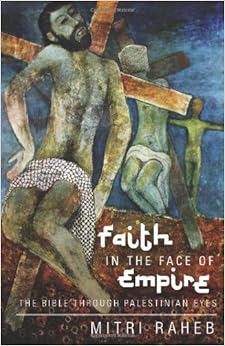
I have been reading and blogging my way through Mitri Raheb’s book
Faith in the Face of Empire: The Bible
through Palestinian Eyes[i]. In
the previous chapter Raheb asked four questions that help shape his hermeneutic –
one of which was “Where are you, God?”
It is a question found repeated in various ways throughout the scriptures – in both
the Hebrew Bible / Old Testament and the Christian New Testament as well. From the cries of the descendents of Abraham
as they suffered under the slavery of Pharaoh in Egypt to Jesus’ cry of despair
on the cross, “my God, my God, why have you abandoned me?” The question is a central question to faith
in Palestine.
This is not to say that the questioner believes God to be non-existent or
absent. The question, instead invites
the hidden God to intervene.
Raheb contrasts the God of Palestine to the gods of Empire. The gods of empire
are showy, loud, and visible in the shrines built by conquering armies in every
new territory. The expanding reach of
empire is a sign of their claim to omnipresence. Their victorious armies are a symbol of their
omnipotence. But the God of Palestine is
different. He was not found in huge
expansive empires, but in a narrow tract of land with few natural
resources. He was not loud and showy
demanding shrines and temples in far flung corners – in fact he was somewhat
resistant to having a temple built for him at all. The strength of the God of Palestine was not
seen in conquering armies.
In fact, time and again, the people of this God were defeated and captured, and
taken away into slavery and exile, where their captors asked the question
again:
As with a deadly wound in my body,
my adversaries taunt me,
while they say to me continually,
“Where is your God?”
Psalm 42: 10 (NRSV)
What is uniquely
revealed of the God of Palestine is that he is always there – even in defeat
and despair and exile. He has not
fled. He has not abandoned his
people. He maintains solidarity with
them. Raheb finds this most fully
demonstrated in the crucifixion of Jesus – the God/Man - the high priest who is not unable to
sympathize with our weaknesses and struggles for he has endured them with us (Hebrews
4: 15) (Raheb, 87).
Those who have this God
with them are able to rebuild and restart again and again. Defeat at the hands of Empire is not an
ultimate defeat.
For Raheb, there is no critique of Empire without God. No other state, power, organization, or
people group can help. Politicians bicker and argue, but only God comes to the
help of his people. “Seeing God on the
other side of the empire queries and challenges the morality of the empire,
which is a key link in weakening it (Raheb, 85).”
Previous Chapters:
[i] Raheb,
Mitri, Faith in the Face of Empire: The Bible through Palestinian Eyes, Orbis
Books, Maryknoll, NY, 2014.


 There Once Was a Prophet from Judah: Biblical Limericks for Fun and Prophet


