My troll caught up
with me on my day off. He had to, obviously. Rule of three, right.
That’s how these things work. In folklore, in comedy, in
advertising. One. Two. Three. He came first to assault my character.
He came again to challenge my doctrine. Now he was back a third time
to question my faith as I was buying groceries. Standing there in the
produce department, as I picked out onions and peppers, I saw him
coming to me.
“You are common,
but you have nothing of the common love in your heart – being of
one accord, one mind. You are divided in yourself. There is no
eternity in your heart.”
“Hey, Gunner.
What do you think of these tomatoes? They’re not red. They’re
pink and pale. Probably mealy too. Winter produce is so…”
“What will little
Satans like you do if loosed upon the world? Adultery, fornication,
uncleanness, lewdness, idolatry, witchcraft, hatred, variance,
emulations…”
“Emulations?” I
scoffed. “What are you…?” But he rolled on with his list of
condemnations. I had my shopping list; he had his.
“Wrath, strife,
sedition, and heresies. That’s your thing. Heresies.”
“Here? You want
to do this here? Now? In the supermarket?”
“Sure. Why not
now? Are you afraid? Now is the judgment of this world and the prince
of this world shall be cast down. You should be afraid.”
“Okay. Okay. But
come with me and keep your voice down.” I put the tomato back and
moved on towards the baked goods. “I need bread,” I told him.
“Man shall not
live by bread alone, but by every word that proceeds from the mouth
of God. That’s your real problem. You don’t live by the word of
God.”
“Oh, come on,
dude,” I said as I picked up a loaf of sourdough. “I read the
Bible every day. Or nearly so.”
“Yeah. Yeah,”
he said as he followed me towards the meat department. “You read
it. But you wrest it. Unstable and unlearned. You twist it, distort
it out of true. You read it but you don’t believe it. You won’t
accept the verbal plenary inspiration that makes it true. Inerrant.
Infallible. Authoritative. God breathed, without mistake or
contradiction.”
I chuckled and
pointed to the lamb shank behind the glass of the refrigerated
shelves. “Behold the Passover lamb. How were the Israelites to
prepare it?”
“What?” He
recoiled.
“Were they to
roast it or boil it? Exodus or Deuteronomy? They don’t agree.”
“No. Not like
that. You’re not going to get me with those proof texts, with those
alleged contradictions. You pick and chose the parts you like because
you think it’s easier that way. But the whole word is inspired. God
breathed. It cannot fail.”
“God breathed,
you say?” I turned my cart down the canned good aisle. I would
finish my shopping. “What about Adam? He was inspired. Literally
God breathed. But he failed. Yeah? I don’t think inspiration means
what you think it means.”
Just then Gunner
reached out and stopped my hand as I was selecting cans of kidney
beans. “Who inspires these perversions in you? You’re going to
have to learn the lesson. Leave the Bible alone. Get better and get
saved.” The flickering fluorescent lights cast on again off again
shadows across his face
“I don’t wrest
the scripture, Gunner.” I said as I placed the beans into my cart.
“But I do wrestle with it. Like Jacob wrestling through the night.
And like Jacob, it’s broken me. Left me limping.”
“You limp because
you’re broken. Because you’re so lame.”
“Lame as I am, I
leap for joy in God,” I said. “And that is the miracle.”
Gunner stood there,
unmoved and blocking my path through the aisle.
“We can continue
if you want,” I said. “But I still have several things on my
list. Do you mind?”
He pursed his lips
tight and shoved my cart – not hard, but away. He said nothing
more. Just walked down the aisle and out of the store. I returned to
my list – getting cheese and milk, and a few other things.
Welcome, welcome welcome to the Biblioblog Carnival for May 2017, a round up of, if not the best of biblical studies on the world wide web of information, then at least the stuff I thought was interesting. Here at the carnival there are rides and games of chance, performers and daredevils (and regular devils, too). The bearded woman's here (she's Calvanist, obviously). There are thrills and spills and delights around every new corner. Take your time. Stroll down the midway and enjoy the sights.
The story of Moses doesn’t just show up in the Bible. In the
ancient world, nearly every culture had their own version of what happened. The
Egyptians, the Greeks, and the Romans all had their own way of explaining why
thousands of people left Egypt to live in Jerusalem. The Moses you know, who
performed miracles and freed the Jewish slaves from Egypt, is just one version
of the story. There are others – and they paint a completely different picture
from the one you’ve heard
Our discussion is all about the mystery of Israel’s origins.
And it is a mystery. The exodus and conquest of Canaan (Exodus through Joshua)
are central to Israel’s identity, and are certainly informed by old traditions
and authentic historical memory—but they not historical accounts in the modern
sense. How and when, historically speaking, Israel stepped out onto the world
stage is a huge mystery, though we have some clues to piece together a
compelling picture.
…the first story in 1 Kings has many incredible elements. This did not incline
me to reject the existence of Solomon as a historical person (as it did some),
but it suggested that much of what we find in the Bible about Solomon is not
history.
Saying this in non-musical language is nearly impossible. My
overall thesis is that the use of the accents defines poetic structure (and
prose also) beyond the scope of the line and beyond the scope of the verse. As
I have noted elsewhere, this thesis contradicts claims made over the past 1000
years in the literature on the accents, notably from Wickes in his treatises
from the 19th century. Two excellent examples are Psalm 96, where the accents
define the scope of the stanzas so clearly, and from the prose books, the
lament of David over the death of Saul and Jonathan. I can only illustrate
these with the music, which to a musician is so much clearer than any list of
accents would tell us.
Thus, Jewish priestly
education inherited from the Babylonian lexical lists some numerical schemes
based on the sexagesimal counting system (i.e., a numerical system with sixty
as its base), and the Levitical author presented it as part of priestly
knowledge. Once Levi learns how to prepare the holocaust offering and
accompanying meal offering together with the fraction notations (14–61), then
in his wisdom poem (82–98) he instructs his children/students not to neglect
the study of scribal craft (88, 90, 98). The priestly education system is
characterized as belonging to the scribal type of knowledge, which indicates a
strong Babylonian background and a clear link with the pseudepigraphic book of 1
Enoch
In this volume of collected articles—most of them published
previously in a variety of scholarly venues, though updated here—Loren
Stuckenbruck of the Ludwig-Maximilians-Universität, Munich, takes the reader on
a detailed exploration of the birth and early history of this legend as
attested in ancient Judaism and earliest Christianity. There are few, if any,
as capable of guiding this tour, and though these individual studies were not
originally intended to be read as part of a comprehensive account, readers of this
book will come away with a rich understanding of the myth of the fallen,
rebellious angels and their offspring as understood in ancient Judaism and
Christianity.
NT Jesus Never Saidby Scott Fritzsche at Unsettled Christianity:
An argument from silence is a rhetorical device designed to
be a convincing argument in a simple and straight forward way. It often, on the
surface, is. There are numerous inherent flaws in an argument form silence
however. This becomes important in theology as arguments from silence are, and
have been, used to try and form persuasive arguments as well as having become
part of the basis for theological stances.
I love this line on Galatians: “The best way to comprehend
Galatians is to read it out aloud, shouting in an angry voice at the
appropriate points” (475).
The chapter begins with a very
brief run through the rhetorical structure of Philippians with a view to
possible sacrificial metaphors. Patterson's claim is that these sacrificial
metaphors are more than "rhetorical flourishes" but are "a tool
of active thought" (113). She wishes to show that "the shelamim sacrifices
(sacrifices of thanksgiving) constitute a pattern of offering that Paul applies
metaphorically and imaginatively as a guide for the actions of the
Philippians" (86).
In some discussions of a Christian view of creation much has
been made of the phrase “it was good” in Genesis 1 repeated in verses
3,9,12,18,21. In verse 31 we have the summary: God saw all that he had
made, and it was very good. One can, of course, take the position that the
image of the sea as chaos and the denizens of the deep as creatures of terror
are a result of the fall. Prior to Genesis 3 they were “good” in an
idyllic sense. If there had been no fall, they’d be good and tame yet. But
we still have a problem in scripture – at least if we take a literal
approach as preferred and assume a motif of creation, fall, redemption, and
restoration. Revelation does not really depict a restoration of an idyllic
primeval garden or the reestablished perfect creation of Genesis 1.
Kevin McKissick, M.Div student at Grand Rapids Theological
Seminary, reviews The Apostle Paul and the Christian Life, edited by Scot
McKnight and Joseph B. Modica.
Wait. What? … We don’t need to blacken Simon’s character,
but it’s totally cool to call the woman a whore even if there’s no evidence of
it in the text? We can construct an entire narrative around her life as a
prostitute, and her expensive oil that could only have been purchased through
her elicit [sic] activity, but let’s make sure we don’t disparage the man in
the room — the one who is totally missing the message of Jesus, who is over
there looking down on this woman in his heart, playing at the pretense of
hospitality with no real love behind it, withholding the lavishness of his love
and worship while this woman lets it all out?
Here’s the big picture: Those educated today in typical
schools learn to think in what is called the historical-critical method. That
is, students in theology and Bible are taught to think like a historian, to
think critically over against the received traditions, and to base their
theology on the evidence (the Bible). The goal, then, is to determine the
intent of the author. They are taught not so much to say What does God say in
Matthew 5:17-20 but instead, What does the author of Matthew intend to communicate
with this text in his historical (Jewish) context?
That form of interpretation is not 1st Century and derives
from developments following the Renaissance and the Enlightenment and,
ironically enough, the interplay of tradition and history in the orthodox-fundamentalist
vs. the who-cares-about-the-orthodox and modernist stream of thinking.
Jesus, the apostles and the early church did not read the
Bible in the historical-critical method.
The Date of Thomas – by Jonathan Bernier at Critical Realism
and the New Testament:
Now, let me be clear: I'm not arguing that Thomas' Gospel
should be dated c. 60. The above is a hypothesis, one which at this point I
neither affirm nor reject. I have not yet thought through the issue
sufficiently to reach a final judgment. But one who would undertake to argue
that many of the texts of the New Testament canon are notably earlier than
typically supposed cannot in principle exclude the possibility that the same is
the case for some of the New Testament apocrypha. It is thus incumbent upon me
to explore such possibilities, considering and vetting hypotheses for such
earlier dates. Any other procedure would run the risk of special pleading.
What the Gemara does not point out, but struck
me as remarkable, is that the Torah portion that lays out the rule for levirate
marriage comes in Deuteronomy, while the story of Zelophehad’s daughters is in
Numbers, which of course precedes Deuteronomy in the Five Books of Moses. In
other words, the rabbis envision Moses possessing a complete Torah while the
events the Torah recounts are still taking place. While he is wandering the
wilderness, in Numbers, he can consult the law code he will not actually
deliver to the Israelites until years later, in Deuteronomy.
The Apocalypse of Elijah is not strictly speaking an
apocalypse. It is strongly influenced by the book of Revelation, especially
11:1-12 (the appearance of two witnesses in Jerusalem). There are dozens of
possible ways to interpret the two witnesses, from literal people (Elijah and
Moses, Elijah and Enoch) to figurative (the Old and New Testament, two
volcanoes, etc.) The book does not contain any of the sorts of things we expect
in a true apocalypse: heavenly journeys, thinly veiled reviews of history,
revelation of mysterious secret knowledge, or angelic guides. Coptic
translations of a Greek original of the Apocalypse date to the fourth century.
The book is clearly dependent on Revelation and appears to quote 1 John 2:18. A
date of the mid-second century seems probable (OTP 1:730). If the book was a
Christian re-working of a Jewish original, then some material may be still
older (There is a Hebrew Apocalypse of Elijah which may stand in the background
of the book, but no one has systematically studied the possibility of a Hebrew
to Greek to Coptic translation). The book may reflect an Egyptian Christianity,
but this is far from clear.
Reports came last week that President Donald Trump would
avoid visiting the ancient site of Masada in the Judaean desert during his trip
to the Middle East because his helicopter was not allowed to land on the sacred
ground there. Here is why the site is important and why President Trump should
have walked or taken the cable car to the top--just like everyone else.
Numismatic Report – by David Hendin – at The Ancient Near
East Today:
Readers of Israeli newspapers and archaeology blogs for the
last few years have seen a notable uptick in the number of coin finds reported
by “good Samaritans” (both Israelis and tourists) and turned into the Israel
Antiquities Authority (IAA), as well as some newsworthy numismatic finds at
licensed excavations. This led The Ancient Near East Today to ask me to
look into the finds and their importance, as well as other numismatic
discoveries in or related to Israel. I recently returned from Israel, where I
talked with numismatic scholars, officials of the Israel Antiquities Authority,
licensed antiquity dealers, and collectors. Here is my report.
In light of the recent day-session on “Coins and the Bible”
here, I want to note two recent books.
Coins were a regular medium for kings and administrators to promote
themselves and their regimes. Coins were
also sometimes minted to celebrate military victories. Coinage is one important part of the
“material culture” of the ancient world.
The metals used, the use of images and writing, the places where coins
were minted, all these things and more contribute to historical understanding
of the period in which they were minted.
Thousands of artifacts are being stolen every year and
making their way into Jewish hands, yet the Israeli division responsible for
theft prevention has just one inspector to cover 2,600 sites
Behaviour is deeply embedded within individual cultural
psyches, reinforced by the social groups. As children we are taught to say
please and thank you, or to refer to our elders with special terminology to
infer respect. In British society, certain behaviour is encouraged and
considered polite - eating with a knife and fork, keeping your elbows off the
table - standard parental ways to help children understand what is expected of
them socially.
We Evangelicals have a 500-year history of dividing over all
sorts of issues ranging from modes of baptism to the color of the carpets in
our sanctuary – even (maybe even especially!) with our fellow Protestants.
While there is a pastoral responsibility to inquire with love about a leaver’s
spiritual health, what happens if you discover that the one moving to another
faith tradition is doing so because their faith is growing, and that growth has
shifted their faith out of your particular stream?
… his progressive views have garnered no shortage of
controversy. Conservative pastor Tim Keller has gone so far as to say that he’s
not sure whether George MacDonald was even a Christian. However, despite all
the accusations brought against him, I’ve never heard anyone call George
MacDonald an open theist. Of course that would technically be anachronistic, as
the term open theism didn’t come into use until the late twentieth century, but
my point is that I’ve not heard his beliefs compared to what open theists
believe about God and the settledness of the future.
It is rare that archival research makes the national
news. Jeffrey Alan Miller’s
identification of a draft of a portion of the King James Bible hit the
headlines in October 2015: not only was it the earliest known draft, but was
uniquely a draft written by the hand of one of the translators, who was known
by name. The notebook in which Miller
found this work – Sidney Sussex College, MS Ward B – had belonged to Samuel
Ward (1572-1643), Master of the College from 1610 until his death. Eighteen months after the discovery, the
notebook has been digitised in full and published on the Cambridge Digital
Library, in the latest instance of an ongoing collaboration between the
University Library and the Cambridge Colleges to make archival and manuscript
material available online.
Augustine’s reading is what many Christians believe Paul
actually said, and which is why Augustine’s notion of “original sin” is
defended with such uncompromising vehemence as the “biblical” teaching. But
neither Romans nor Genesis or the Old Testament supports the idea.
Matthew Bates’ book Salvation by Allegiance Alone: Rethinking Faith, Works, and
the Gospel of Jesus the King is just one straw in a strong wind blowing out of
biblical studies, driving us away from theological towards narrative
constructions of Christian identity and purpose. In my view, this is an
exhilarating and necessary development, but Matthew’s book, for all its merits,
has highlighted a fundamental shortcoming. Because evangelicals naturally want
to retain the direct practical application of the “gospel”, evangelical
narrative theologies exhibit a consistent tendency to leapfrog history.
Jesus said, "I am the #Covfefe of life. All who cov and fefe in me shall have eternal life."
— Unvirtuous Abbey (@UnvirtuousAbbey) May 31, 2017
How odd then, that the man who believed in spiritual
perfection of the saints as one full of grace would remove this article? Odd or
completely in line with Wesley’s thinking? I think Wesley got tired of the
elevation of bishops clearly undeserving of blessing the sacrament. It was a
new world, with no episcopal jurisdictions, yet, Wesley was laying the ground
for a kingdom of priests, without sin.
"It has never been good for anyone—including (and
particularly) Martin Luther—to look too frequently or lengthily or seriously or
systematically at demons (who for Luther were usually compressed into the
single figure of the Devil.) It does not make the slightest impression on the
demons if we do so, and there is the imminent danger that in so doing we
ourselves might become just a little or more than a little demonic."
My basic thesis is that inerrancy may only be used as a
secondary criterion for the original reading. It cannot be used to overturn
strong external support or to support conjecture.
Recently, Andrew Wilson shared an impressive critique of
open theism called: “Responding To Open Theism In Fourteen Words.” Andrew’s
article didn’t persuade me, but it did challenge me (seriously!). Below I will
respond to each of the words Andrew presents. But first I will add one word of
my own (if Andrew gets 14 words, I should get at least 1, right?). The word I
want to add to the discussion is “Holy.”
Taking inspiration from grim Hollywood reboots like Man of
Steel and Batman v Superman: Dawn of Justice, B&H Kids announced Tuesday
that it would be relaunching the Bibleman series of superhero stories in a dark
and gritty resurrection of the purple-and-gold caped crusader.
Jim Bakker says Colbert Is Provoking Anti Trump Violence -
KimKierkegaard:
Enjoy how you look now because you're not getting any younger. The most painful state of living is remembering the future.
— KimKierkegaardashian (@KimKierkegaard) May 13, 2017
At the end of the day, no one had come up with a Grand Unified Theory about how
Joseph Smith translated, but we had raised some important issues that show the
inadequacies of the old model (Smith translating from one language to another
without any of his own input, or what Skousen called the “tight control”
model).
The Book of Mormon is a wholly American Scripture. It is the
sacred text for the 15 million-strong Church of Jesus Christ of Latter-day
Saints. It’s the calling card for thousands of missionaries, and part of the
inspiration for a Tony award-winning Broadway musical. But rarely has the book,
on its own merits, been considered a genuine work of art. That’s changing, as
American literary scholars embrace it as worthy of attention. In 2012, during
the waning days of Mitt Romney’s presidential campaign and the nation’s
so-called “Mormon moment,” literature professors were on the cusp of their own
“Book of Mormon moment.” For the first time, studies of the Book of Mormon’s
literary qualities were appearing in major journals of American literary
studies. Literature courses that prominently featured the Book of Mormon
started to appear with more frequency in secular university course catalogues.
Now the text, first published in 1830 and once derided as “a fiction of
hob-goblins and bugbears,” is being parsed by non-Mormon students across the
country, with literature scholars breaking more than a century of professional
silence on the book.
St.
Athanasius:
“The world is against you, Athanasius!”
”Then I am against the world." + St Athanasius (commemorated May 2) pic.twitter.com/uxSKTOUP3J
Stephan Huller spent hours compiling all the bad things that
scholars have observed about Epiphanius's reliability as a historical witness.
"But when you give a feast, invite the poor, the crippled, the lame, the blind, but don't make it too good cause, you know..." Luke 14:13 https://t.co/hj334dvuNX
Today is the feast of Gregory of Nazianzus. Of Christ's full humanity, he said "that which He has not assumed He has not healed." pic.twitter.com/4hoRHzCPIE
Oh, and by-the-by, Jim West is hosting his own so-called "Avignonian Carnival." You can visit there if you like, but don't feel like you have to, or anything. I mean, if you do you're likely to see him wearing plaids - two different plaids. How uncouth.
FUTURE CARNIVALS
If you would like to host the Biblioblog Carnival in the near future (and I recommend that you do) contact Phil Long:
I had it with me the other day as I sat in the doctor’s
office for an appointment, reading as I waited for my turn to see the
physician. He knocked on the door, and then entered the room and, seeing the
book, he asked, “What’s on the reading list today?” I always have a book with me as I wait, and
he usually asks.
“It’s a junk novel,” I told him.
“Junk?”
“I read junk novels now and again to remind myself what bad writing looks like.” He chuckled and then proceeded with the
doctor stuff.
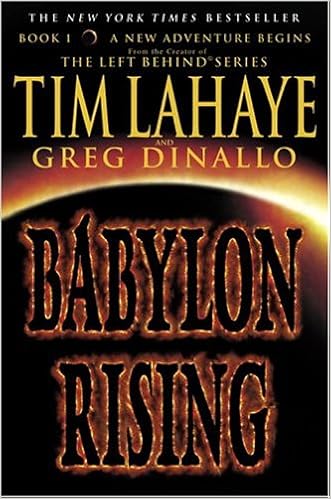
The junk novel in question was Babylon Rising the first book of Tim
LaHaye’s “Babylon Rising” series (written with Greg Dinallo), a sort of prequel
series to his expansive series of Left Behind novels – also junk novels.
The “Babylon Rising” series never garnered the reputation or fan base of the
Left Behind novels. I couldn’t say why.
They’re written in the same style, with same flat characterization, the same
incredible plot lines filled with the same stupefying and ridiculous plot
failures. It’s fast paced and filled with cliff hangers, but not at all believable.
The series follows one Dr. Michael Murphy – who is one part Indiana
Jones and one part evangelical minister; he is a “Biblical Archaeologist” who
chases around the world looking for archaeological artifacts and lecturing a
class of college students to prove the truth of the Bible. “It’s not just
digging up artifacts and finding out where they came from. That’s what regular
archaeologists do. It’s about proving the truth of the Bible” (LaHaye 161).
But what happens in this series of junk novels is not
archaeology, is not academics, and is barely Christian. To summarize:
An allegedly ancient scroll, without provenance is given to Dr. Murphy by an
anonymous and suspicious ‘benefactor.’ Murphy assumes, without testing, - based
only on the word of this ‘benefactor’ that the scroll was written during the
time of King Nebuchadnezzar – the Chaldean king of the Neo-Babylonian Empire.
The scroll describes a bronze serpent, and we’re off and running. “We’re definitely dealing with the Biblical
Brazen Serpent” (98).
Apparently the bronze serpent fashioned by Moses, and broken by King Hezekiah,
was preserved and eventually stolen away to Babylon by the Nebuchadnezzar’s
army. The three pieces were then scattered and hidden in various parts of the
Babylonian Empire. And it’s up to Murphy to find them.
First he’s off to a place described as the “Horns of the Ox” which was a “prominent
landmark reasonably close to the old Babylon” (98). But LaHaye tells us that
this landmark is in “Samaria.”
Samaria, in Biblical times, was the central region of Israel bounded by the Jezreel
Valley, the Carmel Ridge, the Sharon Plain, and the Jerusalem mountains. In
recent years the term “Samaria” has been used by Israeli officials to refer to
the northern portion of the West Bank, but that term is not recognized by the
Palestinian Authority or the international community. But neither of these "Samaria"s is reasonably
close to the old Babylon. No other place names or cities are given to identify this place.
Murphy uses his connections with a shady, semi-retired
Mossad agent to sneak into “Samaria”with “no hassles with officials or customs”(109). He wants to get in and out with
ancient treasures without interference from the government.
While in “Samaria” looking for the “Horns of the Ox” he literally
falls into a room full of hundreds of amphoras, one of which happens to contain the
tail section of the Brazen Serpent. “Moses made this,” he says, without any examination,
dating, or testing. “Moses actually held this in his hands” (137). Murphy takes it home with him to show it off
to his students.
Meanwhile, the immensely wealthy CEO Shane Barrington, acting as a stooge for a
mysterious cabal of international figures known as “the Seven” tasks one of the
reporters working for a news agency he owns to investigating and making an
exposé of a dangerous, fanatical, terrorist group – Evangelical Christians.
(151)
Other agents of “the Seven” paint the phrase “J 3 16” across eight floors of the exterior of the
United Nations building – in broad daylight – in blood! (and no one notices
this until the floodlights are turned on that evening) and to plant explosives
in the North Carolina church where Murphy and his wife are members.
Murphy, along with his colleague, Dr. Isis McDonald, a philologist whose
basement laboratory Murphy compares to the Maze of Forgetting in “Annacherib’s
Pyramid,” (293) (Uh…. Perhaps Dr. Murphy meant Sennacherib, they Assyrian king?), use the first piece of the
Brazen Serpent to lead them to the second – hidden in Saudi Arabia.
They travel (without having to get visas or permission or anything) to the (fictional)
city of Tar-Qasir, famous for its medieval underground sewers. There, in the medieval
sewers they discover a cult chanting in “a dialect of Terammasic,”(a
(fictional) language that has been dead for over 1,000 years, but in which Dr.
McDonald is conversant) (334) preparing a human sacrifice. Murphy and McDonald
chase off the cultists and take the second piece of the serpent.
Which in turn leads them to the third and final piece hidden away in a pyramid
in Egypt. They race to Egypt to retrieve it. (Meanwhile the first piece, the
tail, is stolen from Dr. McDonald’s lab by an agent of “the Seven.”) Murphy and
McDonald find the final piece of the bronze serpent, but before they can do
more than take a few photos of it, it is stolen from them by the agent of “the
Seven.”
But using those photos they are led to Iraq, to the temple of Marduk where,
with help from a U.S. Marine Colonel and a troop of American grunts, uncover an
ancient door, and behind that door – the Golden Head of Nebuchadnezzar’s giant golden
statue.
Murphy and McDonald bring the golden head back to the United States. (389) THE END.
Nothing more is said of the bronze serpent. And nothing in the following
novels is said of the golden head. No tests, no study, no examination. No
ramifications, no meaning.
As I said: this is not archaeology. This is not academics.
And it’s barely Christian.
LaHaye, Tim and Greg Dinallo. Babylon Rising. New York, NY: Bantam Books. 2003. Print.
Tomorrow afternoon Donald J. Trump will place his hand on a Bible and take the
oath of office to become the 45th president of the United States of
America. And he will do so using a bible once owned by the 16th
president, Abraham Lincoln. Lincoln arrived in Washington D.C. for his
inauguration without his own copy of the scriptures; the so-called “Lincoln
Bible” was given to him by William Thomas Carroll, clerk of the U.S. Supreme
Court. The same bible was used by the 44th president of the United
States, Barack Obama, for both of his inaugurations in 2009 and 2013.
And while I understand the historical resonance of America’s first black
president swearing his oath on the same copy of the scriptures once held by “the
Great Emancipator,” I don’t really care that President Obama used and that
President-elect Trump will use “Lincoln’s Bible.”
Neither that particular copy of the bible, nor any copy of the bible-no matter
how storied, or noble its provenance is a magical book. It will not make Trump’s
promise any more or any less trustworthy. Let him “swear on a stack of bibles”
(as the kids say, and as President Obama did in 2013) – let him swear “on his mother’s
grave,” let him “cross his heart and hope to die, stick a needle in his eye” if
he wants, it doesn’t make his words any more credible or trustworthy.
Trust is earned. Honesty is demonstrated. And liars will lie – even on
historically significant copies of the scriptures.
“Again, you have heard that it was said to those of ancient times, ‘You shall
not swear falsely, but carry out the vows you have made to the Lord.’ But I say
to you, Do not swear at all, either by heaven, for it is the throne of God, or
by the earth, for it is his footstool, or by Jerusalem, for it is the city of
the great King. And do not swear by your head, for you cannot make one hair
white or black. Let your word be ‘Yes, Yes’ or ‘No, No’; anything more than this
comes from the evil one. – Matthew 5: 33 – 37 (NRSV)
In the Evangelical branch of the Christian community, we have
been taught that the right way, the proper way to interpret a passage of
scripture is to attempt to understand it in its historical-grammatical context.
We are to put aside (as best we can) our own worldview and attempt to find the
author’s original intent. We are to ask ‘what
did the author write?’ and ‘what did the author mean?’ before we even begin
answering the question ‘what does it mean to me?’ Observation and
interpretation before application.
And I appreciate this method. It is an attempt to be objective in our exegesis.
It is an attempt to favor exegesis over eisegesis. Properly followed it would keep us from wild
interpretive flights of fancy and from reading our own issues backwards into
the sacred texts.
But this is not the way that our biblical predecessors worked; this was not
their hermeneutic.
I’ve been reading from Luke 20: 27 – 38[i]
this week, in preparation for Sunday’s sermon – the story of Jesus’ singular
encounter with the enigmatic Sadducees in Luke’s gospel – and thinking about
the question of hermeneutics. How should we hermeneutic? How should we
interpret the scriptures?
In the story we are told that the Sadducees did not believe
in the resurrection. And this is,
apparently, all that we need to know about them for the story to play out. In
fact we know little about them at all – and what little we do know comes from
sources that were biased against them.
In addition to their denial of the resurrection, one of the
things that is commonly said of the Sadducees is that rejected everything
except the Pentateuch. The Jewish historian Josephus said that they observed nothing
apart from the Law. “But the doctrine of the Sadducees is this: that souls die
with the bodies; nor do they regard the observation of anything besides what
the law enjoins them…” and “…the Pharisees have delivered to the people a great
many observances by succession from their fathers, which are not written in the
law of Moses; and for that reason it is that the Sadducees reject them and say
that we are to esteem those observances to be obligatory which are in the
written word, but are not to observe what are derived from the tradition of our
forefathers…” (Antiquities of the Jews 18.17
and 13.297)
This should not be read to mean that they kept only the Torah and rejected the Writings and the
Prophets. It may mean only that they elevated the authority of the Torah over the other books of Hebrew
scripture (which had not yet been firmly established. It may be “that at a time
when the Jewish canon was still in flux, the best ‘ground rules’ for a dispute
among the Jews who differed in their theological outlook were for both sides to
draw their scriptural citations and their arguments from the universally
revered written Torah of Moses” (Meier 420).
When the Sadducees approached Jesus that day with a question
about the resurrection, it wasn’t specifically an attack on Jesus or his
followers (though as a group that denied the resurrection, this certainly set
them in opposition to the Christian audience reading the gospels.) They came to
him with one of the theological questions of the day.
It was, of course, a trick question, a question designed to make the idea of a
physical resurrection of the dead (and anyone who held that belief) look as
foolish as possible. Their question revolved around the hypothetical ridiculousness
of the system “Levirate”marriage. They took the situation and stretched it to
what they felt were absurd, ludicrous conclusions: Polyandry is ludicrous – Resurrection
will lead to polyandry - Therefore resurrection is ludicrous.
Jesus answers in two parts – first to side-step their trick question. He
nullified their ridiculous conclusion by showing that they really didn’t understand
the concept that they were trying to refute. There won’t be any need for
marriage in the resurrection because the resurrected will be immortal and there
won’t be the need for procreation to create children to carry on one’s name.
Then, secondly, Jesus attempts to prove the resurrection to the Sadducees by
citing one of the texts that he knows they can both accept as authoritative
(Exodus 3:6), but it is his interpretive hermeneutic that is under question
here.
There is little in the Old Testament that speaks about a resurrection. The idea
of a resurrection of the dead “does not appear except in texts that are rare,
obscure with regard to their precise meaning, and late” (Martin-Achard 680). In
the Old Testament there is no concept of resurrection, life after death, or
rewards or punishments in the afterlife. In the Old Testament, the dead, all of
them –the good, the bad, and the ugly, go to the grave, the pit, to sheol. And that’s it.
The origins of Jewish belief in a resurrection after death
are unclear (Nickelsburg 685). But by the time of Jesus, many (but not all) Jews
accepted the idea of a life after death. The Sadducees did not accept this
theological point, and thus the debate we have recorded in the gospels.
The text that Jesus chose to use as a defense of the resurrection, if we are
following our historical-grammatical method, says absolutely nothing about
resurrection. “I am the God of your
father, the God of Abraham, the God of Isaac, and the God of Jacob.” (Exodus
3:6 NRSV) You can pull it apart, you can examine the verse in the larger
context of Moses’ encounter with God in the burning bush, you can parse the words
and phrases of the text, but you won’t find any clear, authorial intent to
describe, define, or defend the resurrection in Exodus 3:6.
Jesus was not interpreting the scriptures the right and
proper way – not the way that we have been taught to do it. Jesus (along with the Jewish rabbis) started
from a different point and followed a different set of interpretive rules and guidelines.
Jesus started with his community of faith, a community “that already held to belief
in the resurrection. Already confident that God does in fact raise the dead and
that he had revealed this truth to Israel in the Scriptures, [they] readily
found clues and intimations of resurrection in texts whose literal sense has
nothing to do with the subject” (Meier 426).
So how should we hermeneutic? Should we be objective and neutral? Should we
favor exegesis over eisegesis? Or is interpretation more fluid? Should we look
for support of theological concepts we believe in texts that may not apply in
the plain sense to those concepts?
Martin-Achard, Robert. “Resurrection (OT)” The Anchor Bible
Dictionary Volume 5. New York. NY: Doubleday. 1992. Print.
Meier, John P. A Marginal Jew Volume 3: Companions and
Competitors. New York, NY: Doubleday. 2001. Print.
Nickelsburg, George W. E. “Resurrection (Early Judaism and
Christianity)” The Anchor Bible Dictionary Volume 5. New York, NY:
Doubleday. 1992. Print.
[i]
The story is also in Mark 12: 18 – 27 and Matthew 22: 23 – 32.
Greetings and Salutations! Welcome to the Biblioblog Carnival roundup for April 2016 - a collection of blog posts, videos, podcasts and tweets relevant to the broad field of biblical studies posted last month. These may not have been the BEST of ALL possible blog posts, videos, podcasts and tweets, but they are ones that caught my eye and captured my interest. I've hosted the biblioblog in the past, and now as then, I've utilized a more-is-more, throw the spaghetti against the wall and see what sticks kind of approach. Jim West at Zwinglius Redivivus will, no doubt, be much more selective in his own version of the Carnival.
To be merciful means to grow in a love which is courageous, generous and real.
It seems as though God’s voice – the lion’s roar – may be a
much more central theme in the book than I had initially thought. The cutting
of the lines of communication comes up again and again as both Israel and God
do it. It is this cutting of contact that warrants Israel’s punishment, and it
is also the punishment itself. Amos’s role as intercessor in Amos 7 becomes so
much more important, because it is through the prophets that Israel might “seek
the Lord and live. As we move through the book, we find that God’s voice is
linked to sin, punishment, and even salvation.
… although in the recent past (e.g., just a few decades ago) violence against
women was not the subject of international attention or concern, it has now
“come to be recognized as a legitimate human rights issue and as a significant
threat to women’s health and well-being.” The fact that there is now much more focus
on gender-based violence is such a good thing, so right, so important. Of
course, the witness of Scripture (and this is one of the reasons for recounting
Dinah’s story here) is that gender-based violence is a very old problem.
The strength of the article lies in its identification of
the extent of literacy in far-flung reaches of Judea, among various ranking
members of the military and military administration. It would be not too rash
to say that, given the literacy levels in the military establishment, we would
expect that scribal literacy would be competent to produce more literary works
of the forms which we find in the Hebrew Bible/Tanach. Indeed, the Tell Deir
‘Alla plaster inscription, written in a Hebrew dialect and located bang in the
middle of Israelite territory during the period of its hegemony in the region,
dates some two centuries before this. So scribes would be capable of the
literary forms found in the Hebrew Bible. This doesn’t really tell us about the
general literacy in the wider population, as the article implies it does. But
more important is the question of literacy among the elites, which the article
provides reasonable evidence for.
The Odes cast a
spell. Something beautiful is happening here. It has a literary integrity I
think that’s very important. The Odes are very unusual in the different imagery
that they come up with. But that imagery is used again and again. One place
where the Odes seem to have mined this imagery is the Book of Psalms. And Rendel Harris, the great scholar who really brought the
Odes to the attention of the modern world, refers to these Odes as Psalm
pendants. It’s as though the congregation might have sung a particular Psalm,
and then, the Odes would’ve been sung as a response to it. And so many of the
Odes when one reads through them one realizes that the imagery of Psalm 45 is
being used or Psalm 63 is being used. And that’s one of the beautiful things
about these Odes is that they’re so close to scripture.
Although the
Testament of Moses is cut off half-way through the manuscript, it is
nonetheless helpful in reconstructing ideologies and worldviews from the Levant
in the 1st century C.E., and even earlier if we assume the text had previous
written and oral traditions preceding it’s composition. The testament claims to
be “the prophecy which was made by Moses in the book of Deuteronomy”; however,
while it takes up a similar tone, the testament incorporates material relevant
to the Maccabean Period, indicative of the late date of the text.
Based on the
previous information, it is evident that we should read the Testament of Moses
as its own piece of literary work, self-sustaining and independent. What we
will consider today is Moses’ role as a divinator in the Testament of Moses.
*James McGrath is trying to find a balance between naive
credulity and extreme skepticism with respect to the Gospels and other early
Christian sources in description of Jesus’ death in Philippians 2: 6 – 11. Philippians 2 and the Historical Jesus It is striking to turn in light of this to Philippians
2:6-11. If Paul is there quoting a hymn, then this might be our earliest source
of information about the death of Jesus, as well as about how Christians
understood it. In that passage, Jesus’ death is nothing else but the
culmination of his obedience, leading to his exaltation.
That's what upsets me about crowds cheering and thrilling to
calls to bomb ISIS, so-called "Christians" who are viewing violence triumphalistically rather than tragically. Because Jesus said "put
your sword away" Christians can never cheer violence. We must only grieve
it.
...if Jesus silenced confession of him as Messiah how
much more would have silenced for strategical reasons any suggestions of his
deity. I find the logic solid, if not compelling.
Revelation 4-5 is built first on the foundation of the
Hebrew Bible. There are several texts which describe God as enthroned, such as
Isaiah 6 and Ezekiel 1-2. In both of these passages the prophet sees a vision
of God enthroned in heaven surrounded by otherworldly angelic creatures
(seraphim in Isaiah, cherubim in Ezekiel). In both cases the prophet is stunned
by the vision and eventually commissioned to a prophetic office. In Revelation
4 there is a central throne, angelic beings, but John is not a prophet as much
as an observer of the impending judgment contained in the scroll given to the
Lamb to open.
I had the privilege of attending last night’s debate on “Did Jesus Exist?”
between two well-versed debaters – Dr. Craig Evans and Dr. Richard Carrier.
When I learned of this debate, I wanted to take advantage of listening to
Carrier, who is probably the world’s foremost mythicist scholar. In other
words, I felt that this debate would expose me to the best arguments scholars
could put forth suggesting Jesus was simply made up in history. Now I took
plenty of apologetic classes in my undergraduate and graduate studies to become
convinced of the overwhelming evidence regarding Jesus’ existence, but I could
not pass up the chance to listen to Richard Carrier live. So I piled up my car
with a few of my bright students and we took off to witness the debate. Here are some of my observations of last night’s event:
I know that might not seem very reverent, especially since Romans is often
thought of as the primo example of Paul at his difficult yet nevertheless
logically consistent best, where he once and for all lays out the basics of the
gospel for all to hear and for all time. Not that Romans is a jumbled mess—may it never be (see what I did
there?)—but to me Romans reads more like Paul is in creative-problem-solving
mode for Roman Christians facing a pressing problem (how Jews and Gentiles make
up one people of God) than Paul sitting in his study writing a theological
treatise intended for wider publication.
Is there a vast international conspiracy to convince you that Jesus was a real
person? Well, not really. It’s a game of probabilities. Scholars say that,
given the evidence we have, it’s more likely than not that there was an actual
dude named Jesus walking around in the desert 2000 years ago. Of course, you
are free to draw your own conclusions, and a belief in Gnosticism certainly
does not need to include a belief in a historical Jesus.
Too often, Christian writers and
commentators assume (or do not question) an equivalency between femininity and
the female; therefore, the mere presence of female bodies within a church’s
congregation is believed to engender an effeminate style of Christianity. Evangelicalism’s
enduring phobia of “liberal” feminism is largely to blame, and has made its
members ignorant of even the most innocuous principles of basic gender theory:
namely, that there is a distinction between biological sex and gender identity,
that humans are responsible for creating culturally contingent gender roles
(not God), and that both men and women hardly ever conform completely to their
prescribed roles.
If you are heterosexual, married, divorced, and remarried
with an understanding parish priest, you have reason to be hopeful that your
“irregular situation” can be fixed. If you use most forms of effective birth
control, have an abortion, or are a sexually active LGBTIQ Catholic, you might
as well read Dante and/or seek another denomination if you expect to be treated
with equality, dignity, and respect. ... The “Joy Love Club” is members-only.
Too often the 'just war theory' has been used to
endorse rather than prevent or limit war," they continue. "Suggesting
that a 'just war' is possible also undermines the moral imperative to develop
tools and capacities for nonviolent transformation of conflict…We need a new
framework that is consistent with Gospel nonviolence," say the
participants, noting that Francis and his four predecessors have all spoken out
against war often. "We propose that the Catholic Church develop and
consider shifting to a Just Peace approach based on Gospel nonviolence.
Of course, even if Christians did engage in
contextualization—expressing their message and worship in the language or forms
of the local people—that in no way implies doctrinal compromise. Christians
around the world have sought to redeem the local culture for Christ while
purging it of practices antithetical to biblical norms. After all, Christians
speak of "Good Friday," but they are in no way honoring the worship
of the Norse/Germanic queen of the gods Freya by doing so.
But, in fact, in the case of Easter the evidence suggests
otherwise: that neither the commemoration of Christ's death and resurrection
nor its name are derived from paganism.
Today, America seems divided between those who engage with some version of the
prosperity gospel and those who smugly dismiss it as fraudulent and puerile.
While there are a number of problems with the gospel, it’s important to look at
why this strand of religious thinking evolved in the first place, and why it
persists.
I believe salvation is not from hell but to good works (Eph.
2.8-10). Salvation is not a momentary conversion, but a process of ontological
importance. It is found in the Creed, but never defined. However, Protestantism
usually sees it in terms of avoidance of hell. You’ll here mentioned “we
deserved hell” and “we aren’t worthy.” Yet, Scripture never declares these
things as well as the Reformers did. For Scripture, and Orthodoxy (and
Wesleyanism), Salvation begins with the love of God, ending in the positive,
rather than the negative.
It was assumed back in the 1970s that these bones were
buried and no longer available for analysis–but it turns out this is not the
case. What is even more intriguing, the victim was arguably none other than
Matitiyahu Antigonus–the last of the Hashmonean kings–who was both beheaded and
crucified by Marc Anthony. in 37 BCE. And even more significant, Greg Doudna
has persuasively argued that this Antigonus is none other than the famed
“Teacher of Righteousness” in the Dead Sea Scrolls,
*Archaeology News Network - Reported that construction workers in Gaza have discovered ancient ruins
that archaeologists say may be part of a Byzantine church dating from around
1,500 years ago, The findings include segments of marble pillars with ornate Corinthian
capitals, one nearly three meters (yards) long, and a 90 cm (35 inch)
foundation stone bearing a Greek symbol for Christ. Fifteen pieces have been
uncovered, with excavations continuing.
According to Dina Avshalom-Gorni, the project’s chief
archaeologist on behalf of the IAA, “the incense shovel that was found is one
of ten others that are known in the country from the Second Temple period. From
early research in the world it was thought that the incense shovel was only
used for ritual purposes, to care for the embers and incense that were burnt in
ritual ceremonies. Over the years, after incense shovels were discovered in a
non-cultic context, it appears they were also used as tools for daily tasks.
The incense shovel and jug found in our excavation were exposed lying next to
each other on the floor in one of the rooms, at the late Second Temple period
storehouses that is located adjacent to the dock of the large Jewish
settlement, on the shore of Sea of Galilee. These implements might have been
saved in the storeroom as heirlooms by a Jewish family living at Migdal, or
they may have been used for daily work as well.”
“I think that people need to worship and believe in GOD regardless of their belief. This is a free country.” pic.twitter.com/VM8sY6dmlt
Given that I have sat on both sides of the interview
table–as both candidate looking for a post, and as President or Academic Dean
looking to fill a post–I thought I might offer a few reflections on the
interview process. In particular, I want
to help candidates know what we are really looking for in a potential
professor. I say “really” because I think candidates often misunderstand what
we are looking for. And, due to that misunderstanding, sometimes candidates are
simply heading down an unhelpful path in the interview process.And when I say
“we” I am thinking particularly of those leaders in the world of evangelical
seminaries. Those in university
settings, or those who are not evangelical, are unlikely to offer the same
advice.
It’s like they’re ripping off the plot of Miracle on 34th Street. Only this
time, it’s set in Arkansas at the state capitol. And instead of trying to
establish whether or not Santa Claus is real, now they are trying to determine
if Jesus was real. Because that would totally happen in real life in a court of
law. And it’s totally relevant to the case at hand.
This may be the most important book in Christology to appear
in recent years. Written in an era when it has become increasingly popular to
insist that Jesus is already depicted as a pre-existent figure in the Synoptic
Gospels, one who is absorbed into the “divine identity,” Daniel Kirk makes a
persuasive case for viewing the depiction of Jesus in Matthew, Mark, and Luke
as one of idealized humanity. Unlike many other proposals, this category, and
this volume in which it is proposed, does good justice to the evidence, and is
likely to stand the test of time.
And even when the NT writers were transforming the OT text in creative ways,
for example as Paul does in Gal. 4, these improvisations presuppose a stable
text to which one can return again and again, and use in a variety of ways. I
would use the analogy of say John Coltrane’s famous version of the Sound of
Music song ‘My Favorite Things’. ‘Trane was not trying to faithfully ‘exegete’
that song, he was rather using it as a taking off point for a creative
improvisation, but at the same time he was well aware of what playing the tune
straight amounted to and sounded like, and he presupposed that his audience did
as well (they could look at a copy of the original sheet music or put on the
recording of the Sound of Music), so they could appreciate where he was, so to
speak, playing outside the lines on the staff paper. I think, in other words,
that figural interpretation was only one of the tools in the hermeneutical
toolbox of the Gospel writers, and it was not one they always used, certainly
not to the exclusion of other ways of using the OT.
I am not trying to make the case that no music is sacred. On
the contrary, I am more inclined to make the opposite case and argue that all
music is sacred. Music takes vibrations in the physical world and combines them
in ways that we perceive as beautiful. And so music by definition points
towards transcendence, towards the fact that there is more to life that what
one perspective can do justice to. And since music is a pointer towards God, it
makes sense to use music – any music – as an opportunity to talk about one’s
faith and the things that are important to us.
Ruben Zimmermann’s Puzzling the Parables of Jesus:
Methods and Interpretations is a very fine work. One value of the book is
that it consciously seeks to bring together current German and American
research on the parables. Another important feature is that Zimmermann applies
recent research on historiography and memory to the interpretation of the
parables. This post will highlight a third contribution of the book, namely
Zimmermann’s perceptive discussion of the genre of parable and his convincing
suggestion that there are, in fact, parables in John. In Memoriam
“Dan was one of the great Catholics of our time, a champion
of social justice and a tireless promoter of peace…His influence on the peace movement,
particularly during the Vietnam War, cannot be overstated, but his aim was not
simply peace in Indochina, but peace everywhere.” Berrigan was one of seven
Catholic priests who used napalm to burn draft cards in 1968 in protest against
the Vietnam War, according to the National Catholic Reporter. As a result, he
was sentenced to three years in prison.
The great Daniel Berrigan, SJ, Jesuit priest, activist, poet and peacemaker, died today. May he rest in peace. pic.twitter.com/SYcdaF2Zqq
*Poet and Prophet A literary giant in his own right, Berrigan was
best known for his dramatic acts of civil disobedience against the Vietnam War
and nuclear weapons. He burned draft files with homemade napalm and later
hammered on nuclear weapons to enact the Isaiah prophecy to “beat swords into
plowshares.” His actions challenged Americans and Catholics to reexamine their
relationship with the state and reject militarism. He constantly asked himself
and others: What does the Gospel demand of us?
June 2016 (July 1) – Kris Lyle at Old School Script, @KristopherLyle
After that there's nothing - unless you act now. Phil Long at Reading Acts, who organizes these events, would love for you to volunteer as host for upcoming biblioblog carnivals. Contact him PLEASE! (via Twitter @plong42 ) if you're interested.