Pages

google analytics

Showing posts with label mental health. Show all posts

Wednesday, May 18, 2016

Biblical Limericks – Why Bring Him to Me?


David played mad for Abimelech
till the annoyed king said, “what the heck?
He’s head-butting the door
and drooling on the floor;
this fool’s not dealing from a full deck.”

1 Samuel 21: 14 - 16

Saturday, November 22, 2014

Biblical Limericks: Ezekiel


With his bouts of catatonia,
and his bizarre neurasthenia,
though it might cause chagrin,
perhaps he should have been
diagnosed with schizophrenia.


Tuesday, August 20, 2013

Yesterday Was Miserable. Tomorrow May Be Better…

Yesterday was miserable. 

It started out fairly well.  I had a productive meeting at the church over lunch, then worked on some music for our brass band to rehearse later that evening.  Then I went to visit my friend.  And that’s when things took a turn for the miserable. Yesterday was miserable for me because I chose to share my friend’s misery.  But it was only a vicarious misery and it was only for a few hours.  My friend has been miserable for pretty much his entire life. 

He has been told by so many and for so long that he is terrible, that he is abominable, and that God could never love him that he has come to believe it.  He is bruised and broken emotionally and spiritually and believes that he deserves whatever pain and misery he experiences.

When he’s feeling particularly miserable he drinks.  And even though The Salvation Army is an alcohol abstaining denomination, I find it hard to begrudge him his drink.  (Not that I’d encourage him to drown his pain in alcohol, but I can't bring myself to condemn him for it…)

Give strong drink unto him that is ready to perish,
And wine unto the bitter in soul:
Let him drink, and forget his poverty,
And remember his misery no more.

Proverbs 31: 6 – 7 ASV

What worries me though, is when he drinks he tends towards the suicidal.  The weight of his grief is so overwhelming that even the numbing effects of alcohol can’t help.  He’s attempted suicide in the past – so I’m more than a little nervous when he starts talking about it again…

Put me out of my misery
I'd do it for you, would you do it for me
We will always be busy making misery

Misery – Soul Asylum


I left him yesterday afternoon without being able to help and this bothered me.  I’m not quite so naive as to believe that I can in just one afternoon undo the effects of a lifetime of scorn and abuse, but I was quite miserable for and with him just the same.

I wrote the lyrics for this new hymn with him in mind.

And then the following quote, attributed to the Jewish American composer Harry Ruby, came through my Twitter feed last night.  I don’t know if it’s attributed accurately, but I like the quote:

The best bridge between despair and hope is a good night's sleep.

And, at least for now, that has proved true.  I went again to visit my friend this afternoon, and things were much better – or at least comparatively better.  He was sober, and glad to see me.  He asked me to pick him up for church Sunday morning. 

The psalmist said that weeping lasts for a night and that joy comes in the morning (Psalm 30: 5) but how quickly does joy come when the misery has lasted a lifetime? 

Monday, August 19, 2013

Biblical Limericks: Was He Diagnosed with Catatonic Schizophrenia?


Ezek’el was a man to excite
and when he saw Israel’s sad plight
on his left side he lay
three hundred ninety days
and another forty on his right.

Ezekiel 4: 4 – 6

Saturday, May 11, 2013

How Low is the Bottom Shelf?


Jim is one of those people. He’s hard to spend time with because he talks and talks and talks.  He’s nice enough but his stories are spiraling exercises in tangential patience.  He talks about his noisy neighbors, the motorcycle that he’s eager to ride, the tools he bought 15 years ago, his time in military training, one story leading to another without any (apparent) connection.  He lives on his own but he has some sort of general learning disability.
He attends our worship services on Sunday mornings and prayer meetings on Sunday evenings. And, as I said, he’s a very nice guy, but…

Recently he asked me what would be required in order to become a member of our church – officially.  Usually I meet with prospective members of the church to review the doctrines and history of our denomination (The Salvation Army) to make sure that they fully realize what they’re asking.  But in Jim’s case, I’m not sure how “fully” we’re going to get.

I don’t want to be dismissive and say that he can’t understand it -  that it’s altogether beyond him– but I don’t want to burden him with the pressure  of it all if it is, in fact, beyond him.
He read through our 11 doctrinal statements and declared them to be concise and to the point, but whether or not they made sense to him, I don’t know.  When I asked if he understood them, he said “yes” and immediately proceeded to tell me about the coupons that Burger King used to send out in the mail. 

When I preach on Sundays, or lead a bible study, I try to keep in mind some advice that my homiletics instructor gave me – “keep most of it on the bottom shelf where people can reach it, but keep some of it just out of their reach so they know there’s something more to stretch for…”  I’ve always thought that to be good advice.  But determining how low that bottom shelf actually is- without insulting them and without preaching over their heads – is often difficult.

I eventually gave up on the doctrines this afternoon.  I gave Jim a copy of them so that he can read them again at his leisure.  We talked about chainsaws and seed catalogues and the Canadian band, the Guess Who, and about his brief stint in the military and, and, and, and…

And that was good enough for today.


Friday, May 10, 2013

What I’m Reading: Valis


It is one part science-fiction, one part theodicy and two parts Gnostic cosmogony.  Ancient Gnostic Christians are breaking through the illusion of time in order to dethrone the Anti-Christ that is Richard Milhous Nixon.  An orbiting satellite named VALIS (Vast Active Living Intelligence System) is beaming salvific information directly into people’s brains via a pink laser.  King Felix is on the rise.

Reading Valis – the 1981 novel from science fiction author Philip K. Dick – is like reading the secret thoughts of a schizophrenic.  Hallucinations are real.  Reality is itself deranged.  Personalities are split and separated.  Philip Dick himself is a character in the story, as is his schizophrenic other – Horselover Fat (Philip in Greek = “lover of horses,” Dick in German = “Fat”).  And all of it really did happen to him or to them.

In 1974 Philip Dick began to have intense hallucinations, visions, and mystical experiences that he attempted to describe in his writings.  He was living two (or more) lives, seeing visions of Ancient Rome and of an artificial satellite network (VALIS) that is God – or one aspect of God.  He received information from the pink light that helped him save his son from an undiagnosed birth defect.  He had experiences of xenoglossia – speaking a language he’d never learned – specifically Koine Greek, the language of the New Testament.

Although the ancient grey-robed Christians had been slaughtered by the Romans, the cosmic plasmate – the eternal spirit of VALIS had gone into hiding, trapped within the Nag Hamadi texts buried and forgotten in the sands of Egypt.  But, once rediscovered it was loosed again and seeking to share its information.  Real time was suspended in 70 CE with the Roman destruction of Jerusalem.  It resumed again in 1974 CE, but the Empire Never Ended. 

Dick weaves elements of Christianity, Gnosticism, Buddhism, Judaism, Greek Mythology and and and into a franticly complex narrative that makes sense as long as you don’t try to make sense of it.  If you do that it turns into paranoid madness.

The two year old girl, Saint Sophia, has the answers – but she may not be real and she dies.  

Wednesday, March 6, 2013

The 5 Stages of Christian Grief

 photo 5stagesofChristianGrief_zps1147f6b7.jpg

I shouldn't assume that the satire is obvious; I know that.

So, to be clear: SATIRE.

The quoted verse has been badly translated here.


Saturday, March 2, 2013

Good Words...That's where Hope Begins


... I prefer strangling and death, 
rather than this body of mine.
Job 7: 15 

"How we deal with death is at least as important as how we deal with life."
 Captain Kirk in Star Trek II

David Marcus: You were smart enough to tell Saavik that how we deal with death is at least as important as how we deal with life.
Kirk: Just words…
David Marcus: But good words. That’s where ideas begin.
Star Trek II


Where No One Has Gone Before photo Wherenoonehasgonebefore_zps81615175.jpg


On Thursday I received a phone call telling me that a friend of mine had either tried to, or threatened to commit suicide.  I had only just returned home from Omaha, Nebraska after four days of meetings, but I immediately threw a few more clean shirts and underwear into my bag and drove another five hours to visit him in the hospital.

One thing that I try to remind myself of when visiting with someone in crisis situations like this is that Job's friends were great friends for the first seven days - until they opened their mouths.

So far I haven't said much.  I've tried to listen without offering advice (especially that kind of noxious advice that well meaning Christians proffer: You just need to trust God... You just need to pray...)   But he and I (and another of our friends that is here) are fans of Star Trek so these words have come to mind.  Like Kirk, I'm not sure I always believe them.  And I worry that to my friend in crisis they will sound like "just words..."

But that's where ideas begin.  It might be where hope begins...


***

For those who might be curious about such things - the picture above is my own work.  It was created from a photograph of an Enterprise model that my other friend (the non-crisis friend) put together, as well as a photo of a lace curtain and a photo some red onions. 

Wednesday, October 3, 2012

YellowBrickRoad - The Road to Madness and Inexplicable Mysteries


One morning in 1940, the entire population of Friar, NH, walked north up an unmarked trail into the wilderness.

Some were later found frozen to death.  Others were mysteriously slaughtered.  Most, however, were never found.

YellowBrickRoad (2010) begins with 70 year old mystery - where did the inhabitants of Friar, New Hampshire go? Why did they leave their homes, their clothes, even their pets tied up and slowing starving to death?  What happened to them?  Like the still unsolved mystery of the Roanoke Colony, whose inhabitants disappeared leaving only one clue behind - the word "Croatoan" carved into a tree - the mystery persists.

The film follows a group of scholars who set out to follow the path taken by the missing community in order to discover what happened to them, to turn the legend into "recorded history."


It isn't long into the expedition before the team's GPS device fails them.  It variously locates them in Guam, 40 miles NW of Florence, Italy and "just outside  Melbourne."  They begin to hear strange sounds and music from the 1940's in the wind.  The team posits several possible explanations for these strange occurrences:


1 - Scientific explanations such as solar flares or magnetic resonance or, or, or...
2 - Human pranksters playing  a joke on the team
3-  A shared psychosis spread between the members of the team
4 - An act of God.

"What if the people of Friar believed this was the road to God or the Wizard or whatever?"


But the path they follow, this "yellow brick road," as the tag line of the movie says, does not lead to "a fairy tale ending." It leads into madness and horror and despair.With elements of the Roanoke Colony mystery, the Bermuda Triangle, and even Joseph Conrad's Heart of Darkness - the movie leads the viewer deeper and deeper into madness and inexplicable mysteries.

When the team realizes that they can't rely on their electronic GPS device, they turn back to the surveying equipment of their cartographic experts and their compasses.  They make detailed notes about their heading and the distances they've travelled, but the numbers don't add up. They're lost.  And they can't follow their calculations back the way they came because the "numbers only make sense going forward."

The ending of YellowBrickRoad has left some reviewers unsatisfied.  Little is explained.  The mystery is not solved.   But this is a movie about being lost and being lost in madness.  The numbers only make sense going forward.  If you try to look back from where you came, it won't make any sense.

If I were going mad, how could I tell?


Friday, August 24, 2012

Friday, August 5, 2011

You Just Need to Get Over It!


“You just need to get over it.”

That’s what her mother told her when she tried to express the range of emotions she felt after loosing her home in the flood on the Souris River in Minot, North Dakota.   Her mother cut short their telephone conversation with the brutally curt advice, “you just need to get over it or take some medication and stop crying about it all the time.”

The woman who told me this is a 55 year old mother of three.  She and her husband came to The Salvation Army today for some financial assistance.  Their house, like so many others in this community, was completely flooded by the waters.  And while I was able to give them a voucher for some of the things they need, what she really needed was a chance to express her grief.

Her grief wasn’t for the loss of their home.  She and her husband seemed to be dealing with that pretty well.  They’d bought the house some years ago, paid off the mortgage and thought all was well.  Now they’re getting an SBA loan and starting over.  It’s hard but they feel up to the challenge. 

Her grief felt more like a death… and in a way it is.  She’s grieving for the loss of a close knit family.  She’s grieving for the loss of that intimacy she thought she had with her parents and her sibling.

Immediately after the flood her family helped her and her husband and their still at home teen-aged son to evacuate, but as the days and weeks and months now have passed they want her to “just get over it.”

“They don’t understand. And they don’t care,” she said before the tears and sobs choked her voice. “They don’t call.  They don’t ask about how we’re doing.”

She and her husband spent a little more than an hour talking with me.  And they came to realize that her sense of loss wasn’t so much for the house or the possessions they lost; her sense of loss is rooted in the realization that she doesn’t have the relationship with her family that she thought she had.

“Sometimes we see what we want to see.  We see things that may not be there because we want them to be there.”

But rather than drowning in that sense of loss, she very quickly came to the realization that she has in this the chance to reevaluate more accurately what kind of relationship she has with her family, the chance to ask herself what kind of relationship she would like to have, and the chance to ask herself what she can do to make the relationship better.

“It would be easy to make the relationship worse, to fight and say ‘I never want to speak to you again’… but I don’t want to do that.”

She might want that familial intimacy more than they do, but at least she’s aware of that fact now.  The immediate future will be difficult, and she’s anxious about the traditional family get together at Christmas, but she feels strong.  She has a good husband and three children that she loves and who love her.  She has friends at work and at church.  And she has a “calm in the center” that she attributes to faith in God.

Before they left I gave her a hug, and before I could turn to shake her husband’s hand, she grabbed me and hugged me again.  “Thank you.” she said.

I’m not sure what I did but I think she’ll be all right.

To volunteer in Minot visit http://www.usc.salvationarmy.org/usc/www_usc_minot.nsf,
or call: 701-838-8925.

Monetary donations can be made in the following ways:
-Donate $10 by texting “MINOT” to 80888 and replying “yes” to the confirmation text. A one-time donation of $10 will be added to your cell phone bill. For terms, see www.igfn.org/t.

-Or by calling 800-SAL-ARMY (725-2769)

-Or by mailing a check to The Salvation Army,
315 Western Ave., Minot, ND 58701
Be sure to designate your donation “Minot Flood.”


Thursday, March 10, 2011

Ezekiel the Madman

Though I wrote some time ago about my developing interest in the traditional liturgical calendar of the Church, I’m not yet following it. Instead we have, at our church, developed a preaching calendar for this year that focuses on the prophets, major and minor.


This has been an interesting and motivating challenge, at least for me. I love the prophets – most of them. My favorite parts of the bible are among the prophets (but so is the one book that I really cannot stand…) There is so to learn from the prophets.

And we’ve come now to the book of Ezekiel.

Saint and Doctor of the Chruch Jerome called the book “a labyrinth of the mysteries of God.” And the rabbis forbad anyone under the age of thirty from approaching it. Its allegories are obscure and some of the book approaches, if not crosses the line into pornography. Ezekiel himself seems almost schizophrenic.

He veers from frenzied actions like a furious pantomime of the siege of Jerusalem to prolonged periods of catatonic silence and immobility. He subjects himself to degradation and defilement. He cuts himself. He starves himself. He talks about mysterious visions and mystic journeys outside of his body. He shouts vulgarities that no dignified and respectable man of God would utter.

And it’s no wonder that he seems schizophrenic. This kind of physical and mental torture seems designed (by God?) to cause a psychic break. And break Ezekiel does. In becoming the prophet of God, Ezekiel becomes everything but himself.

He speaks as the voice of God.
He acts as the enemy of the people
He takes the sin and punishment of the people of Israel on himself.

He becomes a visible sign to the people of all that that they could not or would not say.

In chapter 3 Ezekiel is lifted up in the Spirit for a visionary encounter with the majesty of heaven. He sees the glory of Yahweh and hears the sound of an earthquake. And he says, “I went in bitterness and in the heat of my spirit, [but] the hand of Yahweh was strong upon me.” (3:14)

Is he a madman, driven by religious fervor? In some sense, yes.
And because of that, I feel a certain amount of pity for Ezekiel the man, cut off as he was from his homeland , from his intended career as a priest in the temple, from his own wife, and from his community.  He was alone with his ravings and with his God. Ezekiel suffered for his faith.

So my pity is mixed with admiration and respect and esteem and gratitude.

Thursday, July 22, 2010

Snakes in Suits

I am in the middle of reading the book Snakes in Suits: When Psychopaths go to Work by Paul Babiak, Ph.D. & Robert D Hare, Ph. D.  It was recommended to me by one of my Anonymous friends after I had read Feet of Clay - a study of madmen and gurus.  This all stems from my recent interest in the cult of Scientology. 

Snakes in Suits  is written as a layman's guide to the psychopathic personality - particularly as it relates to the corporate and business world.  It is not a clinical or technical book, but is filled with examples from real life situations and composite hypothetical examples.

First point:  Psychopathy is a personality disorder - not a mental illness. (There is a difference.)  They are not raving lunatics or slobbering catatonics.  For all intents and purposes, they are quite normal.  At least they appear to be. 

The psychopath - male or female - can be charming, persuasive, and quite likable.  But they are predators. They are not charming and friendly because they like other people or care about them in any way.  On the contrary, to the psychopath other people exist only to serve them.  Other people are either pawns to be manipulated, patrons to be exploited or threats to be neutralized.  When charm and persuasion can't get them what they want, the psychopath feels no guilt in using threats, intimidation, or even physical violence. 

They feel no guilt.  They feel no remorse.  They have no empathy. 

As I said, Snakes in Suits is written primarily for the business world and the corporate structure but it does occasionally describe the psychopath in a religious setting.   They are chameleons and can adapt to whatever group they've infiltrated; they can shout "hallelujah" with the faithful just as easily as they can attend a board meeting with the shareholders.  And since the organizational structure of  my own church - The Salvation Army - is a strange blend of both the religious and the business, I began to wonder if there are any snakes in Salvation Army uniforms. *

I doubt it (though I wouldn't be so foolish as to say absolutely not).  I doubt it because The Salvation Army is rather bureaucratic. No. We're heavily bureaucratic.  We have layers upon layers of organizational rules.  We have a thick book of Orders and Regulations to which we're expected to adhere.  And while there are potential rewards for the exploitative psychopathic personality (i.e. power, privilege, and access to money) the obstacles are numerous. 

"We doubt that psychopathic individuals would be very successful in a highly structured bureaucracy for several important reasons. First, psychopaths are generalized rule breakers; rules and regulations mean little to them.  The sheer number of policies, procedures, and laws governing how companies must act, as well as the fact that managers and supervisors are charged with enforcing them, makes them inhospitable to those prone to psychopathic behavior.  They would not last long in a traditional, textbook bureaucracy.  It is unlikely that they would even consider working for one, unless they knew the boss and could get away with getting a paycheck without producing any work." page 95-96


But while the structure and bureaucracy of an organized religion might be a deterrent to a psychopathic personality the world of New Religious Movements is a bountiful hunting ground.  (New Religious Movement is the more neutral term for those groups sometimes refereed to as "cults.") Loosely organized and free to make up the rules as they go along, the psychopathic person can easily charm, manipulate and swindle those who are caught up in their deceptions.

Psychopathic individuals can and will tell extravagant stories - outright lies and even when they are caught in their lies will not stop. They change their stories, adjust the details as needed until they're believed. And they good at it.  They are persuasive story tellers, raconteurs of the highest calibre.  They're willing to say anything without regard for truth or accuracy.

I'm not a psychologist. I cannot make a diagnosis of any kind - but I would suspect, after reading biographies of L. Ron Hubbard and interviews of people who knew him and worked with him, that the founder of the cult (or NRM, if you prefer) of Scientology was psychopathic.  He used people for what they could give him, and when they could no longer give him what he wanted or they opposed him, he threw them away and destroyed them, without remorse.

The Church (cough, cough) of Scientology in Australia recently made the outrageous claim that they're "just like the Salvation Army."   But the history of The Salvation Army isn't filled with reports of abuse and exploitation like Scientology.  Just compare biographies of our founders, look at our organizational structures, and I think you'll be able to see the difference. 


* Since The Salvation Army - like every other human organization - is made up of fallible humans there are of course some "snakes" amongst us, people who act badly, who occasionally lie or cheat or whatever.  It's inevitable. Even in a religious movement.  But here I'm referring specifically to "psychopathic snakes" and to no specific individuals within the leadership whatsoever.  Is that enough of a disclaimer?

Friday, July 2, 2010

Feet of Clay - Saints, Sinners and Madmen: A Study of Gurus

He's a god, he's a man,
he's a ghost, he's a guru
- Nick Cave & the Bad Seeds – “Red Right Hand”

The Sanskrit word Guru refers to one who brings light out of darkness.  The guru - or teacher - is an illuminator, a light bringer, a guide.  Hopefully.
 
We know, however, that not all religious leaders are good.  Many gurus have exploited and manipulated their followers for money and for sex, leading them into financial ruin, mental anguish, physical pain, and in too many tragic cases -  even death.
 
British psychologist, Anthony Storr, wrote about some of the common characteristics of gurus - good and bad - in in his 1996 book, Feet of Clay - Saints, Sinners, and Madmen: A Study of Gurus. 

I found this book at the public library (thank you inter-library loan system!)  and read it because of my recent interest in Scientology and its founder L. Ron Hubbard.  And while LRH and his invention are not mentioned in Storr's book,  there is much that those who are familiar with LRH and Scientology will recognize.

The book is brief - 254 pages and that includes the index.  I wish he had either included more examples or had been more detailed about those figures he did analyse.  But this is a minor complaint (and really, I know I'm just a nerd who always wants to know more...)

The first half of the book is devoted to a brief description of the life and teachings of various gurus - some (in)famous and some obscure, some deadly, and some who were truly beneficial despite their "feet of clay."
Included are Jim Jones and David Koresh - who lead their followers into suicide, the Indian guru Bhagwan Shree Rajneesh - who had a passion for collecting Rolls Royces, (He had ninety-three before his arrest and deportation from the United States and the psychologists Sigmund Freud and Carl Gustav Jung (who for all their talk of psychiatry as "science" promulgated a secular religion and promised salvation...)

Also included in this section is the guru Jesus. I must admit that I am not always objective (none of us are) and it was a little difficult at first for me to think of Jesus in the same context as Jones, Koresh, Rajneesh and the others.  Though Storr's thesis - that there isn't so much a LINE between the sane and the insane as there is a spectrum or a continuum.  Some who are mentally ill live functional and productive lives.  Some who are thought of as sane are actually very maladjusted.  "We tend to diagnose mental abnormality in the socially incompetent and overlook it or deny it both in the socially dominate and the socially unobtrusive. (page 153)"

Looking at my guru Jesus in the light shone light on others who would take up religious leadership. If the dangerous and crazy gurus like Jones and Koresh are at one end of the spectrum then Jesus is at the other.  I am forced to consider where I am along this continuum.  Am I closer to being a bringer of darkness than an illuminator? 

The second half of the book looks at the larger issues of mental health, sanity and insanity, - and the difficult question of where to draw the line between faith and delusion. This is a topic that concerns me.  Though my interest in Scientology is recent, and will in all probability diminish somewhat over time, I am continually interested in what it means to have faith.

Gurus through the years and around the world share a number of similarities, says Storr.  Often they: 
-are solitary or isolated as children
-are charismatic and charming
-are fluent speakers
-create a mysterious history of travel - usually in central Asia
-are elitist and anti-democratic
-endure a period of mental distress or illness which is followed by a new spiritual insight
-are paranoid and suspicious of others
-develop intricate and wildly eccentric cosmologies

But the most important characteristic of gurus - is their narcissism. 

They are arrogant.  And why shouldn't they be?  They've received a special knowledge (either from God, the universe, or from their own diligent study)  that the rest of us mere mortals could never attain.  They are superior, and they know it.  They will not suffer to be questioned.  They will not tolerate disagreement.  They will not accept correction or suggestions.  Touch not the Lord's anointed!

"Whether a guru has suffered from manic-depressive illness, schizophrenia, or any other form of recognized, diagnosable mental illness is interesting but ultimately not important.  It is not their thought disorders, not their delusional beliefs, not their hallucinatory visions, not their mystical states of ecstasy:  it is their narcissism. (page 210)."

A religious leader (or political leader, or a leader in any field) who will not allow that he or she could be wrong is a danger to him or herself and to any who would unquestioningly follow - but that is the only way that (dangerous) gurus would have them.

Monday, May 17, 2010

Mission Earth 10 - The Doomed Planet

Here it is,  The Doomed Planet, the 10th and final volume of L Ron Hubbard's arid and interminable Mission Earth Series.

I've been seeing these books in libraries ever since I can remember but had never picked them up.  And now, 1.2 million or so words later, I almost wish I never had.  LRH may have been a decent writer during his early years, writing adventure stories for pulp magazines, but by the end of his life he had completely forgotten his craft.  He was no longer a story teller.  The Mission Earth books are not about story - they're not even really about people. The Mission Earth  books were merely an excuse for Hubbard to spout his venom and bile in a nearly endless rant against anyone and everyone who had ever done him wrong.

LRH poison penned psychologist, psychiatrists, the FBI, the CIA, the IRS, Universities, Homosexuals, Punk Rock music, Religious leaders, Public Relations and Advertisers and, and, and, and...  The only people who don't receive this bitter treatment are the members of Godfather mafia styled organized crime family (LRH even named them the Corleone mob!)  It's curious that these criminals are the only one to be treated as righteous and noble.   Why is it that the only people LRH didn't despise were criminals?  Because he, himself, was criminal? 

Here in the final volume the series' hero, Jettero Heller, single-handedly restores the Voltarian Confederation's government after a violent revolution and forestalls the invasion that has been threatened in the whole series. And he does this simply by making an official declaration that the planet Earth does not exist.

Wait... That's it?  1.2 Million words to play ostrich?  1.2 million words to pretend that the things we don't like don't exist.?  Seriously? 

Monte Penwell, the very first investigative journalist on Voltar,  has, in the course of his investigation of this story, become infatuated with all the things from Earth that have never been used on Voltar - things like: psychiatry and psychology, drugs, Public Relation, Drugs, Sex, and Spies and so on.  Penwell is angry with Heller and the restored government for covering up the mission to Earth and concludes his work (ostensibly the books we've been reading...) with a hymn to encourage the people of Voltar to wake up and recognize the cover up that has been perpetrated and to take up the mission to invade earth.

ODE TO EARTH
Oh, Earth, oh, Earth, you luscious globe,
You beckoning, wine-fat treasure-trove,
You whet our hunger as you spin
And lure us with your wealth to win.
You saved my life with your PR.
I triumph now without a scar!
Your spy techniques are quite sublime
And can be used to undermine.
And who could think but to extol
Your psych and psych for mind control.
Who would refuse to cut their fug
If offered some divine Earth drug?
Who can deny that men will drool
For just one shot of good white mule?
And no musician would heed sneers
If he had Punk Rock to drown their ears.
And who, pray tell, would show aversion
To lovely butt and mouth perversion?
And Earth, you number in your riches
Sex that converts girls to (bleeepches).
Did I say sex? Oh, you excel!
Never has such concentration
Been levelled at self-gratification!

It goes on like this for another two pages.  But I can't take very much more... I'll skip down to the last couple of lines.

Don't plead, O, Earth, for mercy now!
Your time has come and this I vow:
Each thing you know we will suck up
And toast your death with blood in cup!
Surrender? No, it is too late.
Just weep while solders fornicate
Upon your grave up there so high,
So soon will be our Voltar sky.
But, cheer up, Earth! When soul has flow
It will in Voltar find its home.
Your wisdom wise like graveyard flowers
Will come to us and will be ours!
So, Earth, just bare to us your breast
And let us suckle you in death!
VOLTAR!  SEEK NOT MORE OF MY PERSUASION!
LAUNCH ON TIME THE EARTH INVASION!

THE (TRIUMPHANT) END!

I cannot comprehend how the adherents of the Church of Scientology could read these and still think that every word LRH spoke / wrote was genius. I cannot understand how the founder of their religion can be revered in the face of this series.  If Jesus of Nazareth had written something like this, I'm not sure that I could continue to call myself a Christian. 

The books of LRH's Mission Earth series should be a troublesome source of perpetual embarrassment to all Scientologists. I suggest that they should purchase and destroy every copy still in print and then, like Mission Earth hero Jettero Heller, issue a proclamation that the series has never existed. 

Monday, April 26, 2010

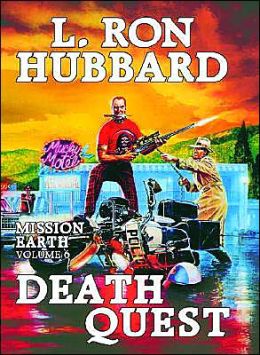
Mission Earth: Death Quest - Death to Mental Health

It's no secret that L. Ron Hubbard (LRH) disliked psychiatrists and psychologists.  He loathed, abhorred, despised, and hated them. And even that might be understatement.

His "non-fiction" books (and that term is used reluctantly) is filled with venom for mental health professionals.  And so is his sprawling 10 volume Mission Earth series -"the Biggest Science Fiction Dekalogy Ever Written"

I've challenged myself to read the entire series - as a learning experience.  I think I'm learning as much about LRH in his fiction as I am in his other writings and in biographies. I have just finished reading volume 6, Death Quest and  I am convinced that he was seriously twisted. 

It wouldn't be anything strange to be somewhat hesitant to consult a psychologist or psychiatrist, or a "shrink".  There has been, and to some degree still is, a stigma about seeing a counselor.  But mental health professionals have through the years have helped countless numbers of people.  That stigma is fading as more and more people realize that there's no shame in seeking professional help.  Sometimes a problem is beyond our ability to fix and we need someone who is trained to help us deal with it. Sometimes it's a more serious condition - a very real, and medical condition - that can be accurately diagnosed and treated with proper medication.

There have been, of course, failures and horror stories as well.  There have been abuses and scandals.  There are in every human profession - humans being humans after all.  But LRH saw ONLY the horror stories.

By psychology theory, there was neither limit nor personal penalty to crime unless it happened to oneself...man was just an animal that had no conscience or soul, just a rotten beast, in fact.- page 127

Psychiatry is for the rich to keep the poor in line. - page 139

Psychiatrists and psychologists are professional and they are not bound by any law: they can even murder people and nothing is done about it because they actually work with the government and courts and like them, are above the law.  They can do anything they want to anyone placed in their care.  Even murder them. - page 320
LRH filled the pages of Death Quest with lurid accounts of perverse sexual activities - bestiality, homosexual prison rape, necrophilia, and urolagnia (look it up) - and laid them at the feet of psychologists and psychiatrists.  Mental Health professionals in the book are blamed for encouraging their clients in these grotesque behaviors.  One man is told by his psychiatrist to imagine having sex with his mother.  When that didn't achieve the desired result he was told to imagine having sex with the corpse of his mother.  Another 15 year old girl was forced by her counsellor to have intercourse with the boys of her school.

This isn't just satire (as LRH claimed of the series).  This is what he really and truly believed about mental health professionals.

A psychiatrist today has the power to (1) take a fancy to a woman (2) lead her to take wild treatment as a joke (3) drug and shock her to temporary insanity (4) incarnate [sic] her (5) use her sexually (6) sterilise her to prevent conception (7) kill her by a brain operation to prevent disclosure. And all with no fear of reprisal. Yet it is rape and murder… We want at least one bad mark on every psychiatrist in England, a murder, an assault, or a rape or more than one… This is Project Psychiatry. We will remove them.  -Confidential memo "Project Psychiatry" (22 February 1966)

There's only one remedy for crime -- get rid of the psychs![Psychologists, Psychiatrists, any professionally trained mental health worker] They are causing it! -"The Cause of Crime" (6 May 1982)
And his hatred has continued to infect his church - The Church of Scientology - long after his death.  In the aftermath of the 9-11 attacks Scientologists sent a team of their volunteers to ground zero to disrupt the work of professional mental health workers.

...we are trying to move in and knock the psychs [professional mental health workers]  out of counseling to the grieving families and that could take another 100 plus people right now. Due to some brilliant maneuvering by some simply genius Sea Org [Scientology's private "Navy"] Members we tied up the majority of the psychs who were attempting to get to families yesterday in Q&A, bullbait and wrangling. They have a hard time completing cycles of action and are pretty easy to disperse. But today they are out in full force and circling like vultures over these people and all of our resources are tied up in the support efforts in the disaster zone at present.


There is nowhere on Earth right now that hurts like this place. These are brave people and they are the able and they don't know it but they need the Scientologists with LRH's tech to be here right now. ...
 
The fire-fighter company down the street from the org lost 14 members on Tuesday. No one can do anything for them or the rest but Scientologists. The other religions here with their ministers have shown their true colors and are working hand in hand with the psychs to give these people as much false data and restimulation as they can. They HAVE NO TECH and they're not even trying to hide it anymore. They've crossed over and abandoned anything spiritual and to hell with them. - An intercepted Email from Scientologist "Lt." Simon Hare

And again, after the shootings at Virginia Tech, Scientology volunteers were on the scene, claiming that their assistance had been requested by The Salvation Army and the Red Cross.  This was not true.  Their "help" wasn't requested or wanted.  This kind of help we don't need.  One man's (mental) illness and hatred should not be allowed to continue to infect people.
Jeff Carter's books on Goodreads
Muted Hosannas Muted Hosannas
reviews: 2
ratings: 3 (avg rating 4.33)

Related Posts with Thumbnails