Pages

google analytics

Showing posts with label Rape. Show all posts

Sunday, November 20, 2016

Amnon and Tamar in the Modern American Version


David’s son Absalom had a beautiful sister whose name was Tamar; and David’s son Amnon fell in love with her.  So Amnon lay down, and pretended to be ill; and when the king came to see him, Amnon said to the king, “Please let my sister Tamar come and make a couple of cakes in my sight, so that I may eat from her hand.”

Then David sent home to Tamar, saying, “Go to your brother Amnon’s house, and prepare food for him.” So Tamar went to her brother Amnon’s house, where he was lying down. She took dough, kneaded it, made cakes in his sight, and baked the cakes. Then she took the pan and set them out before him, but he refused to eat. Amnon said, “Send out everyone from me.” So everyone went out from him. Then Amnon said to Tamar, “Bring the food into the chamber, so that I may eat from your hand.”

So Tamar took the cakes she had made, and brought them into the chamber to Amnon her brother. But when she brought them near him to eat, he took hold of her, and said to her, “Come, lie with me, my sister.”  She answered him, “No, my brother, do not force me; for such a thing is not done in Israel; do not do anything so vile!  But he would not listen to her; and he said, “When you're a star they let you do it. You can do anything ... Grab them by the pussy. You can do anything."

2 Samuel 13: 1 – 14 Modern American Version


Saturday, October 8, 2016

Is this the Evangelical Choice?


Almost every day - sometimes twice a day - I find myself asking the question: Is this the evangelical choice? Is Donald J. Trump really the person that evangelical Christians want to see in the White House?


Trump has issued an apology - of sorts. It's more of a faux-pology. If he'd stopped after 21 seconds, it could have been an apology but everything after that cancels out his 'apology.'


But how does this 'apology' (even if we credit it as sincere) ring against his earlier comments that he's never felt the need to ask God for forgiveness?


Okay. I get it, Evangelicals, you really don't like Hillary Clinton. I'd go so far as to suspect that you actually hate and loathe her. I am not asking you to vote for her against your conscience, but how can the evangelical support this man for the office of president?  He does not represent you - your values - your morals - your ethics. He is not you.  So why do you embrace him?


Monday, July 27, 2015

Biblical Limericks: Call It What It Is


Some people would the story reshape,
but should we let King David escape?
His sin’s not just murder,
but what he did to her -
what he did to Bathsheba was rape.

2 Samuel 11: 1 - 5

Thursday, July 2, 2015

Biblical Limericks: That’s No Excuse, Lot


The people of Sodom were rotters
committed to rape and to slaughters,
but e’en with their abuse
there is still no excuse
for Lot to offer up his daughters.

Genesis 19: 1 - 8

Monday, November 10, 2014

"Turn the Other Cheek" Is Not a Thing of the Past #notinvisible


The U.S. Army often portrays itself as a band of brothers and sisters, as a community or a family.  This serves to foster the spirit of teamwork and interdependence among its recruits. Many of those interviewed in the documentary The Invisible War, which deals with rape and sexual assault in the military, described that sense of community as one of the primary reasons they wanted to join the military.  That sense of family and community is broken by sexual assault, and often twisted in order to protect either the rapist or the power structure, or both. 

In response to pressure to protect the rights of victims of rape and sexual assault and to create an environment where sexual assault is no longer tolerated or ignored, the Sexual Harassment / Assault Response &Prevention (S.H.A.R.P.) program of the U.S. Army has established the Intervene, Act, and Motivate (I. A.M.) STRONG program to encourage soldiers to prevent sexual assaults before they occur.  As part of this I AM STRONG program, the Army has created a series of brief rap videos emphasizing the values of the I AM STRONG program.

One of the videos includes these lyrics:

Turn the other cheek’s a thing of the past,
up close and real when they try to harass.
Don’t let a bad situation ever go unchecked;
soldiers helpin’ soldiers, that’s a message connect.
I’m strong, worldwide, we defend and protect,
let ‘em know we here; we demand respect.
When they there in the dark and the predator persists,
step up in his face; you can tell him this: 
We stand.  We fight. Intervene. That’s right.
I stand. I fight. I.A.M. Strong.


While I appreciate that the U.S. Army is encouraging a greater sense of interdependence and the responsibility of soldiers to protect one another from sexual assault, I’m concerned that the creators of this video do not understand the biblical instruction to “turn the other cheek” and that they have relegated it to the dustbin of history.

Jesus’ instruction to “turn the other cheek” is recorded in both the Sermon on the Mount (in Matthew’s Gospel) and in the Sermon on the Plain (in Luke’s).  The creators of this video seem to understand this to be a command to let assaults go unchecked and ignored.  If that were the case, these words of Jesus should rightly be dismissed.  But while interpretations vary greatly as to how followers of Jesus are expected to obey this instruction, it is not an injunction to blindly allow people to be victimized. It is an instruction to not return violence for violence.  And this teaching is still incredibly relevant in the modern world.

Again, I appreciate that the U.S. Army (along with the other branches of the military) are taking steps to protect the rights and dignity of victims of sexual assault, and trying to prevent assaults before they occur by emphasizing that sense of family and community, but they have seriously misunderstood the teaching of Jesus in this case and have misappropriated his words for their own use.

Thursday, November 6, 2014

A Pastor in the Hallways


I have recently begun going back to school.  I tell people that I’m on the 25 year plan; that if I focus my attention and really knuckle down on the work, I can cram all four years of college into 25.  I have just a few more classes to complete in order to earn my Bachelor’s degree.  And I’m finally getting around to completing them.

One of the classes that am currently taking is an English Composition class – writing. A few of my friends have suggested that I probably could have tested out of it and not had to actually take the class.  I can write and (if I may be allowed a bit of self-promotion) have a book that should be available any day now.

But I wanted to take the class anyway – for a couple of reasons.  1) It has been a while since I was in a classroom as a student.  And while ENG COMP may be an easy class for me, I have a math and a science class to take as well, and those will be more challenging.  I wanted this class to be an easy reintroduction to student life.  2) I know enough about myself to realize that, given the opportunity, I will avoid human interaction.  I’m very much an introverted person.  So taking the class was a purposeful choice to put myself into a situation where I would need to meet and interact with new people.   And 3) I wanted to find new ways to be a pastor to people.  The last two points are related and interconnected.

And some of those things are starting to happen.

In my ENG COMP class last night, we watched the documentary, The Invisible War, about rape and sexual assault in the various branches of the United States military.  It was a powerful film, very moving. Very emotionally draining.  We have an assignment to write in response to the film.  250+ words on the issue.  The standard sort of ENG COMP kind of writing assignment.

But after the movie ended and the class was dismissed, I could see that one of my classmates was still upset.  He’s mentioned several time in class that he spent a number of years in the military. It’s something that he’s quite proud of.  It is a large part of how he identifies himself.  And the film made him very upset.  Angry.  But not angry in a “how dare they say that” sort of way.  He was embarrassed and angry, angry that the institution that helped him to define who he is would allow people to be victimized and assaulted and then treated so shabbily afterwards. 

I was tired after class, tired and emotionally drained.  I was ready to go home and very nearly turned the other direction in the hallway to head out to the parking lot through a different exit.  But I could see that he was hurting, so I hustled down the corridor to catch up to him, and engaged him in conversation for a few moments. 

I let him vent.  And vent he did.  He cursed. He swore. He even growled a little bit. As I said, the film was very powerful.  After he had the chance to verbalize most of what he needed to express, he paused, took a deep breath, and then said, “Now I have to go home and face my family.  I don’t think I can do that.”

“Give them a hug,” I told him.

“I’m not sure I can.”

“You can.  You love them,” I said.  He shrugged and headed out towards his car.  I trekked back the other direction towards mine, and then went home.


I may complain a little bit about the rudimentary level of this class (I know how to use punctuation, I know how to do a research paper, I know how to write a bibliography…) but I’m glad that I’m taking it.  It is good for me to be here.  I haven’t gone out of my way to tell the class that I’m a pastor – but I’m glad to be there as a pastor in the hallways when they need one.

Saturday, July 19, 2014

Biblical Limericks: Advice to Young Women


Virgin women, hear and heed me well:
If you are raped, remember to yell.
You must be loud and clear
for if the men don’t hear
you’ll have to be stoned to death as well.

Deuteronomy 22: 23 - 24

Wednesday, December 18, 2013

Christmas Carol Limericks: Baby, It’s Cold Outside


My dear, don’t be so aloof-y;
my love for you I’d like to prove-y.
Baby, it’s cold outside
so come sit by my side,
nevermind that I’ve slipped you a roofy…


Other Christmas Carol Limericks:
Un Flambeau, Jeannette, Isabelle
I Saw Three Ships (Come Sailing In)
The First Noel
Jingle Bells

Friday, November 1, 2013

No. The APA Does Not Endorse Pedophilia – But the Bible Might...


The internets have been burning the past couple of days with claims that the APA (the American Psychiatric Association) had classified pedophilia as a sexual “orientation” in the recently released DSM-V (Diagnostic and Statistical Manual of Mental Disorders).  A press release from the AFA (American Family Association), picked up by many conservative blogs and news outlets claimed:

"Just as the American Psychiatric Association declared homosexuality an ‘orientation’ under tremendous pressure from homosexual activists in the early seventies, now, under pressure from pedophile activists, they have declared the desire for sex with children an ‘orientation,’ too.  It's not hard to see where this will lead.  More children will become sexual prey. 

"Sanity will never return to this culture until truth is reclaimed.  It is not now, nor has it ever been acceptable for men or women to desire sex with children.  Any who struggle with this must at least know that it is wrong before they can combat it and seek change." - AFA Press Release


But it’s just not true.  The only change in the DSM-V’s classification of Pedophilia is that “the disorder name was changed from 'pedophilia' to 'pedophilic disorder'" in order to "maintain consistency with the chapter’s other disorder listings.”   The APA has not said that it is acceptable for men or women to desire sex with children.

The APA has not endorsed pedophilia as an alternative lifestyle neither has it reclassified it as an acceptable orientation.  The freakout is unwarranted.  It’s an emotional reaction to facts not in evidence.   

But the discussion did prompt my curiosity to ask the question: What does the Bible have to say about Pedophilia?  And the simple (maybe shocking) answer is not much – and what little it does say might leave us feeling a little uncomfortable.

There is no direct reference to pedophilia in the bible (not as the DSM and contemporary psychiatry defines it – as a psychiatric disorder in persons 16 years of age or older typically characterized by a primary or exclusive sexual interest toward prepubescent children.) 

Zip. Zero. Nada.

However, there are some ambiguous passages in the Old Testament that might have some relevance. In Judges 21 (a horrible and horrifying story altogether) concludes with the men of the Tribe of Benjamin abducting (technically “raping”) 400 young virgin girls.  (Judges 21: 12) and then abducting (raping) even more women from Shiloh (Judges 21: 20 – 23).  Similar incidents are recorded in Numbers 31: 1 – 18 and Deuteronomy 20: 1 – 14. The ages are not specified – but they are “young” in the case of Judges 21 and “children” in Numbers and Deuteronomy.

We should also recall that, while a specific age for marriage (and sex) isn’t recorded in the bible – the appropriate age for marriage (and sex) was much younger in the ancient world than it is today.  “In Egypt girls were married between the ages of twelve and fourteen, and young men between fourteen and twenty.  In Greece girls were usually between fourteen and twenty, and men usually between twenty and thirty.  In Rome, at the time of Augustus, the legal minimum age for girls was twelve, and for boys fourteen.  The Talmud recommends marriage for girls at the age of puberty, which would be between twelve or thirteen (Yebam. 62b).  Males are encouraged to marry between fourteen and eighteen.  A girl younger than twelve-and-a-half, according to Talmudic law, could not refuse a marriage arranged by her father. " [i]

(The similar, but still different, issue of Pederasty (a homosexual relationship between an adult male and a pubescent or adolescent boy) might be discussed in some of Paul’s writings in the New Testament –but that point is debated.)

Is this a biblical endorsement of pedophilia, or sex with children for today’s world?  Hardly.  But we would probably lump these things into discussions of pedophilia.  The ancient world was different from ours today. Their values and cultural norms are not ours.  Even if (IF! )it could be shown that the Bible endorses pedophilic sex, that does not mean that we are beholden to accept it in our society today.  Slavery and genocide were once thought acceptable biblical practices…

The APA is not saying that pedophilia is okay.  The DSM-V does not classify it as an orientation. 
Let’s take a breath and relax a little.  We can discuss these issues (as troubling and discomfiting as they may be) without an emotional freakout. 


[i] Anchor Bible Dictionary Volume IV “Marriage (OT and ANE)” Victor P. Hamilton – page 562-3

Tuesday, October 8, 2013

American Mary: The Transmogrification of Mary


American Mary (2012) is a horror film by and about women, written and directed by the Soska Sisters and starring Katharine Isabelle.  It is a dark and transgressive film about the concepts of beauty and self identity.  The eponymous Mary is a medical student struggling to pay her bills and to meet the expectations of her instructors, despite her talent and drive to succeed.  But when, in an odd twist of fortune, she is offered money in exchange for her surgical knowledge and a willingness to participate in less than legal operations, Mary ventures into an underground world of body modification surgeries and revenge.  

The monster in this “monster movie in October” is beautiful.  Mary is an attractive and intelligent young woman, motivated and strong willed, but in the course of the film she is transformed (morally, if not externally) even as she performs body modification surgeries to alter the appearance of her clients.  American Mary is a film about the transmogrification of its central character, the strange and grotesque transformation characterized by distortion, exaggeration and exaggeration.  The tongue splitting, teeth filing, surgical implants, genital modifications, and voluntary amputations of the “bodmod” culture are less extreme and less grotesque than the self mutilation that Mary inflicts upon her own humanity.

There are few likable or sympathetic characters in this movie – male or female.  The men are either abusive and cruel or weak and easily manipulated.  Her med school professors are verbally and sexually abusive. They invite her to a party in order to drug and rape her. And when Mary takes up body-modification work, her male clients and associates are powerless and infantile.  The one exception is the police detective who, in what little we see of him seems honorable and sincerely interested in helping Mary, is, by nature of his role, is pitted against Mary.

The female characters – though more central to the story and more interesting – are just as unsympathetic.

There is Beatrice, a woman so fixated upon the cartoon character Betty Boop that she has endured multiple cosmetic surgeries in order to recreate herself in the image of that animated icon.  She and Mary almost develop an interaction that goes beyond a doctor / patient relationship, but Mary consistently severs it.

Beatrice introduces Mary to her friend “Ruby Realgirl” who desires nothing so much as to become a real doll, completely asexualized.  She asks Mary to remove her nipples and labia, and to sew up her vagina as much as possible.

Later in the movie, as Mary has developed a reputation in the bodmod world, she is approached by twin sisters (played by the writers/directors themselves) who feel they have no connection to anyone else in the world except each other.  They ask Mary to amputate and swap their left arms so that, in the case of the death of either one, the survivor would still have something of her sister.

A horror movie by and about women is interesting – especially since so much of the horror genre seems predicated upon violence towards women.  But I wonder if it can accurately be called a “feminist” film.  As a male, I’m not sure I’m even allowed to offer an opinion on feminist studies, but let me offer a couple of observations. 

American Mary passes the Bechdel test; it has 1) at least two women in it 2) who talk to each other 3) about something other than a man but… there are no real relationships developed between the female characters. 


American Mary also features a strong female central character who takes charge of her own life, but… she can hardly be described as a hero figure.  In her quest for self expression, Mary becomes morally indistinguishable from those who abused her.  They violate her body sexually.  She violates her rapist by practicing her body modification surgeries on him – keeping him hostage by amputating his limbs and sewing his mouth shut…

None of the female characters are especially whole.  Their body modifications seem less motivated by self expression and a secure sense of self identity than by self loathing and loneliness.  I don’t know if this film, which on the surface seems to have all the traits of a feminist work, can really be described as feminist. 

Repeated three times throughout the movie is the song Ave Maria in increasingly complicated arrangements – serving to illustrate Mary’s increasing skills as a surgeon – culminating in her inverted apotheosis.  It’s an interesting movie – well filmed, and powerfully performed.  But it’s very much a discomforting movie.  It shocks.  It purposefully violates our sense of order; it traipses unapologetically over our taboos. 

How is a healthy sense of identity expressed in one’s body?  Are “normal” cosmetic surgeries like breast augmentations examples of self-mutilation or self-expression?  What about circumcision?  Should it be considered a body-modification surgery like piercing, tattooing, branding, or implants?  What makes one more acceptable than another?

Other Monster Movies in October this year:

Monday, September 9, 2013

Biblical Limericks: I Think it was Shechem who was Raped


Dinah was shamed by the prince, Shechem,
but he felt bad and tried to amend.
A marriage was proposed
with conditions imposed:
his men must have their penises hemmed.

Shechem agreed to pay this bride price;
each of the men had their manhood sliced.
Then, while they were floored,
her brothers came with swords
and they slaughtered them all in a trice.

Genesis 34


The traditional understanding of this story is that Shechem “raped” Dinah.  But the word “rape” isn’t used.  Instead the text actually says that he “shamed” her.  He probably did have intercourse with her, and that was considered shameful or defiling.  But he seems to have sincerely loved her.

And the people of the city were open and welcoming of Dinah’s family, even submitting to this bizarre and painful condition.

It was Simeon and Levi who were the “rapists” in this story. They never intended to let their sister marry this prince.  

Friday, September 6, 2013

Biblical Limericks: Not Exactly a Love Story


The concubine fled after their fight,
the Levite trailed to prove he was right,
but when threatened by men
who were set upon sin,
he left her to be gang raped all night.


Judges 19

Friday, August 30, 2013

Biblical Limericks: Plunder and Rape Your Way to a Biblical Marriage


The men of Benjamin had no brides
so they armed themselves, set forth to ride.
No virgin would escape
as they plundered and raped,
not till enough women were supplied.

Judges 21


“Rape” in this sense means: “an act of plunder, violent seizure, or abuse; despoliation; violation, the act of seizing and carrying off by force.” – As in the rape of the Sabine women – but I’m sure that the more modern meaning of the word was involved as well.


Tuesday, October 9, 2012

I Spit on Your Grave – Legitimate Rape, Legitimate Revenge


The movie Day of the Woman (1978) is more widely known by its 1980 re-release title –I Spit on Your Grave.   To say that it is an infamous movie is a bit of an understatement. It is listed among Time magazine’s Top Ten Ridiculously Violent Movies[i] and was described by film critic Roger Ebert as “one of the most depressing experiences” of his life.[ii]  It is a relatively simple story and it is simply told – with minimal dialogue, music, or fancy camera work or special effects.  But that simplicity only underscores the intense brutality of the story.  And it is brutal; from start to finish it is scandalously brutal.

The movie follows Jennifer, young woman from New York who has rented a cabin by a lake in the countryside for the summer, where she intends to get away from city life and to focus on her writing.   Jennifer’s arrival is noticed by several men who begin to taunt and torment her.  And then they isolate and rape her.  Repeatedly.  It may be that I Spit on Your Grave has the longest rape sequence in film history – nearly 25 minutes.   We watch (if we can keep from turning away from the screen) as Jennifer is violated over and over again in every conceivable fashion.  And then her attackers leave her for dead.

The second half of the film describes Jennifer’s revenge on her attackers.  She isolates them and kills them – by strangulation, by castration, with an axe, and with an outboard motor. These sequences are as brutal as the first.

Now, I know that many of my friends and co-workers and co-religionists would object that this kind of film is wholly inappropriate for a Christian, for a pastor… but if they are correct then we need to take a pair of scissors to our sacred book of scripture. As I watched I Spit on Your Grave I was reminded of the extravagantly violent story in Judges 19 in which an unnamed concubine is betrayed, gang-raped, tortured, murdered, and dismembered. And all this in the book that churches routinely give to young children and encourage them to read.

The story of the unnamed concubine in Judges 19, like the story of Jennifer in I Spit on Your Grave is a story that we'd perhaps just forget.  But we cannot. “To hear this story is to inhabit a world of unrelenting terror that refuses to let us pass by on the other side.”[iii]  As long as we have leaders making statements about “legitimate rape” and the victims of rape are blamed (she was asking for it, look at the way she was dressed…) and rapists are unprosecuted, we need to continue to tell these stories.

I Spit on Your Grave was written and directed by Meir Zarchi who has said that his inspiration for the film came from his own interaction with a rape victim.  While driving one evening he saw a traumatized young woman wandering along the side of the road. When he stopped to help she told him that she had been raped by two men. Zarchi took the terrified woman to the nearest police station but rather than treating the woman with compassion and understanding, they tied her up in police red tape, forcing her to file a report, asking her  to tell them her name and to repeatedly spell it even though her jaw was broken and she was in desperate need of medical attention.

This is the reality. It is unsatisfying.  And that is part of why we tell stories…

In Zarchi’s film Jennifer doesn't seek help from the police, but instead returns to take her own revenge.  The unnamed concubine in Judges 19 doesn’t get either – help from the police or her own measure of revenge.  She is murdered and dismembered.  But her story is followed by a revenge story that leaves twenty-five thousand dead and leads to the rape (abduction by force) of many of the young women of Shiloh (Judges 20 – 21). 

Rape is followed by Revenge – or at least, the desire for revenge.  And this, I think, horrifies us almost as much as the original offense.   Christians, after all, should forgive and forget, right?  Revenge is wrong.

“Most people assume that revenge is bad, that the desire for revenge is a base, primitive emotion that has no place in Christian society…Unfortunately, we are all apt to dress the concept of forgiveness  in garments that are too refined and delicate to handle the battle of life… Many Christians view the desire for revenge as incompatible with love and forgiveness.   Revenge seems to come from an ugly, bitter heart.  But is that the case?”[iv]

The desire for revenge is, underneath all the darkness and pain, a desire for justice – to see the wrong made right. The problem with revenge is that, like all our desires, it can run unchecked and become a destructive force.  But to ignore the desire for revenge is as harmful as denying the original offense.  I do not believe that victims of rape (or other forms of abuse or violence) should take up arms against their abusers in violent, unrestrained quests for revenge.  But I do believe that we should take their stories and their fears and their desires seriously.  

We must tell their stories.


As an aside - I think that it is interesting and significant that the movie I Spit on Your Grave -where the violence is inflicted upon and revenge is sought by a woman - is derided as exploitative and sadistic and void of artistic merit while the movie Deliverance (1972) -which has a nearly identical story but involves men seeking revenge, is praised and selected for preservation in the United States National Film Registry by the Library of Congress.   


[iii] Trible, Phyllis Texts of Terror: Literary-Feminist Readings of Biblical Narratives
Fortress Press, Philadelphia PA, 1984. Page 65
[iv] Allender, Dan B., Lampman, Lisa Barnes, ed.  God and the Victim: Theological Reflections on Evil, Victimization,
Justice and Forgiveness, William B. Eerdmans Publishing Co. Grand Rapids MI, 1999. Page 205

Wednesday, April 11, 2012

Return of the Biblical Limerick - 2 Samuel 13: 1 - 5

Amnon feigned sick so Tamar, his sister,
brought cakes to his room; he tried to kiss her.
He had planned this caper
to trap and then rape her.
When Tamar cried, Amnon dismissed her.

Wednesday, February 23, 2011

Lamentations: An Incomplete Theodicy

Sunday's sermon will come from the book of Lamentations.  I'm not yet sure what I'll be preaching, but I do have this that I wrote some time back.  A Theodicy is an attempt to explain the "problem of evil",  an attempt to answer that question "why?".  This series of poems based on the book of Lamentations is an incomplete theodicy. I believe that all theodicies are incomplete - even biblical ones.


Lamentations: An Incomplete Theodicy

Chapter One

How doth the City Sit Solitary
How doth the city sit solitary that once was full of people.
How she sits alone; widowed
in the stifling heat - like being in a car left in the sun
     in air one hundred and fourteen degrees,
     heat lying upon the skin and filling the lungs like sackcloth and ashes.
She weeps long into the night; her tears carving canyons of grief
     through the dirt and grime of her filthy face
     and there is no one to comfort her.

All my friends have abandoned me and betrayed me.
My lovers are gone, my children - dead.
How doth the city sit solitary that once was full of people.

When the war planes screamed overhead and the bombs fell
and the night was full of fire
(phosphorescent fire fell from the sky and ravaged her bones)
then the adversary spread out his groping hands upon all her pleasant things
copping a feel, plundering, raping, spreading her nakedness for all to see.
Soldiers in their camouflaged fatigues and heavy boots entered her and defiled her.

Is it nothing to you, all ye that pass by,
flipping past CNN and FOX news for more enjoyable info-tainment?
Behold, and see if there be any sorrow like unto mine.

Chapter Two

The Bombs Exploded
Our enemies, they hiss and gnash their teeth,
for He has flung a dark shadow over the city.
He hurled a dark shadow upon all the population
and has brought their opened mouths down to gravel and dust.

He bent his bow in his anger
and flung a dark enemy over them.

Like a giant magnesium flare over the fairest of cities,
his bow like an enemy - without mercy the Lord has destroyed them,
They hiss and gnash their teeth.

The bombs have exploded, Lord! Lord!
Your tremendous anger flashed dangerous,
blue-white light and dark shadow over the city.

The explosion brought intense glare and heat and horror,
the explosion brought the rumbling sound
of uncontrolled terror to the heights of heaven.

O God, think about this.

A Burning of My Bones
I am the ash-heap of memory,
scraping infected boils with potsherds
and I can believe that this is
the "no-place" utopia of nowhere.

The brutal assault of daily invasion
and routine inhumanity continued
while the evil-doers,
the authors of nowhere and nothing
trampled me underfoot into the ash-heap of history.

Afflicted in every way, pressed down and crushed,
persecuted, struck down, and struck mute,
hemmed in on every side,
Violence and terror on every side!

Great is thy faithfulness,
great is thy faithfulness,
Lord, but
Great is thy terror!
Violence and terror on every side!
I know your hands of peace, your arms of love
but the hands of love sometimes pull down,
uproot and destroy.

I shall not live until I see God
and when I have seen him I shall never die
.
But why is he perpetuating the horrors
that pummel me, trample me?
I am caught in the snares of the Lord of Terror.

O God, you liar, you deceived me, you enticed me.
O God, you strong-armed bully, you knocked me to the ground
and beat me to a bloody pulp,
O God, you duped me, thrashed me, raped me.

But it becomes a fire in my heart, burning in my bones
and I can't be silent.

Chapter Three

Who?
Who beat me senseless?
Who kicked me repeatedly in the head and gut?
Who, with steel-toed boots, kicked me in the rectum till I bled?
Who with razors slashed at my face
     causing these "defensive wounds" on my hands and wrists?
Who tore out my hair - pulling away bloody pieces of scalp?
Who imprisoned me; chained  and shackled me, and threw me in the hole?
Who broke my ribs and punctured my lungs?
Who fed me poison till I puked up blood and bile?
Who duct-taped my mouth when I tried to scream for help?

He did.

And like the battered wife I crawled back to him.
I deserved it. It was my fault.
How can I complain about the punishment of my sins?

Three Days
For three days I was trapped under the rubble
when the walls of my home collapsed
under the enemy's bombardment.
Three days in the dark - I thought I'd gone blind.
Three days without food - without water
I drank my own piss to stay alive.

I cried out but no one could hear
I prayed but he would not hear
or, if he heard, he did not care
or, if he did care... I don't know


For three days I lay trapped beneath the rubble,
concrete shards pinned me to the ground as neatly
as a butterfly on display.  My organs were crushed.
My body was twisted, contorted, my face in the dirt,
my legs splayed out in an unnatural direction.
I thought I was dead - buried,
stones rolled over top of me and sealed in the pit.

I cried out but no one could hear

I prayed but he would not hear
or, if he heard, he did not care
or, if he did care... I don't know

Great is Thy Faithfulness
I am disheartened
my words have come to an end.

I think of my LORD,
let him give this human element
some portion of that balm of Gilead.

I wait for God to speak
I wait quietly to hear what he will say,
to heal is Thy faithfulness.

I fear I'll feel his mercies never again.

Chapter Four

A Fugitive Arrives with the News
(FADE IN FROM STATIC)... those killed in the chaos of the initial bombings were, perhaps, better off than those who survived only to starve to death now that the city has been completely cut off.  No supplies of any kind have entered the city for nearly a month.  Food is gone. Water is scarce and the corpses are everywhere.

There are reports coming in of mothers who have actually eaten their own children. The devastation here is nearly indescribable.  Horror like this is inconceivable and yet... (FADE TO STATIC)

But now the anger of the Lord is satisfied
O God! Please say the fury is spent.
We can't go on like this
our resistance is broken
as is our will.

We are obliterated
O, God, please say "no more."


Chapter Five

Tenebrae
In the face of a rocky hill on the western side of the city sits Jeremiah
in the shadowy smoke-darkened twilight.
he has nothing left to say to us; he will speak no more.
He came to us before, but we would not listen.

In the face of a rocky hill beyond the smoldering ruins
we gather for silence;
joy has vanished from our hearts.

Remember Us
We are the orphaned and fatherless;
our mothers are widowed and lost.
We are the children of death,
the progeny of disease.

We are slaves.
We are victims.
We are murdered in the streets.

Our sisters and daughters are raped
Our sons and brothers are sodomized

Our hearts are sick.
Is it enough, O Lord, that you remain the same forever?
Restore us, or have you rejected us?
Remember us.

Remember what has come upon us.

Sunday, February 13, 2011

A Fire Burning in My Bones - Not A Good Sermon

"It won't be a good sermon," I warned them before I began.  "A good sermon, preachers are sometimes taught, will have a memorable formula - an alliterated three point outline that will be easily remembered, for example: the Power, the Purpose and the Plan....

Or a good sermon will follow a narrative arc.  People like stories and a good sermon is like a good story.  We have a beginning wherein we meet a compelling character, a middle wherein the protagonist's life is complicated by struggle and then we have a glorious ending that swoops upwards toward victory and confidence and joy.

But what I had to preach today wasn't a "good" sermon. Jeremiah chapter 20 doesn't lend itself to good sermons.

The prophet Jeremiah lived in precarious times.  The once great and powerful Assyrian empire (the constant and foreboding threat found in the prophet Isaiah's writing) had waned and was crumbling.  And with that, the little nation of Judah began to flex its aspirations for independence.  But there was another force on the rise.  The Babylonian empire was becoming more and more powerful.  Some within the nation of Judah recommended that they should ally themselves with the nation of Egypt as a hedge against the waning Assyrians and the waxing Babylonians.  Some said they should keep as they were with their heads down.

But the prophet Jeremiah crossed them all with his message.  It doesn't matter.  None of that will be of any use, because Yahweh God has already decided to bring judgement on this nation for it's idolatry and violence.  The only way out of our predicament, Jeremiah said, is repentance... but I know and God knows that you won't so your doom is imminent.

This was not a message that won him many friends.
But it was the message that he was called to deliver.

Even before he was born, while he was still being knitted together in his mother's womb, before he had any sense of self or identity, God had marked Jeremiah for this role.  And when Jeremiah tried to object, "I'm only a boy, I can't do that."  God refused to hear Jeremiah's demure.  "Don't say, 'I'm only a boy' !"  You'll go where I send you and you'll say what I have for you to say, and I'll be with you. (Jeremiah chapter 1)

He would speak God's message to the people.  He would tell them of the coming wrath of God.  And he did.  And for this he was despised and arrested and beaten and thrown in jail and put in stocks and mocked and abandoned....

Chapter 20 verse 7  - 18 is part of what is sometimes called "the confessions of Jeremiah." These are passages within the book that are not part of God's message to the people, but rather Jeremiah's very personal and very intimate responses to God.  And they are not easy.  They don't make for "good" sermons.

You seduced me, Yahweh, and I was seduced.

Seduced, tricked, persuaded... the many translations use various words to try and capture the slippery meaning of this phrase in Hebrew.  It contains all of those ideas.  But what can we say - that God tricked him, fooled him, duped, - or what may be worse, God seduced him?  And then to put that against the next phrase - You overpowered me, you were the stronger.

Dare we say it?  God raped the prophet's will? 

Jeremiah's bitter complaint is that God not been fair.  God came to him when he was a young and naive and inexperienced boy and -forced- him into this life.  "You came to me when I knew nothing and you told me to be your prophet, but you didn't tell me what it would be like.  You didn't prepare me for this.  You didn't give me a choice..."

And now my life is a joke.  I speak your words and everyone hates me.  My enemies plot against me and those who were my friends avoid me or turn against me. And it's your fault, God.

Jeremiah says that he would, if he could, just quit.  I would leave it all behind. I would not mention your name and I would not speak in your name ever again ...

... except that when I tried to quit it was like a fire in my bones, burning me from the inside.  I could not stay silent.  I was damned by the people if I spoke and I was damned by God if  I was silent.

Then there is a turning point.  And here is where the text follows a nice narrative arc.  We've followed the prophet down into dark despair and now we're ready to hear a word of comfort - a word of the gospel, the good news.  And the prophet says, "But Yahweh is with me like a mighty hero." 

Jeremiah celebrates the presence of God in his life, and the protection and vindication that God brings to his faithful servant.  His enemies will be judged and Jeremiah will be rewarded.  "Sing to Yahweh.  Praise Yahweh.  for he has rescued this needy one from the hand of the oppressor."

And if this were a "good" sermon, this is where it would end.  I could deliver a nice and tidy word from God: when you're facing trouble and dark times, be confident because God will rescue and God will reward the faithful....

But the prophet won't let me end there.  I really wish that he would have stopped there. I could feel comfortable with that sermon.  We go through tough times, despair and loneliness come... but have faith, rescue is around the corner, blah, blah, blah...  But Jeremiah didn't conclude the matter like that.

Instead he turns again sends the whole thing crashing back down into the dark depths of despair - sinking even lower than before. He curses his entire existence from the day he was born to the present moment. And though he doesn't curse his mother or his father or God (for that would have been a capital offense) he comes awfully close. And this, I think, is some of the darkest language in the bible. 

Cursed be the day on which I was born
the day my mother bore me, let it not be blessed.

Cursed be the man who brought the 'good news' to my father...
let him be like the cities of Sodom and Gomorrah
forced to listen to the screams and cries of the people


why couldn't I have just died in the womb
why couldn't my mother's womb have been my grave?


From the womb on my life has been sorrow and shame.

How do make a "good" sermon from that?  Maybe there is no good sermon here.
But I am glad that this passage - as ugly and as dark as it is - I'm glad,  grateful even, that this passage is included in our scriptures.

I remember being 13 or 14 and we had just moved - again.  I was in a new town with few friends and I felt alone and abandoned.  My parents were busy with the things of the church - and I knew that we were there because they were answering God's call for their lives - but that was no comfort to me. 

I remember being out one autumn afternoon, delivering the papers on my paper route. It was a bright and sunny afternoon.  The sky was bright blue and the air was crisp.  And I stopped in the sidewalk and looked up into the sky and I said, out loud, "God, I believe you're there, but stay the hell out of my life."

I don't know what I expected to happen.  Maybe I thought there would be a flash of lighting or an earthquake or something. But no.  I went on and finished my route and went home and nothing changed.

And that's what comforts me.  Nothing changed. 

God didn't hear that blasphemous boy and deliver a lightning bolt from the sky to smite him.  God didn't throw me out.  He didn't cut me off.  No.  He allowed me to be angry - even allowed me to be angry with God, and he still loved me.

God heard Jeremiah's confession - heard the prophet's bitter complaint, that borderline blasphemy and did not count it as a sin. We can be angry with God and it can be okay.

The other comfort (small comfort) I find in this difficult passage is that the life of faith isn't going to be all wine and roses; the word of God isn't going to always be honey on our lips. 

I know.  That doesn't really sound like comfort, does it?  But it is.  At least to me.   

Because to hear some preachers, you'd think that the life of faith is going to be nothing but sweetness and light.  That if we have been saved and if we have faith then we're going to have long and happy and healthy lives and we're going to be loved and respected and our children will be wonderful. We'll have great jobs and plenty of money, and we'll live our lives in sunshine and bliss.

but you and I know that that's a fairy tale.  It's just not true.  We're not promised a life of easy comfort.  In fact, it seems that most of the biblical examples demonstrate that the life of faith is a life of pressure and danger and struggle.  But there is reward in the struggle and there is victory.

Again, I know that doesn't sound like comfort.  And maybe it's not.
I told you this wasn't a good sermon.

Monday, April 26, 2010

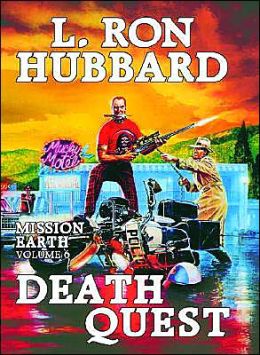
Mission Earth: Death Quest - Death to Mental Health

It's no secret that L. Ron Hubbard (LRH) disliked psychiatrists and psychologists.  He loathed, abhorred, despised, and hated them. And even that might be understatement.

His "non-fiction" books (and that term is used reluctantly) is filled with venom for mental health professionals.  And so is his sprawling 10 volume Mission Earth series -"the Biggest Science Fiction Dekalogy Ever Written"

I've challenged myself to read the entire series - as a learning experience.  I think I'm learning as much about LRH in his fiction as I am in his other writings and in biographies. I have just finished reading volume 6, Death Quest and  I am convinced that he was seriously twisted. 

It wouldn't be anything strange to be somewhat hesitant to consult a psychologist or psychiatrist, or a "shrink".  There has been, and to some degree still is, a stigma about seeing a counselor.  But mental health professionals have through the years have helped countless numbers of people.  That stigma is fading as more and more people realize that there's no shame in seeking professional help.  Sometimes a problem is beyond our ability to fix and we need someone who is trained to help us deal with it. Sometimes it's a more serious condition - a very real, and medical condition - that can be accurately diagnosed and treated with proper medication.

There have been, of course, failures and horror stories as well.  There have been abuses and scandals.  There are in every human profession - humans being humans after all.  But LRH saw ONLY the horror stories.

By psychology theory, there was neither limit nor personal penalty to crime unless it happened to oneself...man was just an animal that had no conscience or soul, just a rotten beast, in fact.- page 127

Psychiatry is for the rich to keep the poor in line. - page 139

Psychiatrists and psychologists are professional and they are not bound by any law: they can even murder people and nothing is done about it because they actually work with the government and courts and like them, are above the law.  They can do anything they want to anyone placed in their care.  Even murder them. - page 320
LRH filled the pages of Death Quest with lurid accounts of perverse sexual activities - bestiality, homosexual prison rape, necrophilia, and urolagnia (look it up) - and laid them at the feet of psychologists and psychiatrists.  Mental Health professionals in the book are blamed for encouraging their clients in these grotesque behaviors.  One man is told by his psychiatrist to imagine having sex with his mother.  When that didn't achieve the desired result he was told to imagine having sex with the corpse of his mother.  Another 15 year old girl was forced by her counsellor to have intercourse with the boys of her school.

This isn't just satire (as LRH claimed of the series).  This is what he really and truly believed about mental health professionals.

A psychiatrist today has the power to (1) take a fancy to a woman (2) lead her to take wild treatment as a joke (3) drug and shock her to temporary insanity (4) incarnate [sic] her (5) use her sexually (6) sterilise her to prevent conception (7) kill her by a brain operation to prevent disclosure. And all with no fear of reprisal. Yet it is rape and murder… We want at least one bad mark on every psychiatrist in England, a murder, an assault, or a rape or more than one… This is Project Psychiatry. We will remove them.  -Confidential memo "Project Psychiatry" (22 February 1966)

There's only one remedy for crime -- get rid of the psychs![Psychologists, Psychiatrists, any professionally trained mental health worker] They are causing it! -"The Cause of Crime" (6 May 1982)
And his hatred has continued to infect his church - The Church of Scientology - long after his death.  In the aftermath of the 9-11 attacks Scientologists sent a team of their volunteers to ground zero to disrupt the work of professional mental health workers.

...we are trying to move in and knock the psychs [professional mental health workers]  out of counseling to the grieving families and that could take another 100 plus people right now. Due to some brilliant maneuvering by some simply genius Sea Org [Scientology's private "Navy"] Members we tied up the majority of the psychs who were attempting to get to families yesterday in Q&A, bullbait and wrangling. They have a hard time completing cycles of action and are pretty easy to disperse. But today they are out in full force and circling like vultures over these people and all of our resources are tied up in the support efforts in the disaster zone at present.


There is nowhere on Earth right now that hurts like this place. These are brave people and they are the able and they don't know it but they need the Scientologists with LRH's tech to be here right now. ...
 
The fire-fighter company down the street from the org lost 14 members on Tuesday. No one can do anything for them or the rest but Scientologists. The other religions here with their ministers have shown their true colors and are working hand in hand with the psychs to give these people as much false data and restimulation as they can. They HAVE NO TECH and they're not even trying to hide it anymore. They've crossed over and abandoned anything spiritual and to hell with them. - An intercepted Email from Scientologist "Lt." Simon Hare

And again, after the shootings at Virginia Tech, Scientology volunteers were on the scene, claiming that their assistance had been requested by The Salvation Army and the Red Cross.  This was not true.  Their "help" wasn't requested or wanted.  This kind of help we don't need.  One man's (mental) illness and hatred should not be allowed to continue to infect people.

Saturday, April 17, 2010

Jeff Carter's books on Goodreads
Muted Hosannas Muted Hosannas
reviews: 2
ratings: 3 (avg rating 4.33)

Related Posts with Thumbnails